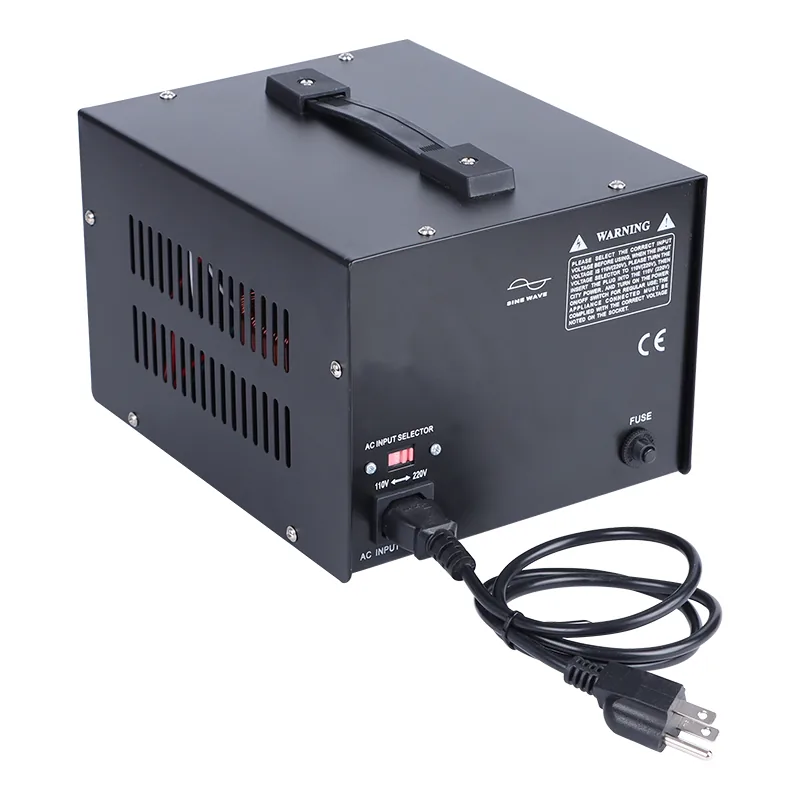
Step Down Transformer for Blender and Juicer: Sizing Guide
A US 110V blender or juicer in a 220V country is a common problem with a simple answer: a step down transformer sized for the motor surge. Blenders and juicers have universal motors that pull several times their running watts at start, and they are used in short, sharp bursts all day. This guide covers sizing, the motor question, and the details that keep a smoothie maker happy.
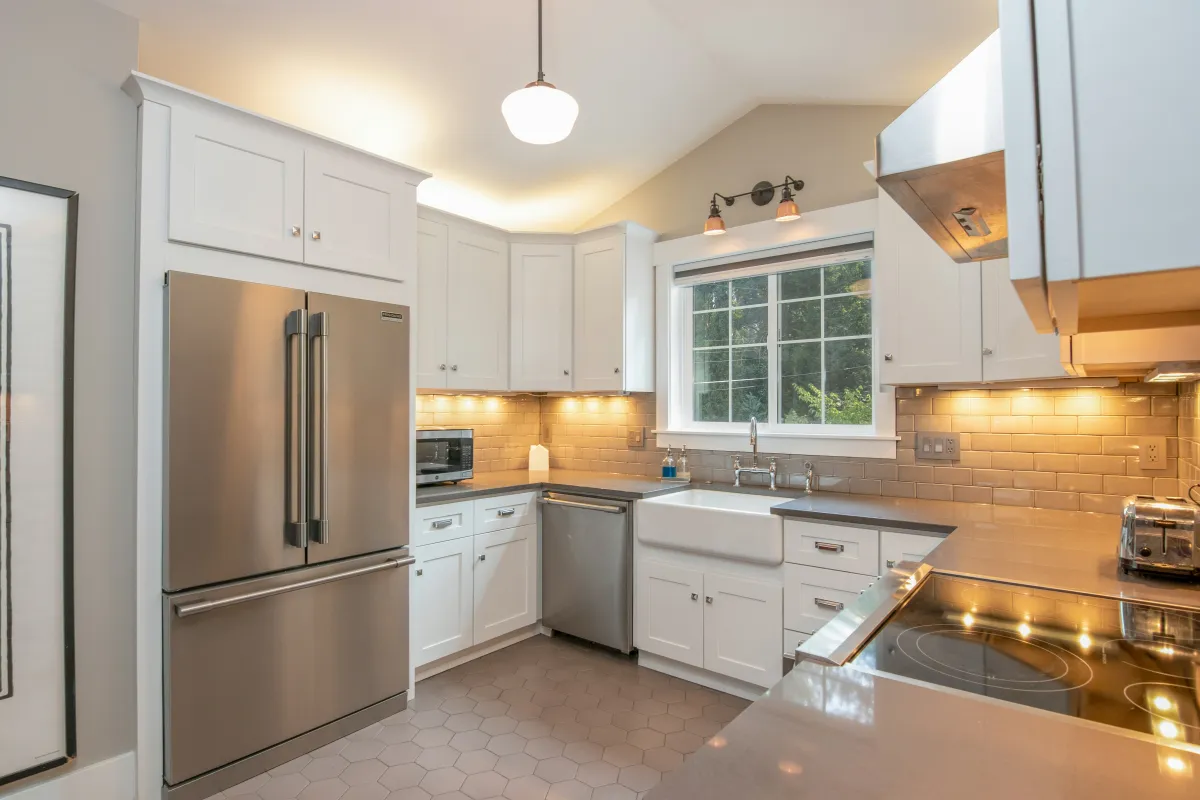
Why blenders and juicers are motor loads
Blenders and juicers are built around universal motors — the same family as power tools. At switch-on, the motor surges to 2-4 times its running watts for a split second as it spins up under load. A 700W blender can pull 1500-2000W at start, especially blending frozen fruit. The transformer must cover that surge, which is why the size recommendation is always bigger than the label watts suggest.
The motor also draws more when the blades meet resistance — frozen berries, ice, thick pulp. A transformer with margin holds the voltage stiff under that load, keeping the motor at full speed and the blend consistent. An undersized unit sags, the motor slows, and the result is a chunky smoothie.
Step down transformer size for blender and juicer
| Appliance | Running watts | Motor surge | Recommended transformer |
|---|---|---|---|
| Small blender (personal) | 300-500W | ~1000W | 1000-1500VA |
| Full-size blender | 600-1000W | ~2000W | 2000VA |
| High-speed blender (Vitamix class) | 1200-1800W | ~3500W | 3000-5000VA |
| Masticating juicer | 150-400W | ~800W | 1000VA |
| Centrifugal juicer | 700-1200W | ~2500W | 2000-3000VA |
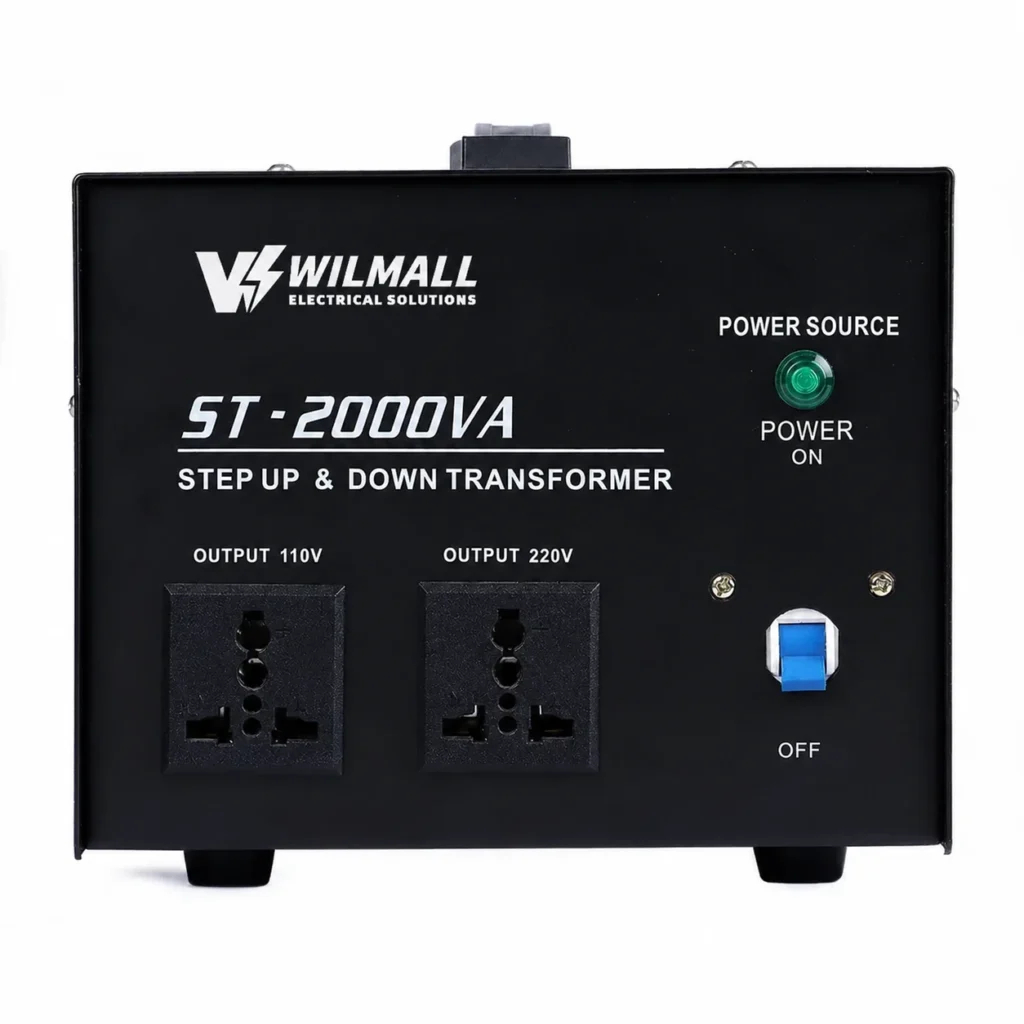
The ST-2000 covers a full-size blender and a centrifugal juicer with margin. High-speed blenders — the ones people pay real money for — need the 3000-5000VA unit because their motors surge hard. Masticating juicers are gentle and fit the 1000VA size. When in doubt, the motor surge decides.
Short bursts and duty
Blenders and juicers run in short bursts — 30 seconds to 2 minutes per use, many times a day. The transformer sees repeated surges, not long continuous loads, which is easier on the unit than running flat out. The one exception is a juicer doing a big batch or a blender making multiple smoothies; even then, the duty is light compared with a heater or a dehumidifier.
High-speed blenders deserve the bigger unit
Here is the thing: high-speed blenders like the US 1500W models are the ones people regret under-sizing. The motor pulls 3000W+ at start, and a 2000VA transformer trips or sags. Buyers who spent real money on the blender should spend the extra on the transformer. The STU-3000 or STU-5000 keeps the motor at full speed and protects the investment.

Common mistakes with blender transformers
- Sizing on the label watts. The motor surge is 2-4x; it is the real sizing number.
- Using a converter. Motor surges kill electronic converters fast.
- Sharing with other kitchen appliances. Add the loads and buy the next size.
- No RCD near the sink. Kitchen counters and water are the risk case.
- Wrong primary winding. Output drift changes motor behaviour.
Why buy from a factory directly
Wilmall supplies step down transformers for kitchen motor appliances across Asia, the Middle East and Africa. Copper winding, RCD protection and batch test records with every shipment. MOQ 1 pc for stock units, 10 pcs per model for custom voltage, 15-25 day lead time, FOB Ningbo or Shanghai with CE / RoHS documents.
Frequency and blenders
Universal motors in blenders and juicers run on either frequency — they are DC-series motors internally and do not care about 50Hz or 60Hz. This is one appliance class where the frequency question never comes up. The transformer only changes voltage, and the motor runs identically.
That simplifies the buying decision: match the voltage, size for the surge, and the frequency is irrelevant. One less thing to check.
Buying for resale: the kitchen range
Kitchen motor appliance distributors stock the 2000VA size as the workhorse and the 3000-5000VA for high-speed blenders. Two or three SKUs cover the whole blender and juicer market. Private labelling from MOQ 1 pc for stock units, 10 pcs for custom voltage, and we can print the compatible appliance list on the carton.
High-speed blender owners are the buyers who understand why the bigger transformer is worth it — they already spent on the blender. The upsell is natural.
Warranty and support
Every Wilmall transformer carries a 12-month warranty, and we keep common spares for fast resolution. Kitchen motor appliances get daily use, so reliability matters. Batch test records ship with every order, and we respond to support enquiries within 24 hours.
The frequency note
Universal motors in blenders and juicers run on either frequency — they do not care about 50Hz or 60Hz. This is one appliance class where the frequency question never comes up. The transformer only changes voltage, and the motor runs identically. One less thing to check when ordering.
Ordering, shipping and lead time
Send us your blender or juicer model, the motor watts, your country voltage and the quantity. We confirm the transformer size and the winding in writing, then produce in 15-25 days and ship FOB Ningbo or Shanghai. MOQ 1 pc for stock units, 10 pcs per model for custom voltage, private labelling available.
How a blender actually loads the transformer
A blender motor is rated in watts, and that figure tells you very little about what the transformer sees. A 1000W motor draws that much at full speed under load. At the instant you press start with a jug of frozen fruit holding the blade still, the same motor can pull five to seven times its rated current for a fraction of a second. The transformer has to survive that spike every time somebody makes a smoothie, and it has to do it a hundred times a month.
That is why we size blenders on the motor rather than on the wattage. A 1000W blender gets a 3000VA transformer in our sizing table, not a 1500VA one. The extra capacity is not wasted, it is the mass of copper that keeps the output voltage from sagging when the blade loads up. A unit that is only just big enough browns out the motor on thick mixtures, a motor that browns out runs hot, and a hot motor is a motor with a short life.
Why the jug size matters as much as the wattage
Two blenders with the same 1000W motor behave differently if one has a 1.5 litre jug and the other has a 2 litre jug, because the larger jug puts more frozen mass in front of the blade and stretches the stall at start. The label does not tell you this. The practical rule we give buyers is that a 1.5 litre jug blender is comfortable on 3000VA, while a 2 litre jug or a commercial blender wants 5000VA.
Juicers are gentler on the transformer. A centrifugal juicer spins a light basket and the load is smooth, so an 800W juicer runs well on 2000VA. A slow masticating juicer has an even softer starting current but runs for far longer, so on those units the thermal margin matters more than the surge margin. If your customer juices for twenty minutes at a time, go up one size for the sake of the case temperature rather than the surge.
The application guides walk through the other kitchen appliances with the same motor-versus-resistive logic.
Extension leads, adapters and how a good transformer gets a bad name
The most common failure we hear about is not inside the transformer at all. It is in the extension lead between the transformer and the wall. A thin lead on a 3000VA unit will drop volts under load, warm up, and eventually cook the plug. If you need extra reach, buy a heavy-duty lead rated above the transformer current, keep it as short as it will go, and never join two leads end to end.
The second one is the multi-way adapter on the output. Running a blender, a kettle and a coffee machine from one transformer through a cheap adapter is how a 3000VA unit ends up delivering 4500VA in real life. Add the watt figures up honestly before the second appliance is plugged in, and if the numbers do not fit, buy the larger unit rather than another adapter.
All of our motor-rated units sit in the step up and step down range, with the VA figures quoted for motor loads rather than resistive loads, so the number you read is the number that survives a blender.
One more habit worth passing on to your customers is to unplug the transformer when the kitchen is finished for the day. A transformer with nothing attached draws only its magnetising current, which is small, but one left warm inside a closed cupboard month after month ages its insulation faster than one that is allowed to cool down between uses. It costs nothing to unplug it, and it is the sort of small instruction that makes a distributor look like the expert in the room rather than the person who sold a box. We print that line on the instruction leaflet for exactly that reason, so your counter staff do not have to remember it.
The short version
Blenders and juicers are motor loads — size for the surge, not the label watts, and the high-speed models deserve the bigger unit. The ST and STU series cover every size, with RCD protection and copper winding as standard. That is the complete answer for blender buyers.
Frequently asked questions
What size transformer do I need for a blender?
A full-size blender needs 2000VA. High-speed blenders need 3000-5000VA. The motor surge is 2-4x the running watts, and it is the sizing number.
Why does a high-speed blender need a big transformer?
A 1500W high-speed blender can pull 3000W+ at start. A 2000VA unit trips or sags; the STU-3000 or STU-5000 keeps the motor at full speed.
Why does my blender transformer trip?
The motor surge at start exceeds the transformer rating if it is sized on watts alone. Size on the surge with margin.
What transformer does a juicer need?
A masticating juicer needs 1000VA. A centrifugal juicer needs 2000-3000VA because its motor surges harder.
Can I order blender transformers with my brand?
Yes, private labelling from MOQ 1 pc for stock units, 10 pcs per model for custom voltage, with RCD as standard.
Related reading
- Step Down Transformer 220V to 110V: Sizing and Safety
- Step Down Transformer for Kitchen Appliances
- Step Up and Down Transformer Products
Get a factory-direct quote
Email info@wilmall.com or WhatsApp +86 197 3022 6757 with your appliance list and country. We confirm the size within 24 hours. MOQ 1 pc for stock units, 10 pcs for custom voltage.