Step Down Transformer for Textile and Garment Factories
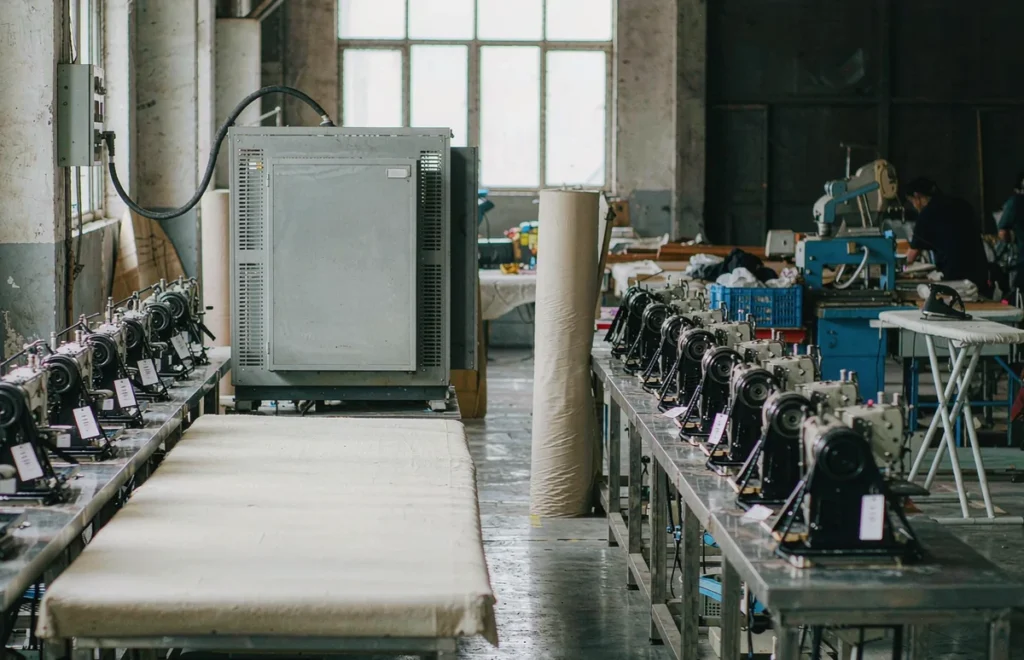
A garment factory never buys one sewing machine. It buys a floor of them, forty or eighty or two hundred, and that single fact changes the whole discussion about power. The machines arrive from the United States and Japan built for 110V, the building hands you 380V three-phase with 220V single phase taken off it, and somewhere in the middle sits the step down transformer that has to feed the room without anyone on the floor noticing it is there.
My inbox fills up with requests for a step down transformer for a textile factory from plant engineers and buying houses in Bangladesh, Vietnam, Uzbekistan, Ethiopia, Egypt, Kenya and Turkey. Nearly every message opens the same way. There is a short equipment list, a request for price, and a line saying the shed is new. Then the real question lands, how many units for one line and what rating. That is what I want to lay out on this page. If you are feeding a single machine rather than a whole line, hold off here and read our Step Down Transformer for Sewing Machine: Sizing Guide instead, because one machine and one production line are sized on different logic.
Before the numbers, one thing worth saying plainly, because it avoids a wrong order later. A transformer changes voltage. It does not change frequency, and it does not store energy. If your site runs 50Hz and a machine wants 60Hz, the transformer will not rescue you, and if the mains drops the transformer drops with it. Keep that in mind while you read the sizing method below, because the transformer is only one part of a plant that has to keep running.
Why a Garment Plant Cannot Run on Plug Adapters
Somebody always suggests the cheap route first. Buy a handful of travel adapters, plug the 110V machines straight into the 220V wall sockets, and see how it goes. It does not go well. An adapter changes the shape of the pins and nothing else. Feed 220V into a machine wound for 110V and you are pushing roughly double the voltage into a motor and a control board that were never built for it. The smell of hot varnish comes before the smoke, and by then the motor is already damaged.
The load on a sewing floor is also nothing like the load in a house. There is no single big appliance to plan around. Instead there are dozens of small motors, each one switching on and off hundreds of times a shift as operators lift the presser foot and start again. On top of that you have cutters, fusing presses and steam irons pulling short bursts of high current. A line that looks modest on paper can surprise a small transformer during a busy afternoon.
Add the mains reality in most of the markets I ship to and the picture gets clearer. Voltage in a new industrial estate may sit near 220V, but in an older shed at the end of a feeder it can sag well below that during the hottest part of the day, exactly when every fan and press is running. A properly sized transformer with a little headroom rides through those dips far better than a unit that was matched to the nameplate total and nothing more.
Which Machines on the Floor Actually Need 110V
When a factory sends me its equipment list, I read it line by line and split it into two columns, needs a transformer and does not. Here is what normally lands in the first column, with the wattage I see on real quotes from garment plants.
- Industrial sewing machines — lockstitch, overlock, coverstitch and chainstitch heads, usually 400W to 750W each, and there can be dozens of them on one line.
- Direct-drive servo sewing machines — lower running watts, but the electronic drive inside draws a chopped current that puts harmonics back on the supply.
- Straight knife and round knife cutters — 500W to 1200W, and the motor start pulls 2.5 to 3 times that for a moment, which is what sizes the feed to the cutting room.
- Fabric spreading machines — 300W to 800W depending on the roll weight and the table length.
- Fusing presses — these are heaters first and motors second, often 2kW to 4kW, and they hold full watts while the platen is down.
- Industrial steam irons and vacuum ironing tables — intermittent by nature, but the element draws hard when it kicks in, and several irons on one breaker add up fast.
- Fabric inspection and rolling machines — 250W to 600W, usually running for a full shift with a steady load.
- Buttonhole and bar-tack machines — 300W to 700W, with a punchy motor cycle on every garment.
- Embroidery heads and multi-needle machines — 500W to 1500W, sensitive to a dip because a bad stitch ruins the run.
What does not need us, and I say this often because it saves money: a growing pile of electronics carries a 100-240V, 50/60Hz rating on the back. Those devices are already happy on your 220V socket and bolting a transformer in front of them just gives somebody a cable to trip over. Go through the nameplates before you build your load sheet, and mark each item honestly.
How Many Machines Can One Transformer Feed
Here is the mistake I see most often. A buyer totals the nameplate watts of every machine on the line, then orders a transformer that matches that total. That number is a spreadsheet figure, not what the box actually lives with, because no line runs every motor at full load at the same instant. Operators stop, machines idle between garments, and the real demand sits well under the sum of the plates.
So we work with a diversity factor, sometimes called a demand factor. For a sewing line the number I use sits between 0.5 and 0.7. Multiply the connected load by that factor, then add 25 to 30 percent on top for headroom and for the short inrush when the big motors start. That final figure is what you size the transformer for, and it is usually far below the naive total.
The factor is not a guess. On a line of forty machines, the odds that all forty motors peak together are tiny, but the odds that a cutter, an iron and a handful of machines run at once are high. That is why I keep the factor tighter for the sewing floor and looser for the cutting and finishing rooms, where you have fewer but hungrier loads sitting side by side.
A Worked Example: A Forty-Machine Sewing Line
Take a line with forty direct-drive machines at 550W each. Forty times 550W is 22kW of connected load. Apply a diversity factor of 0.6 and you are at 13.2kW of realistic demand. Add 30 percent headroom and you need to plan for roughly 17kW, which is about 17kVA of transformer capacity in the simple 1:1 power-factor case. On a three-phase feed that splits across the phases, and it is why a full garment line is rarely one small box.
Now break the same line into zones. The sewing floor might carry 24 machines at 550W, which is 13.2kW connected, 7.9kW after diversity, and roughly 10kVA with headroom. The cutting room is a separate job. In the finishing area, three fusing presses at 3kW each and four steam irons at 1.5kW each bring their own pattern of demand. Each zone can then run on its own transformer and its own breaker, which is far better for maintenance than one giant unit nobody dares switch off.
Why the Cutting Room and the Ironing Area Pull Differently
The cutting room behaves like a motor room. You have few loads, but each one starts hard and the spreaders and cutters may run together during a lay-up. A straight knife cutter that pulls 900W running can demand well over 2kW for the fraction of a second its motor spins up, so the sizing conversation here is about starting current, not running watts.
The finishing and ironing area is the opposite. Steam irons and fusing presses are heat loads, so they hold close to their full watts the whole time they are on, and a group of them left switched on during a long shift will keep a transformer warm for hours. Where the sewing floor rewards a diversity factor, the ironing area punishes anyone who uses one too aggressively.
| Zone in the plant | Typical connected load | Diversity factor | Suggested transformer rating | Why this size |
|---|---|---|---|---|
| Sewing line, 20 to 30 machines | 11 – 17 kW | 0.6 | ST-2000 or multiple 2000VA units per rack | Many small motors, low coincidence, inrush still matters |
| Cutting room, cutters and spreaders | 3 – 6 kW | 0.7 | ST-2000 2000VA with RCD | Motor starting current decides the size, not running watts |
| Fusing and pressing area | 6 – 14 kW | 0.8 | STU-3000 or STU-5000 bidirectional | Heater loads hold full watts for long periods |
| Ironing and finishing | 4 – 9 kW | 0.6 | ST-1500 or ST-2000 units per bench group | Intermittent high draw, spread across benches |
| Inspection and packing | 1 – 3 kW | 0.6 | DT-1000VA bidirectional | Light steady load, some items already dual voltage |
| Whole floor, two shifts | 25 – 45 kW | 0.6 – 0.7 | Zoned units rather than one large box | Zoning keeps one fault from stopping the whole plant |
Taking Single Phase From a 380V Three-Phase Supply
Most garment plants are wired for 380V three-phase, and a step down transformer that wants a single-phase input has to take one live conductor and the neutral. That works, but how you distribute the transformers across the phases is what keeps the building healthy. If every unit hangs off the same phase, that phase carries a heavy load while the other two sit light, and the voltage on the loaded phase drops first.
So we spread the demand. One transformer on R, the next on S, the next on T, and we keep the list of which unit sits on which phase taped inside the panel door. On a retrofit where the electrician is working fast, that one page of paper saves an afternoon of chasing a nuisance trip later. If your plant has a power factor meter at the incomer, an unbalanced plant shows up there as well, and the fix is the same.
For heavier zones where the load no longer suits a single-phase input, that is the point at which the conversation shifts to a three-phase input unit. We build those to order, and a plant engineer who knows the zone will grow should plan for it rather than adding a fourth small box two years later.
Inrush, Harmonics and the Direct-Drive Servo Machine
Modern direct-drive machines are efficient and quiet, and they bring a wrinkle that older clutch motors did not. The drive inside converts the supply electronically, and that conversion puts harmonic current back onto the wiring. A few machines make no difference. A floor of eighty of them on the same feed will warm a transformer more than the running watts suggest, and it will also confuse a cheap meter if anyone is measuring.
The practical answer is a transformer with some real margin, copper windings rather than aluminium, and a separate feed for the servo floor so the harmonics stay local. On a plant where the servo machines share a feeder with the fusing presses, the harmonic current and the heater load arrive together, and that is exactly when a transformer that was sized on a tight budget starts to complain.
Starting current is the other half of it. Any motor pulls several times its running current for a moment at switch-on, and the same is true for the compressor behind the plant air line. If two big starts land together, the lights on that phase dip for a heartbeat. Headroom is what absorbs that dip, and headroom costs far less than a production line that stops every time the cutter starts.
Lint, Heat and Where the Box Should Sit
A garment floor is a hard place for anything with vents. Cotton and synthetic lint drifts everywhere, and it settles inside any opening it can find. A transformer with a blocked cooling path runs hot, and a hot transformer ages fast. So we build enclosures that keep the windings covered, and I still tell buyers to mount the unit off the floor, away from the spreading tables, and to wipe the vents on the same schedule as the machine air filters.
Ambient temperature matters too. A shed in Dhaka or Chennai through July can sit above 40 degrees Celsius inside, and a transformer rated at its nameplate assumes a cooler room. When the plant is hot, pay attention to the vents.
Give the unit air around its sides when it sits in a wall cabinet, do not bury it behind a stack of fabric rolls, and keep the output sockets fitted and labelled rather than hanging on a loose lead. On a busy floor a labelled socket is the difference between an operator plugging in the right machine and one plugging a 110V iron into the wrong outlet.
The Units We Build for Garment Plants
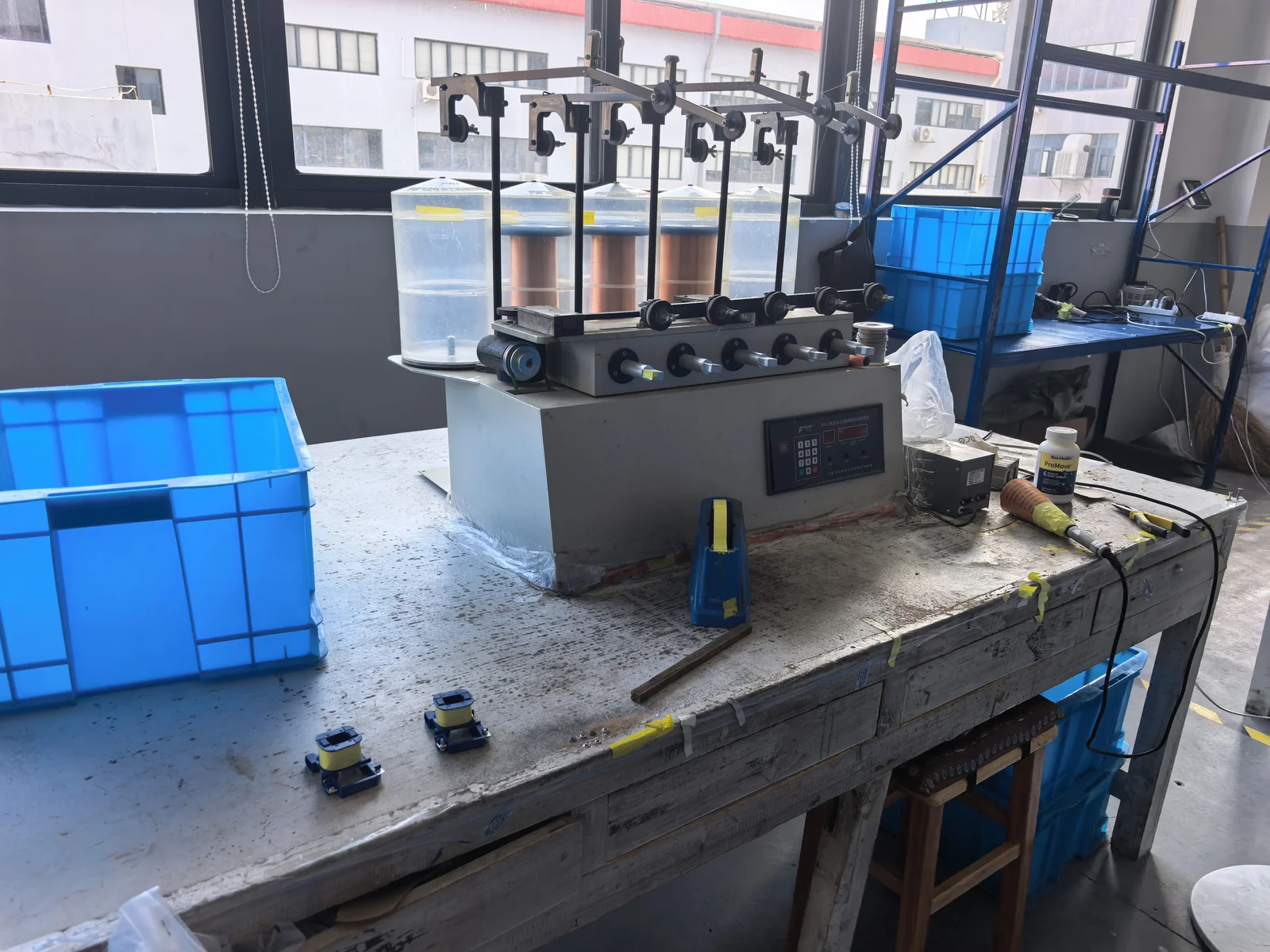
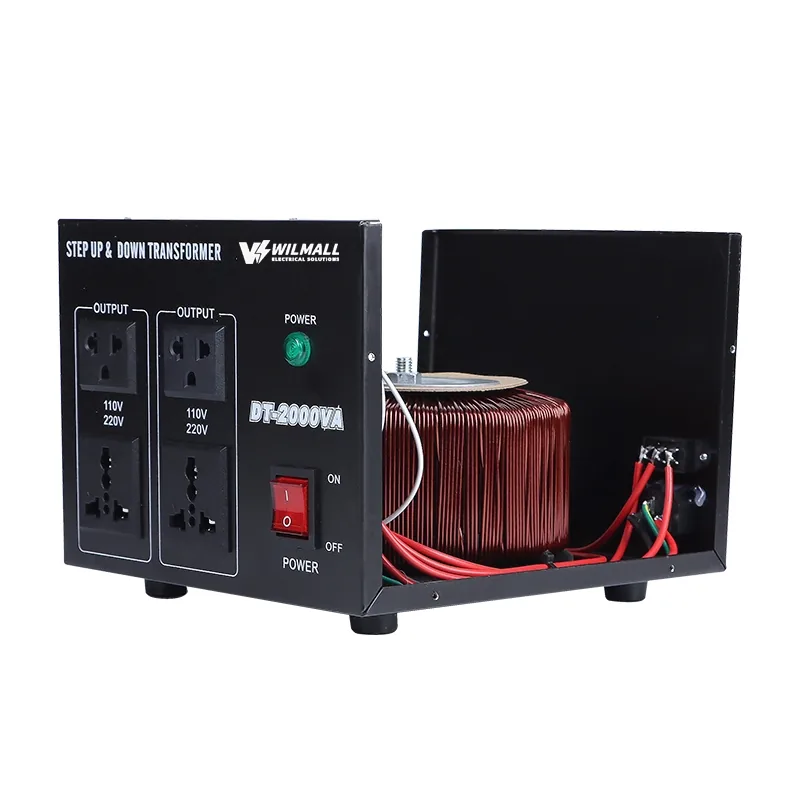
I run the winding line myself, so I know what goes into each box. For a single zone on a garment floor the ST-2000 is the workhorse: 2000VA, 220V in and 110V out, with the RCD fitted inside the case so a fault on the 110V side trips right there rather than somewhere else in the building. The ST-1500 covers the lighter benches and inspection stations at 1500VA.
Where a zone carries heaters and heavy motors, the STU-3000 and STU-5000 take over. They run in both directions, stepping down or stepping up, which matters in a plant that owns a mix of 110V and 220V machines and may repurpose a line later. The DT-1000VA is the automatic bidirectional unit, and it earns its place on packing lines and small utility loads where nobody wants to think about direction.
Between those boxes sits the Variac range at 500VA, 1KVA, 2KVA and 3KVA, with a dial you can turn. A dial does not sound like much until a technician is commissioning an imported embroidery head and wants to watch it settle at 105V or 115V, and after that the service bench tends to keep one for good. For the control side of the plant, our step up & down transformers hub explains where a two-way unit fits and where a plain step down box is the simpler answer.
Order Size, Delivery and the Test Paper in the Box
Let me put the commercial side on the table, because buyers ask for it early. Our minimum order is 10 pieces, whether you are fitting out one line or sampling before you equip a second floor. Lead time runs 15 to 25 days, and where you land in that window depends on how many units you take and whether you need custom labelling or a particular socket type. Goods ship FOB Ningbo or Shanghai, and every unit carries a 12-month warranty.
Inside the carton you will find the test record for the batch your unit came from, with input voltage, loaded output and no-load current written down. Every unit we make is wound and 100 percent tested in our own factory in Yueqing before it leaves, and that sheet is the proof of it. If your plant has an auditor or a buyer who wants documented evidence, that paper is what you hand over.
Customisation is worth raising early on a factory order. We can fit the socket your machines use, set the output to 110V or 120V to match the nameplates on your floor, print your own brand on the faceplate, and pack units so they can go zone by zone rather than all to one storeroom. Tell us the roll-out schedule and we will stage the shipments instead of dropping a pallet of twenty boxes at your gate on one day.
How to Build a Load Sheet Before You Write to Us
You do not need a finished specification to start a conversation. Send what you already have and it is usually enough. Write down, zone by zone, the equipment name, the watts on the nameplate, and how many of each. Note the mains voltage and frequency your building supplies, and whether you are on a single-phase or three-phase feed. Add the number of separate 110V circuits you want, and your target date for the installation.
Two lines of extra detail carry a lot of weight. Say whether any machine has a purpose-built 110V plug that has to be matched, and say whether the floor will grow, because a plant that plans a second shift should buy the headroom now rather than a second unit later. Hand me that list and I can pick the units, price the quantity and tell you when they ship.
While you pull that list together, a couple of reads help. There is a full set of more application guides on the site, covering everything from cold storage rooms to food plants, and the patterns are often similar to what you are doing on a garment floor.
If any line on your list is muddy, send it over with a photo of the plug and the nameplate. Sizing a step down transformer for textile factory lines is routine work for us, and a ten-minute chat on WhatsApp is far cheaper than ordering the wrong box for every zone in a new shed.
Garment Factory Transformer Questions Buyers Ask
These are the questions that come back most often from plant engineers fitting out a line, and I have answered them here the way I would on a call.
How do I size a step down transformer for a textile factory line?
Add up the connected watts of the machines on the line, multiply by a diversity factor of 0.5 to 0.7, then add 25 to 30 percent for headroom. A forty-machine line at 550W each lands near 17kVA. Send us the list and we will confirm the right step down transformer for textile factory use.
Can one transformer run a whole sewing line?
For a very small line, yes. On the floors we quote, most plants split the load into zones so a fault on one does not stop everything. A sewing line of 20 to 30 machines is often fed by several ST-2000 units on a rack, each with its own breaker and its own label.
Do I need a separate transformer for the cutting room?
I recommend it. Cutters and spreaders start hard, so a unit shared with the sewing floor will dip every time a blade spins up. Giving the cutting room its own ST-2000 keeps those starts away from the machines that need a steady supply, and it makes maintenance simpler when something trips.
Why do industrial steam irons matter so much in sizing?
Because they are heat loads, not motor loads. An iron holds close to its full watts the whole time it is on, and several on one feed will keep a transformer warm for a full shift. That is why the finishing area wants more headroom than its running watts alone suggest.
Can I take single-phase 110V from a 380V three-phase supply?
Yes, and most plants do. Take one live conductor and the neutral through the step down transformer. Spread your units across the three phases so one phase does not carry everything, and keep a note of which unit sits on which phase inside the panel door.
Tell us how many lines you are fitting out and what is on each one. Send the machine list with watts, the number of 110V circuits you want, and the country your shed is in. You will normally get a recommended unit, a quantity and a price back the same working day, and we can spread the shipments to match your installation schedule.
Prefer to talk it through? WhatsApp +86 197 3022 6757 · Email sales@wilmall.com
MOQ 10 pcs · Lead time 15-25 days · FOB Ningbo or Shanghai · 12-month warranty