Step Down Transformer for Air Conditioner: Sizing & Safety
An air conditioner is the heaviest appliance most homes own, and the one that punishes an undersized transformer the hardest. If you are running a US-spec 110V air conditioner in a 220V country, the step down transformer between the wall and the AC is doing a job that looks simple on paper but is brutal in practice. The compressor start-up current, the hours of continuous running, the heat in the middle of summer – all of it lands on that one box. This guide covers how to size it properly, what to avoid, and why the AC is the appliance where you do not want to cut corners.
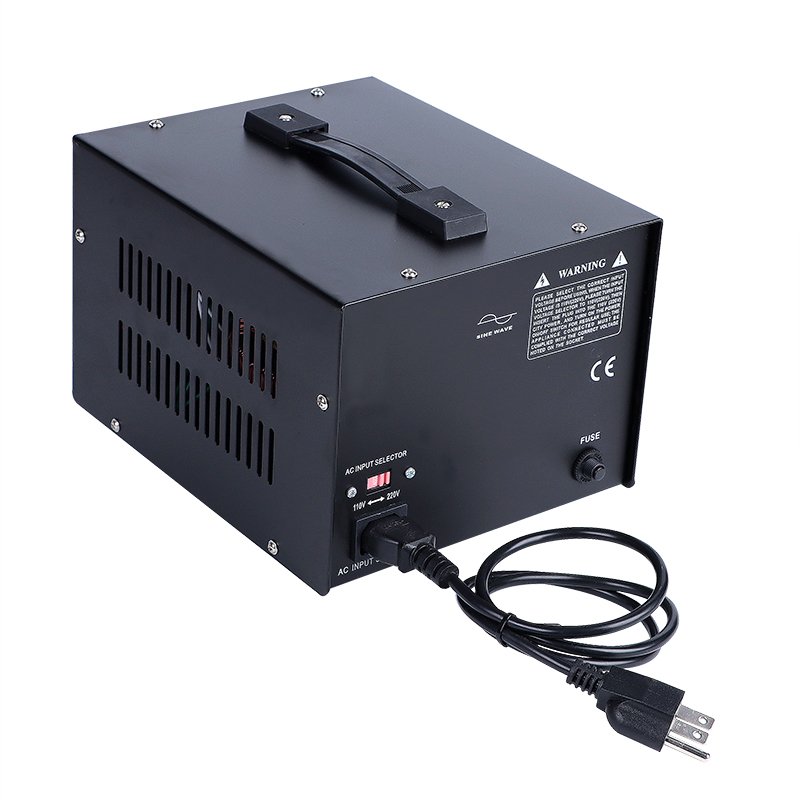
Why an air conditioner is not like other appliances
Most appliances draw what their label says. An AC does not. The compressor inside is a motor, and a motor draws several times its running current for the first second or two every time it starts. That is called inrush, and for a window AC it can hit 3 to 5 times the rated running watts. If you size the transformer for the label watts, it trips or runs dangerously hot every time the compressor kicks in – which, in a hot climate, is every few minutes.
The second problem is duty. An AC runs for hours at a stretch in summer, cycling on and off all day. That is continuous duty, and the transformer has to be rated for it. A transformer sized with proper margin and wound with copper runs warm but stable all afternoon. An undersized or aluminium-wound unit cooks itself by evening, and repeated overheating is exactly how insulation fails.
Step down transformer size for air conditioner
| AC type | Running watts | Start-up surge | Recommended transformer |
|---|---|---|---|
| Window AC (5,000-8,000 BTU) | 500-900W | ~3,000W peak | 3000VA |
| Window AC (9,000-12,000 BTU) | 900-1,400W | ~4,200W peak | 4000-5000VA |
| Split AC (9,000-12,000 BTU) | 1,000-1,500W | ~4,500W peak | 5000VA |
| Split AC (18,000 BTU) | 1,800-2,400W | ~7,000W peak | 8000VA |
| Central AC unit | 3,000-5,000W | surge per compressor | 10KVA or per-unit |
The short version: take the running watts, multiply by three, and buy at least that size. A 1,000W split AC wants a 5,000VA transformer, not a 2,000VA one. Most buyers who tell us their AC “keeps tripping the transformer” are exactly one size too small. The extra cost between 3000VA and 5000VA is small compared to a fried compressor or a fire risk in summer.
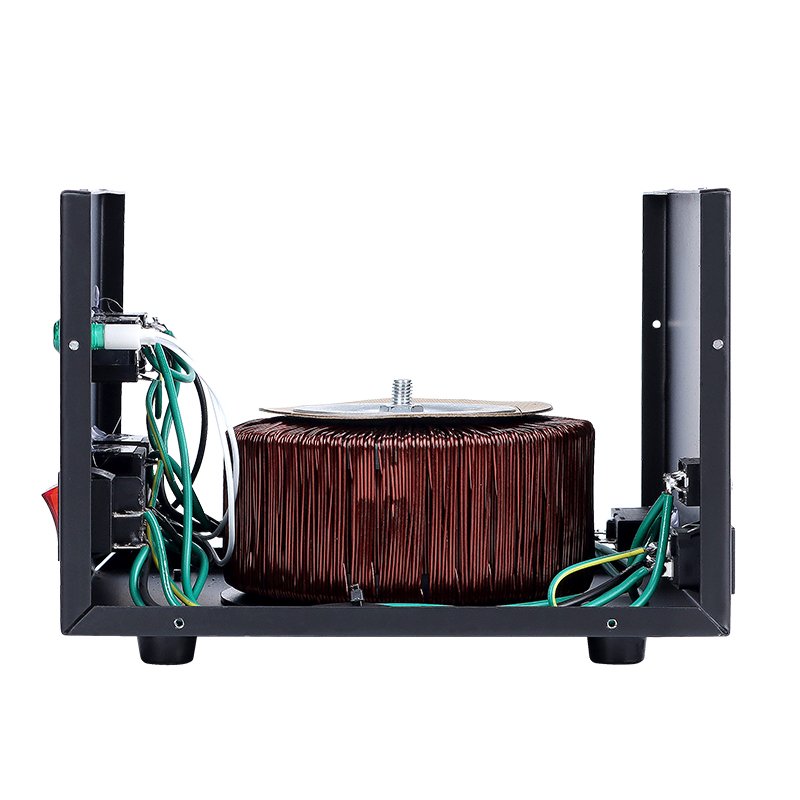
Compressor inrush and locked rotor current
Here is the thing about AC start-up: when the compressor starts, the motor briefly behaves like a short circuit until it spins up. The current spike lasts a second or two, but that is long enough to overload a marginal transformer. Good transformers handle it by having real copper and real iron – the core saturates less, the voltage sags less, and the compressor starts cleanly instead of struggling.
You also want to think about restart cycles. When the power blips and everything comes back at once, an AC may try to restart against head pressure, which pushes the start-up current even higher. This is why we recommend margin on top of margin for air conditioners, and why the STU series with auto-selection and RCD is a popular choice – it protects the compressor through messy mains conditions.
Wiring and RCD protection
An AC transformer should be wired as a dedicated circuit, not shared with half a dozen other appliances. Give it its own outlet or its own terminals, sized for the current. RCD protection on the output is not optional for an appliance that runs for hours – if the AC develops a leakage fault, the RCD trips in milliseconds instead of letting the current leak through the frame.
Common mistakes buyers make
- Sizing on label watts. The running watts are not the start-up watts. Multiply by three.
- Sharing one transformer with other appliances. The AC needs the circuit to itself.
- Using a travel converter. Converters are rated for minutes, not for a summer of AC duty.
- Skipping RCD. Hours of running = real risk if a fault develops.
- Aluminium winding. Long summer duty needs copper to stay cool and last.
Why buy from a factory directly
Wilmall supplies step down transformers for air conditioners across Asia, the Middle East and Africa. Copper winding, generous margins for compressor inrush, RCD protection and batch test records with every shipment. MOQ 10 pcs per model, 15-25 day lead time, FOB Ningbo or Shanghai with CE / RoHS documents. Send us your AC nameplate and we will confirm the size within 24 hours.
Window AC versus split AC transformer needs
The shape of the load changes with the type of unit. A window AC is a single self-contained box – one compressor, one fan motor, one control board – and its start-up surge is short and sharp. A split system is worse on the transformer side: the outdoor compressor unit starts hard, the indoor fan is small, but the whole system cycles constantly, and the transformer sees those surges every few minutes through a hot afternoon. That constant cycling is harder on a transformer than one big start, because the thermal stress repeats.
For a split system, add a little extra margin on top of the standard rule. A 12,000 BTU split running around 1,200W should sit on a 5000VA unit, not a 3000VA one, purely because of the cycling. Buyers who match a split AC to the minimum size are the ones who come back within a season saying the transformer “runs hot”. It is running hot because it is working at its limit all day, every day.
Inverter ACs and electronic loads
Newer inverter ACs complicate the picture, because they do not slam a motor on and off. An inverter compressor ramps up and down smoothly, which means the start-up surge is gentler – sometimes half of a fixed-speed unit. That is good news for the transformer. The catch is that an inverter AC has a switch-mode power supply on the input, and some of those are fussy about the quality of the voltage they receive.
A transformer gives a clean sine wave, which is what the electronics inside an inverter AC want. Just keep the margin anyway – the running load is still real, and a transformer run near its limit for years is a transformer that does not die young. If your AC is an inverter type, tell us when you order and we will confirm the size with the gentler surge in mind.
Buying for importers and resellers
There is a steady trade in US-spec air conditioners into 220V markets, and every unit sold needs a transformer at the door. If you are in that trade, the smart bundle is the transformer with the AC – it is margin for you and a headache saved for the customer. We private-label step down transformers for AC distributors, from MOQ 10 pcs, with your brand, your packaging, and the socket standard your market uses.
We also build custom voltage combinations from 500VA to 30KVA, so if your market runs a non-standard supply or your ACs come in a specific rating, we match the transformer to the product line instead of the other way around. Send us the AC models you stock and we will map a transformer range to them.
The short version for buyers
Size an AC transformer at three times the running watts, give it its own circuit, fit RCD protection, and buy copper-wound for the long summer duty. The STU series with auto-selection covers most household ACs, and we confirm the size from your nameplate in one message.
Reading the AC nameplate
Every AC has a nameplate with the electrical data, and it is the most useful thing you can photograph when ordering a transformer. Look for the input voltage, the rated current, and the cooling watts. The rated current at 110V is your sizing anchor – multiply it by the voltage to get the running watts, then apply the three-times rule. If the nameplate lists both cooling and heating wattage, size on the larger number. Send us that photo and we will do the math for you.
Frequently asked questions
What size transformer do I need for a 110V air conditioner?
Multiply the AC running watts by three. A 1,000W split AC needs about 5,000VA, and a window AC around 3,000-5,000VA depending on BTU rating. Compressor start-up current is 3-5x the running current.
Can a 3000VA transformer run a window AC?
It depends on the BTU. A 5,000-8,000 BTU window unit running around 500-900W works on 3000VA. Anything bigger, move up to 4000-5000VA.
Why can I not use a travel converter for an air conditioner?
Travel converters are rated for short, light loads. An AC runs for hours with heavy start-up surges. Only a continuous-duty transformer with real margin survives that.
Does an AC transformer need RCD protection?
Yes. An AC that runs for hours should be protected by RCD – it trips on leakage in milliseconds if a fault develops, protecting the appliance and the household.
Can I order AC transformers with my brand?
Yes, private labelling from MOQ 10 pcs per model, with RCD and continuous-duty rating as standard. We also build custom voltage combinations from 500VA to 30KVA.
Related reading
- Step Down Transformer 220V to 110V: Sizing and Safety
- Step Down Transformer for Kitchen Appliances
- Step Up and Step Down Transformer Range
Get a factory-direct quote
Email sales@wilmall.com or WhatsApp +86 197 3022 6757 with your AC specs and country. We confirm the size within 24 hours. MOQ 10 pcs.