What Size Transformer Do I Need for an Air Conditioner?
Quick answer: size your transformer at 200-300% of the air conditioner’s running watts. A 1HP (900W running) AC needs at least a 2000VA transformer, because the compressor draws 3-5 times its running current for the first second of every start. Buy smaller and the transformer trips, buzzes loudly, or overheats within a season.
Key Takeaways
- Size AC transformers at 200-300% of running watts.
- Compressors draw 3-5x their running current at start.
- A 1HP AC needs at least a 2000VA transformer.
- Never run an AC on a cheap electronic converter.

Quick Size Guide
| AC size | Transformer |
| 1HP / 9000 BTU | 2000VA |
| 1.5HP / 12000 BTU | 3000VA |
| 2HP / 18000 BTU | 5000VA |
Why Air Conditioners Need Oversized Transformers
Everything with a compressor has a start-up surge. A fridge, a freezer, and most of all an air conditioner. When the compressor kicks in, it draws a massive inrush current to get the motor spinning, then settles back to normal running watts. An AC’s start-up current is typically 3-5 times its running current, which means a 2000W “running” unit can pull close to 8000W for a split second.
A transformer rated exactly at the AC’s running watts will trip or overheat on every single start. The fix is simple: oversize by 200-300%.
Transformer Size by AC Capacity (BTU / HP)
| Air Conditioner | Running Power | Recommended Transformer |
|---|---|---|
| 0.75HP / 7000 BTU | ~700W | 1500VA |
| 1HP / 9000 BTU | ~900W | 2000VA |
| 1.5HP / 12000 BTU | ~1300W | 3000VA |
| 2HP / 18000 BTU | ~1800W | 5000VA |
| 3HP / 24000 BTU | ~2600W | 7000VA |
These numbers assume a standard 220V input, 110V output. If you are converting for a US-spec AC running on 220V mains, use the same table — the wattage is what matters, not the brand.
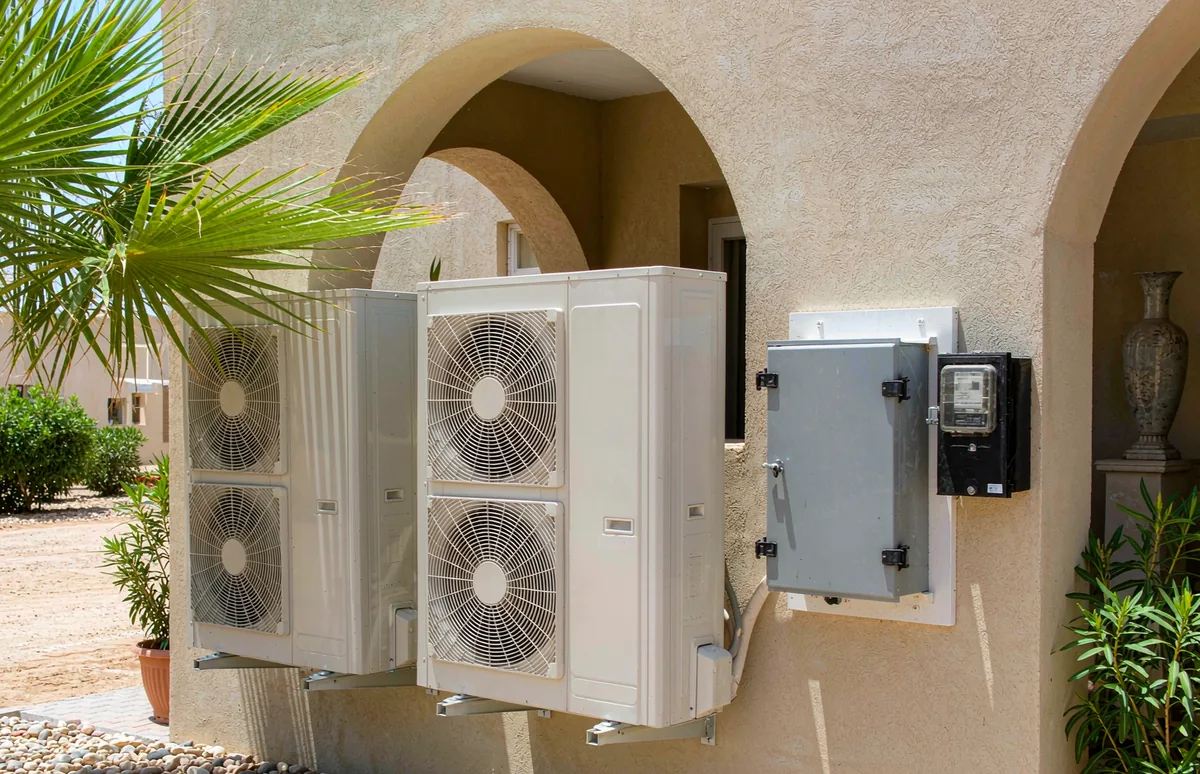
Fixed Window Unit vs Portable AC
Fixed split units and window units start harder than portables, so give them the full 300% margin. Portable ACs draw less surge, but their running power is deceptively high (they have to cool AND pump water), so check the nameplate before choosing — and still keep the 200% rule.
What Happens If You Undersize?
- Tripping: the internal breaker or fuse pops every time the compressor starts.
- Overheating: the transformer runs hot, the varnish smell appears, and the winding insulation degrades fast.
- Voltage sag: the AC gets low voltage at start-up, which stresses the compressor motor and shortens its life.
None of these are “normal wear”. All of them are caused by a transformer that is simply too small for the job.
BTU, watts and the sizing connection
Air conditioners are rated in BTU, British Thermal Units, and the BTU number converts to watts with a simple factor: divide by about 3.4 to get the electrical watts. A 5000 BTU unit draws roughly 500W running, a 9000 BTU unit about 900W, and a 12000 BTU unit about 1200W. These running numbers are the starting point for the transformer size, but the surge is the deciding factor.
An air conditioner compressor surges to 3 to 5 times its running draw for a second or two at every start. A 5000 BTU unit that runs at 500W can surge to 2000W, which is why a 500VA transformer would die instantly and a 2000VA unit is the safe floor for even the smallest window AC.
Window units vs mini-splits
Window units and mini-split systems size differently. A 110V window unit up to 12000 BTU runs on a single 110V circuit, and the transformer must handle the compressor surge, so the 2000VA is the floor for anything up to 9000 BTU and the 3000VA covers the larger window units. Mini-splits over 12000 BTU usually need 220V, which changes the whole question, they run on the local mains directly and need no step down.
If you are importing a 110V window unit for a 220V country, the transformer is mandatory, and the installation must keep the transformer out of the rain and away from the AC’s condensate drip. A weatherproof cover with ventilation is the standard for outdoor installations.
Starting current and the inverter question
Some modern air conditioners are inverter type, which ramps the compressor up slowly instead of starting it with a hard surge. An inverter AC is much gentler on a transformer, the start current is a fraction of a conventional unit, so a smaller transformer can work. A 9000 BTU inverter AC running at 800W peaks near 1200W at start, which fits a 1500VA unit where a conventional unit would need 3000VA.
If you are choosing between conventional and inverter AC for a 110V setup in a 220V country, the inverter type saves you both electricity and transformer cost. The payback on the inverter premium is quick when the transformer can be one size smaller.
Installation and wiring notes
An air conditioner transformer runs long duty cycles, often hours at a stretch in hot climates, so the installation matters. Mount the transformer off the ground, away from water, in a ventilated spot, and give it its own circuit. Do not share the circuit with other high-draw appliances, the AC’s surge plus a kettle or a microwave is an overload waiting to happen.
If the transformer trips when the AC starts, the diagnosis is usually straightforward: the unit is undersized for the compressor surge, or the AC has a hard start that needs a soft start kit. A soft start kit on the AC reduces the surge, which can let a smaller transformer work, and it is a common fix in this exact situation.
Power factor and the real transformer load
Air conditioner motors have a power factor below 1, typically 0.7 to 0.85, which means the VA drawn from the transformer is higher than the watts. A 5000 BTU unit that runs at 500W may draw 650VA from the transformer because of the motor’s reactive current. This is why we size AC transformers in VA and apply the 80% rule, the VA number is the honest load the transformer carries.
If you only know the watts of your AC, add 20 to 30% to get the VA before matching a transformer. A 1200W window unit at 0.8 power factor draws about 1500VA, which belongs on a 2000VA transformer with the 80% rule, not on a 1500VA unit that would run at its limit.
Sizing table for common AC units
Here is the practical sizing table we give to buyers: a 5000 BTU window unit, about 500W running, belongs on a 2000VA transformer. A 7000 to 9000 BTU unit, 700 to 900W, belongs on a 2000VA or 3000VA depending on whether it is an inverter. A 10000 to 12000 BTU unit, 1000 to 1200W, belongs on a 3000VA for a conventional unit and a 2000VA for an inverter. Anything larger is usually 220V and needs no step down.
These sizes assume the transformer is dedicated to the AC and nothing else. If the same transformer also feeds a fridge or other appliances, add their running VA and re-check the 80% rule. When in doubt, go one size up, the cost difference is small and the reliability gain is large.
And a word on the seasonal pattern that catches AC buyers: the transformer sized for a mild-weather day may fail on the hottest day, when the AC runs longest and the compressor cycles hardest. Size the AC transformer for the worst day of the year, not the average, and add the fan-ventilated case option if the unit sits in a warm enclosed space. The extra margin costs little and it is the difference between a transformer that survives its first summer and one that dies in it.
One more AC-specific point: the capacitor. Many window AC units use a start capacitor for the compressor motor, and a weak capacitor makes the start surge worse, which trips the transformer even when it is correctly sized. If the AC starts hard and the transformer trips, check the capacitor before upgrading the transformer, a capacitor replacement is cheap and fixes the hard start. The capacitor check is the kind of detail that saves buyers a transformer upgrade they do not actually need, and it is the first thing we ask about when the tripping pattern is at start-up only.
What to Read on the AC Nameplate Before You Order
Five numbers decide the transformer: BTU rating, running voltage, frequency, running current and locked rotor amps. The BTU tells you the cooling capacity but not the electrical load, so the current figure is the one that matters. A 12000 BTU window unit running on 110V draws around 1100W in steady service, and its compressor pulls two to three times that for a fraction of a second at every start. Locked rotor amps, sometimes printed as LRA, is that start surge written down. If the nameplate lists LRA, size against it; if it does not, assume 2.5 times the running current and check with us before ordering.
The fastest way to get a correct answer is a clear photograph of the nameplate plus your country. One image removes every guess about voltage, frequency and inverter type. We read it, apply the 80% rule and the start surge margin, and reply with the exact VA in one message. For worked examples across window units and mini-splits see the air conditioner transformer guide, and the wider set of worked cases sits in our application guides.
Frequently asked questions
Can I run my AC and lights on the same transformer?
Yes, as long as the total stays under the transformer’s safe load. Keep 20-30% headroom after adding everything.
My AC says 110V but my country has 220V. Which transformer do I need?
A step-down model from 220V to 110V, sized per the table above. If you need help picking, send us the AC nameplate photo — we will tell you the exact VA in one message.
Is a cheap electronic converter okay for an AC?
No. Electronic switchers cannot survive compressor inrush current. Use a real copper-wound transformer with a thermal protector.
What about 60Hz AC units on 50Hz mains?
Most modern ACs tolerate 50/60Hz, but compressors run slightly hotter. If you are buying new, buy a unit rated for your country’s frequency.
Related reading
- How to Calculate Transformer VA Rating: A Simple Formula
- Step Down Transformer 220V to 110V: Sizing and Safety
- Transformer Application Guides
Get a factory-direct quote
Email info@wilmall.com or WhatsApp +86 197 3022 6757 with your AC nameplate photo and country. We name the exact VA in one message. MOQ 1 pc for stock units, 10 pcs for custom voltage.