Step Down Transformer for Cold Storage Rooms: 220V to 110V
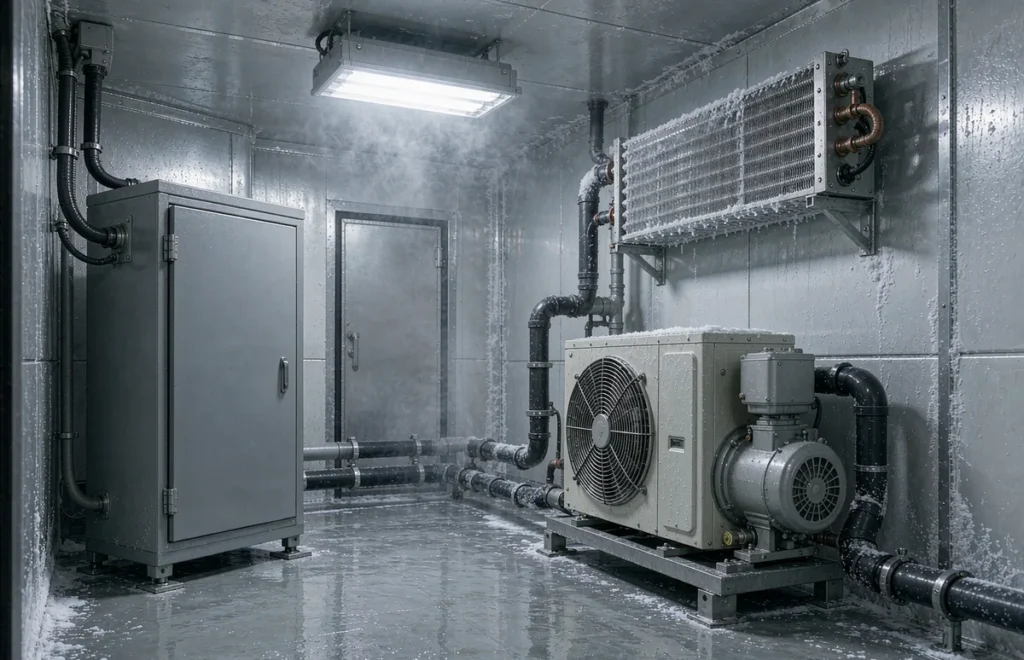
A commercial cold storage room is not a big kitchen fridge, and the power question around it is not the same either. The cabinet you see through the door is the easy part. The real load sits in the machine room: the condensing unit, the evaporator fans, the defrost heaters and the controller, and most of that kit was built for 110V because the compressor and the controls came out of a North American or Japanese catalogue. Your building gives 220V or 230V. Somebody then asks whether a small step down box will do, and the honest answer is that the sizing here is trickier than the home version.
I build these units in Yueqing and cold storage enquiries are a steady part of the week, usually from a cold chain operator, a food importer, or a contractor fitting out a walk-in room. The mistakes I see are almost always the same, so let me walk through them the way I would on a call.
Why a Cold Storage Room Is a Harder Load Than a Fridge
The short answer is the compressor. A residential fridge compressor is small and starts gently. A walk-in condensing unit with parallel compressors can pull six to eight times its running current for a moment each time it locks and turns, and that locked-rotor current is the number that decides your transformer size, not the running watts on the nameplate.
Then there is the duty pattern. A cold room cycles the compressor on and off all day as the load in the box changes, so the transformer sees repeated inrush instead of one gentle start in the morning. Each start is a few hundred milliseconds, but it happens often, and a unit sized right at the limit will run hot and annoyed.
One more point that catches people. The defrost cycle stacks load on top of everything else. Many rooms fire electric defrost heaters while the fans keep running, so for a window of ten or fifteen minutes you have heater watts plus fan watts plus a compressor that may also be calling. Size for that window, not for the quiet idle, or the box browns out exactly when the coil is icing up.
What Inside a Cold Room Machine Room Usually Runs on 110V
When a contractor sends me the plant list I split it the same way every time. Here is what normally needs a transformer in a commercial cold store, with the ranges I see on real quotes.
- Parallel condensing compressors, 800W to 3000W running each, with locked-rotor start current of 6 to 8 times that figure.
- Evaporator fans and air coolers, 100W to 400W, running whenever the room calls for pull-down.
- Electric defrost heaters, 800W to 2500W, fired in a short window and stacked on top of the fans.
- Temperature controllers and room thermostats, 10W to 40W, small but they hate a dip that resets the setpoint.
- Pressure switches and solenoid drivers, 20W to 80W, part of the control circuit.
- Alarm and logging panels, 30W to 120W, where a clean steady output keeps the record honest.
What does not need us: most three-phase condensing units, which take the building supply directly, and any control gear already rated 100-240V. Go through the nameplates before you build the load sheet, because counting a three-phase compressor as a 110V load pushes you into a unit far bigger than the job needs.
How to Size a Transformer for a Cold Room
Here is the method I use. Start from the running watts of everything that can be on at once, then add the defrost window on top, then size the transformer for the compressor locked-rotor current rather than the running figure. The running load tells you the rating you wish you needed. The start current tells you the rating you actually buy.
For a single compressor at, say, 1500W running with a 7 times locked-rotor start, the transformer has to survive a momentary pull near 10,000W without its protection tripping. That does not mean you buy a 10kVA unit, because the start is brief, but it does mean the unit must be rated for that repetitive surge. We build our STU series with that headroom designed in, and I would rather see a room on a 3000VA or 5000VA unit than a 2000VA box living at the edge.
A Worked Example: A 40 Cubic Metre Chilled Room
Say the room has two parallel compressors at 1200W each, evaporator fans at 300W, defrost heaters at 1800W, and a controller at 30W. The worst case is defrost firing while both compressors can call: 1200 + 1200 + 300 + 1800 + 30 = 4530W, and the compressor start adds a brief surge on top. Add 30 percent and you are near 5900VA, so a 5000VA bidirectional unit is right at the edge and a 5000VA with the next frame up, or splitting the compressors across two units, is the safer call.
For a smaller chilled room with one 900W compressor, 200W of fans and 1200W of defrost, the simultaneous worst case is about 2300W. With headroom that is a 3000VA unit, and the defrost window does not drag the controller down with it.
| Cold room plant | Typical simultaneous load | Suggested unit rating | Why this size |
|---|---|---|---|
| Small chilled room, one compressor | 1500 – 2500 W | STU-3000 bidirectional | Compressor start plus defrost window needs the headroom |
| Medium room, two parallel compressors | 3000 – 5000 W | STU-5000 bidirectional | Both can start while defrost fires, size for that window |
| Evaporator fans and controller only | 300 – 800 W | ST-2000 2000VA with RCD | Light load, steady output keeps the setpoint |
| Defrost heaters as a separate feed | 1000 – 2500 W | STU-3000 bidirectional | Short heavy window, keep it off the compressor circuit |
| Large freezer, multiple circuits | 5000 – 9000 W | Two STU-5000 units | Split zones so one fault does not warm the whole box |
When the Defrost Cycle Pushes You up a Size
The cases where I tell a cold store to go past the 30 percent rule come up often. A room that fires defrost while the compressors are already calling is one, because that window is a step change, not an average. A freezer running in a hot ambient with poor machine room ventilation is another, because the compressor works harder and the transformer has nowhere to shed heat. And any site planning to add a second room later should buy the bigger frame now rather than a second unit down the line.
If you are not sure where your room sits, send us the compressor nameplate and the room volume. We have sized enough cold store loads to tell you in one message whether a 3000VA unit is enough or whether the defrost window puts you on the 5000VA.
Low-Temperature Insulation and Where the Unit Sits
The machine room is cold and often damp, so the transformer has to cope with that, not just with the wattage. Our enclosures use insulation rated for the environment, and we keep the terminations clear of where condensation can run. Do not mount the unit where a defrost drain can drip on it, and do not seal it inside a panel with no air, because the transformer makes its own heat and needs to lose it.
For a retrofit, which is what most cold store jobs are, I suggest one unit feeding the 110V plant and a second small unit for the controller and alarm, so a fault on the compressor circuit does not reset the setpoint and silence the alarm. On a larger site you can group the fans and the defrost on one unit as long as you have written down what is on it and taped the list inside the door.
RCD, Earthing and a Wet Machine Room
Ask for RCD first, not last, on a cold store unit. On the ST-2000 and STU units it lives in the case, so a 110V fault trips at the unit instead of waiting for a breaker on the other side of the room. In a machine room with a floor that gets hosed and a drain that backs up, do not trade that away to save a few dollars per unit.
The earth connection is what I check next. The case must tie into the building earth, and the 110V side should land on real sockets rather than a bare lead hanging out of the box. If you are also fitting out a smaller chilled cabinet, our guide to What Size Step Down Transformer Do I Need for a Refrigerator covers the lighter end of this work, though a walk-in room is a different sizing job as you can see above.
The Units We Build for Cold Storage Plant
We make these, we do not just resell them, so the spec is straight from the bench. The ST-2000 is a 2000VA step down transformer, 220V in to 110V out, RCD included in the build, and it carries the light load: fans, controller and alarm each on their own feed.
On the compressor and defrost side I reach for the STU range. The STU-3000 and STU-5000 go both directions, step up and step down, and they take the heavy, surge-loaded cold store duty. Both ways counts here, because a site that imports 110V and 220V plant together will need to reverse course sooner or later, and swapping the box on the wall then is a headache no one prices in.
The Variac range sits in the gap for commissioning and bench test, across 500VA, 1KVA, 2KVA and 3KVA. A variable output is quiet until you are wiring up an imported controller and want to see how it behaves at 105V or 115V before the room goes live. A service tech who tries one usually asks for one to keep.
Order Size, Delivery Window and Test Paperwork
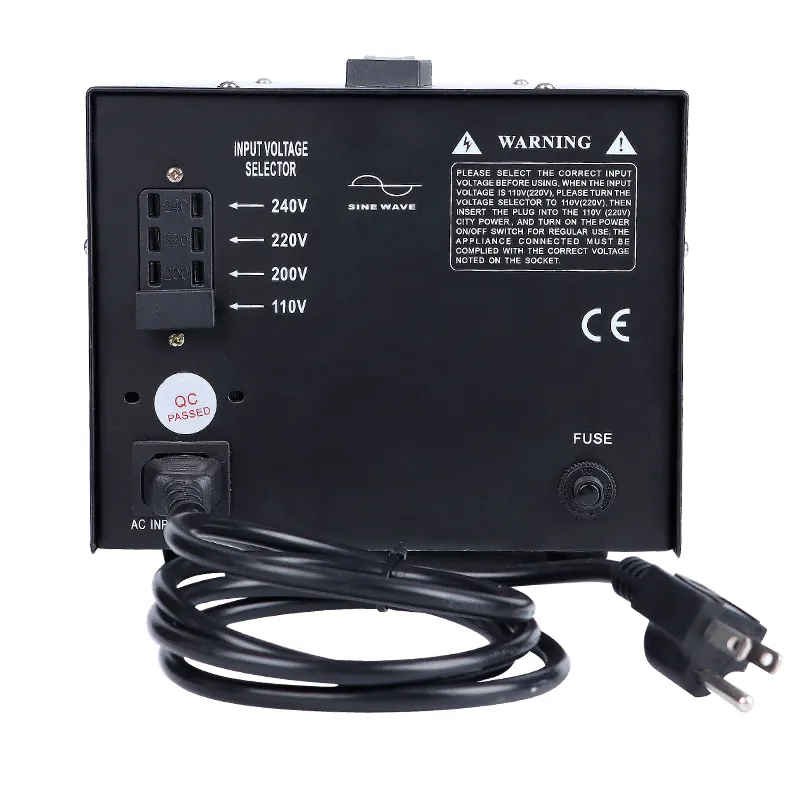
The numbers come first here, because cold store buyers want them before they read another line. Our minimum order is 10 pieces, whether you are fitting out one room or sampling before a chain roll-out. Delivery takes 15 to 25 days, and your place in that range turns on the quantity and on any custom labelling or socket you ask for. We send FOB from Ningbo or Shanghai, and every unit is covered for 12 months. The carton holds a test report from the batch your unit belongs to, listing input voltage, output under load and no-load current, because we test all of what we make in our own Yueqing factory.
Cold store jobs are where the custom work gets fun. We match the inlet and outlet sockets to your plant, dial the secondary to 110V or 120V straight from the nameplate, put your label on the case, and box each unit so it drops straight into its cold room. When you are fitting several rooms, give us the schedule and we phase the deliveries instead of leaving one pallet parked by the compressor.
Our windings are copper, full stop, not aluminium. An aluminium winding sits hotter at the same load, and heat is what ages the insulation until the transformer fails. Under cold store duty, where a unit is switched on and left on through every defrost cycle, that difference shows up inside a couple of years.
What to Send Us Before We Size a Cold Room
A finished specification is not needed before we talk. Send whatever you already have. The compressor nameplate with running watts and locked-rotor amps, the defrost heater wattage, the fan wattage, your mains voltage and frequency, the socket type in the machine room, how many separate 110V feeds you need, and the room volume. Give me those points and I will size the unit, quote the number and name a dispatch window.
Two pieces worth a look as you build the list. When you are not yet sure if you need step down, step up or both in one box, our page on step up & down transformers explains the difference with no sums to work through. There is a full set of more application guides on the site as well, covering everything from pharmacies to construction sites.
Where a line on the list is not clear, send it with a picture of your plugs. Sizing a step down transformer for cold storage rooms is routine work for us, and we would much rather spend ten minutes on WhatsApp than have you order the wrong unit for a room full of stock.
Cold Storage Transformer Questions I Get Most Weeks
The questions below are the ones that land on my desk most weeks from cold chain operators and their contractors, answered the way I would on a call.
Why does my cold room need a bigger transformer than the running watts suggest?
Because the compressor pulls 6 to 8 times its running current for a moment at every locked-rotor start, and a cold room starts often through the day. Size for that start surge plus the defrost window, not the idle running watts, or the unit runs hot and trips. Our STU-3000 or STU-5000 step down transformer is built for that headroom.
Should the defrost heaters be on the same transformer as the compressor?
Not ideally. Defrost fires a short heavy load while the fans and maybe the compressor are already calling, so that window is the worst case. Put the defrost on its own feed, often a separate STU-3000 step down transformer, and keep the controller on a small unit so a fault never resets the setpoint.
Will a 50Hz supply hurt a 110V compressor built for 60Hz?
The transformer changes voltage only, never frequency, so you get a clean 110V at 50Hz. A compressor built for 60Hz runs a little slower and warmer on 50Hz, which means longer run times, not damage. Send us the model and we will flag anything that needs a closer look before you order.
Do I need RCD protection in a cold storage machine room?
Yes, ask for it first rather than last. On our ST-2000 and STU units the RCD is part of the build, so a fault on the 110V side trips the unit locally. In a damp machine room with a floor that gets hosed, that local trip is not optional, it keeps a leak from reaching the rest of the building.
Can one transformer run two parallel compressors?
Yes if you size for both starting together, which is the hard part. Two 1200W compressors with fans and defrost land near 4500W plus start surge, so a 5000VA step down transformer is the edge and splitting them across two units is safer. Send the nameplates and we will confirm the exact rating.
Send us your compressor nameplate and room volume and we will size it at no charge. Tell us the running watts and locked-rotor amps, the defrost wattage, and how many 110V feeds the machine room needs. You usually get a unit, a quantity and a delivered price back within a day, lined up to the fit-out.
Or talk to us directly: WhatsApp +86 197 3022 6757 · Email sales@wilmall.com
MOQ 10 pcs · Lead time 15-25 days · FOB Ningbo or Shanghai · 12-month warranty