How to Calculate Transformer VA Rating: A Simple Formula
Quick answer: VA = Volts × Amps. Add the VA of everything the transformer will power, multiply by 1.2 (20% safety margin), and round up to the nearest standard size. For motors and compressors, use 1.5-2.0 instead of 1.2 because of start-up current.
Key Takeaways
- VA = Volts x Amps, then add a 20% margin.
- Motors and compressors need 1.5-2.0x margin.
- Size by VA, never by watts, for motor loads.
- When in doubt between two sizes, buy the bigger one.
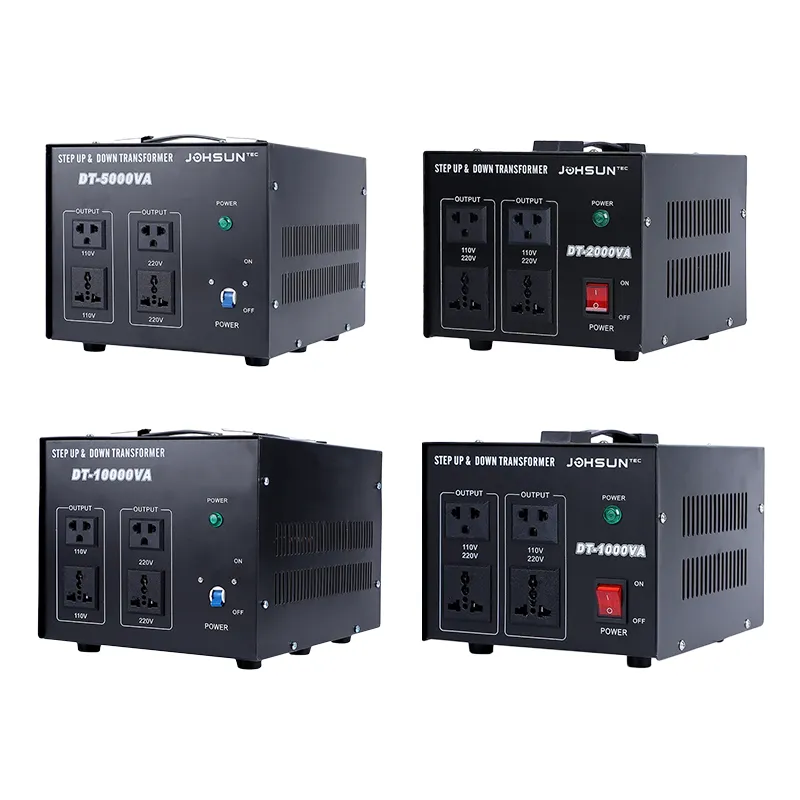
Quick Sizing Examples
| Load | Buy |
| 110V x 9A = 990VA | 1500VA |
| 220V x 6A = 1320VA | 2000VA |
| Motor loads | 1.5-2.0x VA |
The Formula and a Worked Example
Every electrical load has a voltage (V) and a current draw in amps (A). Multiply them and you get the apparent power in VA — this is the number printed on a transformer’s nameplate, and the number you must match or exceed.
Worked example 1 — a 110V appliance drawing 9A:
110V × 9A = 990VA → with 20% margin: 1188VA → buy a 1500VA transformer.
Worked example 2 — a 220V machine drawing 6A:
220V × 6A = 1320VA → with margin: 1584VA → buy a 2000VA transformer.
| Load | Volts × Amps | VA | +20% | Buy |
|---|---|---|---|---|
| 110V device, 9A | 110 × 9 | 990 | 1188 | 1500VA |
| 220V machine, 6A | 220 × 6 | 1320 | 1584 | 2000VA |
| 110V motor, 13A | 110 × 13 × 1.6 | 1430 | 2288 | 2500-3000VA |
VA vs Watts: Why They Differ
Watts is real power doing work. VA is what the transformer must supply, including the extra current motors and power supplies draw that does no work (called reactive power). For resistive loads like heaters and incandescent lamps, VA ≈ watts. For anything with a motor, coil, or switched power supply, VA is higher than watts — sometimes 20-60% higher. Always size by VA, never by watts.
The Safety Margin Rules
| Load type | Margin multiplier | Reason |
|---|---|---|
| Resistive (heaters, lamps) | 1.2 | Steady current |
| General (TV, computer, small appliances) | 1.2-1.3 | Power-supply surges |
| Motors, compressors, pumps, AC | 1.5-2.0 | Start-up inrush 3-5x |
| Transformer running continuously 24/7 | 1.3+ and derate | Heat buildup |
If you ever have to choose between two sizes, take the bigger one. The money you save undersizing is less than the cost of one fried appliance.
Common Mistakes That Burn People
- Adding watts instead of VA for motor loads.
- Ignoring start-up current on fridges, freezers and ACs.
- Sizing for one appliance but plugging in three.
- Buying a “2000W converter” and assuming it is 2000VA — check the nameplate.
Questions Customers Ask Us
My appliance only shows watts, not VA. What do I do?
For general appliances use watts × 1.25 as an estimate. For motors use watts × 1.6-2.0.
Can a transformer run at 100% VA continuously?
Technically yes, but it will run hot. Staying at 70-80% of rating keeps it cool and doubles its life.
Do you have a calculator or tool?
Send us the appliance list — we will calculate the exact VA for you, free and within hours.
Still not sure which model fits?
Tell us your appliance, wattage and country — we reply within 24 hours with a straight recommendation.
The VA formula, worked through
The VA rating of a transformer is the product of the output voltage and the output current it can deliver continuously. For a single-phase transformer, VA equals volts times amps. A 110V output at 9 amps is 990VA, which is why the 1000VA size is the natural rating for that output. The watts it can deliver depend on the load’s power factor.
Worked example: you want to run a 900W kettle on 110V through a step down transformer. The kettle is a resistive load, power factor 1, so 900W equals 900VA. Apply the 80% rule and the transformer needs to be at least 1125VA, so you buy a 1500VA unit. A motor load at 0.8 power factor would need 1125VA for the same 900W, and the transformer would need to be even larger.
Power factor and why it changes the answer
Power factor is the ratio of real power in watts to apparent power in VA. A heater and an incandescent bulb have a power factor of 1. A motor, a compressor, or a switching supply has a power factor of 0.6 to 0.9, meaning the transformer must carry more VA than the watts suggest. The transformer core and windings are sized by VA, not watts, because the current heats the windings regardless of the phase.
This is why sizing guides tell you to add 20 to 30% to the wattage of motor appliances before picking a VA size. The 80% rule then applies on top, giving you the final size. If you only know the watts of your appliance and not the power factor, assume 0.8 and add the margin, it is the safe assumption for most appliances with motors.
The 80% rule and the working margin
The 80% rule is the operating headroom that keeps a transformer cool and long-lived. A transformer run at 80% of its VA rating stays well inside its thermal limit, runs quietly, and lasts a decade. The same transformer run at 100% runs at its thermal edge, and the insulation ages fast. The 20% margin is the cheapest insurance you can buy for a piece of electrical equipment.
The rule applies to the continuous load, not the momentary surge. A fridge that surges to 1500VA for a second can live on a 1000VA unit that runs at 600W steady, because the surge is short. But a heater that runs at 1500W for an hour needs a transformer rated at least 1875VA, which is the next standard size up, the 2000VA.
The full formula and where it comes from
The VA rating comes from the physics of the transformer core. The core can carry a maximum magnetic flux, and the windings can carry a maximum current without overheating. The product of the voltage and the current at the design limits gives the VA rating, which is the honest capacity of the unit, independent of the load type.
For a single-phase transformer, the formula is VA equals volts times amps. For a three-phase transformer, it is volts times amps times the square root of three, about 1.73. If you are sizing a three-phase unit, the extra factor matters, and the sizing guide should state it, because the single-phase rule undersizes a three-phase load.
Practical examples across appliance types
Work through the common cases and the pattern is clear. A 1200W microwave, resistive plus switching, power factor near 1, needs a 1500VA transformer with the 80% rule. A 600W fridge, motor load at 0.8 power factor, needs 750VA of apparent power, and a 1000VA transformer is the size. A 1500W hair dryer, pure resistive, needs a 2000VA transformer to stay under 80%.
The pattern is: watts divided by power factor gives VA, divide by 0.8 for the 80% rule, round up to the standard size. If you only have the watts, assume 0.8 power factor for anything with a motor and 1.0 for heating elements, and the sizing works.
Tools and calculators that help
You do not need to do the math by hand every time. Our sizing calculator on the tools page takes the appliance watts, the power factor, and the quantity, and returns the recommended VA size. It applies the 80% rule automatically and lists the standard sizes, which removes the arithmetic errors.
For a quick manual check, the rule of thumb that fits most cases is: multiply the watts by 1.3 for motor loads and by 1.25 for heating loads, then round up to the next standard size. The calculator and the rule of thumb agree within one size on almost every household appliance.
The full formula and where it comes from
The VA rating comes from the physics of the transformer core. The core can carry a maximum magnetic flux, and the windings can carry a maximum current without overheating. The product of the voltage and the current at the design limits gives the VA rating, which is the honest capacity of the unit, independent of the load type.
For a single-phase transformer, the formula is VA equals volts times amps. For a three-phase transformer, it is volts times amps times the square root of three, about 1.73. If you are sizing a three-phase unit, the extra factor matters, and the sizing guide should state it, because the single-phase rule undersizes a three-phase load.
Practical examples across appliance types
Work through the common cases and the pattern is clear. A 1200W microwave, resistive plus switching, power factor near 1, needs a 1500VA transformer with the 80% rule. A 600W fridge, motor load at 0.8 power factor, needs 750VA of apparent power, and a 1000VA transformer is the size. A 1500W hair dryer, pure resistive, needs a 2000VA transformer to stay under 80%.
The pattern is: watts divided by power factor gives VA, divide by 0.8 for the 80% rule, round up to the standard size. If you only have the watts, assume 0.8 power factor for anything with a motor and 1.0 for heating elements, and the sizing works.
Tools and calculators that help
You do not need to do the math by hand every time. Our sizing calculator on the tools page takes the appliance watts, the power factor, and the quantity, and returns the recommended VA size. It applies the 80% rule automatically and lists the standard sizes, which removes the arithmetic errors.
For a quick manual check, the rule of thumb that fits most cases is: multiply the watts by 1.3 for motor loads and by 1.25 for heating loads, then round up to the next standard size. The calculator and the rule of thumb agree within one size on almost every household appliance.