Transformer VA vs Watts: What Buyers Need to Know
Every transformer is rated in VA, and every appliance label shows watts. Most buyers assume they are the same number, and for simple heaters they basically are. For motors, compressors and anything with electronics, they are not — and buying the wrong one is how transformers end up hot, tripping, or dead. This guide explains VA vs watts in plain language, with the numbers you actually need for sizing.
What VA and watts actually mean
Watts is the real power the appliance actually consumes — the work it does. VA is the total power the transformer must supply, including the part the appliance borrows and returns each cycle. For a pure heater, the two numbers are nearly identical. For a motor, the motor borrows extra power to magnetise its windings, and the transformer has to supply that too. The borrowed part is what makes VA higher than watts.
The relationship is measured by the power factor, written as a number between 0 and 1. Watts = VA x power factor. A heater has a power factor of about 1.0. A motor sits around 0.6-0.8. A fluorescent lamp is around 0.5-0.9. The lower the power factor, the more VA the transformer must supply for the same watts.
Why this matters when sizing a transformer
| Load type | Power factor | Real watts per 1000VA |
|---|---|---|
| Heater, oven, kettle | ~1.0 | 1000W |
| LED lighting | 0.7-0.95 | 700-950W |
| Motor, compressor, pump | 0.6-0.8 | 600-800W |
| Washing machine | 0.7-0.9 | 700-900W |
| Power tools (universal motor) | 0.85-0.95 | 850-950W |
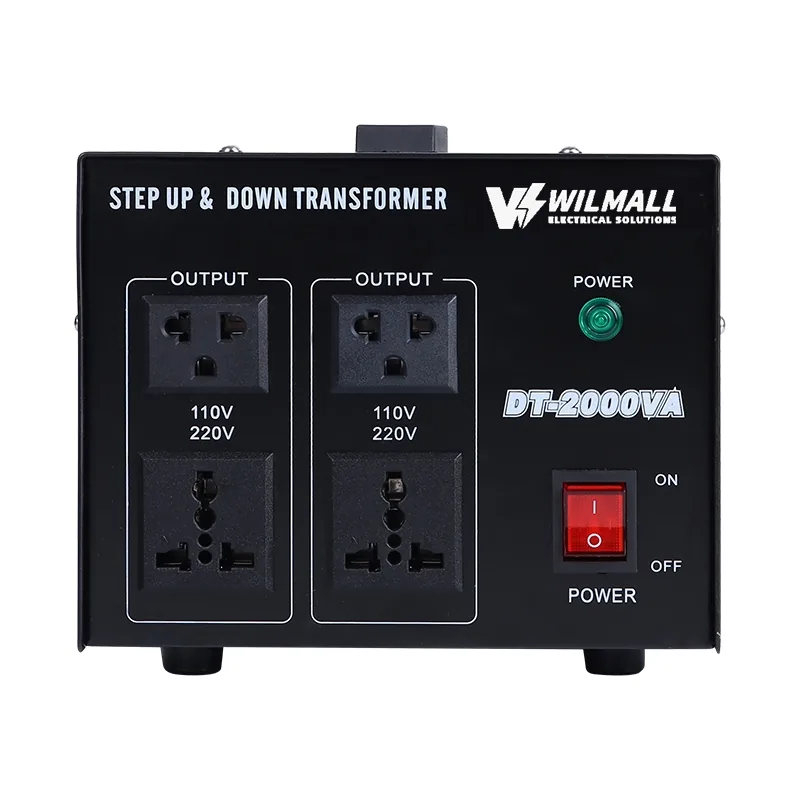
Here is the thing: if you size a transformer for a 1000W motor using watts alone, the transformer needs to supply about 1300-1500VA because of the power factor and the start-up surge. The VA rating is the honest number the transformer works with. That is why every Wilmall transformer is rated in VA, and why we always ask for the appliance watts plus its type.
The surge question on top of VA
There is a third number on top of VA and watts: the start-up surge. A motor draws several times its running current for a second or two at start. So a 750W motor at 0.7 power factor needs about 1070VA running, but surges past 2000VA at start. The transformer must be sized for the surge, with margin. That is why our recommendation for a 750W sewing machine motor is a 2000VA transformer, not a 1000VA.
How to find the VA of an appliance
If the appliance label shows only watts, divide by the typical power factor for that load type — 0.8 is a safe middle guess for mixed loads — and add surge margin. If the label shows amps, multiply amps by the voltage. A US appliance at 110V drawing 10A needs 1100VA before any surge or power factor adjustment. When in doubt, send us a photo of the label and we will do the math for you.
Common mistakes with VA and watts
- Treating watts as VA. For motors this undersizes the transformer by 25-40%.
- Ignoring the surge. The start-up draw is 2-6x the running load.
- Adding nameplate watts of everything in the house. Only simultaneous loads count.
- Forgetting the power factor of electronics. Switched-mode supplies draw high VA for low watts.
- Buying a transformer rated in W. Quality units are rated in VA; that is the number to trust.
Why buy from a factory directly
Wilmall rates every transformer honestly in VA, tests it at no-load and full load, and ships the batch test record with the unit. If you tell us the appliance type and watts, we confirm the VA size in writing. MOQ 10 pcs per model, 15-25 day lead time, FOB Ningbo or Shanghai with CE / RoHS documents.
Appliance label examples
Here are three real examples. A hair dryer labelled 1600W: it is a heater with a small fan, so the power factor is near 1.0 and the surge is minimal — a 2000VA transformer is comfortable. A refrigerator labelled 600W: it is a compressor, power factor around 0.7 and surge 4x — it needs a 3000VA unit. A gaming PC with a 750W power supply: the supply is rated in watts output, draws about 850W from the wall, and the power factor is usually corrected to near 1.0 — a 1500VA transformer covers it.
The label type tells you the power factor. If you are not sure which category your appliance falls into, send us a photo and we will tell you within minutes.
VA rating and the transformer nameplate
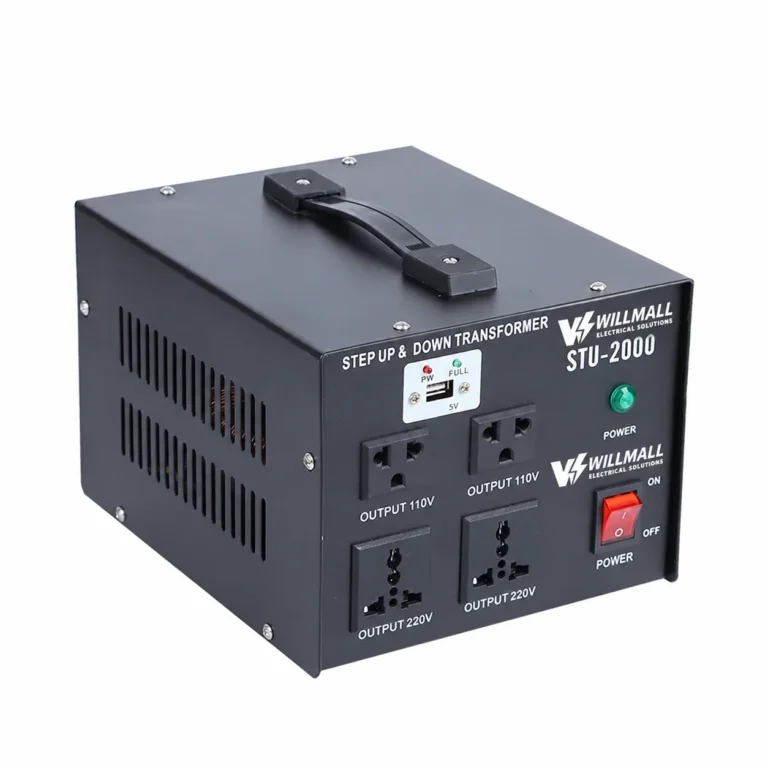
The VA rating on a transformer nameplate is the maximum apparent power the unit can deliver continuously at the rated voltage and ambient. Wilmall ST series units are rated for 80% continuous load — running them at 100% for long periods is possible but shortens life. The nameplate also shows the input and output voltages, the frequency range and the insulation class, which together tell you exactly what the unit can do.
When you compare two transformers of the same price, compare VA ratings honestly. A unit rated 2000VA with a documented test report is a different product from a 2000VA claim on a sticker. Batch test records settle the question.
How we size transformers at Wilmall
When you send us an enquiry, we ask for the appliance list, the country and the quantity, then we size each unit: watts from the label, power factor from the load type, surge from the motor, and 25-30% margin on top. The result is confirmed in writing with the model, the VA and the price. That process is why our recommendations fit on the first try.
If you already have a specification from another supplier, send it over — we will quote to match or improve it. A written spec sheet is the fastest way to an accurate order.
Power factor correction in modern devices
Most new electronics include power factor correction, which pulls the power factor back close to 1.0. A gaming power supply with PFC draws nearly real watts, so a 750W supply needs only about 800VA. Older devices without PFC, and small motors, keep the old behaviour. The trend is helpful: modern loads are easier on transformers than the same watts were twenty years ago.
But the correction only helps electronics. Motors and compressors still run at 0.6-0.8 power factor, so the VA gap still applies to the appliances that matter most in this market. Do not let the PFC trend talk you out of sizing for surge and power factor on motor loads.
The short version
Watts is the work, VA is the total the transformer supplies, and power factor is the bridge between them. Size by VA, use 0.8 as the power factor guess for mixed loads, and always add surge margin. Send us your appliance list and we will confirm the VA sizes in one message.

VA rating and the transformer nameplate
The VA rating on a transformer nameplate is the maximum apparent power the unit can deliver continuously at the rated voltage and ambient. Wilmall ST series units are rated for 80% continuous load, and the nameplate also shows the input and output voltages, the frequency range and the insulation class. When you compare two transformers of the same price, the VA rating with a documented test report is the honest comparison.
How we size transformers at Wilmall
When you send us an enquiry, we ask for the appliance list, the country and the quantity, then we size each unit: watts from the label, power factor from the load type, surge from the motor, and 25-30% margin on top. The result is confirmed in writing with the model, the VA and the price. That process is why our recommendations fit on the first try, and why the batch test record ships with every unit.
Frequently asked questions
VA vs Watts: The Power Factor Question
The difference between VA and watts comes down to power factor, and it matters for motor and transformer loads. For a purely resistive load, a heater or an incandescent lamp, watts and VA are equal because the current and voltage are in phase. For an inductive load, a motor, a compressor, or a transformer, the current lags the voltage, so the VA is higher than the watts for the same real power. That is why a transformer is rated in VA, not watts: the VA rating reflects the current the windings must carry, including the reactive component. When you size a transformer for a motor load, use the VA figure from the nameplate if available, or treat watts as roughly equal to VA and add extra margin for the power factor. Our datasheets list both figures, and our engineers confirm the correct VA for your load.
Reading a Transformer Label: VA and Watts Side by Side
The transformer label states the VA rating, and many buyers wonder why it is not labelled in watts. The answer is that VA is the honest rating for a magnetic device, because the windings carry current that includes the reactive component. When you read a label, treat the VA as the ceiling for the load, and apply the 80 percent rule for continuous use. A 2000VA transformer comfortably runs 1600W of continuous load. Our labels state the VA, the input and output voltages, the frequency range, and the batch number, so you have everything to size and identify the unit. If a supplier labels a transformer only in watts, ask for the VA rating, because the watts figure alone does not tell you the current the windings can carry.
What is the difference between VA and watts?
Watts is the real power an appliance uses. VA is the total power the transformer must supply, including reactive power. Watts = VA x power factor, and the power factor is lower for motors and electronics.
Should I size a transformer by VA or watts?
Size by VA. If the label only shows watts, divide by the power factor (0.8 is a safe guess) and add surge margin. A 1000W motor needs about 1500VA or more.
Why is VA the same as watts for a heater?
A heater is a pure resistive load with a power factor of about 1.0, so watts and VA are nearly equal. Motors and electronics have lower power factors, so their VA is higher than their watts.
Does the start-up surge affect the VA I need?
Yes. Motors surge to 2-6x their running load at start. The transformer must cover the surge with margin, not just the running watts.
How do I find the VA of my appliance?
If the label shows amps, multiply by the voltage. If it shows watts only, divide by 0.8 and add surge margin. Send us a photo of the label and we will size it for you.
Related reading
- How to Calculate Transformer VA Rating
- Transformer Sizing Calculator
- Step Up and Down Transformer Products
Get a factory-direct quote
Email sales@wilmall.com or WhatsApp +86 197 3022 6757 with your appliance list and we will confirm the right VA sizes. MOQ 10 pcs.