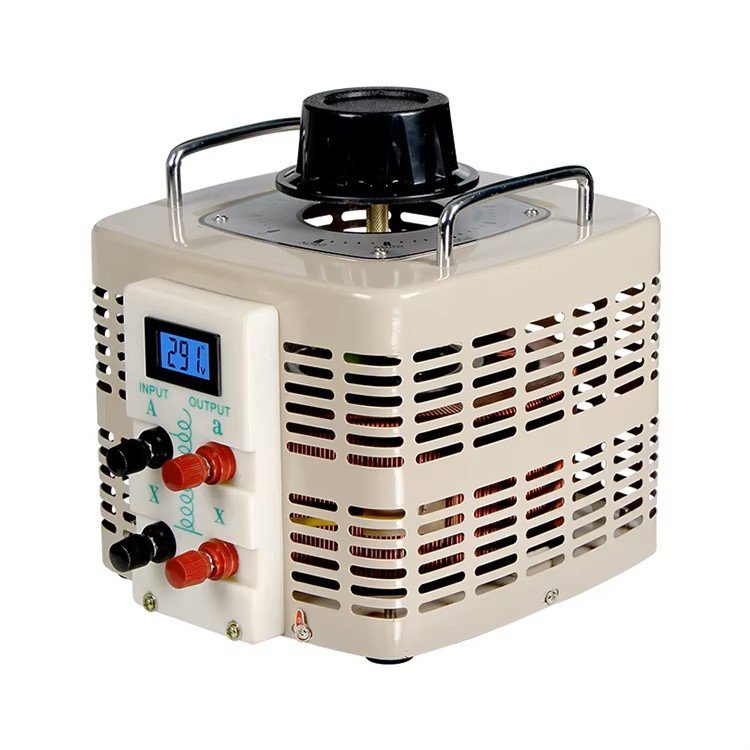
Variac vs Voltage Stabilizer: What Is the Difference?
Quick answer: a variac (variable transformer) adjusts voltage manually with a dial; a voltage stabilizer regulates voltage automatically to keep a steady output. They solve different problems: a variac is a test and control tool, a stabilizer is protection for sensitive equipment. Buying the wrong one wastes money and fixes nothing.
Key Takeaways
- A variac adjusts voltage manually; a stabilizer regulates it automatically.
- Variacs are for testing and control; stabilizers are for protection.
- A variac cannot replace a stabilizer on fluctuating mains.
- Buy the tool that matches your job.
Which Tool for Which Job
| Device | Job |
| Variac | Manual dial-in voltage |
| Stabilizer | Automatic steady output |
One Adjusts, One Regulates — That’s the Whole Difference
The confusion is understandable — both are boxes with voltage in their name. But the job is different:
- Variac (variable transformer): you turn a dial, the output changes from 0 to 260V, and it stays wherever you set it. You control the voltage.
- Voltage stabilizer: you plug it in and forget it. It watches the mains, and when voltage fluctuates, it corrects it automatically to a stable output. It controls the voltage.
Variac vs Stabilizer: Side by Side
| Feature | Variac | Voltage Stabilizer |
| How output changes | Manual dial, 0–260V | Automatic, holds rated output |
| Purpose | Testing, calibration, control | Protection from fluctuating mains |
| Responds to mains fluctuation? | No | Yes |
| Typical user | Labs, repair benches, universities | Homes, shops, sensitive electronics |
| Makes sense for | Dial-in voltage on demand | Stable supply for valuable gear |
What a Variac Is Actually For
We sell a lot of variable transformers, and the buyers are remarkably consistent:
- Equipment testing: ramp voltage up gradually and watch when a device fails.
- Repair benches: simulate undervoltage and overvoltage to reproduce faults.
- Universities: demonstrate AC voltage control safely.
- Light manufacturing: dial down voltage for heaters and lamps.
None of these need automatic regulation — they need manual control.
When You Need a Stabilizer Instead
- Your mains voltage swings (common in areas with weak grids or heavy appliance use).
- You have sensitive gear: medical equipment, servers, high-end electronics.
- You want protection, not control — plug-and-forget.
A stabilizer will keep output steady when the grid is unreliable. A variac will not — it holds whatever you set, and if the mains drops, the output drops with it.
Can a Variac Replace a Stabilizer?
No. This is the question we get most, and the honest answer is that they are different tools. If you set a variac to 220V and the mains sags to 190V, your output sags too. You would be standing there turning the dial all day. For fluctuating supply, buy a stabilizer — or tell us your situation and we will recommend the right gear instead of selling you the wrong one.
The Duty Cycle: How Long Can a Variac Run?
One specification buyers overlook is duty cycle. A bench variac used for occasional testing can run at light load for hours, but a variac feeding a continuous production process needs to be sized for sustained duty. Most of our variable transformers are rated for continuous operation at full rated current when used with an adequate load, and the carbon brush and winding are built to handle it. The thing that limits duty is heat. A variac pushed beyond its rating, or one with a worn carbon brush, will overheat and damage the winding. If your application runs 8 or 24 hours a day, tell us the real duty cycle and we will size accordingly, sometimes going one rating up so the unit runs cooler and the brush lasts longer. For intermittent testing work, a standard unit is perfectly fine.
Carbon Brush Wear and Maintenance
Unlike a fixed transformer, a variac has moving parts, and the most important one is the carbon brush that rides on the exposed winding. The brush wears over time, and a worn brush causes sparking, a rough feel when you turn the knob, and a slightly uneven output. Maintenance is simple: keep the winding surface clean, and replace the carbon brush when it shows significant wear. We supply spare brushes for our TDGC2 and TSGC2 series, and the replacement takes a few minutes with basic tools. For distributors and workshops, keeping a couple of spare brushes in stock avoids downtime. The winding itself, being copper on a silicon steel core, lasts for many years if the brush is maintained and the unit is not overloaded. It is a different maintenance profile from a sealed transformer, but a simple one.
Variac Accuracy: What Output Tolerance to Expect
Buyers sometimes expect a variac to hold a voltage exactly, but a variac is an adjustable autotransformer, not a regulated supply. The output follows the input and the load: if your mains is 220V, the output can be set anywhere from near zero up to roughly 260V on the high range, and the actual voltage you read depends on the line voltage at that moment and the current draw. Expect a tolerance of a few volts, not millivolts. If your application needs a rock-steady output regardless of mains fluctuation, you need a stabilizer after the variac or a stabilizer instead. Many workshops use a variac to set a nominal voltage and accept the small drift, which is fine for testing and for speed control of tools. If your test bench needs a precise, repeatable voltage, add a digital meter and calibrate the dial to the meter rather than trusting the printed scale.
Single-Phase vs Three-Phase Variacs
Most hobby and workshop applications use a single-phase variac, which adjusts one phase and is available from 500VA up to about 30KVA in our TDGC2 series. Three-phase needs are different: each phase is adjusted with its own variac, and the three units are mechanically linked so the knobs move together, which is our TSGC2 series. Three-phase variacs are used for motor speed control, three-phase equipment testing, and load testing in industrial settings. Sizing a three-phase variac means looking at the total kVA across all three phases, not just one. If you are testing a 5KVA three-phase machine, you need a TSGC2 rated for at least 5KVA, with headroom for the load characteristics. If you are unsure whether your application is single-phase or three-phase, send us the machine nameplate and we will point you to the right series.
Choosing Between a Variac and a Variable Frequency Drive
A common question from workshops is whether to use a variac or a VFD for speed control. The short answer: for universal motors, such as those in most handheld tools, a variac is simpler and cheaper. For three-phase induction motors, a VFD is the correct tool because it varies both voltage and frequency, while a variac only varies voltage and an induction motor will stall or overheat at low voltage. There is also a middle case: single-phase induction motors, like those in small fans and pumps, can run on a variac at reduced speed but lose torque, so test before committing. If your application is a test bench that needs to sweep a voltage range, a variac is ideal because the output is a clean sine wave. If your application is a production machine that must maintain torque at low speed, budget for a VFD. Send us the motor details and we will tell you which route fits.
Calibrating Your Variac Dial to a Multimeter
The printed scale on a variac dial is a rough guide, not a precision instrument. Over time, and with brush wear, the actual output at a given dial position drifts from the scale. If your work needs repeatable voltages, calibrate the dial to a multimeter: set the multimeter across the output, rotate the dial to a known point, and mark the actual reading on the face with a label. Check the calibration every few months, or whenever you replace the brush. For production and lab use, add a digital panel meter to the output so you read the true voltage at a glance instead of trusting the dial. This is standard practice in the test benches we supply, and it removes the biggest complaint we hear about variacs: that the output does not match the scale. The transformer is fine, the dial is just a guide, and a five-minute calibration fixes it.
Buying a Variac for Resale: What Stock to Carry
If you are stocking variacs for resale, the range that moves fastest is usually the 1KVA to 5KVA single-phase sizes, because they cover hobbyists, workshops, and light industrial testing. The 0.5KVA and 0.7KVA units sell to electronics hobbyists, while 10KVA and above go to industrial buyers who order less frequently but in larger quantities. Carry both the 0 to 130V and 0 to 260V output ranges if your market has both US-spec and general-spec equipment. The 2KVA and 3KVA sizes with digital meters are strong sellers because buyers trust the readout. For a first container, a mix of 1KVA, 2KVA, 3KVA and 5KVA covers most demand, and we can assemble a mixed order so your stock matches your market. We supply spare carbon brushes with each unit, which resellers can also sell as consumables.
FAQ
Is a variac the same as a voltage regulator?
Not really. A variac is manually adjustable; a regulator (stabilizer) is automatic. Different jobs.
Can I use a variac for my refrigerator?
It could step voltage, but it won’t stabilize it — and you’d have to adjust it manually. A stabilizer is the right tool.
What is a variac used for in a lab?
Testing and calibration: dial a precise voltage and hold it. That is its core job.
Do you make stabilizers too?
We focus on transformers. For a stabilizer need, tell us the load and we will point you to the right solution.
What variacs do you sell?
American-style units from 500VA to 3000VA with analog or digital meters. See the variable transformer range.
Still not sure which model fits?
Tell us your appliance, wattage and country — we reply within 24 hours with a straight recommendation.
Related Posts
- How to Choose a Variable Transformer (Variac): Capacity and Voltage Guide
- Voltage Converter vs Transformer: What is the Difference?
For stepless voltage control instead of regulation, see our variable transformer range.