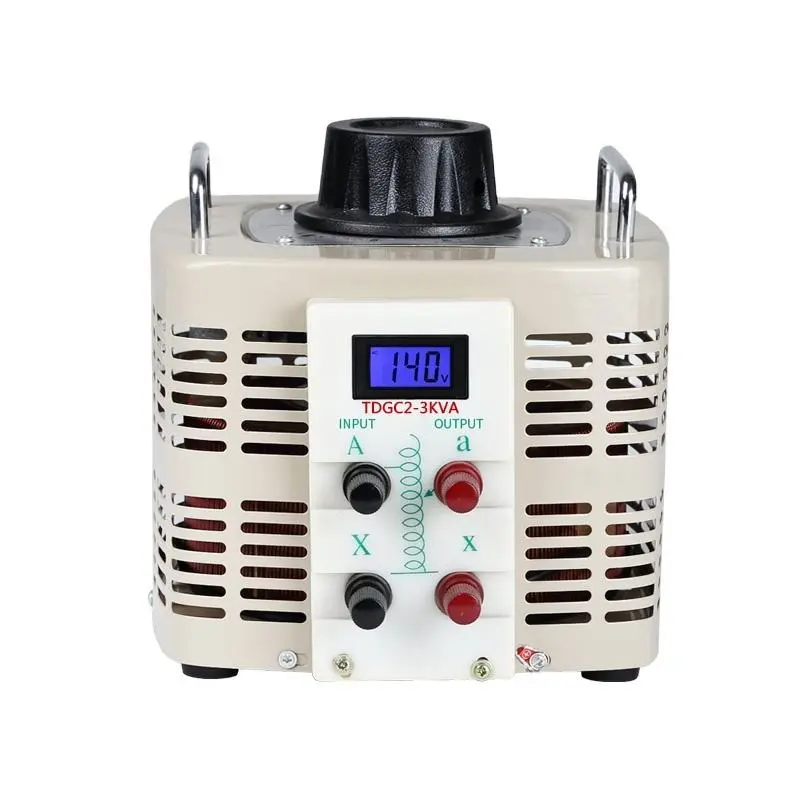
How to Choose a Variable Transformer (Variac)
Quick answer: to choose a variac, match three things — input voltage (110V or 220V), output range (0–260V or 0–130V), and capacity (500VA to 3000VA in our lineup) with headroom for your load. For continuous testing work, buy one size up — a variac running at 70% of rating stays cool and lasts.
Key Takeaways
- Match input voltage, output range and capacity.
- Continuous duty = use at 70-80% of rating.
- 0-260V from 220V input is the standard; 110V input on request.
- Analog dial is reliable; digital display is an option.
Quick Size Guide
| Variac | Safe load |
| 500VA | 400W |
| 1KVA | 700W |
| 3KVA | 2100W |
What Capacity Do You Need?
Variac loads are different from appliance loads — you often test devices at varying voltage, so think about the maximum load you will connect:
| Variac | Safe continuous load | Typical uses |
| 500VA | Up to 400W | Small test instruments, soldering irons, small lamps |
| 1KVA | Up to 700W | Benchtop testing, small motors, heaters |
| 2KVA | Up to 1400W | Repair benches, larger test setups |
| 3KVA | Up to 2100W | Production testing, workshops, universities |
If your load runs continuously at near maximum, size up. A 2KVA variac feeding a 1400W load all day runs warm; the 3KVA unit does the same job cool.
Voltage Range: 0–130V or 0–260V?
- 0–260V output (from 220V input): the standard choice — covers the full range for most testing.
- 0–130V output (from 110V input): for 110V mains countries and low-voltage testing.
Tell us your local mains voltage when ordering — 220V input is standard on our units, 110V on request.
Duty Cycle Matters
A variac’s rating assumes a duty cycle. Intermittent testing (turn it up, check, turn it down) lets you push closer to the limit. Continuous load at the rated maximum generates heat that shortens the brush and winding life. Rule of thumb: continuous duty = use at 70–80% of rating.
Analog or Digital Meter?
- Analog dial: reliable, no electronics to fail, classic look. Good for most bench work.
- Digital display: precise readout, easier to read exact voltage. Available as an option.
Both are offered on our variable transformers — tell us which you prefer.
Common Mistakes When Choosing a Variac
- Buying by appliance watts without headroom. Test loads vary; give yourself margin.
- Ignoring the input voltage. A 220V-input variac is useless on 110V mains.
- Using a variac as a stabilizer. They are different tools — see our variac vs stabilizer guide .
- Forgetting the brush. Variacs have a carbon brush that wears — a spare is cheap insurance.
The 2A Rule: Matching the Brush Current Rating
Every variac has a maximum current per amp per volt characteristic that is set by the carbon brush. In simple terms, the brush is rated for a certain current, usually 2A for our smaller TDGC2 units and more for larger ones, and that rating caps how much current the variac can pass regardless of the voltage setting. This is why a 2KVA variac at low output voltage cannot deliver the full 2KVA: at 50V output the current limit still applies, so the practical power is reduced. When you are choosing a variac for a specific load, check both the VA rating and the current rating, and make sure the current your load draws is within the brush rating. If you need a low-voltage, high-current output, a larger variac is required even though the apparent power looks small. Our datasheets list both figures, and our team can confirm the right model for your load curve.
Using a Variac for Motor Speed Control
One of the most common workshop uses for a variac is controlling the speed of AC motors, such as drill presses, lathes, and small grinders. Reducing the voltage with a variac reduces the motor speed and torque, which works well for fan-type loads and light machining. There is an important limit: universal motors, the ones with carbon brushes, respond well to voltage control, but induction motors can stall or overheat at very low voltage because they need enough voltage to maintain torque. For most workshop tools with universal motors, a variac is a simple and inexpensive speed control. For induction motors, consider a VFD instead, which changes frequency as well as voltage. If you tell us the motor type, the phase, and the load, we can recommend whether a variac or a VFD fits your application and which rating to buy.
Variac as a Dimmer for Lighting and Heaters
Beyond motors, a variac is a smooth dimmer for lighting and a power controller for heaters. Adjusting the voltage on an incandescent lamp changes its brightness smoothly from a soft glow to full output, and the same principle works for heat lamps, soldering irons, and small heating elements. For resistive loads the relationship is simple: halve the voltage and the power drops to a quarter, which gives fine control at the low end. This is the classic use in testing laboratories, where a variac ramps power up slowly to test how a device behaves under different supply voltages. Because a variac is purely resistive in its effect on the load, it produces a clean sine wave without the switching noise of a dimmer or a chopper, which matters for sensitive equipment and for audio work. If your load is a heater or a lamp, a variac gives you smooth, repeatable control.
Variac Safety: Earthing and Enclosure
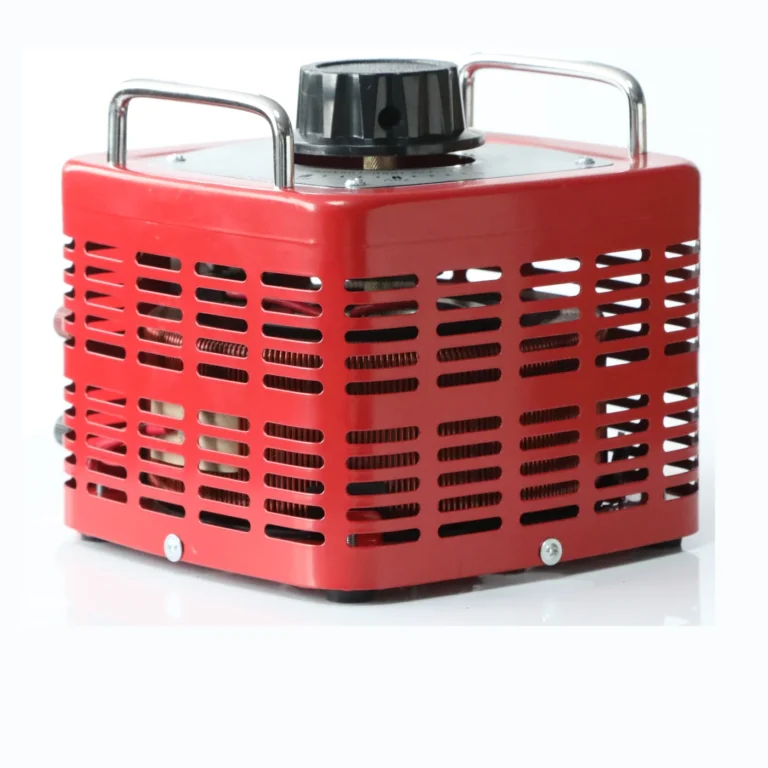
A variac is an autotransformer, which means the input and output share a common winding and there is no galvanic isolation between them. That has a safety consequence: the output is referenced to the same earth as the input, and a fault on the load side can energize parts of the winding. Always connect the earth terminal properly, use an earthed socket and plug, and never operate a variac with the cover removed or in a wet environment. For bench work, a fused input and an earth-leakage circuit breaker add protection. The exposed winding and brush are live parts, so a clear plastic cover over the top of the unit is not decoration, it is a guard. Our TDGC2 units come with a transparent cover and a clearly marked earth terminal. If you are reselling variacs, make sure the instruction sheet covers these points, because they prevent the two most common field incidents.
Reading a Variac Nameplate: Input, Output, and Current
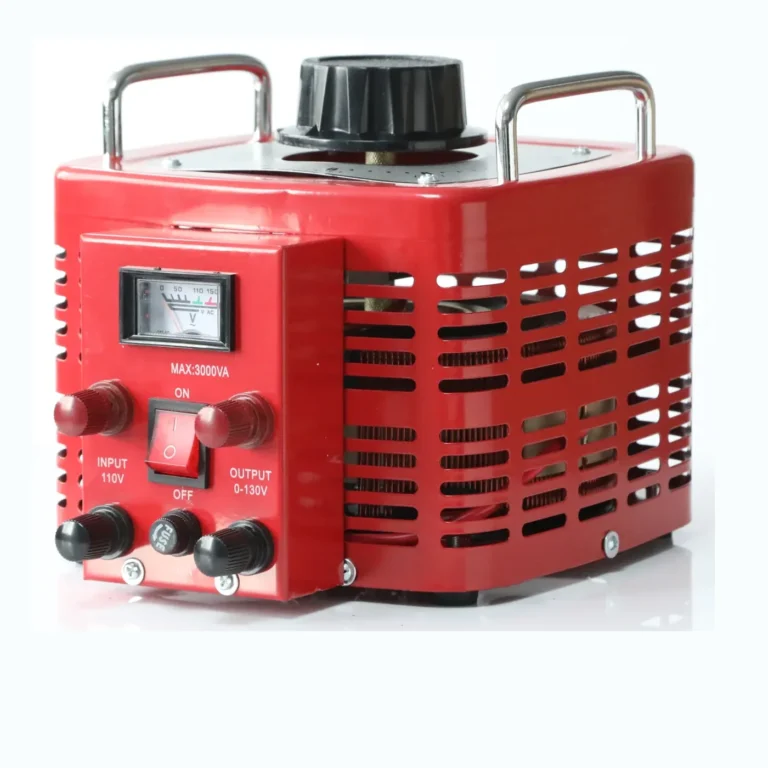
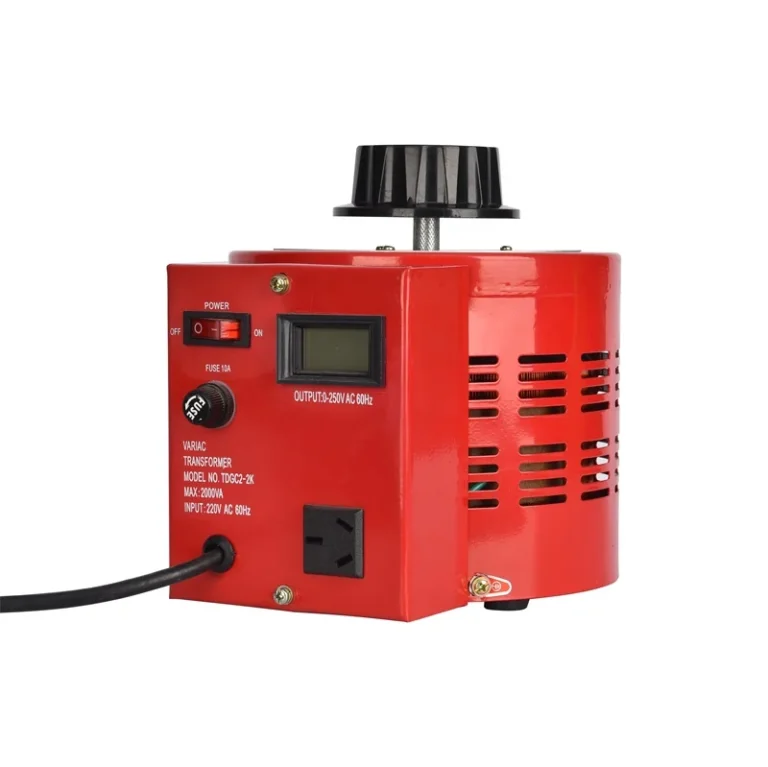
Before you buy a variac, read the nameplate like a checklist. The input voltage tells you what mains it expects, usually 110V or 220V, and the output range tells you what you can set, typically 0 to 130V or 0 to 260V. The VA rating gives the total apparent power, and the current rating is the maximum the carbon brush can pass, which matters more at low output voltages. A unit rated 2KVA at 0 to 260V, for example, can deliver its full 2KVA only near the top of the range; at low settings the current limit binds first. The duty cycle, if stated, tells you whether the unit is rated for continuous or intermittent operation. Our TDGC2 and TSGC2 nameplates list all of these, and the label also shows the model, batch number, and insulation class. If a listing does not show the current rating, ask for it, because that number decides whether the variac suits your load.
Storing and Handling Variacs for Distributors
Variacs are sturdier than they look, but a few handling rules keep them in good shape. Store them upright on a shelf, not piled on top of each other, because the exposed winding can be dented if another unit rests on it. Keep them in a dry environment, because the winding and brush are sensitive to moisture and dust. When you move a variac, carry it by the case or base, not by the knob, and protect the brush area with the original packing if it will sit in storage. For distributors, this matters because a unit with a slightly damaged winding or a contaminated brush surface becomes a warranty claim that should never have happened. We pack each variac with a protective cover over the brush and winding, and we recommend keeping that cover on during storage. A variac that is stored properly and maintained will serve its owner for many years.
FAQ
What is a variac used for?
Dial-in AC voltage for testing, calibration, repair and light manufacturing. It’s a control tool, not a stabilizer.
Can I run a motor on a variac?
Yes, for testing and speed control of small AC motors — but keep the load within the rated capacity.
Is a 3KVA variac enough for a workshop?
For most bench and repair work, yes. If you test heavy equipment continuously, consider higher capacity on request.
Do you make variacs with 110V input?
Yes — 110V input with 0–130V output is available on request.
Can I get OEM branding?
Yes, from 10 pcs. See the variable transformer range or contact us with your specs.
Still not sure which model fits?
Tell us your appliance, wattage and country — we reply within 24 hours with a straight recommendation.
Related Posts
- Variac vs Voltage Stabilizer: What's the Difference and Which Do You Need?
- Voltage Transformer Size Guide: 1000W to 10000W
Browse our variable transformer (Variac) range from 500VA to 30KVA if you are ready to pick a rating.