Step Down Transformer for Refrigerator and Freezer: Sizing Guide
A refrigerator or freezer is one of the most common reasons to buy a step-down transformer. These appliances run continuously and cycle on and off every few minutes, so they draw a high inrush current at every start. Choosing the wrong size transformer is the single most common cause of failed or unreliable installations. This article explains how to size, install and protect a step-down transformer for a refrigerator or freezer in any 220V country.
Why refrigerators and freezers need special attention
Refrigerators and freezers are not like heaters or lamps. They use a compressor motor that draws several times its running current at start-up. Even a small 300W fridge may pull 900-1200W for a fraction of a second each time the compressor kicks in. A transformer that can deliver the running wattage easily may still sag under that surge and cause the compressor to fail to start, or trip a breaker repeatedly.
This is why most failures of refrigerator transformers happen within the first hour of operation, not after months of use. The transformer itself is fine; it was simply undersized for the surge load.
What size transformer do you need?
| Appliance | Running wattage | Start-up surge | Recommended transformer |
|---|---|---|---|
| Mini fridge / bar fridge | 50-150W | 300-500W | 500VA |
| Standard fridge (single door) | 100-300W | 400-900W | 1000VA |
| Standard fridge-freezer (double door) | 300-600W | 900-1500W | 1500-2000VA |
| Large side-by-side fridge | 500-800W | 1500-2500W | 2000-3000VA |
| Chest freezer (small) | 100-200W | 400-700W | 1000VA |
| Chest freezer (large) | 200-500W | 700-1500W | 1500-2000VA |
| Wine cooler | 100-200W | 400-600W | 1000VA |
| Display fridge (commercial) | 500-1500W | 1500-4500W | 3000-5000VA |
The right way to size a transformer for your fridge
Three rules to follow when sizing for a refrigerator or freezer:
- Look at the surge, not the running wattage. A 300W fridge may need a 1500VA transformer because the start-up surge is around 900-1200W.
- Add 30% margin on top of the surge. If the surge is 1200W, choose a transformer rated 1500-2000VA so the start-up is comfortably within the rating.
- Never load a transformer to its nameplate rating for continuous duty. Running a transformer at 80% of its rating keeps it cool and extends its life.
Why transformer type matters
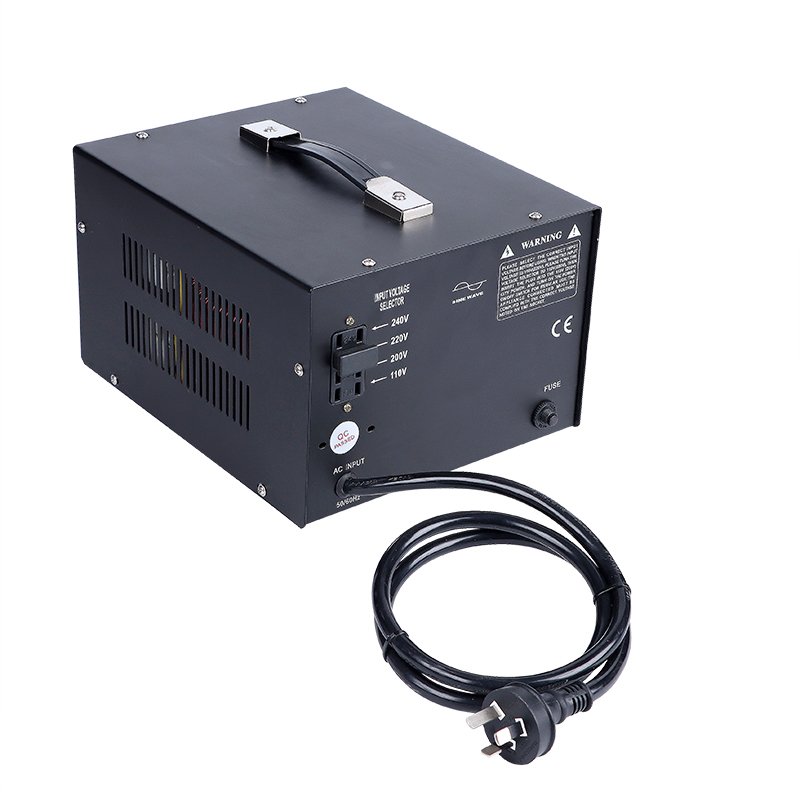
Choose an isolation-type step-down transformer (the ST series from Wilmall, for example) rather than an electronic converter. Electronic converters are usually rated for resistive loads only; many will not start a compressor motor, and some shut down on the surge. Copper-and-steel transformers handle continuous motor loads, surge and the voltage swings common on the grid and from generators.
An isolation transformer also gives you electrical separation between the mains and the appliance — a useful safety feature in humid or coastal climates where condensation can create leakage paths.
RCD and thermal protection
For any refrigerator or freezer, choose a transformer with built-in RCD (residual current device) protection. The RCD trips on leakage current and protects the user from shock in damp conditions. The Wilmall ST-2000 includes RCD protection as standard, along with thermal cut-out that disconnects the output if the transformer overheats.
Combined with a properly rated fuse on the primary side, RCD and thermal protection make the installation safe enough to leave running unattended.
Installation and ventilation
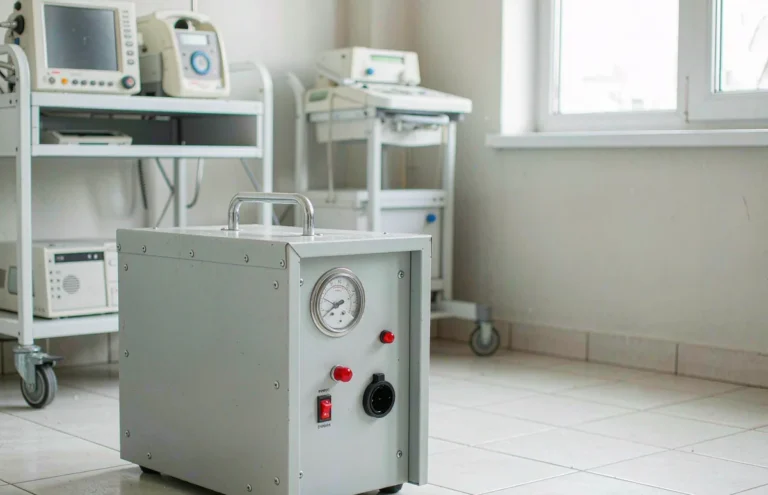
Refrigerators run 24 hours a day, so the transformer must too. Place it in a ventilated location, away from the compressor heat at the back of the fridge. Keep clearance around the case — at least 10 cm on every side — so air can circulate. Avoid mounting it inside a closed cabinet without airflow; this is the most common cause of transformer overheating in continuous-duty applications.

Generators and unstable supply
If your supply comes from a generator or a grid with frequent voltage swings, add 25-30% more VA on top of the normal sizing. Generator output varies with load and engine speed; a transformer with margin absorbs these variations without overheating. In Nigeria, Kenya, and many other markets with unstable supply, this is a common and necessary practice.
What about solar power?
If you are running the refrigerator from a solar inverter, the inverter itself is the voltage source and most modern inverters output pure sine wave at 220-240V. A step-down transformer connected to a solar inverter behaves the same way as one connected to the grid. Choose the size using the same rules.
How to confirm the running wattage of your fridge
The wattage is printed on the energy label, the back of the unit or in the manufacturer’s spec sheet. Look for “input wattage” or “rated power” — not the cooling capacity in watts or BTU. If the only number on the label is the cooling capacity (for example “200L”), check the model number online for the input wattage. As a rough rule, a 200-300L fridge draws 100-200W running, a 300-400L draws 200-400W, and a 500L+ draws 400-800W.
What about old fridges with high start-up surge
Older refrigerators (more than 10-15 years old) tend to have a higher compressor surge than modern units because the compressor motors are less efficient and the starting capacitors are weaker. For an old fridge in a 220V country, choose the next size up transformer to be safe. A 300W old fridge might pull 1500-2000W at start-up, putting it at the limit of a 1500VA transformer. Choose a 2000VA unit for margin.
Why transformer placement matters
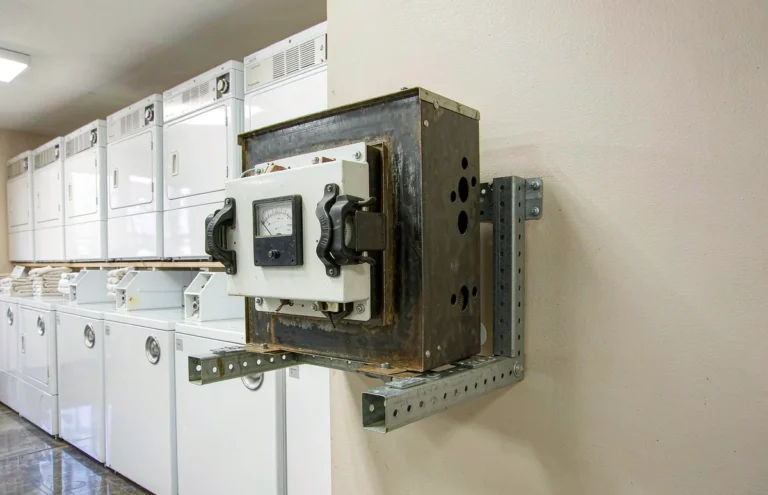
Where you put the transformer affects both safety and performance. Place it on a flat, dry surface at least 10 cm away from walls and the fridge itself. Avoid direct sunlight, which heats the case and reduces the transformer’s ability to dissipate heat. If the installation is in a kitchen or workshop, mount it on a metal bracket above the working surface where spills and dust are less likely to reach it.
Never put the transformer inside the fridge compartment or on top of the fridge where the compressor heat builds up. The combined heat from the fridge and the transformer in continuous duty can shorten the transformer’s life dramatically.
Two fridges on one transformer
If you want to run two fridges (or a fridge and a freezer) on the same transformer, add the running wattages and the surge wattages separately. Choose a transformer rated for the combined surge, with 25% margin. Two 300W fridges with 900W surges each may pull 1800W at simultaneous start, which is the sizing factor. Choose a 3000VA transformer to handle the simultaneous surge with margin.
For practical installations, it is usually better to run each fridge off its own transformer — the smaller units cost less, run cooler, and a fault on one does not stop the other.
Single-door versus double-door fridge-freezers
A double-door fridge-freezer (one fridge, one freezer below) draws more than a single-door unit. The combined compressor load and the frost-free heating element (if present) add 100-200W continuously. For a 400L double-door unit in a 220V country, a 2000VA transformer is the right starting point. For larger 500L+ side-by-side units, choose 3000VA.
Wine coolers and display fridges
Wine coolers and display fridges tend to be smaller and quieter than kitchen fridges, but they run 24 hours a day in warm ambient (restaurants, hotels, retail). Choose a 1000-1500VA transformer with good ventilation. Mount the transformer below the cooler or beside it, with at least 10 cm clearance on every side.
Why copper winding matters for refrigerators
Refrigerators run 24 hours a day, which is the most demanding duty cycle for a transformer. Copper winding conducts better than aluminium, runs cooler, and lasts longer under continuous load. A copper-wound transformer rated 2000VA will deliver its nameplate output continuously for years. An aluminium-wound unit at the same rating runs hotter and ages faster.
Ask for the winding material before you buy. Wilmall builds ST series transformers with copper winding only — that is one reason our units ship to Saudi Arabia, UAE, Nigeria and similar markets at scale.
What to do if the transformer trips thermal protection
If your transformer trips thermal protection after running for an hour or two, two things are likely. First, it is undersized for the load. Add up the running wattage of the fridge and any other loads on the transformer; if the total is close to or above the transformer rating, move up a size. Second, the ventilation is inadequate. Check that air can circulate around the case and the ambient temperature is below 35°C.
If both sizing and ventilation are correct, the transformer itself may be faulty — return it to the supplier under warranty. Wilmall’s 12-month warranty covers manufacturing defects.
Common mistakes to avoid
- Sizing to the nameplate only. The compressor surge is much higher than the running wattage.
- Using an electronic converter. Most cannot start a compressor motor.
- Loading the transformer to its rating. Continuous duty requires 80% or less of the nameplate rating.
- Enclosing the transformer in a sealed box. Heat builds up, insulation ages, life shortens.
- Skipping RCD protection. Refrigerators run in humid kitchens — protection matters.
Buying the right transformer
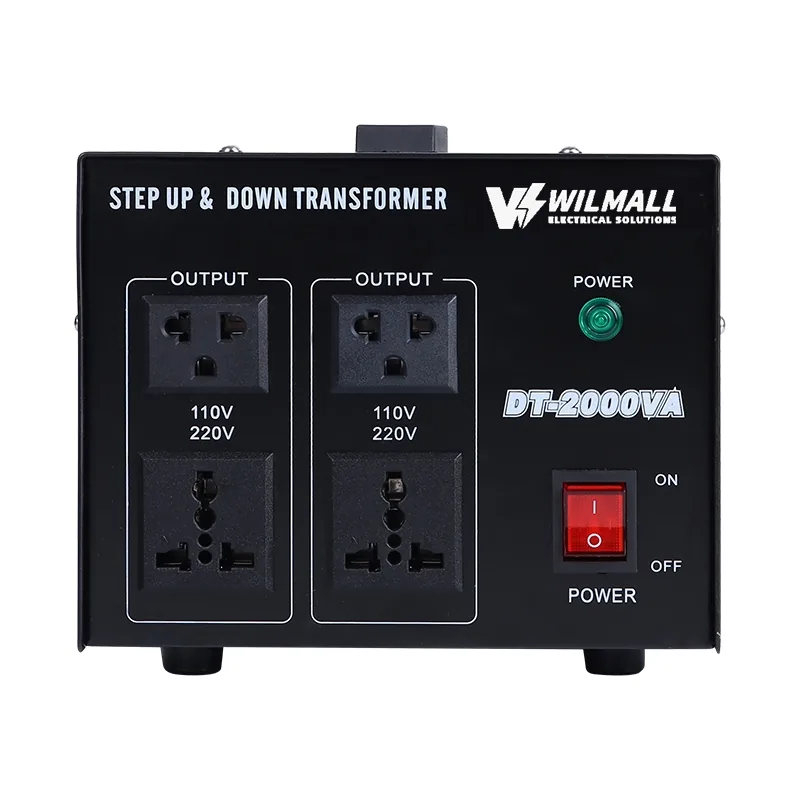
For most household refrigerators and freezers, a 1500-2000VA step-down transformer is the safe starting point. The Wilmall ST-2000 is rated for continuous duty at 2000VA and includes RCD protection; it covers a standard fridge-freezer with margin. For larger side-by-side units or commercial display fridges, move up to 3000VA or 5000VA.
Email sales@wilmall.com or WhatsApp +86 197 3022 6757 with your fridge model and running wattage for a specific recommendation. MOQ 10 pcs per model, factory direct from Yueqing, China.
Frequently asked questions
What size step down transformer do I need for a refrigerator?
Most standard fridge-freezers need a 1500-2000VA transformer because the compressor surge can be 3-4 times the running wattage. A 300W running fridge may pull 900-1200W at start-up.
Can I use an electronic converter for a refrigerator?
Most electronic converters cannot start compressor motors. A copper-and-steel step-down transformer is the dependable choice for refrigerators and freezers.
Why does a refrigerator transformer need RCD protection?
Refrigerators run in humid kitchens and coastal climates. RCD protection trips on leakage current and protects the user from shock in damp conditions.
Can a step down transformer run 24 hours a day?
Yes, if sized with at least 25-30% margin and installed in a ventilated location. Avoid enclosing it in a sealed cabinet without airflow.
Where can I buy a step down transformer for a refrigerator?
Wilmall supplies ST-series step-down transformers from MOQ 10 pcs, factory direct from China, with CE / RoHS documents and 12-month warranty.
Related reading
- What Size Transformer Do I Need for an Air Conditioner?
- Transformer Sizing Calculator: Find the Right VA
- Step Up and Down Transformer Products
Get a factory-direct quote
Email sales@wilmall.com or WhatsApp +86 197 3022 6757 with your appliance list and target market. We reply within 24 hours.