How to Size a Transformer for a Washing Machine
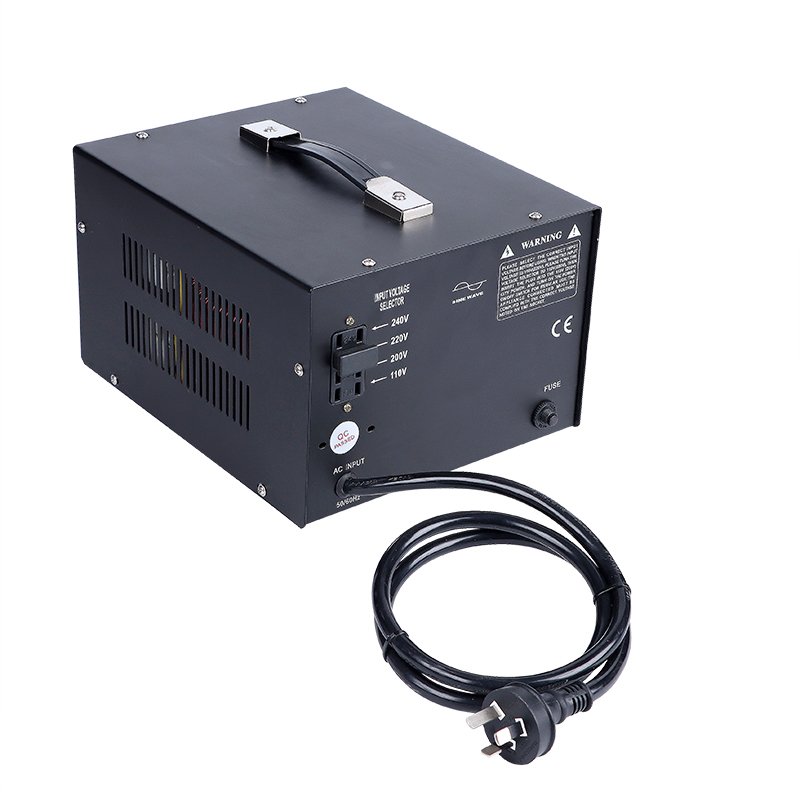
A washing machine is a high-surge motor load, and choosing the wrong transformer is the most common reason for tripped breakers or burnt windings. This guide explains how to size a step-down transformer for any washing machine in a 220V country, whether top-load, front-load, semi-automatic or commercial.

Why washing machines need a special transformer
A washing machine combines a main drive motor, a water pump motor and a control board. The drive motor in particular draws a high surge current at start-up and during the spin cycle. Even a small 350W washing machine may pull 1500-2500W for the first second of spin. A transformer that can deliver 350W continuously will trip under that surge.
The same logic applies to dryers, washer-dryers and commercial laundry equipment. They all use one or more motor-driven subsystems that surge heavily.
What size transformer do you need?
| Appliance | Running wattage | Spin / start surge | Recommended transformer |
|---|---|---|---|
| Mini / portable washing machine | 150-300W | 600-900W | 1000VA |
| Top-load washing machine (5-7 kg) | 300-500W | 900-1500W | 1500-2000VA |
| Front-load washing machine (7-9 kg) | 400-800W | 1200-2500W | 2000-3000VA |
| Washer-dryer combo | 1000-2500W | 3000-5000W | 5000VA |
| Commercial washing machine (10-20 kg) | 1500-3500W | 4500-10000W | 5-10KVA |
| Tumble dryer (electric) | 2000-4500W | 2000-4500W (resistive, but high) | 5-10KVA |
The 3-step sizing method
- Add up the running wattage of the motor and the heating element (for washer-dryers and electric dryers).
- Identify the highest surge — typically the spin cycle start. Multiply the motor wattage by 3-5x.
- Choose the next standard size above your highest surge, with 25% margin for continuous operation.
Worked example: a front-load washer draws 500W running, with a 2000W surge at spin start. Choose a 3000VA transformer (2000W x 1.25 = 2500W → 3000VA). The Wilmall STU-3000 is the right size.
Front-load vs top-load vs semi-automatic
The three washing machine types differ in surge behaviour:
- Top-load — moderate surge at motor start, no spin surge as high as front-load.
- Front-load — high spin surge when the drum accelerates to 1200-1400 RPM. This is the highest surge moment in the cycle.
- Semi-automatic — separate spin tub, surge happens when the spin starts. Two surges in the cycle.
All three need the same sizing rule: transformer’s continuous rating must cover the running wattage AND the highest surge with margin.
Washer-dryer combos are different
A washer-dryer combo adds a heating element that draws 1500-2500W continuously during the dry cycle. The transformer must carry this heating load as continuous duty, not just surge duty. For most 7-9 kg washer-dryers, a 5000VA (5KVA) transformer is the safe choice. Smaller transformers will overheat during the dry cycle.

Running a washing machine from a generator
Generator power adds another layer of complexity. Generator output varies with load; when the washing machine spins, the generator sags slightly, which makes the transformer work harder to maintain output. Choose a transformer with at least 30% margin over the surge rating if you are running the washer from a generator.
For off-grid or weak-grid markets (parts of Nigeria, rural Kenya, Myanmar, Cambodia), a step-up transformer can also help by boosting voltage to the washing machine’s required level.
The exact surge numbers for popular models
Different brands and models vary, but typical start-up surges are:
- LG top-load (5-7 kg) — 900-1100W surge, choose 1500VA.
- Samsung front-load (7-9 kg) — 1500-2000W surge, choose 2500-3000VA.
- Whirlpool washer-dryer combo — 3500-5000W continuous during dry cycle, choose 5000VA.
- Bosch / Miele front-load — 1200-1800W surge, choose 2500VA.
- Semi-automatic twin tub — two surges (wash and spin), each 600-1000W, choose 2000VA.
When in doubt, measure the running wattage with a plug-in wattmeter and assume the surge is 3-5x the running wattage for a few seconds.
Why an undersized transformer overheats with a washer
A washing machine runs in cycles, often for 1.5-2 hours per load. If the transformer is undersized, it overheats over the cycle and trips thermal protection — usually mid-cycle, leaving wet laundry sitting in water. Repeated trips also age the transformer faster because each thermal cycle stresses the insulation.
Choosing a transformer with at least 30% margin over the peak surge avoids the trip-and-restart pattern and extends the life of both transformer and washing machine.
Wiring and outlet considerations
A washing machine draws significant current, so the cable from the transformer to the machine must be sized correctly. For a 2000VA transformer at 110V, the secondary current is around 18A. Use 12 AWG (2.5 mm²) cable for runs up to 5 metres, and 10 AWG (4 mm²) for longer runs. On the primary 220V side, the current is around 9A, so 14 AWG (1.5 mm²) cable is adequate.
Use a grounded outlet (3-pin) on both sides of the transformer. Wilmall ST and STU units come with appropriate sockets for the destination country.
Sound, weight and mounting
A 2000-3000VA transformer weighs 10-20 kg. Place it on a stable surface that can carry the weight. The transformer hums slightly under load — normal for an EI-core transformer. If the hum is loud or unusual, the unit may be overloaded or have a loose mounting bolt.
For laundry room installations, a transformer on a wooden shelf above the washer is a common and safe arrangement. Avoid placing it on the floor where water may splash.
When to upgrade to a larger transformer
If your laundry needs grow — adding a dryer, a second washer, or moving to a larger capacity unit — upgrade the transformer accordingly. Running two large appliances on a 2000VA transformer is a recipe for trips and accelerated aging. The upgrade cost is small compared with the replacement cost of an under-sized transformer that fails prematurely.
Why copper winding matters
A washing machine draws near-rated current for the entire cycle. Copper winding conducts better than aluminium, runs cooler, and lasts longer under continuous load. For a washing machine installation that runs daily, copper winding is the right choice. Wilmall builds STU series transformers with copper winding only.
Buying the right transformer
For a single top-load washer, the ST-2000 (2000VA) or STU-3000 (3000VA) is the typical choice. For a front-load washer, the STU-3000 (3000VA). For a washer-dryer combo, the STU-5000 (5000VA). All units are factory direct from Yueqing, China, with MOQ 10 pcs per model and 15-25 day lead time.
Email sales@wilmall.com or WhatsApp +86 197 3022 6757 with your washer model and capacity for a specific recommendation.
Why isolation transformers are better than electronic converters
Most electronic converters cannot start the motor in a washing machine; they are designed for resistive loads only. Copper-and-steel transformers handle the surge, the continuous heating load and the generator swings without complaint. Choose an isolation transformer (ST / STU series) for any motor-driven appliance.
Common mistakes to avoid
- Sizing to running wattage. The spin surge is the killer.
- Choosing an electronic converter. It will trip or shut down at start-up.
- Running two washing machines off one transformer. The combined surge is too high; either buy one big unit or two separate transformers.
- Ignoring the dry cycle. Washer-dryers heat continuously, not just at surge.
- Forgetting ventilation. A sealed cabinet kills a transformer running continuous duty.
Recommended transformers from Wilmall
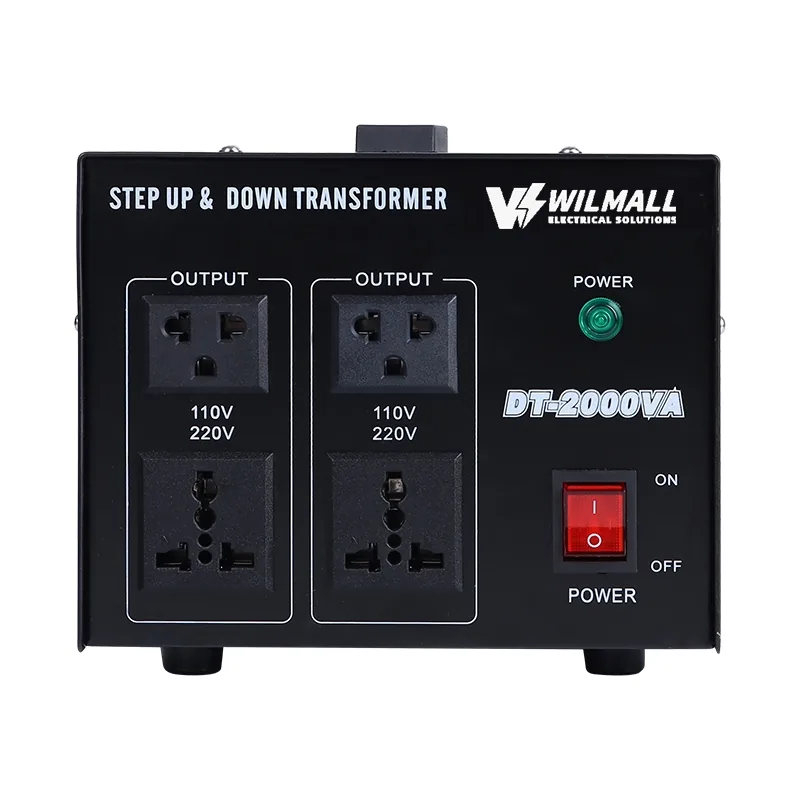
For top-load and small front-load washers, the ST-2000 (2000VA) is the typical size. For larger front-load and washer-dryers, step up to STU-3000 (3000VA) or STU-5000 (5000VA). All Wilmall step-down and step-up transformers use copper winding, separate primary and secondary, full RCD protection and are tested at full load before packing.
Email sales@wilmall.com or WhatsApp +86 197 3022 6757 with your washer model and capacity for a specific recommendation. MOQ 10 pcs, factory direct, 15-25 day lead time.
How to measure your washing machine’s real surge
If you want an accurate surge reading rather than a rule-of-thumb estimate, use a plug-in wattmeter with peak-hold function. Run a normal wash cycle and let the meter record the highest current draw. The peak reading is the surge you must size for, not the average reading.
A cheap plug-in wattmeter (around USD 15-20) is a worthwhile investment for any importer or installer who sizes transformers regularly. It pays for itself in one correct sizing.
Frequently asked questions
Washing Machine Sizing: The Motor and Heater Combo
A washing machine is one of the more demanding appliances to size, because it combines a motor and a heater. The motor drives the drum and spikes at start-up, and the heating element for the wash water can draw a large current during the heating cycle. A typical US-spec washing machine draws 500W to 800W running, but the combination of the motor start and the heater can push the instantaneous load much higher. The practical sizing is 2000VA to 3000VA for a standard machine, and larger for machines with a big heater or a heavy spin cycle. The transformer must handle the load without sagging, because a sag during the spin cycle can leave clothes wet and stress the motor. If you send us the washing machine model or its nameplate rating, we will confirm the exact transformer size for your machine.
What size step down transformer do I need for a washing machine?
For a top-load washer, 1500-2000VA is typical. For a front-load washer, 2000-3000VA. For a washer-dryer combo, 5000VA. The spin cycle surge is the sizing factor.
Why does a front-load washer need a bigger transformer?
Front-load washers spin the drum to 1200-1400 RPM, drawing a surge of 2-3 kW for a second at the start of the spin cycle. Top-load washers surge less.
Can I use an electronic converter for a washing machine?
No. Most electronic converters cannot start motor loads. Use a copper-and-steel step-down transformer.
What size transformer do I need for a washer-dryer combo?
A 5000VA (5KVA) transformer is the typical size for a 7-9 kg washer-dryer combo because the heating element draws 1500-2500W continuously during the dry cycle.
Can I run a washing machine from a generator with a transformer?
Yes, but choose a transformer with at least 30% margin over the spin surge rating, because generator output sags when the motor starts.
Related reading
- Transformer Sizing Calculator
- Step Down Transformer for Refrigerator and Freezer
- Step Up and Down Transformer Products
Get a factory-direct quote
Email sales@wilmall.com or WhatsApp +86 197 3022 6757 with your appliance list. We reply within 24 hours.