Step Down Transformer for Hospitals: 220V to 110V Guide
A hospital running on 220V mains with a ward full of 110V imported machines is not the same problem as a house with a foreign coffee maker. Nobody cares if the coffee maker sits idle for a week. Patient monitors, infusion pumps, a blood gas analyser, a centrifuge in the lab, an autoclave in the sterile services room, an ultrasound cart doing rounds. Those tend to be running at the exact moment somebody is depending on them. That single fact changes how you size the box that creates the 110V supply, and it is the reason hospital enquiries get a longer conversation at our factory than most others do.
I work at a transformer factory in Yueqing, China. Hospital and clinic projects land on my desk most months. Sometimes it is one unit for a private hospital fitting out a new ward. Sometimes it is twenty units against a government tender with a fixed delivery date. The questions that come with them are almost always the same handful, so let me answer them here the way I would answer over WhatsApp, without the sales brochure voice.
Why a Hospital Is a Harder Load Than Almost Any Other Building
The short answer is that a hospital never really gets a quiet hour. A monitor on a trolley might stay plugged in for three weeks without being switched off. An autoclave runs a heating cycle every thirty or forty minutes from six in the morning until the last theatre list finishes. A laboratory analyser is warm from the moment the first technician arrives. Heat builds up in the winding and never gets a proper chance to leave, and that is why we wind hospital units with copper and use a core that is generous for the number printed on the label.
Then there is the sensitivity side, which is where most of the arguments start. Modern medical electronics will usually tolerate a supply within roughly ten percent of nominal, and a few instruments in a laboratory want better than that. That sounds comfortable until you remember how a transformer actually behaves. With no load attached, the output sits a little above the nameplate figure. As you load it up, the output sags. If you buy a unit that is barely big enough, the voltage will dip every time a centrifuge spins up or a compressor starts, and you will spend the following month trying to work out whether the machine or the transformer is to blame. Give yourself headroom and the voltage barely moves.
One point I want to be straight about, because it catches people out on every project. A transformer changes voltage. It does not change frequency. If your building supplies 220V at 50Hz and the equipment was built for 110V at 60Hz, you will get a clean 110V at 50 cycles. Anything purely electronic, which covers most modern diagnostic kit, will not care at all. Anything built around an induction motor or a pump tuned for 60Hz will run about seventeen percent slower and can run a little warmer. That is physics, not a fault in the unit, and it is worth knowing before you place an order for forty of them.
Which Imported Hospital Equipment Usually Needs a Step Down Transformer
When a hospital sends me its equipment list, I go through it line by line and sort everything into “needs one” and “does not”. Here is what normally lands on the yes side.
- Patient monitors and central stations, typically 50W to 300W per bed position, and they stay powered around the clock.
- Infusion and syringe pumps, usually 20W to 100W each. Small on their own, but a ward can easily have thirty of them.
- Ultrasound carts and probe holders, roughly 200W to 800W depending on the system and how many probes are active at once.
- Laboratory analysers, haematology and biochemistry units, from 300W on a bench-top model up past 1500W on a floor-standing one.
- Centrifuges and blood bank equipment, 300W to 2000W, with a clear motor inrush on start and a long spin cycle.
- Autoclaves and instrument sterilisers, often 1000W to 3000W while heating, and they draw that for a solid stretch of time.
- Washer-disinfectors in sterile services, where the heating element alone can pull several kilowatts.
- Dental, ENT and outpatient chairs, 300W to 900W, with motor inrush every time the chair lifts.
- Operating tables, surgical lights and camera towers, 200W to 1000W per theatre, mostly steady load.
- Physiotherapy and rehabilitation kit, shortwave, ultrasound therapy and traction units, usually 100W to 500W.
What does not need us, and I say this often enough that it belongs in writing: laptops, phone chargers, most desk monitors, and a growing pile of medical electronics that carry a 100-240V, 50/60Hz rating on the back panel. If the label says that, the device is already happy on your 220V wall socket, and a transformer only adds a box and a cable for somebody to trip over. Check the nameplates before you build a load sheet, because counting those items can push a hospital into a much bigger and more expensive unit than the job actually requires.
How to Size a Step Down Transformer by Department
Here is the method I use, and you can run it on the back of an envelope. Take one department at a time. Add up the equipment that could plausibly be running at the same moment inside that department, then add 25 to 30 percent headroom. Never size a hospital unit off the total connected load of the building. A hospital’s nameplate total is enormous, but the realistic simultaneous figure for any one ward is a fraction of it, and sizing off the nameplate total is how buyers end up paying for a unit three times bigger than they need.
Simultaneity is what decides the size. Total inventory does not. The intensive care unit at three in the morning looks nothing like the same unit at eight o’clock handover, and the sterile services room is quiet for forty minutes and then pulls its full heating load for the next twenty. Write the duty pattern down next to each line on your list, because it matters as much as the wattage.
A Worked Example: A Four-Bed Intensive Care Cluster
Four bed positions, each with a monitor and a pair of infusion pumps: monitors 4 x 120W is 480W, pumps 8 x 40W is 320W. Two ventilators at 250W each adds 500W. One blood warmer at 300W. Two suction units at 250W each adds 500W. Realistic worst case is everything except one suction unit drawing at the same time: 480 + 320 + 500 + 300 + 250 = 1850W. Add 30 percent and you land near 2400VA, so a 3000VA bidirectional unit covers that cluster with room to spare, and the suction motor starting does not pull the monitors down with it.
Now compare that with a sterile services room holding a single 2400W washer-disinfector that runs on its own dedicated circuit. That one wants a unit sized for the washer alone plus headroom, and it should not be sharing a socket strip with anything else. Same building, same voltage, two completely different sizing conversations.
| Department | Typical simultaneous load | Suggested unit rating | Why this size |
|---|---|---|---|
| ICU bed cluster, 4 beds | 1700 – 2200 W | 3000 VA bidirectional | Motor inrush from suction and ventilators, plus round-the-clock duty |
| General ward, monitor and pump bank | 600 – 1200 W | 2000 VA with RCD | Many small loads running continuously, no large inrush |
| Laboratory bench and centrifuge room | 1200 – 2000 W | 2000 – 3000 VA | Centrifuge motor start is the deciding number |
| Sterile services and autoclave bay | 2000 – 3500 W | 3000 – 5000 VA | Resistive heating load held for long periods |
| Imaging and ultrasound room | 800 – 1800 W | 2000 VA with RCD | Stable output matters more than raw capacity |
| Nurse station and records room | 300 – 800 W | 1000 VA bidirectional | Small mixed load, occasional direction change |
| Biomedical workshop | 500 – 2000 W variable | Variac 1KVA to 3KVA | Needs adjustable output for instrument verification |
When 30 Percent Is Not Enough
There are cases where I push buyers well past the 30 percent rule, and they come up again and again. Any room with a washer-disinfector or an autoclave plus a second heating load on the same unit is one of them, because two resistive elements at once is not an average, it is a step change. A laboratory with two or more centrifuges is another, since eventually two technicians will start them together without coordinating. And any department where a motor drives a compressor needs watching, because the starting current on that motor can sit between 2.5 and 3 times the running figure for a fraction of a second. A transformer sized exactly to the running load will let the output dip on every single start.
If your facility has a chiller, an air handling unit on the 110V side or a steriliser with a vacuum pump, tell us. We will size to the motor rather than to the average, and the price difference between a correctly sized unit and a unit that keeps tripping is smaller than most buyers expect.
Circuits, RCD Protection and Keeping Critical Departments Alive
The layout question comes up on every hospital project. One big unit in the electrical room feeding 110V wiring to the whole building, or one smaller unit per department? Both work, and the choice usually comes down to your existing wiring and your maintenance routine rather than to price. If your building already has 110V circuits running to the wards, a central unit is tidy and cheap on hardware. The catch is that everything depends on that one box. If it trips at ten in the morning with a full ward, the whole ward stops.
For retrofit work, which is what most hospital buyers are doing, we normally suggest one unit per ward, per laboratory or per bed cluster. A 2000VA unit on the floor under the bench, feeding two or three dedicated 110V sockets. If a unit ever fails, you pull a spare from the store room and you are running again in ten minutes. On a larger project you can group three or four rooms onto one bigger unit in a service corridor, which cuts the unit count without losing the ability to isolate a wing for maintenance.
RCD, Earthing and Patient Safety
RCD protection should be the first thing you ask about, not the last. On our ST-2000 it is part of the build, so a fault on the 110V side trips the unit locally instead of waiting for a breaker two corridors away. In a room with a hand basin, a wet bench or a patient on a trolley, do not trade that away to save a few dollars per unit.
Earthing is the next thing I check on a hospital drawing. The enclosure has to be bonded to the building earth, and the 110V output should be a proper circuit feeding proper sockets, not a loose adapter hanging out of the box. For a handful of very sensitive instruments, an isolation transformer arrangement is a better answer than a plain step down unit, and we build those as well. Send us the instrument model and we will confirm the right arrangement instead of guessing at it.
One Spare Unit per Site Is Not a Luxury
Hospitals ask me about redundancy more than any other customer type, and my answer is always the same. Buy one spare. Not a spare for every ward, just one unit that sits in the engineering store, tested and labelled, ready to swap in. A transformer is a simple device and failures are rare, but when a unit does fail it usually fails on a Friday afternoon, and waiting three weeks for a replacement to clear customs is not a plan that a hospital can defend. One spare unit against a twenty-unit roll-out adds very little to the project cost and it removes the worst-case scenario completely.
The Units We Build for Hospital Work
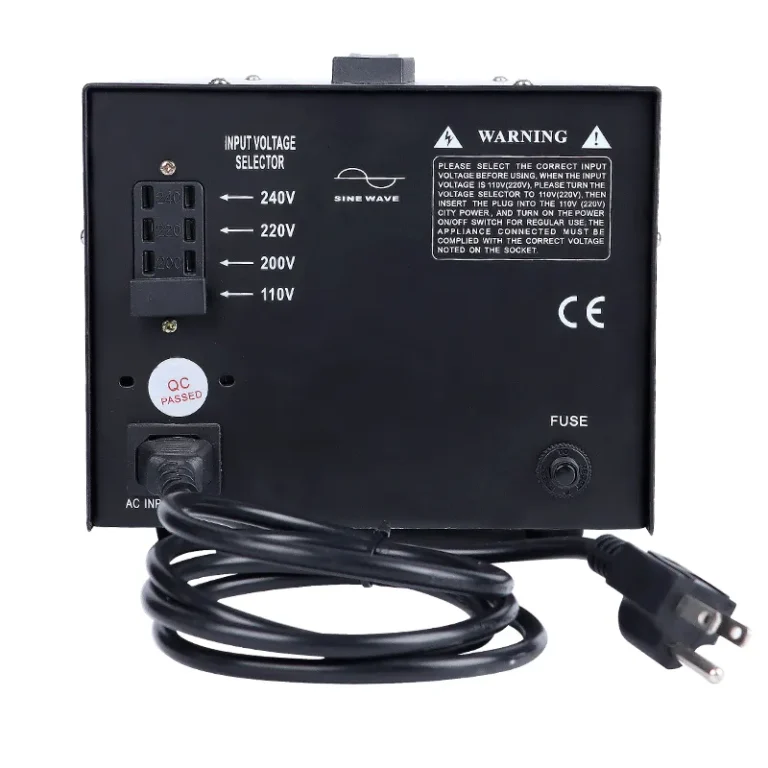
We are a factory, not a trading company, so I can tell you exactly what comes off our line. The ST-2000 is a 2000VA step down transformer that takes 220V in and gives you 110V out, with RCD protection built into the enclosure. For a ward cluster running monitors, pumps, a light and a small analyser, that is the unit I put on the quotation most days.
When the load climbs we move to the STU series. STU-3000 and STU-5000 are bidirectional, meaning they step up as well as step down, and they carry the heavier side of hospital work: sterile services, laboratory benches, laundry and decontamination areas, and the cluster arrangements I mentioned earlier. Bidirectional matters more than people expect, because a hospital that imports both 110V and 220V equipment will eventually need to go the other way, and swapping the box on the wall later is a nuisance nobody budgets for.
The DT-1000VA is our bidirectional automatic unit, and it earns its place at nurse stations, records rooms and small equipment carts where a modest load needs to work in either direction without anyone thinking about it. Then there is the Variac range at 500VA, 1KVA, 2KVA and 3KVA. Adjustable voltage does not sound exciting until you are commissioning an imported instrument and need to confirm how it behaves at 105V or at 115V. Once a biomedical technician uses one, they usually want one on the shelf permanently.

MOQ, Lead Time and Batch Test Records
Numbers, because hospital buyers ask these before anything else. Our minimum order is 10 pieces, whether you are fitting out one ward or sampling before a full hospital roll-out. Production runs 15 to 25 days depending on quantity and whether you want custom labelling. We ship FOB Ningbo or Shanghai, and every unit carries a 12-month warranty. Inside the carton you get a test record from the batch your unit came from, showing input voltage, output voltage under load and no-load current, because we test 100 percent of what we build in our own factory here in Yueqing.
Customisation is where hospital orders get interesting. We can fit the socket type your wards use, set the output to 110V or 120V depending on what your nameplates say, print your hospital or distributor label on the faceplate, and pack units individually so they can go straight to each department. If you are fitting out several sites, tell us the schedule and we will stage the deliveries rather than ship you a pallet of thirty units to store in a corridor.
We wind with copper here, not aluminium, and that is not a marketing line. Aluminium windings run hotter at the same rating, and hot insulation is what kills a transformer early. Under hospital duty, where a unit is switched on in the morning and left on all day, every day, that difference shows up inside two or three years.
What to Send Us for a Sized Quote
You do not need a finished specification to talk to us. Send what you have. The equipment list with the wattage from each nameplate, a photo of one nameplate if that is easier than typing, your mains voltage and frequency, the socket type your wards use, how many rooms or bed positions need a 110V feed, and your target date. From that we can size the unit, quote the quantity and give you a delivery window, usually the same working day.
Two things worth reading while you put that list together. If your facility also handles home care, sleep studies or portable equipment, our guide to a Step Down Transformer for CPAP Machine and Medical Equipment covers the small-load end of this work. And if you are still working out whether you need a step down unit, a step up unit or something that does both, our page on step up & down transformers explains the difference in plain terms. There is a full set of more application guides on the site as well, covering everything from dental chairs to imaging rooms.
If anything is unclear, send the list and a photo of your plugs. Sizing a step down transformer for a hospital is routine work for us, and we would much rather spend ten minutes on WhatsApp than have you order the wrong unit for every ward in the building.
Hospital Transformer Questions I Get Asked Most Weeks
These are the messages that fill my inbox, answered the way I would answer them on a call.
What size step down transformer does a hospital ward need?
Work it out per department, never off the whole building. Add up the equipment that can realistically run at the same moment in that ward, then add 25 to 30 percent. A four-bed intensive care cluster with monitors, pumps, ventilators and suction lands near 2400VA, so a 3000VA bidirectional unit covers it comfortably.
Can one transformer supply a whole hospital?
It can if the building already has 110V wiring to every ward, but most hospitals we quote are retrofits and we suggest one unit per ward, laboratory or bed cluster instead. A single central unit is cheaper on hardware, yet it becomes a single point of failure and a trip at ten in the morning stops the whole department.
Why do you recommend 30 percent headroom for medical equipment?
Because a transformer output sags as you load it, and motor loads such as centrifuges, suction pumps and compressors pull 2.5 to 3 times their running current for a moment on start. A unit sized exactly to the running load will let the voltage dip on every start, which is exactly what sensitive monitors and analysers do not want.
Does 50Hz mains damage 110V equipment built for 60Hz?
The transformer changes voltage only, never frequency, so you get a clean 110V at 50Hz. Electronic instruments are unaffected. Motor-driven devices such as centrifuges and pumps will run roughly seventeen percent slower and slightly warmer. Send us the model numbers and we will flag anything that needs a second look.
Should a hospital keep a spare transformer on site?
Yes, and one spare per site is usually enough. It sits in the engineering store, tested and labelled, ready to swap in. Transformers rarely fail, but when one does it tends to happen at the worst possible moment, and waiting weeks for a replacement to clear customs is not a risk a hospital should carry.
Sending us your equipment list costs nothing and usually prevents a sizing mistake. Tell us what 110V machines you run, how many wards or bed positions need a feed, and which country you are in. We will come back with a recommended unit, a quantity and a price, normally the same working day.
Or talk to us directly: WhatsApp +86 197 3022 6757 · Email sales@wilmall.com
MOQ 10 pcs · Lead time 15-25 days · FOB Ningbo or Shanghai · 12-month warranty