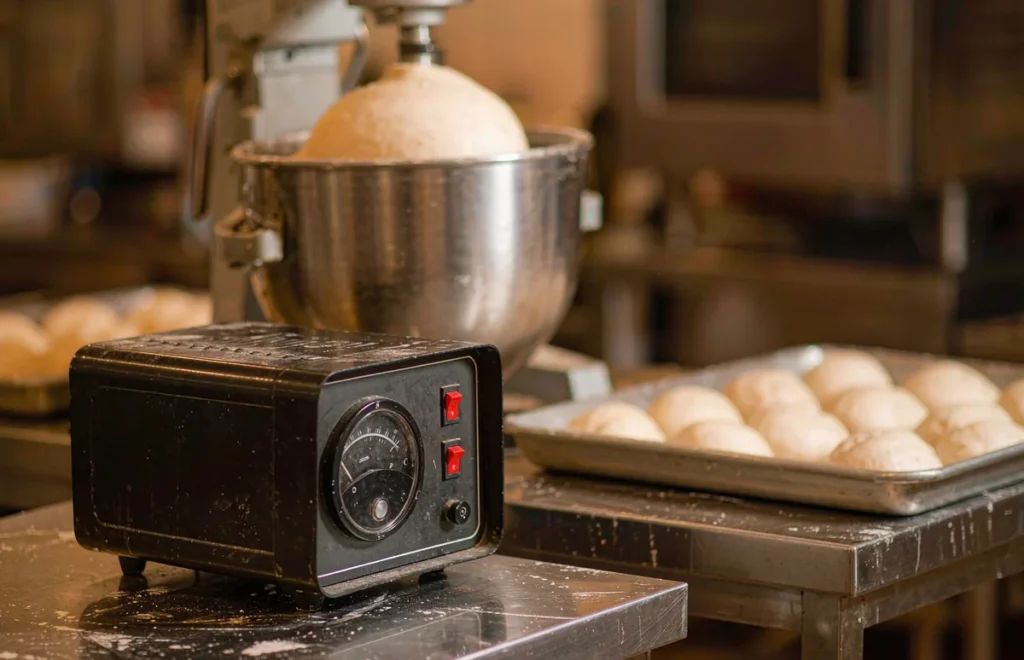
Step Down Transformer for Bakeries: 220V to 110V Guide
A bakery is one of the few places where a transformer order goes wrong for a reason nobody expects. The buyer adds up the nameplate watts on the equipment list, picks a unit that covers that total, plugs everything in, and then the mixer trips the protection the first time the dough gets stiff. Nothing was miscalculated in the arithmetic. The mistake was treating a room full of motors as if it were a room full of light bulbs. A dough hook pushing through twenty kilos of cold dough is not a resistive load, and it does not behave like one.
I work at a transformer factory in Yueqing, China, and bakery enquiries come in almost every week. Some are from a single shop fitting out one location, some are from dealers supplying equipment packages to customers who bought an imported mixer and now need a way to run it. The questions are predictable, so let me answer them here the way I would answer over WhatsApp, without the brochure voice.

Bakery Loads Are Motor Loads, and Motors Misbehave on Start
Here is the thing about a mixer, a sheeter or a divider. The number on the nameplate tells you what it consumes once it is running steadily. It says nothing about the first half second, when the motor is not turning yet and the rotor is effectively a short circuit. For that brief moment the machine pulls somewhere between 2.5 and 3 times its running current. On a 110V single phase supply that is a serious chunk of current, and it happens every single time the operator hits the start button.
A transformer that is exactly the size of your running load will ride through that, but badly. The output voltage dips hard while the motor comes up to speed, and if the mixer is already loaded with stiff dough the dip lasts longer than you would like. Do that four hundred times a week and you will notice it in ways that range from a flickering light in the shop front to a control board that fails a year earlier than it should.
On top of that, bakery equipment runs long. A proofer or a retarder is switched on and forgotten for hours. A deck oven holding temperature is drawing on and off all day. Refrigerated displays never stop. So the transformer sits at a decent percentage of its rating for ten or twelve hours, warms up, and only cools properly after closing. That combination of long duty and repeated motor starts is what separates bakery sizing from almost anything else we do.
Which Bakery Machines Usually Arrive at 110V
When a bakery sends me an equipment list, I sort it into machines that need a 110V feed and machines that do not. Imported equipment from the United States is where the 110V requirement normally comes from. Here is what lands on the yes side most often.
- Planetary mixers, the bench and floor models used for icing, cream and small batches, typically 500W to 1500W with a hard start under load.
- Spiral mixers, the workhorse of a bread shop, often 1500W to 3000W and the machine that decides the size of your transformer.
- Dough sheeters and laminators, 300W to 800W, usually started and stopped constantly through a pastry shift.
- Dough dividers, rounders and moulders, 500W to 1500W, all motor driven with a short, sharp start.
- Proofers and retarder proofers, 1000W to 3000W, mostly a heating element plus a circulating fan running for hours.
- Electric deck and convection ovens, 2000W and up per deck, purely resistive so no inrush to worry about.
- Refrigerated display cases and blast chillers, 300W to 4000W, with a compressor that cycles and surges on start.
- Bread slicers, bun dividers and wrapping machines, 200W to 700W each, small loads that add up across a busy bench.
What does not need us, and I write this on almost every quote: laptops, tablets, phone chargers, LED lighting and anything whose label reads 100-240V, 50/60Hz. Those devices are already happy on your 220V wall. Counting them inflates the load sheet and pushes you into a bigger unit than the shop needs.
Why the Nameplate Watts Cannot Simply Be Added Together
This is the part most buyers get wrong, and it is not their fault. Adding every nameplate figure on the list gives you a number that no bakery ever actually draws, because it assumes every machine starts at the same instant and keeps running flat out forever. What you want instead is the worst realistic minute of your busiest hour.
Take a bread shop on a Friday morning. The spiral mixer runs a four-minute cycle and then rests while the dough proves. The sheeter works for six minutes while a batch is being laminated. The proofer is on all day. The display fridge cycles on and off. In any given minute, two or three machines are drawing real power and the rest are idle. That is your number, plus headroom, plus a check against the biggest motor on the list.
The 2.5 to 3 Times Rule for Motor Starts
Look at the largest motor in the shop, and check the unit you are considering against its starting current rather than its running current. A 1500W mixer motor running at 110V pulls somewhere near 13 to 15 amps. Multiply that by three and you are looking at a brief surge in the region of 40 amps. The transformer has to supply that surge without collapsing, which is why we size bakery units on the generous side and why aluminium windings, with their higher resistance and hotter running, have no place in this application.
If a motor has a soft starter or a variable frequency drive, the surge is much gentler and you can size closer to the running load. Most bakery machines do not. They have a capacitor start motor, a centrifugal switch and a bang. Plan for the bang.
Picking a Simultaneity Factor
You do not need a formula, just a sensible number. Count every machine that can be drawing power at the same time in the busiest hour of your week, add those running watts together, and then apply a simultaneity factor before you add headroom. Shops that batch production and clean down between batches sit near 0.6. Shops running continuous production with two or three people on different stations sit near 0.8 or higher.
| Equipment | Typical running watts | Start behaviour | How to count it |
|---|---|---|---|
| Spiral mixer | 1500 – 3000 W | Heavy motor start under load | Count full running watts, plus the 2.5 to 3 times surge check |
| Planetary mixer | 500 – 1500 W | Motor start, repeated through the shift | Count it against any other motor that may run with it |
| Dough sheeter or moulder | 300 – 800 W | Frequent short starts | Runs in sequence with the mixer, not always beside it |
| Proofer or retarder | 1000 – 3000 W | Resistive plus a small fan, runs for hours | Always on during production, so never discount it |
| Electric deck oven | 2000 W and up per deck | Resistive, cycles on thermostat | Put it on its own circuit if you can |
| Refrigerated display or chiller | 300 – 4000 W | Compressor cycles with a start surge | Never discount it, it runs all day |
| Slicer, wrapper, bench tools | 200 – 700 W each | Small motors, short bursts | Add them up, they are cheap to cover |
Single Phase, Three Phase, and What a Step Down Unit Can and Cannot Do
Worth saying plainly, because it saves a lot of back and forth. The step down transformers we build are single phase. If your imported mixer is a three phase machine running on 208V or 220V at 60Hz, a single phase step down box is not the answer and I will tell you so rather than sell you one. Send a photo of that nameplate and we will tell you what the right arrangement is.
Something else that surprises bakers. A transformer changes voltage, never frequency. If your shop has 50Hz mains and the machine was built for 60Hz, the motor will run roughly seventeen percent slower. For a mixer that mostly means a longer mixing time and a slightly warmer motor housing. For a sheeter or a divider it can affect throughput. It is not damage, it is just physics, and a manufacturer that does not mention it before you buy is not doing you a favour.
A Sizing Walkthrough for a Small Bread Shop
Let me run the numbers on a shop I quoted a few months ago. One spiral mixer at 1500W, one dough sheeter at 550W, one proofer holding 1200W, a bench planetary mixer at 800W, a bread slicer at 350W and a refrigerated display at 400W. The owner’s first instinct was to add everything and land near 4800W, which would have put him on a bigger unit than he needed.
We looked at the busiest hour instead. Spiral mixer, sheeter and proofer all run together at the start of a batch, which is 3250W. The planetary mixer and the slicer come on later, once the dough is already proving, so they overlap with the fridge and the proofer but not with the spiral mixer. The realistic worst minute is around 3200W. Add 30 percent and you land near 4200VA, so a 5000VA bidirectional unit covers it with margin for a second mixer later. The mixer’s start surge stays well inside the unit’s capability, and the proofer does not see a voltage dip every time the mixer kicks in.
| Bakery setup | Realistic simultaneous load | Largest motor | Suggested unit |
|---|---|---|---|
| Cake shop, one bench planetary mixer, fridge, small oven | 900 – 1600 W | 800 W | ST-2000 with RCD |
| Small bread shop, one spiral mixer, sheeter, proofer | 2800 – 3800 W | 1500 W | STU-5000 bidirectional |
| Busy shop, two mixers plus sheeter and proofer | 4200 – 5500 W | 2200 W | STU-5000, or split across two circuits |
| Pastry bench, laminator, chiller, small tools | 1800 – 2600 W | 750 W | STU-3000 bidirectional |
| Prep and finishing bench only | 400 – 1200 W | 500 W | DT-1000VA bidirectional automatic |
One more note on the table above. Anything past roughly 5000VA is better handled by splitting the shop into two circuits with two units rather than pushing one box harder. A bakery that loses its only transformer on a Saturday morning loses the whole weekend of production. Two units also let you put the ovens on one and the mixer bench on the other, which keeps a heating load from sharing a winding with a motor load.
Heat, Ventilation and Where the Unit Actually Goes
Bakery floors are hot. That sounds obvious, but it is the single most common reason a transformer underperforms in a bakery compared with the same unit in an air-conditioned workshop. A transformer is a magnetic device and it runs warm under load. Put it in a closed cupboard, box it behind a sealed panel, or stack flour sacks against it and you have built an oven around it. Vents blocked is the difference between a five-year unit and an eighteen-month unit.
My usual advice for a bakery: mount it on a wall bracket in the back-of-house area, at least 100mm clear on every vented face, away from the oven line and away from the wash-down hose. Do not put it on the floor where the mop water goes. If your shop has no clean wall space, we can supply a unit with a protective enclosure but please keep the airflow path clear. In a room that already sits at 35 degrees Celsius in summer, that airflow is doing real work.
The Units We Build for Bakery Work
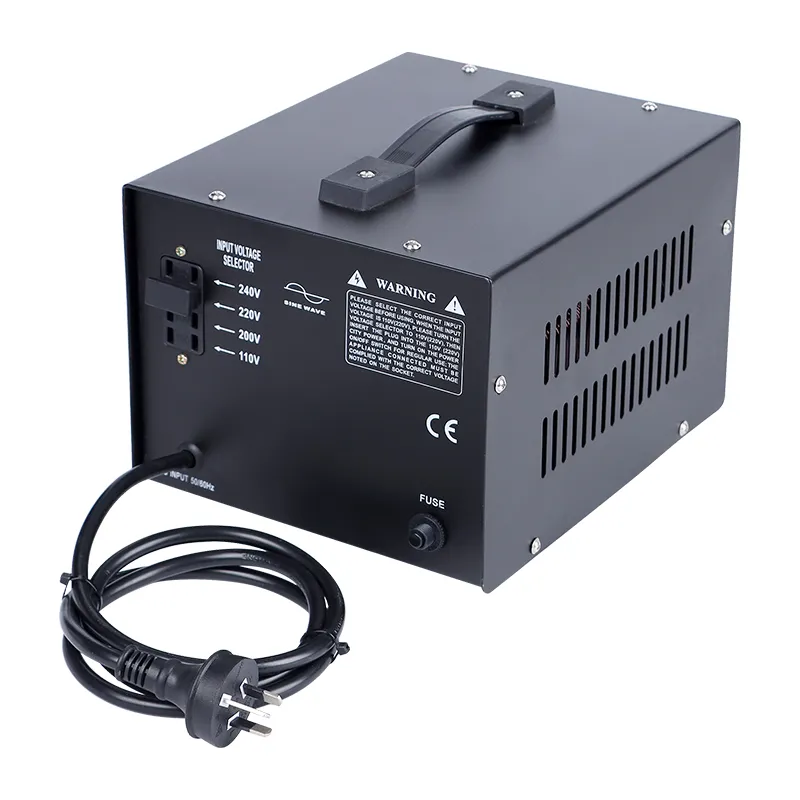
We are a factory, not a trading company, so I can tell you exactly what comes off our line. The ST-2000 is a 2000VA step down transformer taking 220V in and giving 110V out, with RCD protection built in. For a cake shop bench with a planetary mixer, a finishing fridge and a few small tools, that is the box I put on the quotation most days. The RCD earns its keep in a room with a sink, a wet bench and a floor that gets hosed down.
When the load climbs we move to the STU series. STU-3000 and STU-5000 are bidirectional, so they step up as well as step down, and they carry the heavier side of bakery work: spiral mixers, proofer rooms, refrigeration and the cluster arrangements I described. Bidirectional matters more than people expect, because a bakery that imports equipment from both sides of the world will eventually need to go the other way.
The DT-1000VA is our bidirectional automatic unit, and it suits prep benches, offices and small equipment carts where a modest load needs to work in either direction without anyone thinking about it. Then there is the Variac range at 500VA, 1KVA, 2KVA and 3KVA. Adjustable voltage sounds dull until you are commissioning an imported mixer and want to see how it behaves at 105V or 115V before you commit a whole production line to it. Bakeries that service their own machines tend to keep one on the shelf.
MOQ, Lead Time and Batch Test Records
Numbers, because buyers ask these before anything else. Our minimum order is 10 pieces, whether you are fitting out one shop or building a stock for your own customers. Production runs 15 to 25 days depending on quantity and whether you want custom labelling. We ship FOB Ningbo or Shanghai, and every unit carries a 12-month warranty. Inside the carton you get a test record from the batch your unit came from, showing input voltage, output voltage under load and no-load current, because we test 100 percent of what we build in our own factory here in Yueqing.
Customisation is where bakery orders get practical. We can fit the socket type your machines use, set the output to 110V or 120V depending on what your nameplates say, print your shop or distributor label on the faceplate, and pack units individually for shipment to separate sites. If you are a dealer supplying equipment packages, tell us and we will keep the branding on your side of the transaction.
We wind with copper here, not aluminium. In a bakery that distinction matters more than in most buildings. Aluminium windings run hotter at the same rating, and a bakery already runs hot, so the insulation is working with less margin from day one.
What to Send Us for a Sized Quote
You do not need a finished specification to talk to us. Send what you have. The equipment list with the wattage from each nameplate, a photo of one nameplate if that is easier than typing it out, your mains voltage and frequency, the socket type your machines use, and a rough idea of which machines run at the same time during your busiest hour. From that we can size the unit, quote the quantity and give you a delivery window, usually the same working day.
Two things worth reading while you put that list together. If your shop also runs a kitchen with imported cooking equipment, our guide to a Step Down Transformer for Restaurants: 220V to 110V Guide covers that side of the business. And if you are still working out whether you need a step down unit, a step up unit or something that does both, our page on step up & down transformers explains the difference in plain terms. There is a full set of more application guides on the site too, covering everything from mixers to sterilisation rooms.
If anything is unclear, send the list and a photo of the nameplate on your biggest mixer. Sizing a step down transformer for a bakery is routine work for us, and we would much rather spend ten minutes on WhatsApp than have you order a unit that trips every time the dough gets stiff.
Bakery Transformer Questions I Get Asked Most Weeks
These are the messages that fill my inbox, answered the way I would answer them on a call.
Why did my mixer trip the transformer when the wattage added up fine?
Because a motor pulls 2.5 to 3 times its running current for a moment on start, and a stiff dough load makes that moment last longer. A unit sized exactly to the running watts will let the output dip hard on every start. Size past the running load and check the biggest motor against its starting current, not its nameplate.
Can I just add up all the nameplate watts in my bakery?
No, and doing it will push you into an oversized unit. Add up only the machines that can realistically run at the same moment in your busiest hour, apply a simultaneity factor of 0.6 to 0.8 depending on how you batch production, then add 25 to 30 percent headroom on top of that.
What size step down transformer does a bakery with one spiral mixer need?
A small bread shop running a 1500W spiral mixer, a sheeter and a 1200W proofer lands near 3200W of simultaneous load. Add headroom and you are around 4200VA, so a 5000VA bidirectional unit covers it with margin and rides through the mixer’s start surge without dipping the proofer.
Does a 50Hz supply affect imported 110V bakery equipment?
Voltage changes, frequency does not. Electronic controls are unaffected. Motors on mixers, sheeters and dividers built for 60Hz will run roughly seventeen percent slower, which mainly shows up as longer mixing times and a slightly warmer motor. Tell us the machine models and we will flag anything worth watching.
How much ventilation does a bakery transformer need?
More than most installations give it. Keep at least 100mm clear on every vented face, do not box it into a closed cupboard, and keep it away from the oven line and the wash-down hose. A bakery floor already runs hot, and blocked airflow is the most common reason a unit underperforms there.
Sending us your equipment list costs nothing and usually prevents a sizing mistake. Tell us what 110V machines you run, how many of them, and which country you are in. We will come back with a recommended unit, a quantity and a price, normally the same working day.
Or talk to us directly: WhatsApp +86 197 3022 6757 · Email sales@wilmall.com
MOQ 10 pcs · Lead time 15-25 days · FOB Ningbo or Shanghai · 12-month warranty