Step Down Transformer for Car Wash Stations
A car wash sits at the awkward end of everything that makes transformer sizing difficult. The loads are all motors, so they surge on every start. Several of them run at the same time because two or three staff are working separate bays. The environment is permanently wet, which is the exact opposite of what an electrical enclosure wants. And the site usually grows. You start with one bay and a pressure washer, and two years later there are three bays, a vacuum station, a polisher and a water recycling pump, all hanging off the transformer you bought when the place was a single hose and a bucket.
I work at a transformer factory in Yueqing, China, and car wash enquiries come through my inbox in a steady trickle. Some are from the owner of a single site, some are from installers wiring a new build, and quite a few are from the operator of a chain who has already learned the hard way that a cheap unit at the start costs more than the right unit at the beginning. Let me answer the usual questions here the way I would answer them over WhatsApp, without the brochure voice.

Every Load in a Car Wash Is a Motor Load
Look down a car wash equipment list and you will not find a single resistive appliance of any size. There is no heater, no oven, no element quietly pulling a steady current. What you have is pressure washers, wet and dry vacuums, polishers, tyre compressors and a water transfer pump. Every one of them has a motor in it, and every one of them draws somewhere between 2.5 and 3 times its running current for a fraction of a second when it starts.
That single fact changes the number you size to. A unit rated at exactly the running load of the site will work most of the time, and then it will fail you at the worst possible moment, which for a car wash is a queue on a Saturday morning. When two pressure washers, a vacuum and a compressor all start within a few seconds of each other, the transformer has to supply several brief surges while holding the voltage steady for everything else. That is a different demand from a steady load of the same average size.
Frequency is worth a sentence here too, because car wash gear is a mixed bag. Pressure washers with universal brush motors are much less fussy about 50Hz against 60Hz than induction motors. Units driven by an induction motor, and the pumps behind them, will run roughly seventeen percent slower on a 50Hz supply. A transformer changes voltage and never frequency, so if you are importing equipment built for 60Hz into a 50Hz country, expect the pump side of the site to feel slightly slower than the spec sheet promised.
Which Car Wash Equipment Usually Needs 110V
When a site sends me its equipment list, I mark each line as 110V, 220V or “check the nameplate”, because pressure washers in particular come in both flavours and the difference matters a lot. Here is how the list normally falls out.
- Electric pressure washers, 1400W to 2000W on a 110V machine, and the single most important load on the site because they run for long stretches.
- Wet and dry vacuums, 1000W to 1500W for a single motor unit, and up to 2000W for twin motor models that some operators prefer.
- Rotary polishers and buffers, 700W to 1500W, hand held, starting and stopping constantly through a detail job.
- Water transfer and recycling pumps, 500W to 1500W, usually running continuously whenever the wash is open.
- Tyre inflators and small air compressors, 800W to 2000W, with a compressor start that is genuinely hard on a supply.
- Carpet extractors and steam cleaners, 1000W to 1800W, mostly a motor plus a small pump.
- Blowers and air movers for drying, 500W to 1500W each, and operators often run two or three together.
- Kiosk terminals, lighting and signage, small individually, but on for the whole trading day.
What does not need us: the payment terminal, the back-office computer, LED lighting with a wide-range driver, and anything carrying a 100-240V, 50/60Hz label. Also worth saying plainly, because it comes up constantly: if your pressure washer is a 220V or 240V machine, you do not need a step down transformer for it at all. It runs on your wall supply as it is. Only the 110V equipment belongs on the transformer, and mixing the two on the same load sheet is the fastest way to buy a unit twice the size you need.
How to Size a Transformer for a Car Wash Site
The method is the same one I give bakers and laundries, and it takes about five minutes. List every 110V machine. Write down the running watts from each nameplate. Decide which machines can plausibly be running at the same time during your busiest hour. Add those together, add 30 percent, and treat the result as VA.
The simultaneity factor is where the car wash has its own character. If you have three bays and three staff, the honest factor for the pressure washers is close to 0.8, because staff wash cars at the same time rather than taking turns. Vacuums are different. A vacuum runs for four minutes at the end of a wash, so at any moment maybe one in three is in use, and a factor of 0.4 to 0.5 is realistic. The pump is the opposite case again. If you run a water recycling system, that pump is on all day, so its factor is 1.0 and it never comes off the load sheet.
A Worked Example: A Three-Bay Site
Three bays, each with a 1500W pressure washer. Two vacuum stations with 1200W twin motor units. One 900W polisher. One 750W recycling pump running continuously. One 1100W tyre compressor. Site lighting, signage and kiosk at 400W.
Now apply the factors rather than adding the lot. Pressure washers: three units at 1500W with a factor of 0.8 gives 3600W, since at peak two or three bays are active together. Vacuums: two at 1200W with a factor of 0.5 gives 1200W. Polisher at 0.5 gives 450W. Compressor at 0.5 gives 550W. The recycling pump at 1.0 gives 750W. Lighting and kiosk at 1.0 gives 400W. Total peak comes to roughly 6950W. Add 30 percent and you land near 9000VA.
That is beyond a single unit in our range, and I would not quote it as one box. The sensible answer is to split the site. Put a 5000VA bidirectional unit on the wash bays and their vacuums, and a second unit on the recycling pump, the compressor and the site services. The bays stay running if one unit needs attention, and no single winding carries every motor on the property.
| Equipment | Typical running watts | Factor | Counted load | Sizing note |
|---|---|---|---|---|
| Pressure washer, 110V, 3 units | 1500 W each | 0.8 | 3600 W | Staff work bays in parallel, so do not discount heavily |
| Wet and dry vacuum, 2 units | 1200 W each | 0.5 | 1200 W | Short duty at the end of each wash |
| Rotary polisher | 900 W | 0.5 | 450 W | Repeated starts through a detail job |
| Recycling or transfer pump | 750 W | 1.0 | 750 W | Runs continuously, never discount it |
| Tyre compressor | 1100 W | 0.5 | 550 W | Hard start, check against its inrush |
| Lighting, kiosk and signage | 400 W | 1.0 | 400 W | On for the full trading day |
| Peak total, before headroom | – | – | 6950 W | Add 30 percent and treat as VA |
| Recommended site capacity | – | – | About 9000 VA | Split across two units, one per zone |
Sizing by the Number of Bays
Most car wash buyers are not building a three-bay site from scratch. They are adding equipment one step at a time, so here is a quick reference for the common sizes. Use it as a starting point and then send us the real nameplate figures, because pressure washers vary more than any other appliance I deal with.
| Site size | Typical peak load | Suggested unit | Comment |
|---|---|---|---|
| Single bay, one washer and one vacuum | 1200 – 2200 W | ST-2000 with RCD | Handles one washer starting while the vacuum runs |
| Single bay with washer, vacuum and polisher | 2200 – 3400 W | STU-3000 bidirectional | Margin for a second vacuum or a bigger washer later |
| Two bays plus vacuum station | 3400 – 5200 W | STU-5000 bidirectional | Both bays washing at once is the design case |
| Three bays plus recycling pump | 6000 – 9000 W | Two units, one per zone | Split bays from site services |
| Detailing bay only | 600 – 1500 W | DT-1000VA bidirectional automatic | Polisher, lights and small tools |
| Service bench and testing | 500 – 2000 W variable | Variac 1KVA to 3KVA | Adjustable output for checking imported tools |
Water and Electricity in the Same Room: What Actually Keeps You Safe
This is the part of a car wash project I care about more than the sizing, because sizing mistakes cost money and safety mistakes cost more than that.
Keep the Unit Out of the Spray Zone
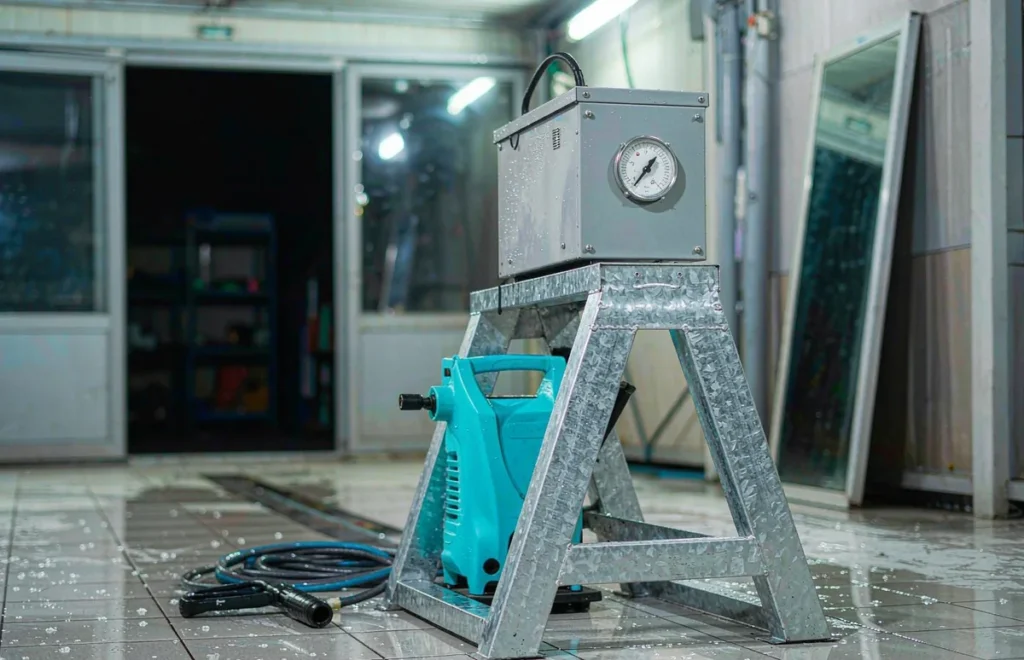
Our standard units are built for a dry, ventilated position, and a car wash is neither of those things by default. So the first rule is placement. Mount the transformer away from the spray, away from the hose reel, and away from the drain line. Not behind the bay where a pressure washer overshoot will soak it, and not on the floor where water pools. A back room, an office wall or a covered service area is right. If your site has nowhere dry at all, tell us what the exposure looks like. We can discuss an enclosure arrangement, but I would rather move the unit than claim a protection level I cannot stand behind.
If the unit has to sit in a wet area, put it inside a splash-proof cabinet that still lets air move through it. A sealed box with a transformer inside is not protection, it is a slow cooker. Vents at the bottom and the top of the cabinet, or louvres on one side, will do the job without letting a jet of water reach the windings.
RCD and Earthing Are Not Negotiable Here
A car wash has wet floors, wet hands, extension leads on the ground and staff moving between bays all day. That combination is exactly what RCD protection exists for. On our ST-2000 the RCD is built into the unit, so a fault on the 110V side trips the unit locally rather than waiting for a breaker in the office. If you are feeding several bays from a bigger unit, make sure every downstream 110V circuit has its own protection and not just the whole site on one device.
Earthing matters just as much, and it is the thing I see skipped most often on retrofit sites. The enclosure must be bonded to the building earth, and the 110V sockets must have a proper earth path back to it. Sockets should be mounted well above the wash-down line, with covers that close, positioned so a hose cannot be sprayed directly into them. That last detail is free and it prevents a category of failure that no transformer can protect you from.
Cable Runs and Long Sites
Car washes are long and thin. The transformer sits in one corner and the last bay is forty metres away, so voltage drop matters more here than on almost any site I quote. At 110V the current for a given load is double what it would be at 220V, and voltage drop rises quickly with current over distance. A cable that looks generous on a drawing can lose several volts before it reaches the furthest bay, and those volts come straight off the pressure washer’s supply margin.
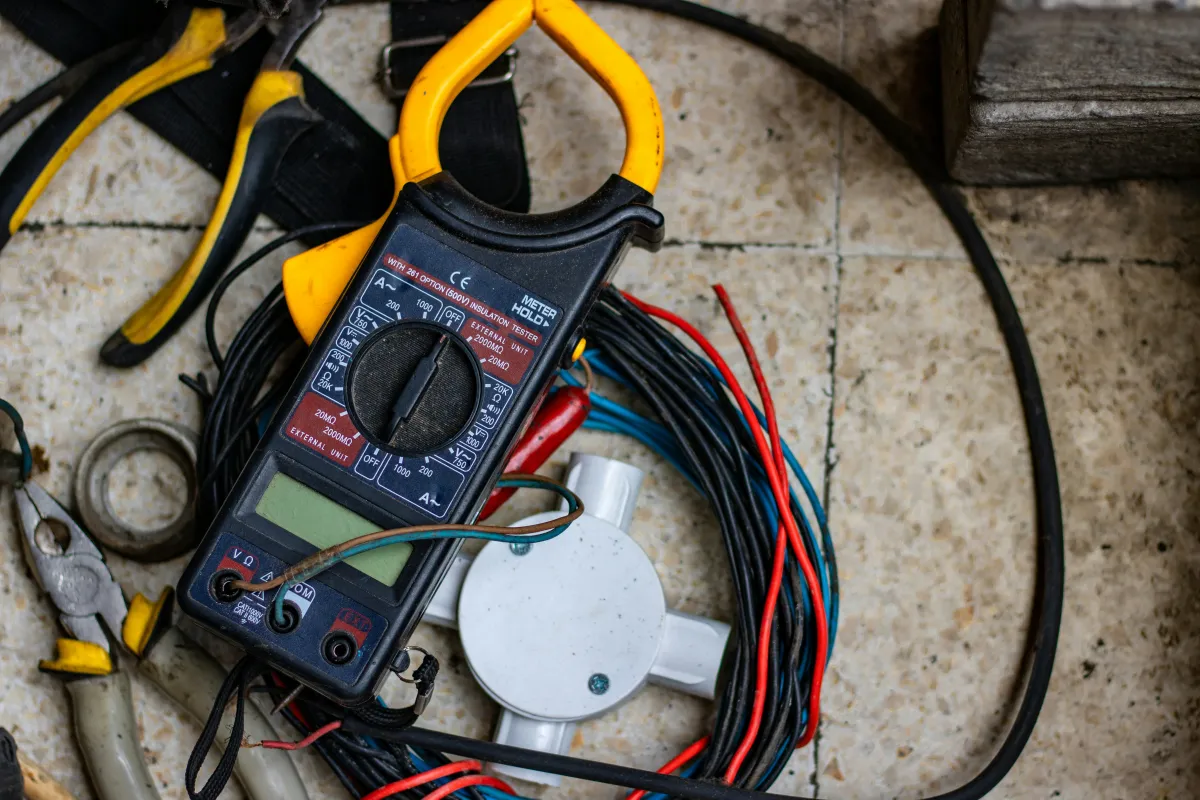
Two practical rules. Keep the 110V runs as short as the layout allows, and go up a conductor size on the long ones rather than assuming the standard size will do. Then measure at the far end with the equipment running. An idle voltage reading is meaningless. If the voltage at the last bay sags when two washers start together, the transformer may be perfectly fine and the cable is the problem. It is better to find that out on commissioning day than in the middle of your first busy weekend.
The Units We Build for Car Wash Work
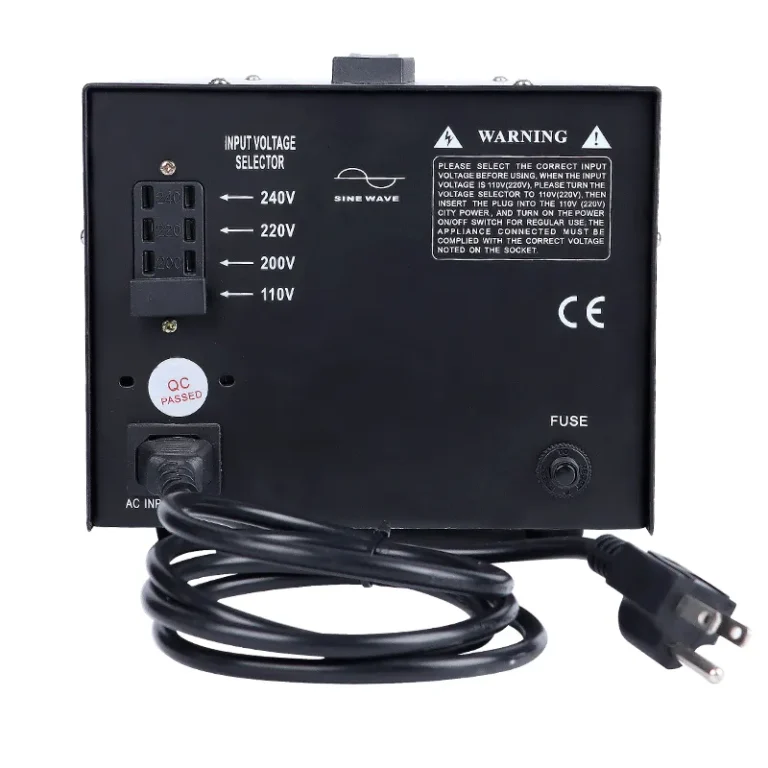
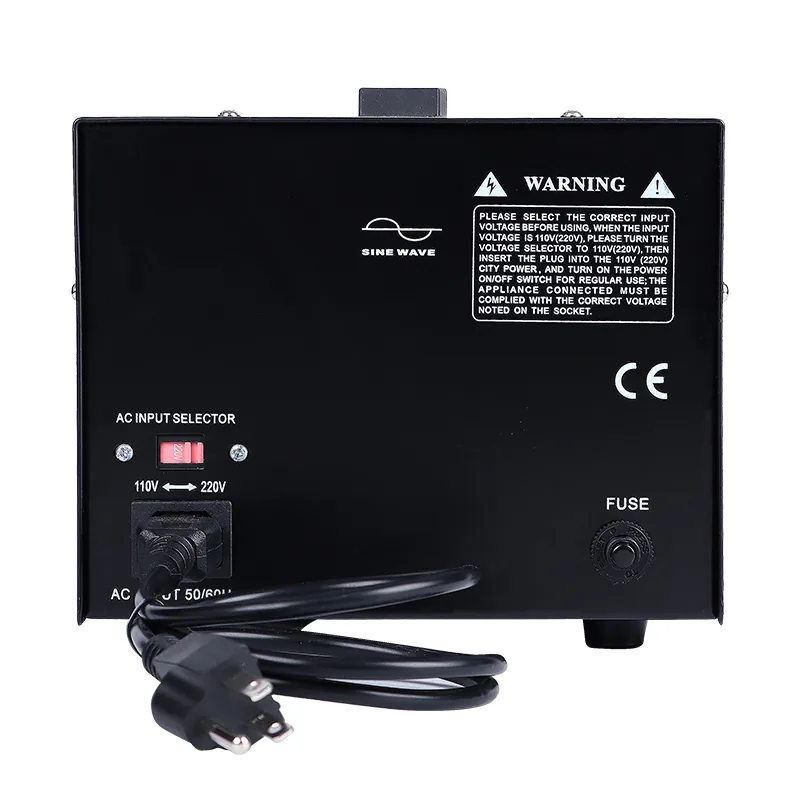
We are a factory, not a trading company, so I can tell you exactly what comes off our line. The ST-2000 is a 2000VA step down transformer taking 220V in and giving 110V out, with RCD protection built in. For a single bay with a washer, a vacuum and a polisher, that is the box I put on the quotation most days, and the RCD is the reason I push it in a wet environment.
When the load climbs we move to the STU series. STU-3000 and STU-5000 are bidirectional, stepping up as well as down, and they carry the heavier side of car wash work: multi-bay sites, vacuum stations, recycling plant and the split-zone arrangements I described. Bidirectional matters on a site that buys equipment from both sides of the world, because you will eventually need to go the other way and swapping the box on the wall later is a nuisance nobody budgets for.
The DT-1000VA is our bidirectional automatic unit, and it fits detailing bays, offices and small equipment carts where a modest load needs to work in either direction without anyone thinking about it. Then there is the Variac range at 500VA, 1KVA, 2KVA and 3KVA. Adjustable voltage sounds dull until a technician is commissioning an imported polisher or a rebuilt pump and wants to watch how it behaves at 105V before committing it to a full day of work.
MOQ, Lead Time and Batch Test Records
Numbers, because buyers ask these before anything else. Our minimum order is 10 pieces, whether you are fitting out one site or stocking a distribution business. Production runs 15 to 25 days depending on quantity and whether you want custom labelling. We ship FOB Ningbo or Shanghai, and every unit carries a 12-month warranty. Inside the carton you get a test record from the batch your unit came from, showing input voltage, output voltage under load and no-load current, because we test 100 percent of what we build in our own factory here in Yueqing.
Customisation is where car wash orders get practical. We can fit the socket type your equipment uses, set the output to 110V or 120V depending on what your nameplates say, print your company or distributor label on the faceplate, and pack units individually so they can go to separate sites. If you operate a chain, tell us the rollout schedule and we will stage the deliveries rather than ship you a pallet of units to store in the back office.
We wind with copper here, not aluminium, and on a car wash site that is not a marketing line. The unit runs for a full trading day in a damp room with limited airflow, and aluminium windings run hotter at the same rating. Hot insulation is what kills a transformer early, and a car wash is not a forgiving place to find that out.
What to Send Us for a Sized Quote
You do not need a finished specification to talk to us. Send what you have. The equipment list with the wattage from each nameplate, a photo of one nameplate if that is easier, how many bays you run, your mains voltage and frequency, the socket type your machines use, and a rough idea of how far the furthest bay is from where the unit would sit. From that we can size the unit, quote the quantity and give you a delivery window, usually the same working day.
Two things worth reading while you put that list together. If your site has compressors or other heavy motor loads beyond the wash bays, our guide to How to Size a Step Down Transformer for Motors and Compressors goes deeper into starting current than I can here. And if you are still working out whether you need a step down unit, a step up unit or something that does both, our page on step up & down transformers explains the difference in plain terms. There is a full set of more application guides on the site as well.
If anything is unclear, send the equipment list and a photo of the nameplate on one pressure washer. Sizing a step down transformer for a car wash is routine work for us, and we would much rather spend ten minutes on WhatsApp than have you order a unit that trips every time two bays start together.
Car Wash Transformer Questions I Get Asked Most Weeks
These are the messages that fill my inbox, answered the way I would answer them on a call.
What size step down transformer does a car wash need?
Add the 110V machines that can run at the same time, then add 30 percent and treat that as VA. A single bay with a washer, a vacuum and a polisher usually lands near 3000VA, so a 3000VA unit fits. A three-bay site with a recycling pump often needs two units rather than one large box.
Why do pressure washers need extra headroom on a transformer?
Because every pressure washer is a motor load, and a motor pulls 2.5 to 3 times its running current for a moment on start. With two or three bays starting at once, a unit sized exactly to the running load will let the voltage dip on every start. Size above the running load and check the largest motor separately.
How do I protect a transformer in a wet car wash environment?
Mount the unit out of the spray zone in a dry, ventilated position, and if that is impossible, use a splash-proof cabinet that still lets air move through it. Keep the enclosure bonded to building earth, fit RCD protection on the 110V side, and mount sockets above the wash-down line with covers that close.
Can I run a 240V pressure washer on a step down transformer?
No, and you do not need to. If your pressure washer nameplate says 220V or 240V, it already runs on your wall supply and the transformer is only there for the 110V equipment. Mixing the two on one load sheet is the fastest way to buy a unit twice the size you actually need.
Why does voltage drop matter on a long car wash site?
At 110V the current for a given load is double what it would be at 220V, so voltage drop over distance grows quickly. Long runs to the furthest bay can lose several volts. Keep 110V runs short, go up a conductor size on long ones, and measure the voltage at the last bay while the equipment is running.
Sending us your equipment list costs nothing and usually prevents a sizing mistake. Tell us what 110V machines you run, how many bays you have, and which country you are in. We will come back with a recommended unit, a quantity and a price, normally the same working day.
Or talk to us directly: WhatsApp +86 197 3022 6757 · Email sales@wilmall.com
MOQ 10 pcs · Lead time 15-25 days · FOB Ningbo or Shanghai · 12-month warranty