Voltage Converter for Bahrain: 230V to 110V Guide
Bahrain runs on 230V at 50Hz, and that single sentence is where most of the confusion starts for anyone importing equipment from North America. A villa in Riffa with a container of 110V appliances arriving from the United States has a real problem to solve, and it is not solved by a lightweight travel adapter from the airport. Bahrain is a small, wealthy, heavily imported market, so a lot of the equipment on the shelves and in the warehouses was designed around a 110V or 120V supply. Making that equipment work properly on 230V is a straightforward engineering job when it is done correctly, and an expensive one when it is not.
I work at a transformer factory in Yueqing, China, and we ship to the Gulf regularly. Bahrain orders tend to come through importers, electrical contractors and hotel or facility maintenance companies, and the questions are pretty consistent. Let me answer them here the way I would answer them over WhatsApp, without the brochure voice.

Bahrain Power Basics: 230V, 50Hz and Type G Sockets
The supply in Bahrain is nominal 230V at 50Hz, in line with the rest of the Gulf Cooperation Council. Sockets are Type G, the British-style three-pin pattern with a 13 amp fuse in the plug, and that is what you will find in apartments, villas, hotels, offices and workshops across the country. The GCC uses the same plug pattern, so equipment wired for Bahrain will also suit Saudi Arabia, Kuwait, Qatar, the UAE and Oman, which is useful if you supply more than one market in the region.
Two consequences follow from Type G. The first is that a fused plug gives you a natural limit of 13 amps per socket, which at 230V is a little under 3000VA. If your equipment needs more than that on one circuit, it needs its own supply rather than a plug. The second is that imported North American equipment arrives with a different plug on the end, so the transformer you buy should be fitted with the socket type your equipment actually uses. Ask for it when you order. Our units can be built with the outlet you need, and it saves you a warehouse full of adapters that nobody trusts.
Mains stability in Bahrain is good by regional standards. You are not dealing with the wide voltage swings that a buyer in some other markets has to plan around. That is helpful, but it does not mean you can size a transformer right at the edge, and I will come back to why in a moment.
Voltage Converter or Transformer? The Difference Matters
Most people searching for this in Bahrain type “voltage converter” rather than “transformer”, so let me draw the distinction properly because it decides whether your equipment survives.
A travel converter is a small, light device with electronic switching inside. It is designed for heating appliances, the classic example being a hair dryer or a travel iron, where the load is purely resistive and nobody cares what shape the waveform is. It works by chopping the supply rather than transforming it. Put a motor or a piece of sensitive electronics behind one of those and you get a distorted supply, a hot motor and a short life. Some of them will not even start a compressor.
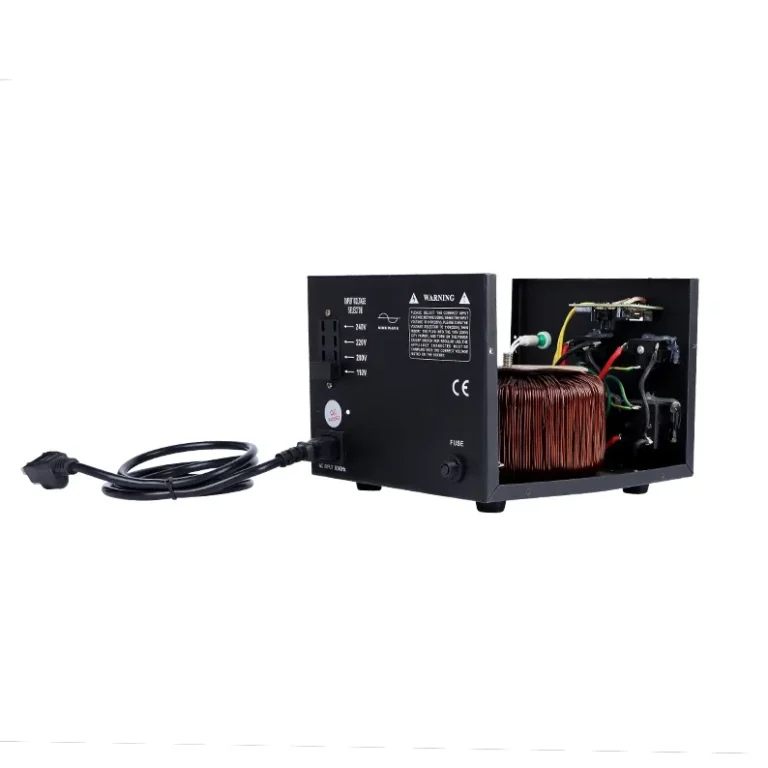
An iron-core transformer is a different product entirely. Two windings on a laminated steel core, copper wire, no electronics in the power path. The output is a clean 110V sine wave, it holds its shape under motor loads, and it will run for years. Every unit we build is this type. If you are powering a refrigerator, an air conditioner, a washing machine, a workshop tool or a medical device, that is what you need, and the price difference between it and a throwaway travel converter is smaller than the cost of replacing one appliance.
Household Loads Versus Commercial Loads in Bahrain
Sizing conversations in Bahrain usually split into two very different cases, and mixing them up is how people end up with the wrong unit.
The Household Case
A family moving into a villa or apartment with a shipment of 110V appliances is the most common enquiry we get from the region. The list is usually some combination of a refrigerator, a chest freezer, a microwave, a coffee machine, a blender or stand mixer, a vacuum cleaner, a TV and entertainment setup, a treadmill, a CPAP machine and a box of power tools. Individually these are modest. Together, and with the fridge and freezer running continuously, they add up faster than people expect.
The mistake I see here is buying one small unit for the whole house and then discovering that the fridge, the freezer and the microwave cannot all be on it. The better arrangement is two or three smaller units, each dedicated to a group of appliances, with the refrigeration on its own. That also means a fault in one group does not take down the kitchen, and it gives you somewhere to plug in the vacuum without unplugging the freezer.
The Commercial Case
Commercial enquiries are a different scale. A restaurant or cafe with imported kitchen equipment. A salon with a row of styling stations and imported dryers. A gym with treadmills and resistance machines. A workshop with imported power tools. A hotel with a store of US-spec small appliances. A facilities company maintaining villa compounds. In these cases the load is continuous through the trading day, the machines are motor driven, and the simultaneity question is real because staff tend to switch things on together at the start of a shift.
For anything with more than a handful of machines, I would size the site by zone rather than by building. Kitchen on one unit, salon stations on another, and the heavy motor loads kept apart from any heating appliance. It costs a little more in hardware and it makes the site far easier to live with.
Air Conditioning and Refrigeration: The Load That Catches People Out
This one deserves its own section because it comes up on nearly every Bahrain enquiry, and getting it wrong is expensive.
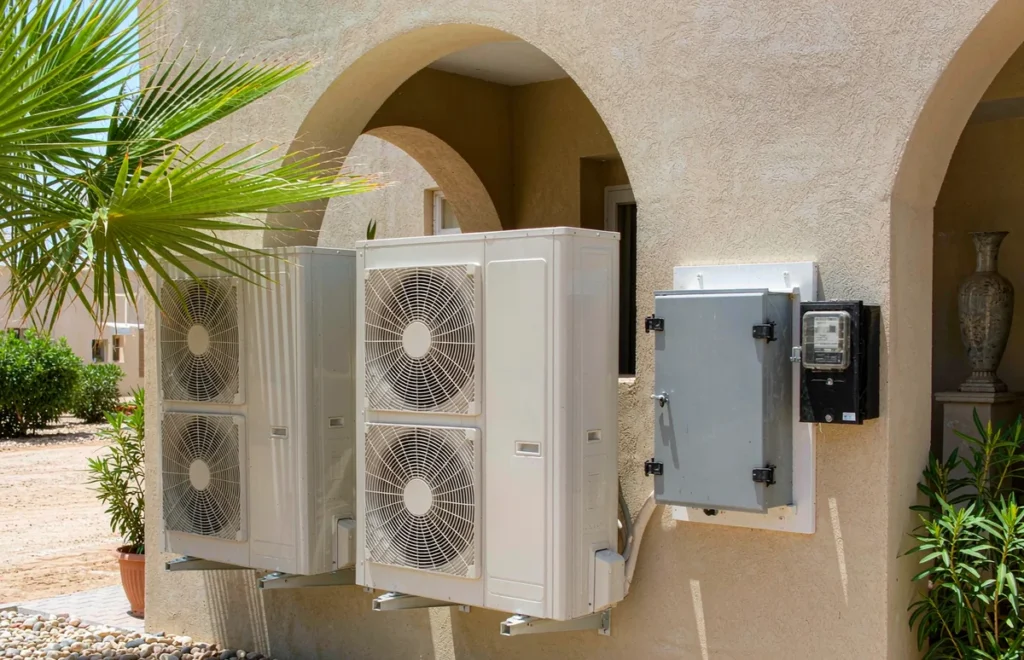
Most split and central air conditioning installed in Bahrain is 230V equipment, and those units need nothing from us. The 110V air conditioning problem comes from imported equipment: window units, portable units and some packaged systems built for the North American market at 115V. Those are compressors, and a compressor is the hardest-starting load you will find in a domestic setting. The starting current on a compressor can sit between 2.5 and 3 times its running current, and it lasts longer than the start of a small fan motor.
A 115V portable air conditioner typically runs somewhere between 1000W and 1800W. Add the same again for the surge and you can see why a 2000VA unit is the sensible minimum for one such machine, and why putting two of them on the same box is a bad idea. If you are running a store room, a staff accommodation block or a labour camp with several imported air conditioning units, that is a commercial sizing job and it needs a proper load sheet rather than a guess.
Refrigeration behaves in a similar way. A 110V chest freezer or display fridge has a compressor that cycles on and off all day and all night, and in a Bahrain summer it cycles more often than it would in a cooler climate because it is fighting a harder temperature difference. Never discount a refrigeration load from your total, even if it is small on paper.
Summer Heat: Why 45 Degrees Changes Your Sizing
Bahrain in July and August is hot. Coastal humidity makes it worse, and a transformer sitting in a garage, a plant room or a roof-level service area can see ambient temperatures well above the 40 degrees Celsius that most units are rated against. This matters because a transformer’s capacity is limited by how hot its insulation gets, and the ambient temperature sets the floor that everything else sits on. A unit that runs comfortably at 30 degrees will run noticeably hotter at 48 degrees, and if it was already running near its rating the insulation pays the price.
Three practical consequences, and they are all cheap to act on.
The first is that you should size up. In a hot installation, going one step higher on the rating is the simplest and most reliable protection you can buy. A 2000VA unit asked to do 1500VA of work in a 30 degree room is comfortable. The same unit doing 1800VA in a 50 degree room is not, and the extra cost of the next size up is trivial next to replacing the unit and the appliances it protects.
The second is placement. Do not put the transformer on a roof, in direct sun, or in the corner of a plant room that has no airflow. An air-conditioned room, a shaded external wall or a ventilated service cupboard is right. Keep at least 100mm of clear space on every vented face, do not stack boxes against it, and never box it into a sealed cabinet. Airflow is doing real work in a Gulf summer.
The third is duty. A unit that runs for two hours in a European kitchen is not the same job as one that runs from six in the morning until midnight in a Bahrain restaurant. Long duty cycles in high ambient temperatures are exactly why we wind with copper rather than aluminium. Aluminium windings run hotter at the same rating, and hot insulation is what ends a transformer’s life early.
What 50Hz Does to Equipment Built for 60Hz
Voltage is only half of the story in Bahrain. The supply runs at 50Hz, and a great deal of North American equipment is designed around 60Hz. A transformer changes voltage and never frequency, so a machine built for 110V at 60Hz will receive 110V at 50Hz and behave slightly differently.
For purely electronic devices, this makes no difference at all. Laptops, phones, TVs, routers, modern control boards and anything with a switch-mode power supply handle both frequencies without noticing. For motor-driven equipment it matters. An induction motor designed for 60Hz will run roughly seventeen percent slower on a 50Hz supply, and it will run a little warmer because the magnetic circuit is no longer matched to the supply. A fridge or freezer compressor running slower will still cool, but it works differently from how it was designed. A pump will move less water. A power tool will spin slower and, in a workshop where cycle time matters, that starts to show.
One visible example worth knowing about: any appliance that keeps time from the mains frequency will run slow. An older style mains-powered clock on a 50Hz supply loses about ten minutes every hour against its 60Hz calibration. It is a small thing, but it tells you clearly that the supply is not what the device was designed for.
None of this is a reason to avoid the equipment. It is a reason to know what you are buying and to tell your supplier what supply you actually have. When a customer sends us a Bahrain list, I go through it and flag anything with an induction motor so there are no surprises on commissioning day.
Shipping to Bahrain and the Paperwork You Will Need
Freight into Bahrain is straightforward, and there are two routes that cover almost every order.
The first is direct. Khalifa Bin Salman Port at Hidd is the country’s main commercial gateway, and vessels from China call there after the main Gulf ports. Bahrain International Airport handles air freight for urgent or high-value shipments. The second route, and the one many importers prefer, is to discharge at Jebel Ali in Dubai and move the cargo onward by feeder vessel or by road through Saudi Arabia via the King Fahd Causeway. That route is often faster and more frequent, and a lot of Bahrain-bound cargo from China is consolidated in the UAE first.
From our side we ship FOB Ningbo or Shanghai, which means you or your freight forwarder control the main leg and can choose whichever routing suits you. If you are buying through a Dubai-based trading company, tell us early, because the bill of lading and the documentation need to match the route and the consignee.
Documents and Conformity
The paperwork set for a Bahrain shipment is the standard one: commercial invoice, packing list, bill of lading, and a certificate of origin. The certificate of origin should be issued and certified through a chamber of commerce, and your customs broker in Bahrain will tell you exactly how they want it presented. Most goods enter under the GCC common customs tariff, which is typically five percent, and Bahrain also applies VAT on imports. Check the current VAT rate with your broker before you quote a landed cost to a customer, because rates in the region have been moving.
On the product side, Bahrain follows GCC-level technical requirements for low-voltage electrical equipment, and importers are usually asked for a certificate of conformity when clearing a shipment. We supply the documentation that goes with our units, and if your broker needs a specific set of papers, tell us at the quotation stage rather than after the container has sailed. It is much easier to prepare documents while the goods are still on our production floor than to chase them once they are at sea.
Choosing a Unit by Application
Here is a reference table for the enquiries that come in most often from Bahrain. Treat it as a starting point and then send us the actual nameplate figures, because imported appliances vary more than the labels suggest.
| Application | Typical load | Suggested unit | Why |
|---|---|---|---|
| Apartment, kitchen appliances and entertainment | 600 – 1600 W | ST-2000 with RCD | Several mid-size appliances on one 230V to 110V feed |
| Villa, one imported 115V air conditioner | 1000 – 1800 W running | ST-2000, one unit per machine | Compressor start surge decides the size |
| Villa, refrigeration plus kitchen and tools | 1500 – 3000 W | Two units on separate circuits | Keeps refrigeration independent and faults contained |
| Salon or barber shop stations | 1200 – 2500 W | STU-3000 bidirectional | Multiple motor loads starting through the day |
| Restaurant or cafe with imported equipment | 2500 – 5000 W | STU-5000 bidirectional | Long trading hours and mixed appliances |
| Gym, workshop or light industrial bench | 2000 – 5000 W | STU-5000 or two units | Continuous motor duty in high ambient heat |
| Service bench and equipment testing | 500 – 2000 W variable | Variac 1KVA to 3KVA | Adjustable output for checking imported machines |
One note on the table. Anything past roughly 5000VA is better handled by splitting the site across two units than by pushing one box harder, and in Bahrain that advice is worth double because of the ambient heat. Two units also mean that if one needs service during the summer, the rest of the property keeps working while you wait for a replacement.
The Units We Build and How We Supply Bahrain
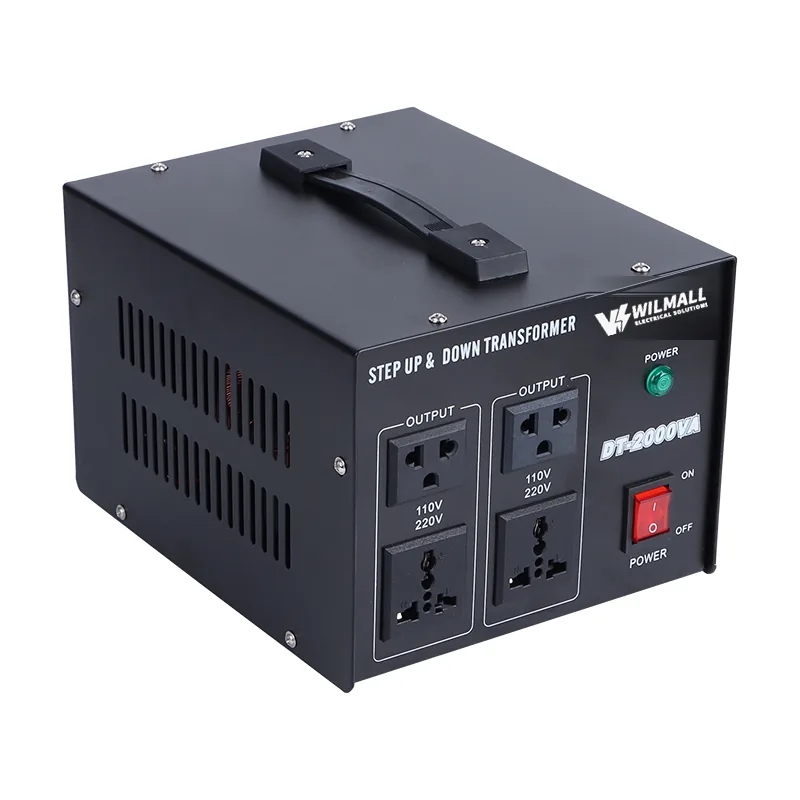
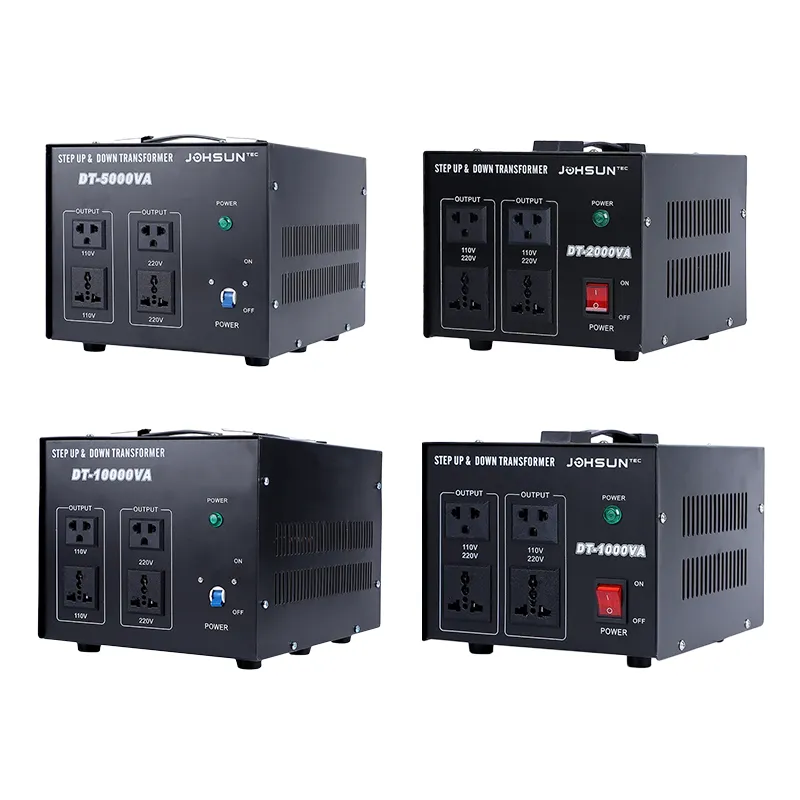
We are a factory, not a trading company, so I can tell you exactly what comes off our line. The ST-2000 is a 2000VA step down transformer taking 230V or 220V in and giving 110V out, with RCD protection built into the enclosure. For a household group of appliances, or a single imported air conditioning unit, that is the box I quote most often into the Gulf. The RCD matters in a country where kitchens and bathrooms are wet rooms and the installation is British-style to begin with.
When the load climbs we move to the STU series. STU-3000 and STU-5000 are bidirectional, stepping up as well as down, and they carry the heavier side of commercial work: restaurant kitchens, salons, workshops and the zoned arrangements I described. Bidirectional is genuinely useful in Bahrain, because a market that imports from both North America and Europe ends up needing to go both ways eventually.
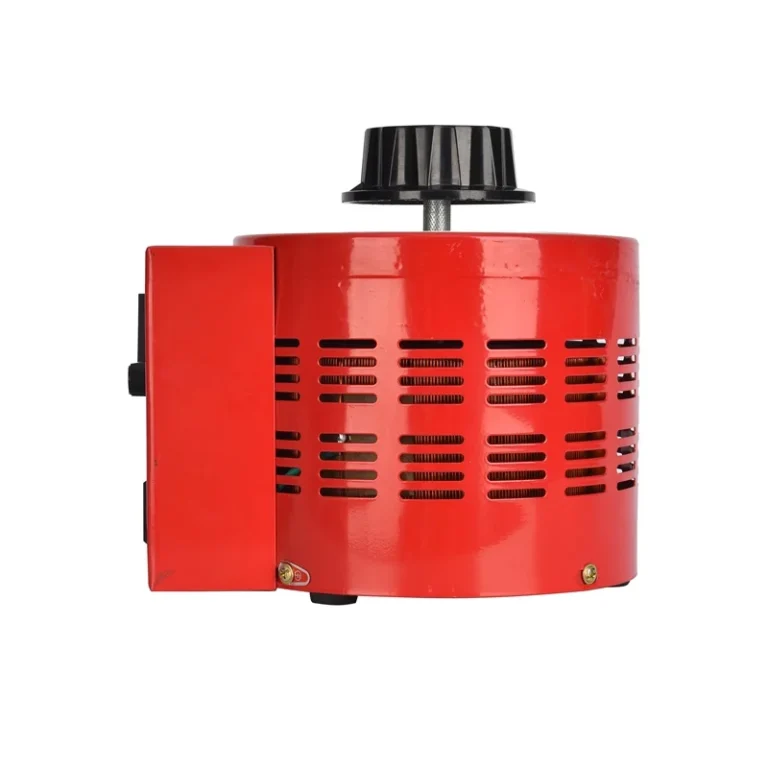
The DT-1000VA is our bidirectional automatic unit, and it suits offices, front desks and small equipment carts where a modest load needs to work in either direction without anyone thinking about it. Then there is the Variac range at 500VA, 1KVA, 2KVA and 3KVA. Adjustable voltage sounds dull until a maintenance technician is commissioning an imported machine in a hotel and needs to see how it behaves at 105V before signing off on the installation.
Numbers, because Gulf buyers ask these first. Our minimum order is 10 pieces. Production runs 15 to 25 days depending on quantity and whether you want custom labelling. We ship FOB Ningbo or Shanghai, every unit carries a 12-month warranty, and we test 100 percent of what we build in our own factory in Yueqing. You get a test record from your batch showing input voltage, output voltage under load and no-load current, which is the document a warranty claim needs if it ever comes to that.
For Bahrain specifically, two customisation requests come up constantly. The first is the outlet type, and we can fit the socket your equipment uses so nobody is relying on a stack of adapters. The second is the label. Importers and contractors often want their own name on the faceplate and their own manual in the box, and we are set up for exactly that. Send us a photo of the appliance plug and we will match it.
What to Send Us for a Sized Quote
You do not need a finished specification to talk to us. Send what you have. The equipment list with the wattage from each nameplate, a photo of one nameplate if that is easier than typing, how many appliances or machines need a 110V feed, whether any of them are air conditioners or compressors, and where the unit will be mounted. From that we can size it, quote the quantity and give you a delivery window, usually the same working day.
Two things worth reading while you put that list together. Our guide to a Voltage Converter for Qatar covers a neighbouring GCC market with the same 230V, 50Hz supply and Type G sockets, so most of the sizing logic carries straight over. And if you are still working out whether you need a step down unit, a step up unit or something that does both, our page on step up & down transformers explains the difference in plain terms. There is a set of voltage guides by country on the site as well, covering the rest of the Gulf and beyond.
If anything is unclear, send the list and a photo of your plugs. Sizing a voltage converter for a Bahrain installation is routine work for us, and we would much rather spend ten minutes on WhatsApp than have you find out in August that the unit you bought cannot start the air conditioner.
Bahrain Voltage Converter Questions I Get Asked Most
These are the messages that fill my inbox from the Gulf, answered the way I would answer them on a call.
What voltage and frequency does Bahrain use?
Bahrain runs on nominal 230V at 50Hz, the same as the rest of the Gulf Cooperation Council. Sockets are Type G, the British-style three-pin pattern with a 13 amp fuse, which caps a single socket at just under 3000VA. Equipment fitted for Bahrain will also suit Qatar, the UAE, Kuwait, Saudi Arabia and Oman.
Do I need a voltage converter or a transformer for 110V appliances?
For anything with a motor, a compressor or sensitive electronics, you need an iron-core transformer with copper windings, not a lightweight travel converter. Travel converters chop the waveform and suit only resistive heating appliances such as hair dryers. A transformer gives a clean 110V sine wave and holds its shape under motor loads.
How does Bahrain’s summer heat affect transformer sizing?
A transformer’s capacity is limited by how hot its insulation gets, and ambient temperature sets the floor. In a garage or plant room at 45 to 50 degrees Celsius, a unit running near its rating will run far hotter than the same unit in a 30 degree room. Size up one step and keep at least 100mm of clear space on every vented face.
Can I run a 115V air conditioner in Bahrain on a transformer?
Yes, if you size for the compressor start rather than the running watts. A 115V portable or window unit draws roughly 1000W to 1800W running, and the compressor surge on start is 2.5 to 3 times that. One 2000VA unit per machine is a sensible minimum, and do not put two of them on the same box.
Which port does cargo from China arrive at in Bahrain?
Khalifa Bin Salman Port at Hidd is the main commercial gateway, and Bahrain International Airport handles air freight. Many importers route cargo through Jebel Ali in Dubai and move it onward by feeder vessel or by road through the King Fahd Causeway. You will need an invoice, packing list, bill of lading and a certified certificate of origin.
Sending us your equipment list costs nothing and usually prevents a sizing mistake. Tell us what 110V machines you run, whether any of them are air conditioners or compressors, and where the unit will be mounted in Bahrain. We will come back with a recommended unit, a quantity and a price, normally the same working day.
Or talk to us directly: WhatsApp +86 197 3022 6757 · Email sales@wilmall.com
MOQ 10 pcs · Lead time 15-25 days · FOB Ningbo or Shanghai · 12-month warranty