Step Down Transformer for Warehouses: 220V to 110V
A warehouse does something to a transformer that a home never will. It leaves it switched on for sixteen hours a day, in a steel building that turns into an oven by two in the afternoon, with a dozen small devices hanging off it that nobody remembers to switch off. Then, once or twice a shift, a forklift charger or a shrink wrapper kicks in and the load jumps. Most of the failed units I see come back from warehouse duty, and almost none of them failed because the buyer picked the wrong voltage. They failed because the box was too small for the hours and the heat.
I work at a transformer factory in Yueqing, China, and warehouse orders come to me from third-party logistics operators, cold store managers, e-commerce fulfilment centres, spare parts depots, and factory stores that grew into something bigger. The lists are always long and full of small items, which is exactly why sizing them properly matters more than buyers expect.

Why a Warehouse Loads a Transformer Differently
Three things separate warehouse duty from domestic duty, and the hours come first. A fulfilment centre running two shifts has its scanners, printers, security system and packing station equipment energised for most of the day and a good part of the night. A transformer under load for sixteen hours builds more heat in its winding than one that runs for two, and it does not get long to shed that heat before the next shift starts.
Then there is the sheer number of devices. Warehouses do not have one big appliance. They have thirty small ones, spread across a receiving dock, a packing bench, a shelving area and a charging corner. Each device is trivial on its own, and the total is not. When a load sheet comes in with forty line items, the buyer’s instinct is to add everything and panic, or to ignore the small stuff and undersize. Neither is right, and I will show you the middle way in a moment.
Ambient temperature closes the list. Inside a steel-clad warehouse on a hot day, the air around a wall-mounted unit can sit well above 40 degrees Celsius, and a transformer’s rated capacity assumes something closer to 25 or 30. Run a unit at its full rating in that environment and it will cook. This is the single most common reason warehouse transformers fail early, and it is why I tell warehouse buyers to go one size up rather than sizing on the plate figure alone.
The 110V Equipment You Actually Find in a Warehouse
When a warehouse manager sends me a list, it usually looks like this. Barcode scanners and RF guns on charging cradles, thermal label printers at every packing bench, desktop printers and label applicators, a bank of forklift or pallet truck chargers, shrink wrap and strapping machines, powered tape dispensers, dock fans, LED task lighting, and the security side of the house: cameras, recording units and a monitoring screen. Some sites also run imported conveyor sections and powered roller beds at 110V.
Here is roughly what those items draw, and how they behave on a transformer. Your own equipment will differ, so take the figures off the nameplate where you can.
- Barcode scanners and charging cradles, typically 20W to 80W each, but a cradle is never switched off, so it runs all day.
- Thermal label printers, 80W to 250W while printing, with a small heater on some models that draws continuously.
- Forklift and pallet truck chargers, often 500W to 2500W per unit, and they pull their full rating for hours on end.
- Shrink wrap machines and strapping tools, 300W to 1500W, with a heater that cycles on and off.
- Security cameras and recording units, 100W to 400W for a whole system, and it runs twenty-four hours.
- Task lighting and dock fans, 40W to 300W per fixture or fan, usually grouped three to six at a time.
- Packing bench computers and monitors, 150W to 400W per station.
- Conveyor sections and roller beds, where motor inrush has to be considered if they are 110V driven.
And what does not need a transformer, which saves a surprising amount of money on a big site: laptops, tablets, phone chargers, and most modern LED lighting and CCTV hardware, because these carry a 100-240V, 50/60Hz rating and run straight off your 220V supply. Check the labels before you write them into the load sheet. On a thirty-line list, that check alone can drop you a size.
How to Size for a Charging Bay and a Packing Bench
My method works the same way as everywhere else, but with two warehouse-specific adjustments. Add up the devices that can genuinely run at the same moment, add 25 to 30 percent headroom, then go one size up if the unit will sit in a hot spot or run more than twelve hours a day. That last step is not padding. It is compensation for reality.
Start with a packing bench. A label printer at 200W, two scanners in cradles at 40W each, a monitor at 60W, a task light at 50W and a fan at 90W. Everything at once is 480W. Add 30 percent and you are at 620VA, so a small unit covers a single bench with room to spare. Now do a bench with a 1200W shrink wrapper and a 250W printer on the same feed, and you are at 1885VA with headroom, which is where a 2000VA unit becomes the sensible choice.
| Warehouse item | Typical running watts | Behaviour on a transformer | Sizing note |
|---|---|---|---|
| Scanner and charging cradle | 20 – 80 W each | Steady, never switched off | Multiply by the number of cradles in the bay |
| Thermal label printer | 80 – 250 W | Burst while printing, warm idle | Count a printer per bench, not per site |
| Forklift or pallet truck charger | 500 – 2500 W each | Full load for hours | Usually the deciding load for the site |
| Shrink wrapper or strapping tool | 300 – 1500 W | Heater cycles on and off | Add headroom when two run together |
| Camera system and recorder | 100 – 400 W total | Steady, 24 hours | Small load, but it never stops |
| Lighting and dock fans | 40 – 300 W per unit | Mostly resistive or small motors | Group them and count the group |
| Packing bench PC and monitor | 150 – 400 W per station | Steady electronic load | Often wide input and not needed |
Diversity: Why You Do Not Add Every Charger
This is the part buyers get wrong most often, in both directions. Say you have a charging corner with eight pallet truck chargers at 1200W each. Add the plates and you get 9600W, and the temptation is either to order a monster unit or to give up and hope. Both are wrong, because chargers do not all run at full draw in the same minute.
Lead acid and lithium chargers taper. They pull hard for the first part of a cycle, then drop to a trickle. In a bay where a shift rotates eight trucks, the realistic overlapping peak is two or three chargers at full draw at once, not eight. So the honest figure is nearer 2400W to 3600W plus the bay lighting, then 25 percent headroom on top, which lands you in the 4000VA to 5000VA region.
| Charging bay size | Plate total | Realistic overlapping peak | Unit we usually suggest |
|---|---|---|---|
| 2 chargers at 1200W | 2400 W | Around 1900 W | ST-2000, one unit for the bay |
| 4 chargers at 1200W | 4800 W | Around 3000 W | STU-3000 for the bank |
| 8 chargers at 1200W | 9600 W | Around 3600 W | STU-5000, or two units split east and west |
| Mixed bay with lighting and fans | Depends on site | Peak plus steady loads | Split the steady loads onto their own unit |
One practical tip that costs nothing. Put the always-on loads, meaning the security system, the cradles and the network cabinet, on their own small transformer, and keep the charger bank on a bigger one. That way a charger problem never takes down your cameras, and the steady loads are not sharing a box with something that surges.
Cable Runs and Voltage Drop in a Big Shed
Warehouses are long, and that matters. If you put one transformer at the front of a hundred metre building and run 110V cable to the back, the voltage at the far end will be lower than the voltage at the terminal, and the drop gets worse the more current you pull. Motors and chargers at the far end then draw more current to compensate, which heats both the cable and the machine.
The fix is not complicated. Feed the far end with a shorter run, or use heavier cable, or split the site into two or three zones with a unit in each. On a large site, zoning also gives you redundancy, so a fault in one zone does not stop dispatch for the whole building.
The Units We Build for Warehouse Work
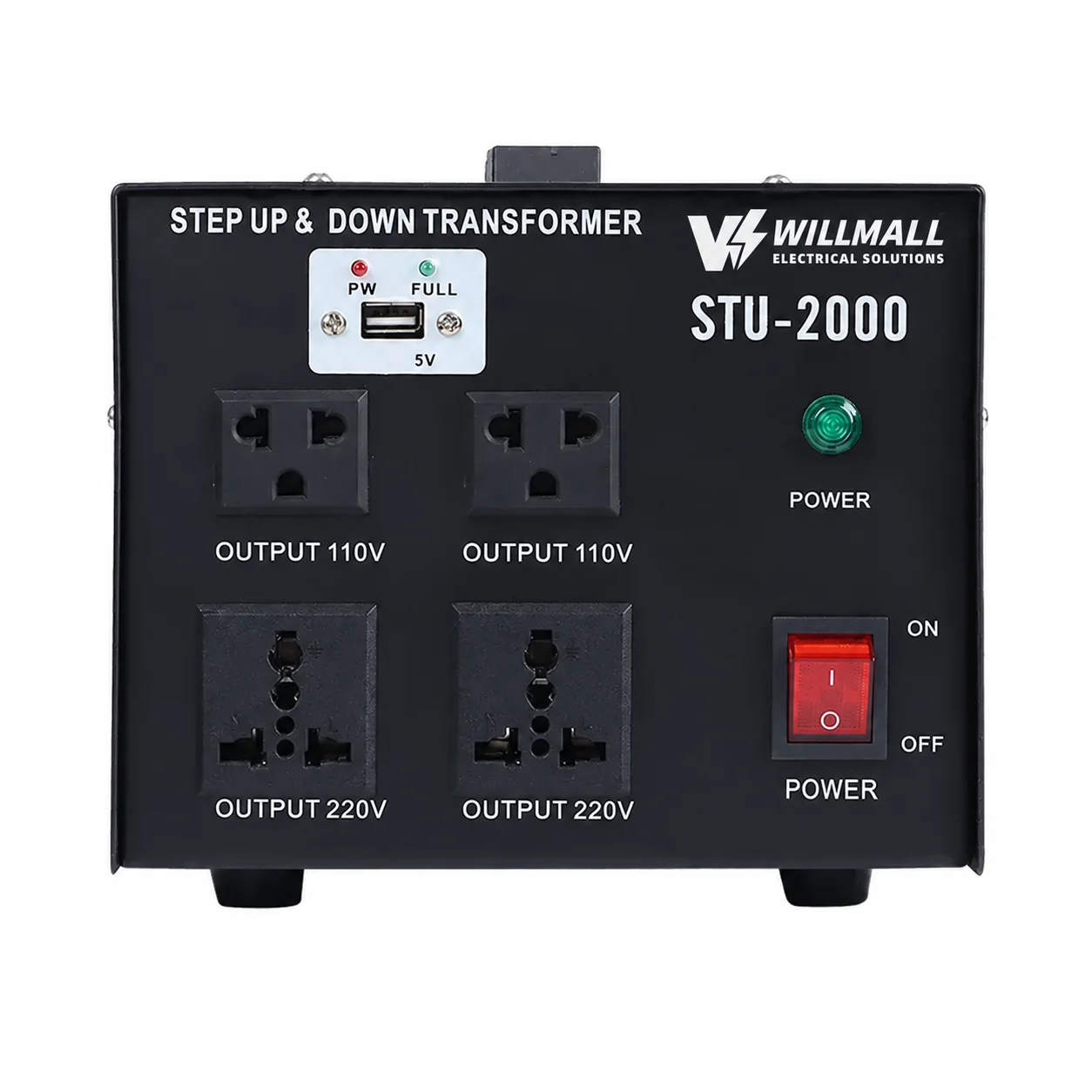
We are a factory rather than a trading company, so I can tell you exactly what comes off our line. The ST-2000 is our 2000VA step down unit, 220V in and 110V out, with RCD protection built in. In a warehouse it suits packing benches, printer clusters, small charging bays and a reception or gatehouse position, and the RCD earns its place anywhere the unit sits near a dock door where the floor gets wet.
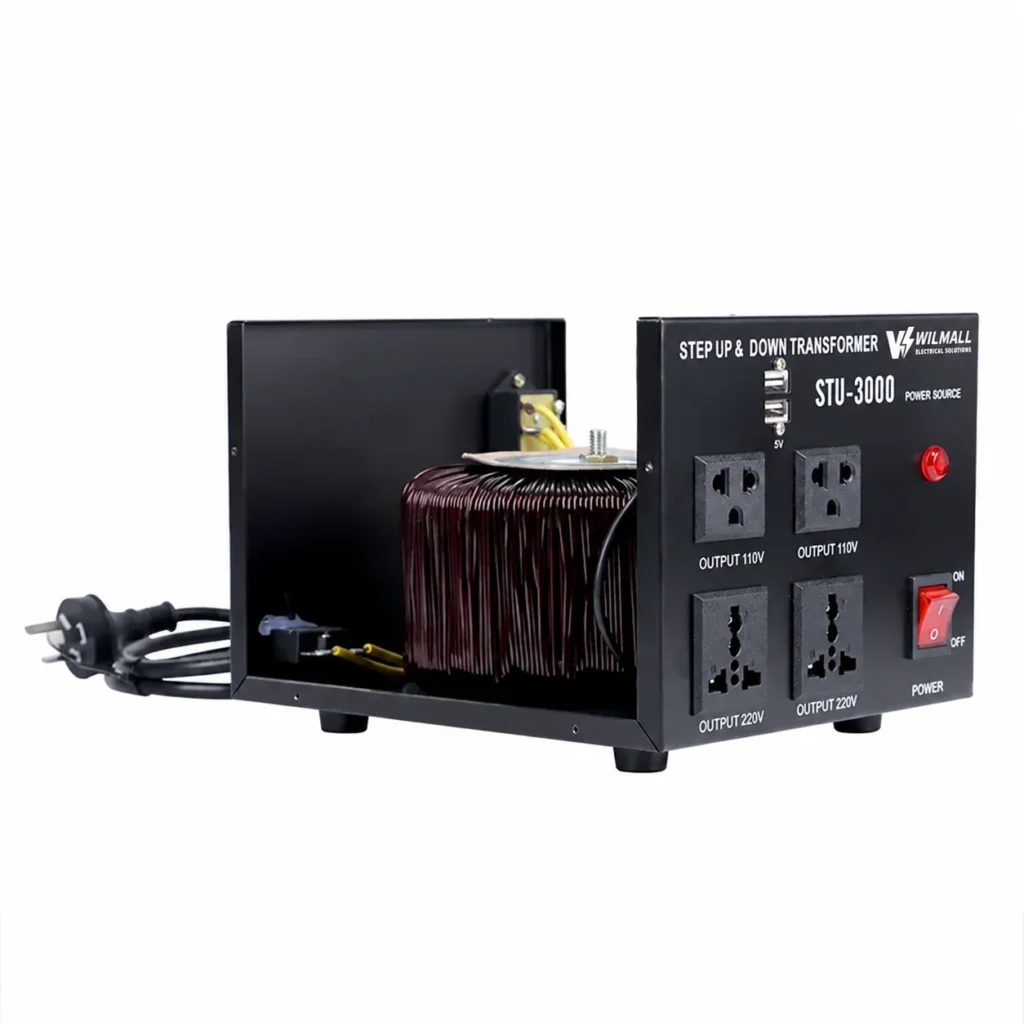
For charger banks and motors you want the STU series. STU-3000 and STU-5000 are bidirectional, stepping up as well as down, and they handle the heavier end of warehouse duty: pallet truck chargers, conveyor sections, shrink equipment, and the mixed bays I described above. Bidirectional is genuinely useful in a distribution centre, because sites that import both 110V and 220V equipment always end up needing to go both ways at some point.
For the light positions we keep the DT-1000VA, a small bidirectional automatic unit. It fits scanner cradles, gatehouse equipment and network cabinets where a modest load needs to work in either direction without anyone thinking about it. The Variac range at 500VA, 1KVA, 2KVA and 3KVA is adjustable voltage, and maintenance teams use them for checking how a charger or conveyor drive behaves at 105V or 115V. If you want to understand what those losses look like over a year of continuous running, our article on Transformer Efficiency and Energy Loss Explained is worth ten minutes of your time.
Heat, Dust and Where to Mount It
Mounting position decides how long a warehouse unit lives. Put it somewhere with free air on every vented face, off the floor so a pallet truck cannot hit it, and out of the direct path of dock doors where rain blows in. Do not box it into a sealed cabinet to keep it tidy, and do not stack cartons against it. If the only available spot is a hot corner under a metal roof, tell us, because that is exactly when we recommend going one size up.
Dust is the other killer. Cardboard dust, shrink wrap fibres and general warehouse grit all find their way into vents. Blow the unit out with compressed air every few weeks and it will thank you. If your site has airborne dust from bulk goods, ask us about a unit with better ingress protection rather than accepting a standard enclosure and hoping.
Earthing is not optional. The enclosure must be bonded to the building earth, and the 110V output should be a proper circuit with proper sockets. Trailing leads across a warehouse aisle is how units get destroyed and people get hurt.
MOQ, Lead Time and Batch Records
Commercial details, since these come up first. Minimum order is 10 pieces, whether you are covering one packing bench or fitting out a whole site. Lead time runs 15 to 25 days depending on quantity and whether you want custom labelling. We ship FOB Ningbo or Shanghai, and every unit carries a 12-month warranty. Inside the box you get a test record from the batch your transformer came from, showing input voltage, output voltage under load and no-load current, because we test 100 percent of what we build in our own factory here in Yueqing.
Customisation suits warehouse orders well. We can fit the socket type you use, set the output to 110V or 120V to match your equipment labels, supply units with longer output leads for wall mounting, and print your company label on the faceplate. If you are rolling the same installation out across several sites, tell us the schedule and we will stage deliveries rather than ship you a pallet of units to store in the goods-in area.
What to Send Us for a Sized Quote
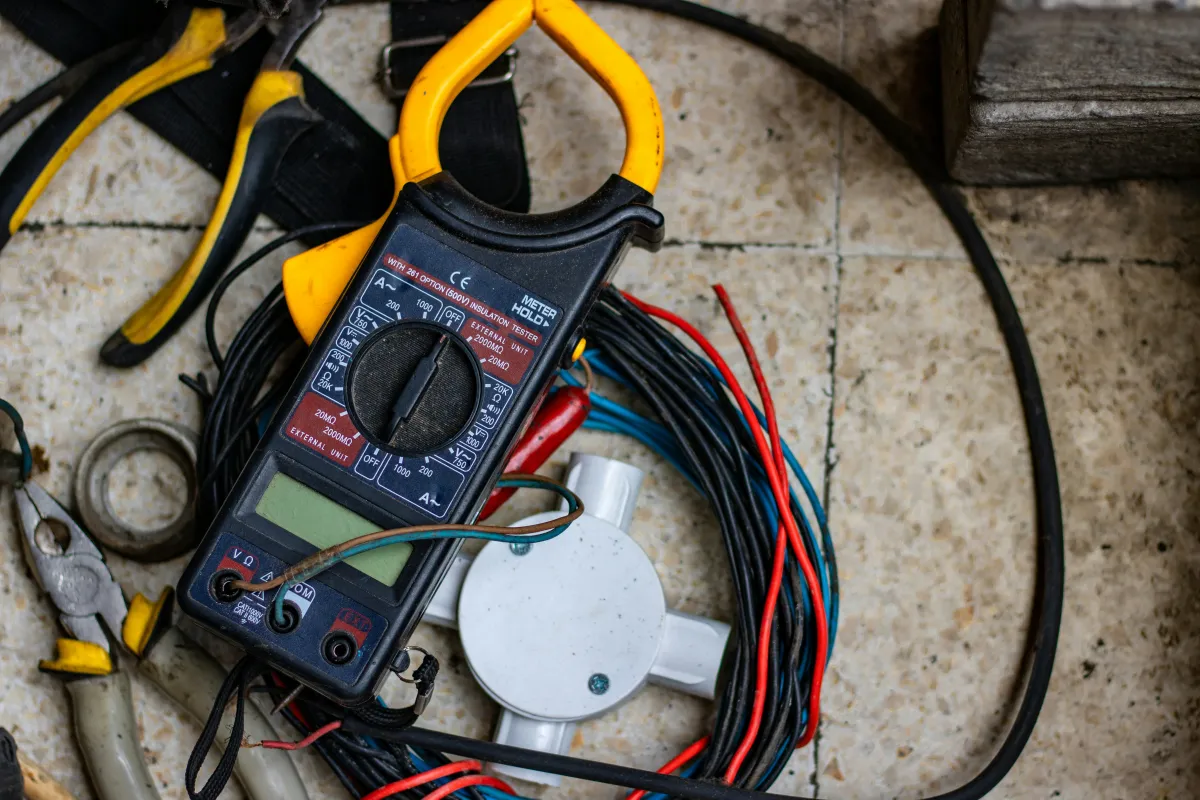
You do not need a finished specification. Send the equipment list with watts or amps off the nameplates, a photo of one nameplate if that is easier, your mains voltage and frequency, the socket type on site, how many zones you want to feed, the number of charger positions in the bay, and how many hours a day the site runs. From that we can size the units, quote the quantity and give you a delivery window, usually the same working day.
If you are still weighing up whether you need a step down unit, a step up unit, or something that handles both, our page on step up & down transformers explains the difference in plain terms. There is a full set of more application guides on the site too, covering everything from charging bays to lighting loads.
If the list looks messy, send it anyway. Sizing a step down transformer for a warehouse is routine work for us, and ten minutes on WhatsApp beats ordering the wrong capacity for every bench and bay in the building.
Warehouse Transformer Questions Buyers Ask Most
These are the questions that come through every week, answered the way I would answer them on a call.
What size step down transformer do I need for a warehouse charging bay?
Do not add every charger at full draw. Chargers taper, so in an eight-truck bay the realistic overlapping peak is two or three units at full current. For eight 1200W chargers that works out near 3600W, and with headroom on top we usually suggest an STU-5000 or two smaller units split across the bay.
Can one transformer run all day in a warehouse without overheating?
A properly sized unit can run continuously, but warehouse duty is hard on transformers and ambient heat is the real enemy. If the unit sits in a hot corner or runs more than twelve hours a day, go one size up from your calculated figure. Make sure it has free air on every vented face and blow the dust out regularly.
Should I buy one big transformer or several smaller ones for a warehouse?
On a large site we usually suggest zoning, with a unit serving each area. It keeps cable runs and voltage drop small, and a fault in one zone does not stop the whole building. Put always-on loads like cameras and network equipment on their own unit so a charger problem never takes down your security system.
Do warehouse scanners, printers and cameras need a step down transformer?
Check the label first. A lot of modern cradles, monitors, CCTV hardware and LED lighting are rated 100-240V, 50/60Hz and run straight off your 220V supply with a plug adapter. Counting them can push a long warehouse load sheet into a larger and more expensive transformer than the site actually needs.
Where should a warehouse transformer be mounted and installed?
Mount it off the floor where a pallet truck cannot hit it, with a hand’s width of free air around every vented face. Keep it out of the path of dock doors and away from shrink wrap and cardboard dust. Bond the enclosure to building earth and wire the 110V output as a proper circuit, not trailing leads.
Send us your equipment list and we will size it for you. Tell us how many benches and charging bays you need to feed, which country the site is in, and how many hours a day it runs. We will come back with a recommended unit, a quantity and a price, normally the same working day.
Or talk to us directly: WhatsApp +86 197 3022 6757 · Email sales@wilmall.com
MOQ 10 pcs · Lead time 15-25 days · FOB Ningbo or Shanghai · 12-month warranty