Step Down Transformer for Workshops: Buyer’s Guide
A workshop is the hardest place in the world to run 110V equipment off a 220V supply. Not because the voltage is difficult, but because of what sits on the benches. A drill press, a bench grinder, an air compressor, a welding set, a dozen hand tools, all of them pulling power in bursts, all of them starting with a kick that is several times their running draw. Buy the wrong box and you will know within a week, usually when the compressor kicks in and everything else on the circuit blinks.
I work at a transformer factory in Yueqing, China, and workshop orders come to me from small machine shops, maintenance departments, cabinet makers, auto workshops, and lads running a fabrication business out of a two-bay unit. What I have learned is that the sizing conversation here is genuinely different from home or clinic work, and most of the mistakes trace back to one thing: people size on running watts and forget startup.

Startup Inrush Is What Actually Kills Cheap Converters
Here is the thing about an induction motor. While it is spinning at full speed, a bench grinder or a drill press pulls a modest, steady current. For the fraction of a second after you flip the switch, while the rotor is still standing still, it pulls somewhere between three and six times that figure. The exact number depends on the motor, and it is worth asking the tool’s maker if you want precision, but the shape of it does not change. A 750W grinder can look like a 3kW load for two hundred milliseconds.
A decent transformer handles that surge without complaint, because a transformer is copper and iron and it has thermal mass. What does not handle it is a lightweight electronic converter, the sort sold in a plastic case with a peak rating printed on the front in bigger type than the continuous rating. Those units have no real ability to absorb a surge, so the first time your compressor starts, the converter either trips out or dies quietly and never comes back. If you are running motors, you want a proper transformer with a magnetic core, not a box full of semiconductors.
Welders deserve their own paragraph. A 110V welding set draws a serious current on the input side while the arc is running, and most of them are rated on a duty cycle rather than continuous output. So the honest way to size one is to read the input current off the nameplate, multiply it by the voltage, and then think about how long the arc actually runs for. A machine that draws 20A at 110V is asking your transformer for roughly 2200VA while you are laying a bead, which is why a welder usually means moving up to a bigger unit than the bench tools alone would suggest.
Which Workshop Machines Usually Need a Step Down Transformer
When a workshop sends me an equipment list, I sort it into machines that need a transformer and machines that do not. Below is what normally lands on the yes side, with the figures I see most often. Your own tools may differ, so check the nameplate.
- Drill presses and tapping machines, typically 350W to 1100W, with a heavy start every time you pull the handle down.
- Bench and pedestal grinders, usually 250W to 750W, and they reach full speed in under a second, which means a sharp inrush.
- Band saws, mitre saws and table saws, from 700W on a small unit past 1800W on a cabinet saw, all motor loads.
- Air compressors, often 750W to 2200W, and the worst of the bunch because they start against pressure.
- Welding sets, 110V input machines that can ask for 2000VA or more at the arc, sometimes well over that on the bigger sets.
- Plasma cutters and induction heaters, where input current climbs fast and the electronics want a clean supply.
- Polishers, die grinders and hand tools, generally 300W to 1200W each, small on their own but often run two or three at a time.
- Bench lighting, extraction fans and cordless tool chargers, usually 50W to 400W, steady loads that are always on while you work.
What does not need us: laptops, phone chargers, most LED work lights with a wide input range, and any machine whose label reads 100-240V, 50/60Hz. Also worth checking before you build a load sheet, some modern inverter-based welders accept a wide input range, and if yours does, it does not need a transformer at all. If the label is unclear, send me a photo and I will tell you what it means.
How to Size a Step Down Transformer for a Workshop
My method is blunt and it works. Write down every 110V machine on the floor. For each one, note the running watts and the starting watts. Then decide which machines can genuinely be running at the same moment, because that is the number that sizes the unit. Add 25 to 30 percent on top and you have your VA figure.
Take a typical two-bay fabrication unit. A 750W bench grinder, a 900W drill press, a 1500W compressor, two 600W hand tools, a 400W extractor and 200W of lighting. Everything at once is 5550W, which would push you into a large and expensive unit. Realistically, the compressor is the boss here, because it starts against pressure and pulls a big surge. What actually matters is the compressor surge plus whatever is running while it kicks in. Say the compressor is the worst case at three times running, that is 4500W momentarily, and the drill press and lighting are going at the same time for another 1100W. With 25 percent headroom you are looking at a unit in the 5000VA to 7000VA region, which in our range means the big bidirectional box rather than a plug-in one.
| Workshop machine | Typical running watts | Starting behaviour | Sizing note |
|---|---|---|---|
| Bench grinder | 250 – 750 W | Fast start, high inrush | Allow for the surge, not the plate figure |
| Drill press | 350 – 1100 W | Motor load, repeated starts | Count it if it runs while the compressor does |
| Air compressor | 750 – 2200 W | Starts against pressure | Usually the deciding load in a workshop |
| Band saw or table saw | 700 – 1800 W | Heavy start, cutting load | Add headroom for thick material |
| 110V welding set | 2000 W and up at the arc | Duty cycle rated, high input current | Size from input amps on the nameplate |
| Hand tools and polishers | 300 – 1200 W each | Small motors, frequent starts | Add them up when several run together |
| Extraction fan and lighting | 50 – 400 W | Steady, always on | Small, but they never switch off |
Working Out a Real Bench Load
Let me do one more example, because this is where buyers get it wrong. A maintenance bench with a 500W grinder, a 600W drill press and a 900W compressor. If you add the plates, you get 2000W and you order a 2000VA unit. Then the compressor starts while the grinder is running, and the unit sits right at its limit during the surge every few minutes, all day long. It will run hot and it will not last.
Do it the other way round. The compressor surge is the governing figure at roughly 2700W momentary, plus the grinder at 500W, which is 3200W. Add 25 percent and you are at 4000VA, so a 5000VA unit is the honest answer for that bench. Yes, it costs more. It also runs cool, keeps the voltage steady, and does not need replacing in fourteen months.
One Big Unit or One Per Bench?
For a workshop, I usually lean towards one unit per bench or per machine group rather than a single central box, and the reason is fault isolation. If one transformer trips, you lose one bench instead of the whole floor. It also means shorter cable runs, and shorter runs matter here. Thick cable and long distances are how you lose voltage, and a motor that gets 103V instead of 110V pulls more current to do the same work, which heats it up.
If your building has a 110V distribution panel and you want a central arrangement, that can work well too, but then the unit needs to sit somewhere it can breathe and you need proper breaker coordination between the transformer and the machines downstream. Tell us what you have and we will tell you which layout we would pick.
The Units We Build for Workshop Loads
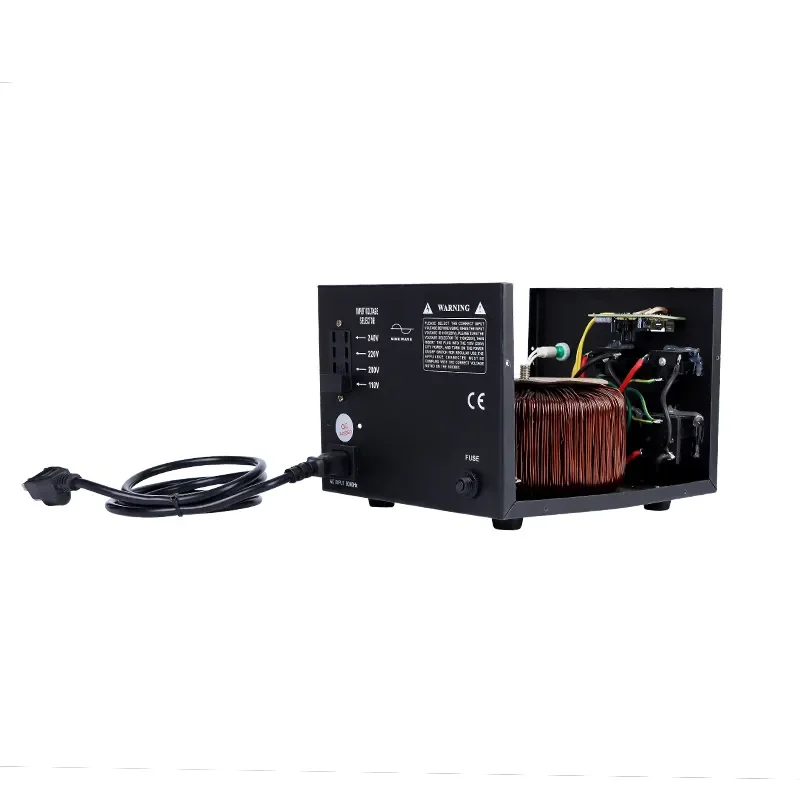
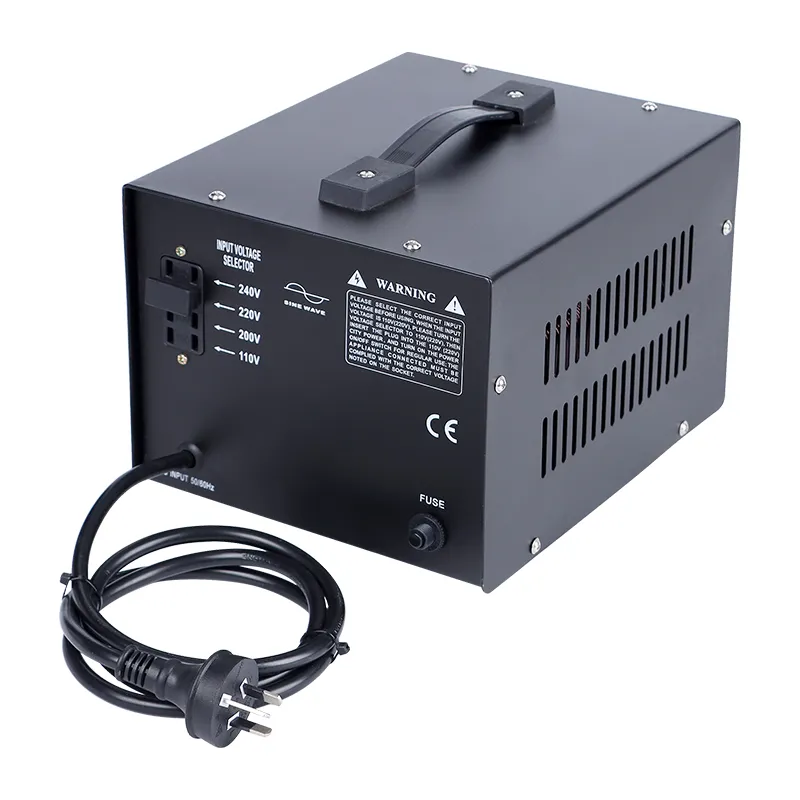
We are a factory in Yueqing with more than fifteen years of manufacturing behind us, so I can be specific. For light benches with hand tools and small chargers, the ST-2000 does the job. It is a 2000VA step down transformer, 220V in and 110V out, with RCD protection built in, and it is the unit I quote for a single bench with a grinder and a couple of hand tools on it.
Once motors and compressors come into the picture, the STU series is what you want. STU-3000 and STU-5000 are bidirectional, so they step up as well as step down, and they are built for the heavier side of workshop duty: compressors, welders, saws, and multi-machine benches. Bidirectional is not a gimmick in a workshop. Half the machines in a maintenance shop are imported at 110V and half the building runs at 220V, and sooner or later somebody needs to go the other way.
The DT-1000VA is our smaller bidirectional automatic unit. It suits workbenches, inspection stations and electrical benches where a modest load needs to work either direction without anyone thinking about it. The Variac range at 500VA, 1KVA, 2KVA and 3KVA is adjustable voltage, and workshops get real value out of these when they are commissioning a rebuilt machine or checking how a tool behaves at 105V. Every maintenance department I have sold one to has come back for a second.
Dust, Heat and Airflow in a Workshop
Workshop environments punish transformers in ways a home never will. Dust settles on the enclosure and blocks the vents, and a transformer that cannot breathe runs hot. Sawdust is worse, because it insulates as well as blocks. Our advice is simple. Mount the unit off the floor, keep at least a hand’s width of free air on every vented face, and blow the vents out with compressed air once a month. Do that and you will get years out of it.
Metal dust is the other one. Do not park a transformer directly under a grinding or cutting station where swarf rains down on it. And keep it well away from welding spatter. Both are avoidable with five minutes of thought about where the box lives.
Earthing matters just as much. The enclosure has to be bonded to the building earth, and the 110V side should be a proper circuit with proper sockets, not a strip of trailing leads running across the floor. In a workshop, trailing leads get forklifted, and a damaged 110V cable is how people get hurt.
MOQ, Lead Time and Testing
The commercial details, since buyers ask first. Minimum order is 10 pieces, whether you need one bench covered or twenty. Lead time is 15 to 25 days depending on quantity and whether you want custom labelling. We ship FOB Ningbo or Shanghai, and every unit carries a 12-month warranty. Inside the box you will find a test record from the batch your transformer came from, showing input voltage, output voltage under load and no-load current, because we test 100 percent of what we build here in our own factory.
Customisation is straightforward for workshop orders. We can fit the socket type you use, set the output to 110V or 120V to match your tool nameplates, fit a longer output lead for wall mounting, and print your company label on the faceplate. If your workshop runs in two shifts and you want a spare on the shelf, order eleven instead of ten, because a spare unit costs less than a lost shift.
We wind with copper, not aluminium. At the same rating, an aluminium winding runs hotter, and in a workshop that already runs warm in summer, that difference is what shows up in year three.
What to Send Us for a Sized Quote
You do not need a finished spec to start the conversation. Send the machine list with the watts and amps off each nameplate, a photo of one nameplate if that is easier, your mains voltage and frequency, how many benches or circuits you want to cover, the heaviest starting load in the shop, and your target date. From that we can size the unit, quote the quantity and give you a delivery window, usually within the same working day.
A couple of things worth reading while you put that list together. If your shop also runs filament or resin machines, our guide to a Step Down Transformer for 3D Printer: 220V to 110V Guide covers the steady-load end of this work, and it is a useful reminder that not every load in a workshop is a motor. If you are still deciding between stepping up and stepping down, our page on step up & down transformers sets out the difference in plain language. There is a set of more application guides on the site as well, covering everything from compressors to power tools.
If you are not sure about any of the numbers, send the list anyway. Sizing a step down transformer for a workshop is routine work for us, and ten minutes on WhatsApp beats ordering the wrong capacity for every bench in the building.
Workshop Transformer Questions Buyers Ask Most
These are the messages that come through every week, answered the way I would answer them on a call.
What size step down transformer do I need for a workshop with motors?
Size on the starting load, not the running load. An induction motor pulls three to six times its running current for a fraction of a second on startup. Add up the machines that can run together, take the largest startup surge into account, then add 25 to 30 percent headroom before you pick a VA rating.
Can I run a 110V welder from a step down transformer?
Yes, but size it from the input amps on the welder nameplate rather than the output welding current. A set that draws 20A at 110V is asking for roughly 2200VA while the arc is running. Welding duty is short bursts, so a unit with real headroom handles it comfortably. Send us the plate and we will size it.
Why does my air compressor trip the converter when it starts?
Because compressors start against pressure, which is the heaviest kind of motor start. A lightweight electronic converter cannot absorb that surge for even a moment. A proper transformer with a magnetic core copes with it, provided the VA rating has enough headroom above the compressor’s running figure.
Is one large transformer better than several small ones in a workshop?
For most workshops we prefer one unit per bench or per machine group. If one unit trips you lose one bench instead of the whole floor, cable runs stay short, and voltage drop stays small. A central unit only makes sense if you already have a 110V distribution panel and proper breaker coordination.
How do I stop a workshop transformer from overheating?
Give it air and keep it clean. Mount the unit off the floor, leave a hand’s width of clear space around every vented face, and blow the vents out with compressed air monthly. Keep it away from grinding swarf and welding spatter. A copper-wound unit that breathes properly will run for years under normal workshop duty.
Send us your machine list and we will size it for you. Tell us what 110V machines you run, the heaviest starting load on the floor, and how many benches need feeding. We will come back with a recommended unit, a quantity and a price, normally the same working day.
Or talk to us directly: WhatsApp +86 197 3022 6757 · Email sales@wilmall.com
MOQ 10 pcs · Lead time 15-25 days · FOB Ningbo or Shanghai · 12-month warranty