110V vs 220V: A Voltage Guide for Buyers in Africa
Quick answer: most of Africa runs on 220–240V (except Nigeria and parts of Central Africa which use 230V, and Liberia/Eritrea which use 120V). If you bring US or Japanese 110V appliances, you need a step down transformer sized 20–30% above the load. If your country uses 120V, you need the opposite — a step up unit.
Key Takeaways
- Most of Africa runs 220-240V; 110V appliances need step down.
- Liberia and Eritrea use 120V and need step up.
- Generator power means extra margin and protection.
- Size for start-up surge on fridges and pumps.
Africa at a Glance
| Country | Voltage |
| Nigeria, Ghana, Kenya | 220-240V |
| Egypt, Morocco | 220-230V |
| Liberia, Eritrea | 120V |
Which Voltage Does Your Country Use?
| Region / country | Mains voltage | What you may need |
| Nigeria, Ghana, Kenya, South Africa | 220–240V | Step down for 110V appliances |
| Egypt, Morocco, Algeria, Tunisia | 220–230V | Step down for 110V appliances |
| Liberia, Eritrea | 120V | Step up for 220V appliances |
| Most of Central/East/West Africa | 220–240V | Step down for 110V appliances |
If you’re not sure, check your wall socket’s label or test with a multimeter — then pick the transformer direction accordingly.
What Happens When You Plug 110V into 220V?
Worst case: the appliance dies instantly — blown power supply, fried motor, damaged heating element. Best case: it runs badly, runs hot, and fails early. Either way, you lose money. A step down transformer is the cheap insurance that makes 110V appliances run safely on African mains.
What Size Step Down Transformer Do You Need in Africa?
Running watts x 1.25, rounded up — with extra headroom for fridges, pumps and tools:
| Appliance | Recommended transformer |
| Phone / laptop chargers | 500VA |
| TV, fans, small electronics | 1000VA |
| Blender, mixer, sewing machine | 1500VA |
| Refrigerator, freezer, washing machine | 2000VA |
| Water pump, deep freezer, workshop tools | 3000VA+ |
Generator Voltage Isn’t Always Clean
Many African homes and businesses run on generators. Generator output can fluctuate — especially under load changes. If your transformer is connected to a generator supply, size it with extra margin (30%+), because brownouts make transformers run hot. For serious fluctuation problems, a stabilizer may also be needed — tell us your situation and we’ll recommend the right combination.
Buying Advice for Distributors and Importers
- Stock the sizes your market actually converts: 1500VA and 2000VA are the volume sellers.
- Choose units with fuse/MCB protection — generator surges punish unprotected gear.
- Buy factory-direct for OEM branding and honest specs.
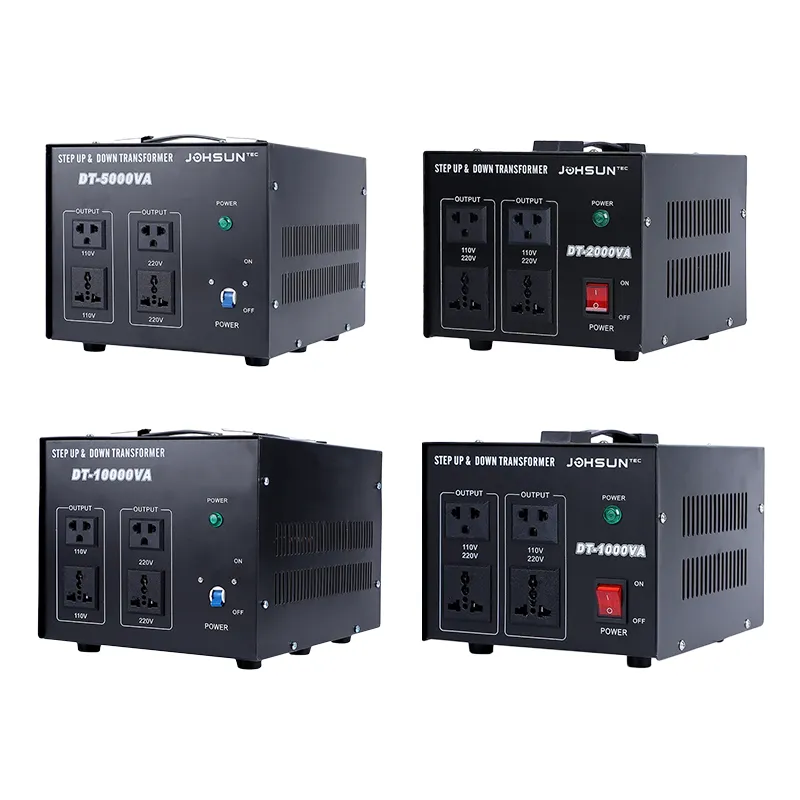
We supply distributors across Africa with their branding and carton design, MOQ from 10 pcs. Browse the step up and step down transformer range or contact us for a distributor quote.
How to Size a Step Down Transformer for African Homes
For most African households, the appliance load is modest: a TV, a laptop charger, a fridge, maybe a sound system. Add the running watts of everything you want to run at the same time, then add 30% headroom, then pick the next standard size up. A TV and sound system alone sit comfortably on a 1000VA unit, while adding a fridge or freezer pushes you to 2000VA because of the compressor surge. If you run a deep freezer and a fridge together, 3000VA is the safer choice. When the grid is unstable or a generator is in the loop, add another 20% margin, because voltage dips stress the transformer. Sizing this way avoids the two failure modes we see most: undersized units that overheat and trip, and oversized units that waste money. If you send us your appliance list and country, we will confirm the right size within 24 hours, free of charge.
Generator Power and Transformer Compatibility
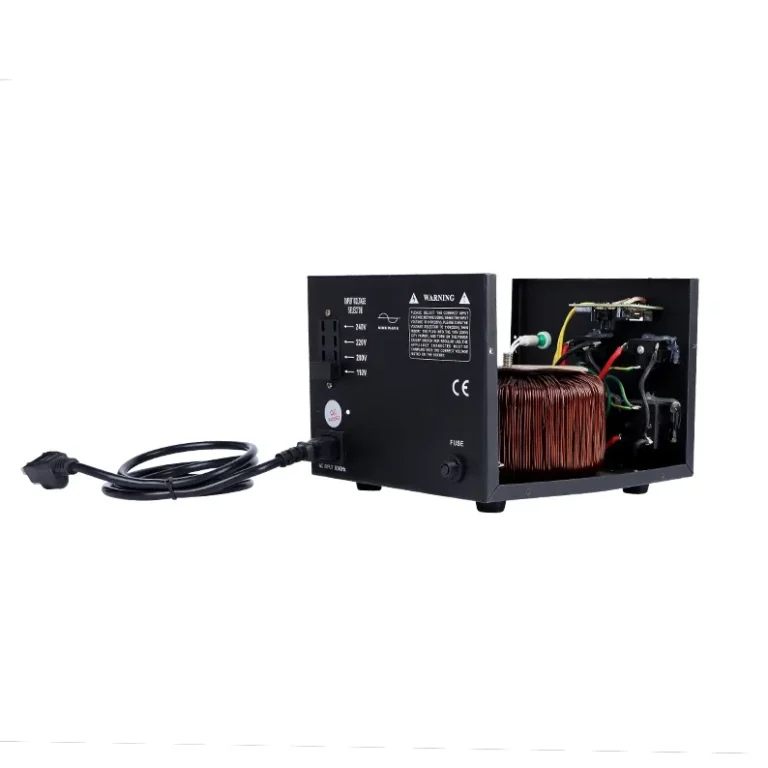
Many African homes and shops run on generator power for part of the day, and that changes the picture. Generators can put out voltage that fluctuates more than mains, especially as the load changes or the engine lugs, and some small generators produce a less clean waveform. A transformer is a magnetic device, so it handles moderate voltage fluctuation better than an electronic converter, but it still needs the generator to stay within a reasonable range, typically plus or minus 10%. If your generator output is unstable or your local grid sags heavily, add a stabilizer or an AVR between the generator and the transformer, or choose a transformer with a wider input tolerance. Our STU series with auto-selecting input handles 110V and 220V inputs automatically, and we can build units with wider voltage tolerance for difficult sites. Tell us your generator type and typical voltage range and we will spec accordingly.
Importing Transformers into Africa: Documentation
Importing electrical equipment into most African countries requires a few standard documents, and having them ready avoids delays at the port. The key papers are the commercial invoice, the packing list, the bill of lading, and in many markets a certificate of origin and a test certificate for the equipment. Since many African ports are congested, an incomplete or mismatched document set can add days or weeks of demurrage charges. When you buy from us, we provide the commercial invoice, packing list, and per-batch test certificate, and we can arrange the certificate of origin. We have shipped to Nigeria, Ghana, Kenya, Tanzania, Ethiopia, Cameroon, and other markets across the region, so we know the common requirements and can advise on what your destination port expects. For larger orders, we can also work with your forwarder to make sure the paperwork matches the customs declaration.
Warranty and After-Sales Support in Africa
A transformer is a long-life product, so the after-sales arrangement matters more than the initial price. Check what the warranty actually covers before you order. Some suppliers offer a warranty that requires you to ship the failed unit back to China, which is rarely practical from Africa. Our policy is replacement-first: if a unit fails within the 12-month warranty, we ship a replacement with the next container to your port and sort out the details afterwards. For distributors, we keep the volume sizes in stock, which shortens the lead time from the standard 15 to 25 days to just a few days for repeat orders. We also answer sizing and application questions after the sale, not just before it, because a transformer that is correctly sized and installed is the one that never calls back. Ask your supplier how they handle a claim from your country before you commit.
How to Identify Your Country’s Voltage and Frequency
Before buying any transformer, confirm your country’s mains voltage and frequency from a reliable source, because the pattern across Africa is not uniform. Nigeria, Ghana, and most of West Africa use 230V at 50Hz, while South Africa uses 230V and some areas see 220V nominal, and parts of East Africa such as Kenya and Tanzania use 240V. The frequency across nearly all of Africa is 50Hz, which is convenient because our transformers are rated for 50/60Hz anyway. The voltage matters because it sets the input side of the transformer you need: a 230V country needs a unit rated for 220-240V input, and a 110V appliance inside it needs a step down transformer to 110V. If you move between countries, or your supplier asks, the voltage and frequency are the two numbers that settle everything. Check the wall socket and any appliance label to confirm before you order, and when in doubt, send us your country and we will confirm.
Surge Protection and Voltage Spikes in Africa
Voltage spikes are common in many African grids, especially where generators, UPS systems, and unstable mains coexist. A transformer converts voltage, but it does not stop fast spikes from passing through to your appliance. For valuable electronics, add a surge protector between the transformer output and the appliance, which catches the high-frequency spikes that can damage circuit boards. For heavy loads like fridges and pumps, the RCD protection built into our ST series cuts power on earth leakage, and a correctly rated MCB protects the wiring. The combination of a transformer, a surge protector, and an MCB covers the three failure paths: overvoltage, leakage, and overcurrent. Many of our African distributor customers include the surge protector recommendation in their own packaging and marketing, because it reduces returns and builds trust. If your market has a reputation for unstable power, this extra layer is worth the small cost.
FAQ
What voltage is used in Nigeria?
230V, 50Hz. US 110V appliances need a step down transformer.
Is 220V or 240V used in South Africa?
230V officially (220–240V in practice). 110V appliances need stepping down.
Can I run a US fridge on African mains?
Yes, with a properly sized step down transformer — at least 2000VA.
Why does my transformer get hot when the generator runs?
Generator output fluctuates; brownouts make the transformer work harder. Size up or add a stabilizer.
Do you ship to African ports?
Yes — Lagos, Mombasa, Durban, Tema and others. Send us your specs for freight pricing.
Still not sure which model fits?
Tell us your appliance, wattage and country — we reply within 24 hours with a straight recommendation.