Step Down Transformer for Rwanda: 230V to 110V Guide
Rwanda runs on 230V at 50Hz, and the equipment that keeps arriving in Kigali from the United States and Japan does not. That is the whole reason a step down transformer for Rwanda is such a common request, and it is not only households asking. Hotels going up around the city, clinics fitting out treatment rooms, and shops bringing in imported appliances all run into the same gap between what the wall supplies and what the box expects.
I ship to Rwanda regularly, and the conversations have a flavour of their own. Buyers are practical, they know their supply sags, and they want a unit that keeps working rather than one that looks good on a spec sheet. So on this page I want to go deep on the country itself, the supply you actually get, the equipment that needs stepping down, and how the overland leg of the journey shapes what you order. This is a Rwanda guide from end to end, not a sweep across East Africa.
What the Rwandan Supply Actually Looks Like
The national grid runs at 230V, 50Hz, and it is managed by the Rwanda Energy Group, usually shortened to REG. In the cities the supply is generally steady enough to run ordinary appliances, and the network has been growing quickly as the country builds out generation and distribution. That is good news, and it is why more imported equipment is arriving every year.
What you cannot assume is that the supply at your socket is a clean, stable 230V all day. The voltage at the end of a feeder can dip, especially where the network is still catching up with new demand, and short interruptions and trips still happen on some circuits. Builders in Kigali know this well. A new hotel or clinic may be on a line that was sized before the neighbourhood grew, and the equipment inside expects a supply the line cannot always deliver.
The socket types you will meet are Type C, the two round pins common across much of Europe and Africa, and Type J, which is a three-pin arrangement used in Rwanda and a few neighbours. If your equipment was brought in from the United States, its plug is a different shape entirely, and the plug is usually the first thing a buyer notices before they think about voltage at all.
What Arrives in Rwanda Needing 110V
Rwandan buyers bring in a wide spread of equipment, and the ones that need help are the ones built for the North American market.
- Kitchen appliances from the United States — mixers, blenders, food processors and small ovens, 300W to 1500W.
- Audio, gaming and home entertainment gear — 100W to 600W, sensitive to a supply that wanders.
- Power tools — drills, grinders, saws and compressors, 500W to 2000W, with a hard motor start.
- Clinic and dental equipment — sterilizers, small suction units and instruments, 200W to 1200W, where a drop mid-procedure is not acceptable.
- Hotel and guesthouse appliances — coffee machines, hair dryers, mini fridges and AV equipment, often a mix of voltages from different suppliers.
- Office and shop equipment — printers, point-of-sale kit and display units, 100W to 800W.
- Water pumps and small machine drives — 500W to 2200W, with the biggest inrush on the site.
Not every item needs a transformer, and I always say so, because it saves buyers money. A lot of modern electronics, phone chargers, laptops and LED lamps carry a 100-240V rating and are perfectly happy on 230V. Read the plate on the back before you decide anything. If it says 100-240V, you do not need us for that item.
Household and Commercial: Two Different Conversations
For a home, the sizing is usually simple. A family might be running a kitchen appliance, a television and a games console off one unit, and a 2000VA transformer covers that comfortably. The bigger question for a household is where the unit sits and whether a single transformer or two smaller ones makes more sense for the rooms involved.
Commercial buyers face a different problem, because a guesthouse, clinic or shop rarely has one load. It has a collection of loads that come on at different times and sometimes together, and the size has to hold when they overlap. That is where a plant engineer or an installer earns their fee, and it is also where a slightly larger unit saves a lot of arguing later.
A Worked Example: A Kigali Guesthouse
Picture a guesthouse with eight rooms, a breakfast kitchen and a small reception. Each room might carry a 700W coffee machine, a 1200W hair dryer and a small fridge at 100W. If every room ran everything at once the total would be enormous, and in practice it never does. Peak demand tends to arrive at breakfast, when several coffee machines and kettles are in use within the same twenty minutes.
So we size for that peak rather than the theoretical maximum. Take four rooms drawing their coffee machines at once, 2800W, plus the kitchen at 1500W and reception at 300W, and you are near 4.6kW. Add 25 percent margin and a 5kVA unit covers the morning rush with room. Two smaller units, one per floor, would also work and would keep a fault from taking the whole guesthouse down, which for a hospitality business matters.
| Rwanda setting | Typical simultaneous load | Suggested unit rating | Why this size |
|---|---|---|---|
| Home, one appliance group | 400 – 1200 W | ST-1500 1500VA with RCD | Light mixed load, occasional motor start |
| Home with power tools | 800 – 2000 W | ST-2000 2000VA with RCD | Motor inrush from a drill or grinder |
| Clinic treatment room | 600 – 1500 W | ST-2000 2000VA | Needs a steady output during procedures |
| Shop or small office | 400 – 1200 W | DT-1000VA bidirectional | Steady load, some items already dual voltage |
| Guesthouse, whole building | 3 – 6 kW | STU-3000 or STU-5000 bidirectional | Overlapping peak loads at breakfast |
| Water pump or small drive | 0.5 – 2.2 kW | STU-3000 bidirectional | Hard motor start decides the size |
Voltage Sag and Trips: Why Input Taps Matter
This is the part of a Rwanda order I bring up early. Because the supply at the end of a feeder can dip, a transformer that expects a firm 230V input may deliver a low output when the line sags, and your equipment notices even if the transformer does not complain. One answer is to size with margin, and another is a unit with input tap options, so the installer can set it for the supply as it actually behaves on site rather than as it looks on paper.
We build units with selectable input taps for exactly this reason. If your line sits high, one tap brings it down to where the equipment wants it, and if your line runs low through the afternoon, the installer can set the box to suit. It is a small feature that makes a large difference in a market where the nominal voltage and the delivered voltage are not always the same number.
The same logic applies to tripping. Short interruptions and nuisance trips are still common on some circuits, and every one of them stresses equipment that is running at the time. A transformer with margin, fed from a supply that is properly protected, lasts longer than one matched tightly to the nameplate. And if a circuit keeps tripping, get it checked. Hiding a wiring fault behind a bigger transformer is not a fix.
Pairing the Transformer With a Small UPS or Inverter
Rwandan buyers often ask whether the transformer alone will keep them running through an outage. The honest answer is no. The transformer changes voltage and has no battery, so when the supply goes, it goes too. If the supply interruption is short, the fix is a small UPS or inverter.
The order is what matters. The UPS or inverter sits upstream, taking the 230V supply and its battery, and the transformer takes the output of that source and feeds your 110V equipment. The backup carries the outage, and the transformer matches the voltage, so the equipment never sees a change. For a clinic with a sterilizer or a shop with a till, that arrangement is worth the modest cost of a small UPS.
Size the backup for the loads that truly cannot stop, not for everything in the building. A sterilizer mid-cycle, a till during a transaction, or a fridge holding medicine are the items worth powering through an outage. Everything else can wait for the supply to return, and pretending otherwise just makes the battery and the inverter bigger and dearer than they need to be.
Sockets, Plugs and the Type J Question
Get the plug right and half the installation trouble disappears. Rwanda uses Type C and Type J sockets, so a unit we build for you should come with an output socket that matches what your equipment plugs into and, where needed, an input plug suited to the wall. Sending the wrong plug type halfway across the world is a slow way to lose a month.
Type J, with its three pins, is worth mentioning specifically, because a buyer who has only seen Type C may not expect it. If your building uses Type J and you want the transformer to plug straight in, tell us, and we will fit the correct input lead at the factory. On the output side, if your American equipment has a moulded 110V plug, the transformer should have the matching outlet rather than a bare terminal block, because a proper socket is safer and easier to live with.
Whatever your setup, avoid the travel adapter shortcut. A travel adapter turns a 110V appliance into something plugged into a 230V wall, and the equipment will not survive it. An adapter is for plug shape, not for voltage, and the two get confused constantly.
Shipping to Rwanda: The Overland Leg
Rwanda is landlocked, so there is no port on its own coast. Goods arrive through Mombasa in Kenya or Dar es Salaam in Tanzania, and from either port they travel overland to Kigali. That overland leg shapes how we pack and what we tell you about timing.
Because the units have a long road journey ahead of them, we pack them for it. Cartons are built to take handling, units are braced so they cannot shift inside the box, and the paperwork travels with the shipment so it clears the border without a delay. If you are ordering for a project with a fixed handover date, tell us early, and plan the shipping time around the port and the road, not just the factory lead time.
We ship FOB Ningbo or Shanghai, and from there the goods go by sea to Mombasa or Dar es Salaam and onward by road. Many of our Rwandan buyers work with a freight forwarder who handles the customs step, and if that is your setup, we simply hand over the documents your forwarder needs and let them move it. The point to remember is that the clock that matters is not only ours. Build the overland leg into your schedule from the start.
The Transformers We Supply Into Rwanda
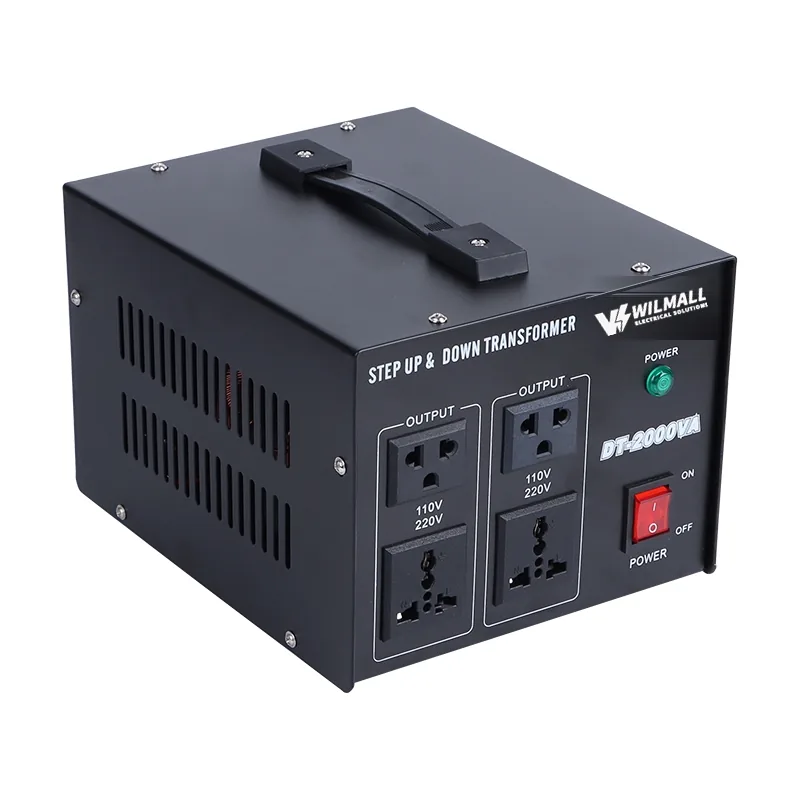
For households and small premises, the ST-1500 and ST-2000 are the units that go out most often. The ST-2000 is the 2000VA model, 220V to 230V in and 110V out, with the RCD mounted inside the case, so a fault on the 110V side trips right there in the room rather than somewhere else in the building. In a market where protection is worth having, that local trip is a real benefit.
Where a buyer has a bigger load, or a mix of 110V and 230V equipment, the two-way units take over. The STU-3000 and STU-5000 run in both directions and carry the heavier duty, and the DT-1000VA is the automatic bidirectional model for small steady loads that just need to keep working. If you are weighing up one-way against two-way, our page on step up & down transformers explains the difference without any maths to work through.
We also keep the Variac range at 500VA, 1KVA, 2KVA and 3KVA on the shelf, which installers commissioning imported equipment find useful. And because Rwanda is not the only East African market we serve, buyers who want to compare notes on a neighbouring supply often read our Step Down Transformer for Kenya: 240V to 110V Guide as well, since the two markets have much in common even though the voltages differ slightly. Every unit is wound with copper and tested in our own factory in Yueqing.
Minimum Order, Lead Time and Test Records
Our minimum order is 10 pieces, which suits a dealer stocking for the Kigali market or a project buying for several rooms or sites at once. Lead time runs 15 to 25 days and depends on the quantity and on any custom labelling or socket requirement. Units ship FOB Ningbo or Shanghai, and each one carries a 12-month warranty.
Every consignment includes the batch test record, with input voltage, loaded output and no-load current for the run your units came from. If a buyer or an inspector wants documentation, that sheet is what you produce. We can also set the output to the voltage your equipment plates specify, fit the input and output plugs your building uses, and pack per site so a project can be delivered room by room.
What We Need Before We Quote for Kigali
Send whatever you already have and it is usually enough. The equipment list with the watts from each nameplate, your mains supply and its frequency, the socket type in the building, and how many separate 110V feeds you need. If you have a photo of a nameplate that is easier than typing, that works just as well.
Two things about Rwanda specifically are worth adding. Tell us whether the supply at your site runs high or low through the day, because that decides the input tap setting. And tell us your target date after you have allowed for the sea leg and the overland journey, so we can plan the production around it rather than the other way round.
If you want to see how other countries compare, our voltage guides by country section covers the supplies we ship into most often. Rwanda is one of the markets we know well, and a quick exchange about your site is always cheaper than ordering a unit that turns out to be the wrong shape for the wall.
If your supply drops more often than you would like, say so when you write. We supply step down transformers for Rwanda to homes, clinics, hotels and shops, and knowing how your line behaves is the fastest way for us to get the unit and the taps right the first time.
Step Down Transformer Questions From Rwanda Buyers
These are the questions I get most from Kigali and beyond, answered the way I would reply to a message rather than a tender document.
What voltage does Rwanda use and do I need a transformer?
Rwanda runs at 230V and 50Hz on the REG network, with Type C and Type J sockets. If your equipment is rated 110V, yes, you need a step down transformer for Rwanda to bring the 230V supply down to the voltage your machine expects.
Which transformer should I buy for a home in Kigali?
For most homes the ST-1500 or ST-2000 covers it. A kitchen appliance, a television and a games console together sit well inside 2000VA. If you also run power tools, take the ST-2000 so the motor start does not drag the supply down when the drill spins up.
Why does my supply voltage drop so often?
The network has grown quickly, and in some areas the line was sized before the demand arrived, so the voltage at the end of a feeder dips and occasional trips still happen. Ask for a unit with selectable input taps so the installer can set it for your supply as it behaves on site.
Can I use a travel adapter instead of a transformer?
No, and this is worth being clear about. A travel adapter changes the pin shape only, so a 110V appliance plugged into a 230V wall through an adapter will be damaged. You need a transformer to change the voltage, and the right plug fitted at the factory.
How long does shipping to Rwanda take?
We build in 15 to 25 days and ship FOB Ningbo or Shanghai. From there the goods go by sea to Mombasa in Kenya or Dar es Salaam in Tanzania, then overland to Kigali. Add that road and sea time to your schedule, especially if the project has a fixed handover date.
Tell us what you are powering in Rwanda and we will size it for your supply. Send the equipment list with watts, your building socket type, and how your line behaves through the day. We will suggest a unit, a quantity and the taps, and we will plan the shipment around the sea leg and the road to Kigali.
Message us on WhatsApp any time: WhatsApp +86 197 3022 6757 · Email sales@wilmall.com
MOQ 10 pcs · Lead time 15-25 days · FOB Ningbo or Shanghai · 12-month warranty