
A customer writes in with a 1500W appliance and a 1500VA transformer, and wonders why the transformer runs hot. The arithmetic looks airtight until you notice that a transformer is not a bucket of watts. It is a bucket of volts and amps, and the watts you can pull out of that bucket depend entirely on how well the current in the winding lines up with the voltage across it.
That alignment is the power factor, and it is the single number that decides whether the conversion on this page is a two second job or a two hour argument. Get it right and the VA figure you order is the VA figure you need. Get it wrong, or worse, assume it is 1.0 because that is the easy case, and the transformer you buy will be too small by a margin you cannot see until the load is running at full production.
This page converts in both directions and gives you the power factor values to use when the label does not. It also covers the two numbers that sit next to power factor and get skipped just as often: three phase, and efficiency.
VA and watts are two different questions
Watts measure the rate at which real work happens. They heat water, turn a shaft, light a room. The electricity meter counts them, and a utility bills for them, because they are what the customer actually consumed.
Volt-amperes measure the total product of voltage and current flowing in the circuit, whether or not that current is in step with the voltage. Some of it does work and some of it circulates. The circulating part is not free: it still flows through the winding, still produces I squared R heating in the copper, and still takes up capacity in the transformer, the cable and the breaker.
So the two figures answer different questions. VA answers how big the equipment has to be. Watts answer how much work you get out. On a purely resistive load such as a heater, they are the same number and the distinction never comes up. On a motor, a compressor, an LED driver or a welding set, they are far apart, and the gap is the reason a 2000VA transformer is not a 2000W transformer.
The vocabulary you will meet around this: kW for real power, kVA for apparent power, and kVAR for the reactive part that fills the gap between them. They form a right triangle, with kW and kVAR at the two legs and kVA on the hypotenuse, and the power factor is the cosine of the angle between kW and kVA. You do not need the triangle to use the converter, but it explains why the numbers never simply add up.
Why transformers are sold in VA and not in watts
Three things set the size of a transformer: the cross section of the core, the cross section of the copper, and the surface area available to get heat out. None of them knows anything about watts.
The core is sized by flux, and flux is set by voltage and frequency. That is arithmetic on the supply, not on the load. The copper is sized by current, and current is set by the VA the transformer has to carry. The surface area is sized by the total losses, which are the core loss plus the copper loss, and copper loss is current squared times resistance, again a current figure and not a watt figure.
This is why every transformer nameplate in the world reads in VA or kVA, why every generator is rated in kVA, and why an uninterruptible power supply is rated in VA. The manufacturer is making a statement about current carrying capability at a stated voltage. How much useful work the customer extracts from that current is the customer’s power factor, and it is not the manufacturer’s variable.
If you are sizing for a load with a poor power factor, you are buying VA you will never see as watts, and that is not waste. It is the physical cost of circulating current. The alternative is to improve the power factor at the load with a capacitor, which is often cheaper than a bigger transformer once the load passes a few tens of kVA.

Power factor in workshop language
Imagine two workers moving boxes across a yard. The first walks straight from the stack to the truck: every step moves a box, and the work done matches the effort spent. The second walks the same distance but at a forty degree angle to the direct line, so he covers more ground than the distance to the truck, and only part of his effort goes into moving the box forward. He is not lazy. He is doing the same useful work while consuming more of the yard’s capacity.
A load with a power factor of 0.8 is the second worker. It draws 25 percent more current than the useful work requires, and the extra current does not leave the transformer; it heats the winding and takes up capacity. A power factor of 1.0 is the first worker, and heaters and incandescent lamps are the loads that behave that way.
In practice, power factor falls into three bands worth remembering:
| Power factor band | Typical loads | What it means for you |
|---|---|---|
| 0.95 to 1.00 | Heaters, kettles, incandescent lamps, resistive ovens | VA and watts are close enough to treat as equal |
| 0.80 to 0.90 | Induction motors at or near full load, larger transformers | Expect 15 to 25 percent more VA than watts |
| 0.60 to 0.80 | Motors at part load, fluorescent ballasts, older compressors | Expect 25 to 65 percent more VA than watts |
| 0.40 to 0.60 | Cheap LED drivers, electronic supplies without correction, small welders | Expect 65 to 150 percent more VA than watts |
| Below 0.40 | Highly inductive or heavily distorted electronic loads | Convert, do not guess, and consider correction |
One trap is worth calling out here. Power factor is not a property of an appliance type; it is a property of the appliance running at a particular point on its curve. A 3 kW induction motor at full load might sit at 0.85. The same motor at 30 percent load sits closer to 0.60, because the magnetising current does not shrink when the mechanical load shrinks. This is why oversized motors are a power factor problem as well as a cost problem, and why a workshop running big motors on light duty often has a lower power factor than its equipment list suggests.
Power factor values for real loads
Use these when the label gives watts only. They are the figures we use when a customer sends a list without power factors, and they are deliberately conservative in the middle of each range.
| Load | Power factor | Conversion note |
|---|---|---|
| Incandescent lamp, halogen | 1.00 | Treat VA as equal to watts |
| Electric heater, kettle, water boiler | 1.00 | Resistive, no correction needed |
| Resistive oven, hot plate | 1.00 | Resistive |
| LED lamp with good driver | 0.90 | Better drivers correct internally |
| LED lamp, low cost driver | 0.50 to 0.60 | Very common source of surprise |
| Fluorescent fitting, magnetic ballast | 0.50 | Add a capacitor if the count is high |
| Fluorescent fitting, electronic ballast | 0.90 | Corrected by the ballast |
| Ceiling fan, small motor | 0.80 | Light load, still inductive |
| Domestic refrigerator | 0.75 | Compressor at part load |
| Split air conditioner, inverter | 0.95 | Inverter input stage corrects well |
| Split air conditioner, fixed speed | 0.80 | Compressor plus fan |
| Industrial sewing machine | 0.75 | Clutch motor, part load often |
| Bench grinder, drill press | 0.75 to 0.80 | Induction motor |
| Water pump | 0.80 | Higher at full flow, lower at low flow |
| Air compressor, piston | 0.75 | Falls sharply when unloaded |
| Three phase induction motor, full load | 0.85 | Falls to 0.60 at 30 percent load |
| Welding inverter | 0.85 | Better than the old transformer welders |
| Welding transformer, older type | 0.50 to 0.60 | Poor, and very peaky |
| Microwave oven | 0.90 | Transformer, fan and electronics |
| Desktop computer and monitor | 0.90 | Corrected supply |
| Phone and laptop charger | 0.50 to 0.60 | Small loads, poor factor, rarely matters |
| Uninterruptible power supply, line interactive | 0.60 to 0.70 | Check the VA and W rating separately |
| Variable frequency drive, input side | 0.95 | The drive corrects its own input |
| Servo or stepper supply | 0.85 | Depends on the supply design |
The conversion, both directions
Two formulas cover the whole page. In single phase, with the load in VA and the power factor known:
Watts = VA times power factor
VA = watts divided by power factor
Work an example in each direction. A workshop buys a 3000VA step down transformer for a load of small machines. The mixed load has an average power factor of 0.78. The real power available at the secondary is 3000 times 0.78, which is 2340W. If the machines together draw 2600W, the transformer is overloaded at 111 percent even though 2600 looks smaller than 3000. That is the error the converter exists to prevent.
Now the other direction. A customer has a 2200W air compressor at power factor 0.75 and wants to know what to order. Divide 2200 by 0.75 to get 2933VA. Add 50 percent margin because it is a compressor with a hard start, and the figure is 4400VA. The nearest frame is 5000VA. If the customer had divided 2200 by 1.0 and added 20 percent, the answer would have been 2640VA and the nearest frame would have been 3000VA, which is undersized on both counts.
The same arithmetic in a spreadsheet, applied to a whole load list, is what the transformer sizing calculator does with the load types built in.
Three phase is not the same formula
Three phase adds a factor of the square root of three and uses the line to line voltage. The relationships become:
VA = 1.732 times line voltage times line current
Watts = 1.732 times line voltage times line current times power factor
Because the root three appears on both sides, the conversion between VA and watts is unchanged: watts still equal VA times power factor. What changes is the current. A 15 kVA three phase transformer at 400V carries 21.7A per line. The same 15 kVA as a single phase unit at 230V carries 65A. That is the whole reason three phase frames are smaller and cheaper for the same rating.
The mistake we see most often is applying the single phase formula to a three phase nameplate, which inflates the current by 1.732 and leads to oversized cable and breakers, or applying the three phase formula to a single phase unit, which does the opposite and leads to hot cables. If the plate says 400V and the unit has three terminals plus earth, it is three phase. If it has two, it is not.
There is more on the current arithmetic on the amps to VA page, and the practical choice between the two configurations is covered under single phase versus three phase sizing.
Where the watts on a label hide the truth
Three label conventions cause most of the confusion, and all three are legal.
Input watts versus output watts. A motor label may give the mechanical output at the shaft, which is what the motor delivers, not what it draws. A motor labelled 1500W output at 88 percent efficiency draws about 1705W from the supply. Converting the shaft figure directly to VA undersizes the transformer by the efficiency gap.
Heating watts versus running watts. Air conditioners and refrigerators are often quoted in cooling capacity, which is a rate of heat removal measured in BTU or in watts of cooling. It is not electrical input. A 12000 BTU unit is around 3500W of cooling and around 1100W of electrical input, and those two figures differ by a factor of three.
Max watts versus rated watts. Some appliances quote a peak figure that lasts a minute, such as a microwave’s rated output or a vacuum cleaner’s air watts. Peak is not a duty figure and should not be used for continuous sizing.
The label that resolves all of this is the one showing voltage, frequency, current and either VA or watts plus power factor. Reading it correctly is its own small skill, and the page on reading a transformer nameplate walks through the fields in the order they matter.
Efficiency: the third number people forget
The conversion from VA to watts describes what the load draws. It says nothing about what the transformer wastes on the way. That loss is the efficiency, and for small low voltage transformers it is not negligible.
| Transformer size | Typical efficiency | Loss at full load |
|---|---|---|
| 100VA | 82 to 86 percent | 15 to 22W |
| 500VA | 88 to 91 percent | 45 to 68W |
| 1000VA | 90 to 93 percent | 75 to 111W |
| 2000VA | 92 to 95 percent | 105 to 174W |
| 5000VA | 94 to 96 percent | 208 to 319W |
| 10000VA | 95 to 97 percent | 309 to 526W |
| Above 20000VA | 96 to 98 percent | Varies with design |
Those watts become heat inside the enclosure, and heat is what shortens the life of the insulation. A 2000VA unit at 93 percent efficiency is dissipating around 150W into a box the size of a shoebox, and that is the reason transformer enclosures have vents and why a unit in a sealed cabinet runs hotter than the same unit on an open wall. It is also the reason we ask where the unit will be installed before we recommend a frame.
Efficiency improves with size and with loading up to about 80 percent, then flattens. A transformer at 40 percent load has a worse efficiency than the same unit at 80 percent, because the core loss is fixed and gets spread over less output. If you want the fuller treatment, the page on transformer efficiency goes through the loss split.

Converting a whole panel at once
For a mixed load list, do not convert each appliance and add the VA. Convert each appliance, add the VA, then apply margin once. Adding the watts first and converting the total by an average power factor gives a different and usually wrong answer, because averaging power factors overweights the big resistive loads.
The shortcut table below is for the common case where you have a rough total in kW and want a VA estimate to start from.
| If the load is mainly | Use power factor | Multiply total kW by |
|---|---|---|
| Heaters, ovens, kettles | 1.00 | 1.00 |
| Mixed domestic appliances | 0.90 | 1.11 |
| Light commercial with air conditioning | 0.85 | 1.18 |
| Workshop with motors at good load | 0.80 | 1.25 |
| Workshop with motors at part load | 0.70 | 1.43 |
| Electronics heavy, uncorrected supplies | 0.60 | 1.67 |
| Welding shop, older transformer sets | 0.55 | 1.82 |
Then apply the margin from the sizing side of the question: 20 to 25 percent for resistive, 50 percent for a mixed workshop, and up to 100 percent where direct on line motors dominate. A 20 kW mixed workshop at 0.80 gives 25 kVA, plus 50 percent margin gives 37.5 kVA, which lands you looking at three phase frames. That is the normal outcome for a workshop of that size, and it is why single phase units stop being practical above about 10 kVA.
Five conversion mistakes
Assuming power factor is 1.0. The single most common error, and it always sizes downward. A motor at 0.8 power factor will overload a transformer sized on the assumption of 1.0 by 25 percent.
Converting the shaft output of a motor. A motor’s mechanical output is not its electrical input. Divide by efficiency first, then by power factor.
Using cooling capacity as electrical input. An air conditioner rated in BTU is not rated in electrical watts. A 12000 BTU unit is around 1100W of input, not 3500W.
Averaging power factors across a list. Convert each item, then add. Averaging weights a small number of large resistive loads too heavily and hides the inductive ones.
Forgetting the conversion is about current, not energy. VA and watts are not two units for the same thing. Treating them as interchangeable is treating current and power as interchangeable, and no transformer was ever sized that way.
When to convert and when to measure
Conversion is a paper exercise based on labels. Measurement is a clamp meter on the actual supply. Both are useful and they answer different questions.
Convert when you are planning an installation and there is nothing to measure yet. Convert when the load list is stable and each item has a readable plate. Convert when you need a number in five minutes to send to a supplier for a quotation.
Measure when the site already exists and something is going wrong. A clamp meter on the live conductor at the distribution board, read at the busiest hour of the day, tells you the real current including everything nobody listed. Multiply by the measured voltage to get real VA. If that figure is far above your converted figure, the difference is the loads that were missed.
What measurement cannot tell you is what will happen when the plant expands. That is the case for converting from a list that includes the next two machines, not just the ones running today. We have replaced enough failed units to be firm about this: size for the site you will have in two years, not the one you have on commissioning day.
If the numbers come out awkward and you would rather have a second opinion, send the load list and we will check it. The other calculators on the site fill in the rest: the sizing calculator for VA from a list, the impedance calculator for fault current, and the voltage by country reference for the supply side. For the conceptual background on why the gap exists at all, the piece on VA versus watts covers the same ground from the buyer’s side.
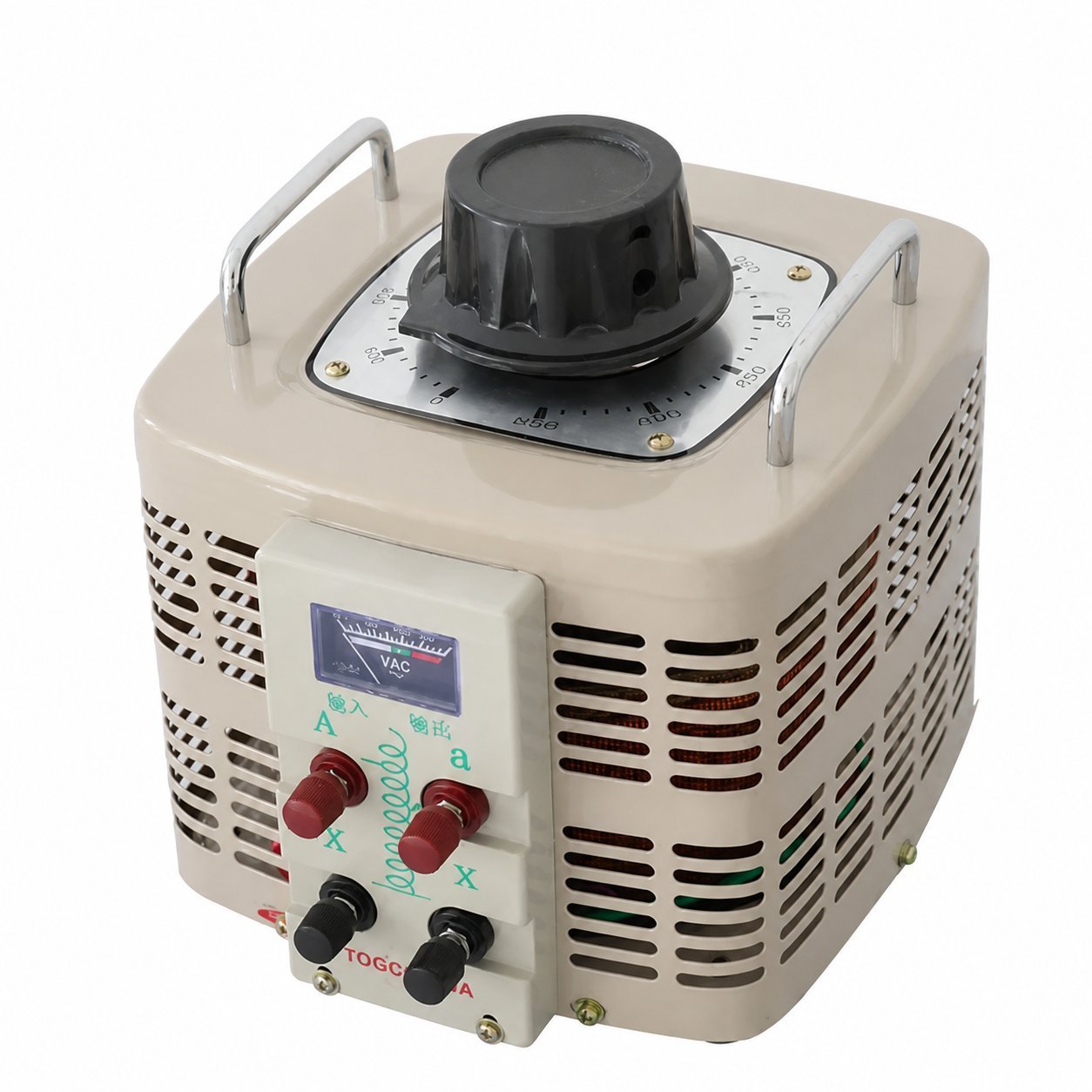
One last case worth mentioning, because it comes up in laboratories and test benches: a variable transformer. A variac keeps its VA rating across the whole dial range, so as you turn the output voltage down, the current limit stays the same and the watts you can draw fall in proportion. On a 2000VA variac set to 50 percent output, you can still draw 9A at 110V, which is about 990VA, and the remaining capacity is simply not available. That behaviour confuses people who expect the dial to behave like a volume control. The variable transformer range has the ratings for each frame.
Frequently asked questions
How many watts is 1000VA?
It depends on the power factor. At power factor 1.0, which is a heater or an incandescent lamp, 1000VA is 1000W. At 0.8, which is a motor running at part load, 1000VA is 800W. At 0.55, which is a cheap electronic power supply without correction, 1000VA is 550W. The VA rating is fixed by the transformer, the watts you can take out of it are not.
How do I convert watts to VA?
Divide the watts by the power factor. A 1500W load at power factor 0.75 is 1500 divided by 0.75, which is 2000VA. If you do not know the power factor, use the appliance type to pick a value from the reference table on this page rather than assuming 1.0, because assuming 1.0 for a motor load will undersize the transformer by 20 to 30 percent.
What is the power factor of a transformer itself?
It depends entirely on the load connected to it. An unloaded transformer has a power factor near zero because it draws magnetising current with almost no real power. A fully loaded transformer presents roughly the power factor of whatever is on its secondary, minus a small amount for its own losses. The transformer does not set the power factor, it passes it through and adds a little reactive burden of its own.
Is kVA the same as kW?
No, and the difference is money. kW is real power, the part that does work and that your electricity meter charges for. kVA is apparent power, the total the equipment must carry, which includes the part that swings back and forth without doing work. Generators and transformers are rated in kVA because their size is set by current and voltage, not by how much of that current is doing useful work. On a power factor of 0.8, 100 kVA of equipment can only deliver 80 kW of useful output.
Why does my 2000VA transformer not run a 2000W motor?
Because the motor needs 2000W divided by its power factor and efficiency to produce 2000W of mechanical output. A motor at power factor 0.82 and efficiency 0.88 needs about 2770VA to deliver 2000W at the shaft, before any starting margin. On a 2000VA transformer it will be overloaded from the moment it starts, and its start-up current alone may be six times that. The correct frame for that motor is 3000VA or larger.