Step Down Transformer for Microwave Oven: 1500W Guide
A US microwave oven in a 220V country needs a properly sized step-down transformer that handles the magnetron load without tripping. This guide covers sizing for countertop, over-the-range and built-in microwaves in any 220V market.
Why microwave ovens are tricky
A microwave oven combines a magnetron (the high-power RF source), a high-voltage transformer (inside the microwave itself), a turntable motor, fan motors and a control board. The magnetron draws 800-1500W when running, and the turntable and fan add another 50-100W. So a 1200W microwave may pull 1300-1600W at peak.
The magnetron also has a soft-start characteristic — the magnetron heater draws current for 2-3 seconds before the high-voltage kicks in. A transformer that delivers the running wattage easily handles the soft-start, but a tight-rated unit may trip thermal protection in the first few seconds.
What size transformer do you need?
| Microwave | Output wattage | Input wattage | Recommended transformer |
|---|---|---|---|
| Compact microwave | 600-700W | 900-1100W | 1500VA |
| Standard microwave | 800-1000W | 1200-1500W | 2000VA |
| Large microwave | 1100-1250W | 1600-2000W | 2500-3000VA |
| Over-the-range / convection | 1000-1500W | 1500-2200W | 2500-3000VA |
Why transformer accuracy matters
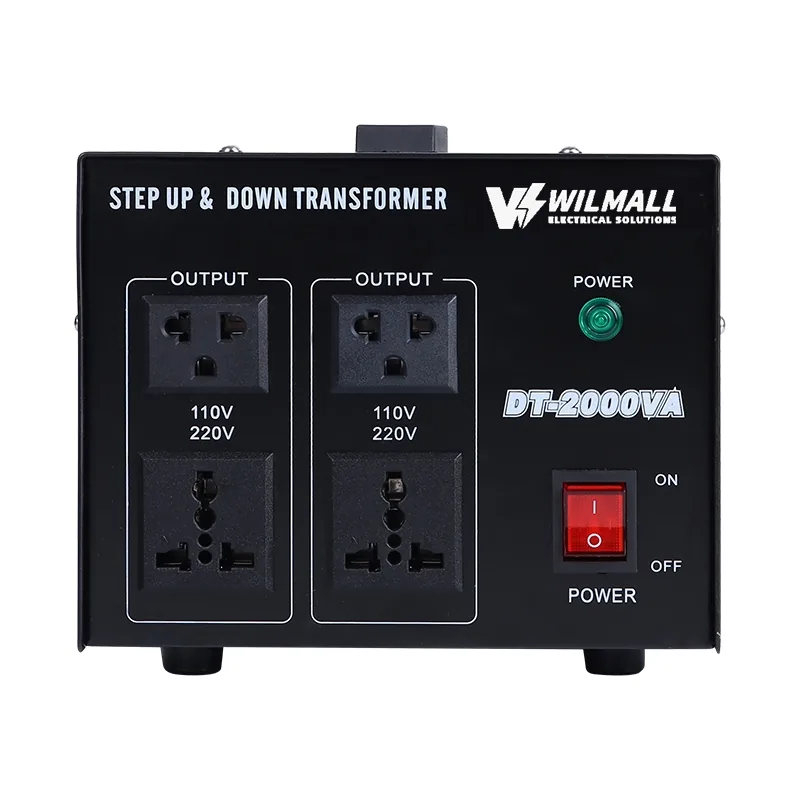
The magnetron is sensitive to voltage. Low voltage reduces the microwave power output; food cooks unevenly and takes longer. High voltage shortens magnetron life. A transformer that delivers 110V accurately keeps the microwave in its design window.
Choose an isolation transformer with a tightly wound secondary, not an autotransformer with a wide output swing.
Why not an electronic converter
Most electronic converters are rated for resistive loads up to their nameplate and cannot sustain the magnetron load for more than a few seconds. Even the better electronic converters trip when the microwave cycles on and off every 30-60 seconds at full power. A copper-and-steel transformer handles the cycling without complaint.
RCD and kitchen safety
Microwaves sit on countertops near water and steam. RCD protection on the transformer is essential. The RCD trips on leakage current if any part of the microwave develops a fault, protecting the user from shock. Wilmall ST-2000 and larger step-down transformers include RCD protection as standard.
Convection and combination microwaves
Convection and combination microwaves add a heating element for the convection mode, drawing 1500-2200W continuously. The transformer must carry this continuous load with margin. For a typical 1000W convection microwave, a 3000VA transformer is the safe size; running a 2000VA transformer at 2200W is too close to its rating for comfort.

Built-in microwave ovens
Built-in microwaves are wired directly to the circuit — there is no plug. If you are an installer, choose a transformer with hardwire input and output terminals rather than a plug-and-socket unit. Wilmall builds both variants; specify hardwire when ordering.
What to do about inverter microwaves
Inverter microwaves use an inverter circuit instead of a transformer to drive the magnetron, which gives more even cooking at lower power settings. From the transformer’s perspective, the input wattage is similar to a conventional microwave of the same output wattage, so the sizing rules are unchanged. Inverter microwaves are sometimes slightly more efficient, so the input is a little lower in practice, but size using the manufacturer’s input rating to be safe.
Convection mode and continuous heating
When a convection or combination microwave runs the convection element (2000W typical), the duty cycle becomes continuous rather than cyclic. The transformer must carry this load continuously, with 25% margin. A 3000VA transformer handles a 1500W convection element at 50% load comfortably; a 2000VA transformer would run at 75% load continuously, which is within rating but tight.
Microwave + other appliances on one transformer
If you want to power a microwave and other small appliances (coffee maker, toaster, kettle) from one transformer, calculate the combined peak load and add margin. A typical 1000W microwave plus a 1500W kettle plus a 1000W coffee maker at simultaneous peak could draw 3500W, requiring a 5KVA transformer. In practice, these appliances do not run simultaneously, but the transformer must cover the highest combination that occurs.
A safer alternative is two transformers — one for the kitchen cooking appliances and one for the microwave. This isolates the high-current microwave start-up surge from the more sensitive electronics in other appliances.
Why aluminium-wound transformers fail first in microwaves
Microwaves cycle on and off frequently, which is harder on transformer windings than continuous operation. Aluminium windings heat up faster and age faster under cyclic load than copper. For a microwave installation that runs multiple times a day, choose a copper-wound transformer like the Wilmall ST series. The higher upfront cost pays back in longer life and fewer warranty claims.
Common mistakes
- Sizing to output wattage. The input is 1.5-2x the output.
- Using an electronic converter. Most cannot sustain the magnetron load.
- Skipping RCD protection. Kitchen safety matters.
- Loading to 100%. Convection heating needs margin.
- Confusing wattage ratings. Microwave ovens are usually labelled by output cooking power, not input power.
Long-term cost of ownership
A copper-wound step-down transformer from a quality factory costs more upfront than a cheap aluminium-wound unit, but the long-term cost is lower. The copper unit lasts 10-15 years under daily use; the cheap unit fails in 2-3 years and must be replaced. For a microwave that runs daily, the lifetime cost of the cheap unit is 3-5x higher than the quality unit.
Add to that the cost of a damaged microwave from a failed transformer (voltage spikes during a fault can destroy the microwave’s control board), and the case for a quality transformer is even stronger.
What to do if the transformer overheats
If the transformer case becomes too hot to touch, switch off immediately. The most common cause is a load above the transformer’s rating or restricted airflow. Let the unit cool for 30 minutes, check the load against the rating, and clear any obstruction around the vents.
If the unit overheats again after correcting the load, the thermal protection may be faulty or the windings may be damaged. Contact the supplier under warranty — do not continue to use an overheating transformer.
Why Wilmall for microwave transformer installations
Wilmall supplies ST and STU series step-down transformers factory direct from Yueqing, China. Our units are tested at full load before packing, with copper winding, RCD protection and 12-month warranty. MOQ 10 pcs per model, 15-25 day lead time, CE / RoHS documents included.
For importers stocking microwave-sized transformers, the ST-2000 is the core range; the STU-3000 covers convection and over-the-range models. Email sales@wilmall.com for a quotation.
Buying from a Chinese factory versus a trader
The price difference between factory direct and a trading company is typically 20-30%, which is significant on container orders. Beyond the price, factory direct gives you control over the specification, the brand label and the documentation. Wilmall supplies ST and STU series step-down transformers from Yueqing, China, with copper winding, full testing and CE / RoHS documents.
For an importer or installer, the right first step is to send us the microwave model and the country. We reply within 24 hours with the recommended transformer size, the price and the lead time.
Common questions from microwave importers
Three questions we hear most often: “What size for a 1000W microwave?” — 2000VA. “Do I need RCD?” — yes for kitchen safety. “Can I run two microwaves on one transformer?” — only if their combined peak is below the transformer’s rating with margin, which is rarely the case. Most customers run one microwave per transformer.
If you are stocking for multiple markets, ask us about input voltage variants. We can build units for 220V markets (most of the world) and 240V markets (UK, parts of Africa, Qatar, Malaysia) with different primary windings.
Final word on microwave transformers
A 220V to 110V step-down transformer sized correctly for your microwave will give years of reliable service. Copper winding, RCD protection, accurate output and proper ventilation are the four pillars of a safe installation. Wilmall ST and STU series transformers meet all four, with CE / RoHS documents, batch test reports and 12-month warranty included. Factory direct from Yueqing, China.
Recommended transformers from Wilmall
For a standard 1000W microwave, the ST-2000 (2000VA) is the typical size. For large or convection microwaves, step up to STU-3000 (3000VA). All Wilmall step-down transformers use copper winding, RCD protection and 12-month warranty, and are tested at full load before packing.
Email sales@wilmall.com or WhatsApp +86 197 3022 6757 with your microwave model and quantity. MOQ 10 pcs per model, factory direct from Yueqing, China.
Frequently asked questions
Microwave Sizing: The Magnetron Surge Explained
A microwave oven has a hidden surge that surprises buyers: the magnetron draws more current when it starts than its running wattage suggests. A 1500W microwave might run at 900W of cooking power, but the total input draw can be 1400W to 1500W, and the start-up surge is higher. The practical sizing is 2000VA for a standard 1500W microwave, which covers the input draw with margin. If the microwave runs at the same time as other appliances, such as a kettle or a toaster, add their wattages before sizing. The microwave also cycles its magnetron on and off during cooking, so the transformer handles repeated surges, which is another reason for the headroom. Our ST series is rated for this kind of cycling load, and we confirm the exact size against your microwave’s nameplate input rating, not its cooking power.
What size step down transformer do I need for a microwave?
For a standard 1000W microwave, a 2000VA transformer is the typical size. The input is 1.5-2x the output wattage, so a 1000W output microwave needs 1500-2000VA.
What size transformer do I need for a 1000W microwave?
A 2000VA transformer is the typical size for a 1000W (output) microwave. The actual input is 1500W, leaving margin for soft-start and continuous duty.
What size transformer for a convection microwave?
A convection microwave draws 1500-2200W continuously in convection mode. A 3000VA transformer is the typical size for a 1000W convection unit.
Can I use an electronic converter for a microwave?
Most electronic converters cannot sustain the magnetron load for more than a few seconds. Use a copper-and-steel step-down transformer.
Why does a microwave transformer need RCD protection?
Microwaves sit on countertops near water and steam. RCD protection trips on leakage current if the microwave develops a fault.
Related reading
- Transformer Sizing Calculator
- How to Choose a Step Down Transformer
- Step Up and Down Transformer Products
Get a factory-direct quote
Email sales@wilmall.com or WhatsApp +86 197 3022 6757 with your appliance list.