Step Down Transformer for Paraguay: 220V to 110V Guide
Paraguay has a power story that surprises most first-time buyers. The country sits on the Itaipu dam, one of the largest hydroelectric plants on earth, and the result is some of the cheapest electricity in the region. Cheap power does not mean stable power, though, and that gap is exactly where a step down transformer for Paraguay earns its place. You can pay very little for a unit of electricity and still watch the voltage at your own socket wander through the afternoon.
I build 220V to 110V transformers in Yueqing and Paraguay has become a regular line in our export book, partly through importers in Asunción and partly through the trading houses around Ciudad del Este that buy by the pallet. The questions are consistent, and the answers depend on whether you are powering one machine in a home or stocking a shop shelf. Here is how I work through both.
Cheap Power, Uneven Voltage: What Paraguay’s Supply Really Does
The national grid is run by ANDE at a nominal 220V, 50Hz, and wall sockets are Type C, the two-pin Euro pattern found across much of South America. In a new building in central Asunción the supply is usually well behaved. Move to the edge of a city, to a neighbourhood on a long feeder, or to a smaller town, and the picture changes, particularly in the hot months.
Summer is the reason. Paraguay gets properly hot, and when the air conditioning load across a district comes on in the middle of the day, the voltage on the feeders drops. It recovers overnight when the load falls away. One end of that range starves motors and the other end stresses insulation, and equipment that was designed against a tight tolerance does not enjoy either. This is the same story you hear in feeder-end networks everywhere, and it is worse where the distribution network has been outgrown by demand.
What a transformer can and cannot do here is worth being blunt about. It cannot hold the line steady, because it is a ratio device, not a regulator. What it can do is avoid making a bad situation worse, by being wound to accept a realistic input band instead of one optimistic figure. Ask me for a unit wound for a 200V to 240V input band and you will get a box that behaves itself through a Paraguayan summer instead of one that spends February complaining.
Summer Load, Compressor Starts and Why Air Conditioning Drives the Size
If a Paraguayan enquiry involves cooling, the sizing conversation gets heavier fast. Air conditioning is a motor load, and a motor load does not start at its running watts. A compressor coming off a hot soak pulls two and a half to three times its running figure for a fraction of a second, and in summer that start pressure is higher than it is in a mild month.
Take a small imported 110V split unit rated 1200W running. At start it can demand over 3600W for an instant. A transformer sized at 1200VA will not carry that, and neither will a 2000VA unit if anything else is drawing at the same moment. This is the single number that decides more Paraguayan orders than any other, and it is why a nameplate photo alone is not always enough. Tell me it is an air conditioner and I will size for the start.
The same logic applies to refrigeration. A shop with a 110V display fridge and a 110V chest freezer will see both compressors cut in independently all day, and occasionally together. Sum the running watts first, then take the largest single motor and multiply it by three, and see which figure is bigger. That is the one to design against.
| Typical Paraguayan use | Simultaneous load | Unit I would propose | Why this one |
|---|---|---|---|
| Imported 110V home appliances in Asunción | 300 – 900 W | ST-1500 1500VA | Steady domestic load, normally one appliance at a time |
| Shop or office with a 110V split unit | 1200 – 2500 W | STU-3000 | Compressor start in summer heat sets the size |
| Retail display and demo bench in Ciudad del Este | 500 – 1500 W | DT-1000VA bidirectional | Small mixed load that may run either direction |
| Bakery, rotisserie or restaurant kitchen | 1500 – 3000 W | STU-3000 | Motors starting against a real load |
| Workshop with power tools and a compressor | 1500 – 3500 W | STU-5000 | Several motors alive in the same hour |
| Mixed pallet for a reseller or appliance importer | By model | ST-1500 and ST-2000 mix | Standard ratings turn over fastest on a shelf |
A Worked Example From a Grocery in Encarnación
Picture a neighbourhood grocery with a 110V display fridge at 700W, a 110V chest freezer at 500W, a 110V mincer at 1100W and a small imported bread slicer at 250W. Running watts add to 2550W, but nothing on that list except the mincer and the fridge is busy at the same time as anything else for long.
The compressor starts are what matter. The mincer is the hardest start in the room at 1100W, so 3300W for an instant. The fridge and freezer rarely start together, but if they do, add another 2100W of momentary demand. Sizing for the mincer start plus the steady freezer load gets you comfortably onto an STU-3000, and the display fridge on a separate DT-1000VA keeps the two circuits apart so a fault behind the counter does not kill the freezer overnight.
Why Wide Input Windings Earn Their Money in Paraguay
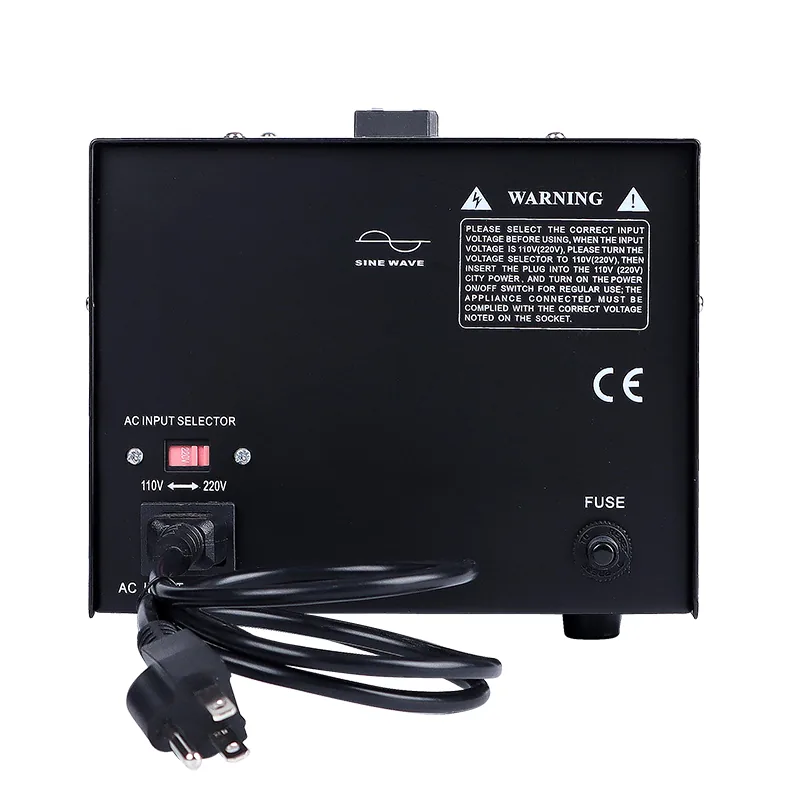
I keep coming back to the winding because it is the part of the box that separates a five-year unit from a fifteen-year unit in this market. A transformer wound for one narrow input figure has to work hardest when the supply is at its worst. The turns ratio stays the same, so a lower input means a lower output and a higher current for the same power, which means more heat in the copper. Heat is what ages insulation, and insulation is what fails.
A wider input band spreads that stress. It also means that an installer commissioning in a heat wave and an operator running the same unit in winter are both inside a sensible operating window. On a unit that will be switched on at dawn and left running until closing, that difference compounds over years rather than months.
There is one honest caveat. A wider band gives you less precision at the output, so if your machine is genuinely fussy about receiving exactly 110V, say so and we will tune the winding tighter and handle the input variation another way. The right answer depends on the load, and I would rather ask than assume.
Asunción, Ciudad del Este and the Mercosur Road
The commercial geography here is worth understanding if you are supplying the market rather than just buying for yourself. Asunción and the surrounding department carry most of the residential and light commercial demand. Ciudad del Este, on the tri-border with Brazil and Argentina, is a trading city in the fullest sense, and a lot of what arrives there is bought to be resold onward rather than installed locally.
Paraguay is a land hub for the Southern Common Market, so goods routinely arrive by sea at a regional port and then travel overland by truck into Paraguay or through it. If your forwarder is routing the container that way, give us the destination city rather than just the country, because the packing and the paperwork for a Ciudad del Este consignment often differ from an Asunción delivery.
For a reseller buying a mixed pallet, the practical advice is to standardise. Two or three popular ratings with a known specification will turn over faster and be easier to support than six niche models, and if a customer asks for something unusual you can always add it to the next order. We ship FOB Ningbo or Shanghai, so your forwarder controls the routing and you can consolidate with other cargo if that saves you money. Tell us the discharge port and the consignee and we will match the invoice, the packing list and the certificate of origin to the entry your broker files.
Spanish Labels, Manuals and the Detail Buyers Forget
Paraguay is a Spanish-speaking market and the documentation has to match. We print the rating label and the operating manual in Spanish on request, and we hold the artwork so a repeat order ships with identical labelling. That is not a marketing extra; it is the difference between equipment that an electrician can install confidently and a box with a Chinese or English label that nobody on site wants to touch.
For resellers, we can also print your own brand on the faceplate and supply the manual under your name, which is worth thinking about before the second container rather than after. And if the units are going to be repacked or relabelled in Paraguay for onward sale into Brazil or Argentina, mention it, because the label language you need may not be Spanish at all.
One more practical note. A Paraguayan importer buying a demonstration unit for a showroom should order it with the correct socket fitted, not with an adapter. Customers who see a machine running on a taped-on adapter draw their own conclusions about the product behind it.
What We Build and Send to Paraguay
I am at the factory, so I can speak to what is actually on the bench. The ST-1500 is the entry unit for a home with one or two imported appliances, and it does that job quietly for years.
The ST-2000 is our 2000VA step down transformer, 220V in and 110V out, with RCD protection mounted inside the enclosure. For a home with a water pump, a workshop corner and a couple of imported machines, that is usually where my quotation lands. The local RCD matters in a domestic setting, because a fault on the 110V side trips at the unit instead of waiting for a breaker in another part of the house.
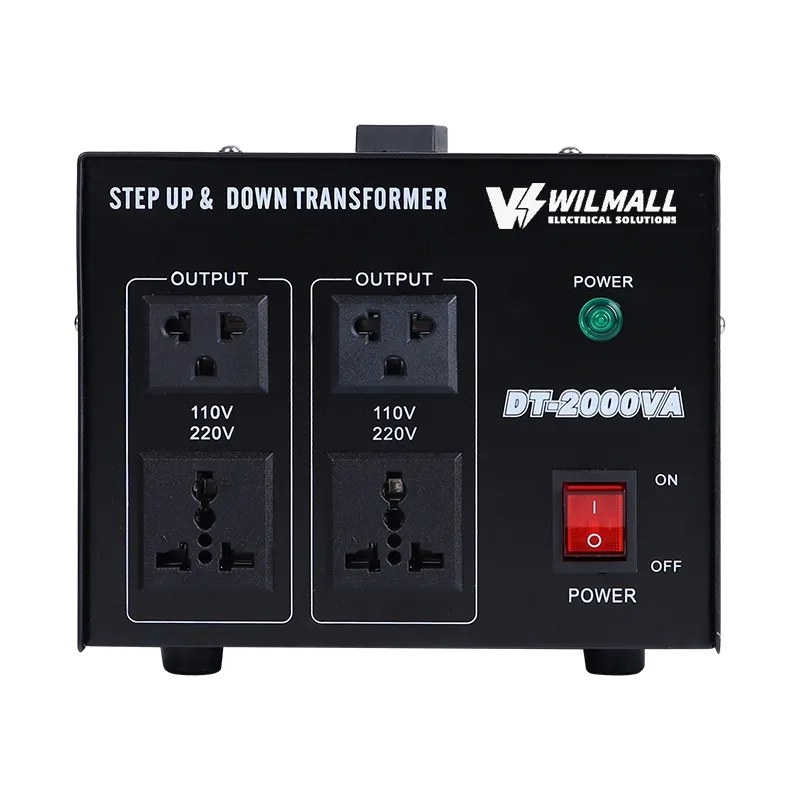
Above that the STU line carries the heavy duty. STU-3000 and STU-5000 are bidirectional units, which is a real advantage in a market that imports equipment from North America, Europe and Brazil all at once, because the same box can be asked to work in either direction without a rebuild. Where the load is light and mixed, the DT-1000VA switches direction automatically with nobody watching it. Control and panel duty inside equipment goes to the TC series control transformer, and the Variac range at 500VA, 1KVA, 2KVA and 3KVA covers anyone who needs to bring an unfamiliar imported machine up slowly on a bench and watch what it does.
Every unit we send out is wound with copper, tested at our plant in Yueqing, and comes with a 12-month warranty. The batch test card travels in the box and records input voltage, loaded output and no-load current, which is the record that settles any question about how the unit left us.
Four Ordering Mistakes This Market Makes Often
I have quoted enough Paraguayan orders to recognise the patterns that lead to a disappointed buyer, and they are nearly always commercial rather than technical.
The first is buying one large unit to cover a whole building. It looks efficient and it is usually a mistake, because a fault on the big box takes everything down at once, and a large transformer running at ten percent of its rating is not doing anybody a favour either. Two smaller units on separate circuits cost slightly more and give you containment, which matters a great deal in a shop where the freezer must stay cold overnight.
The second is shaving the winding to save a few dollars on a market where the voltage genuinely moves. A narrow-input unit is cheaper because it uses less copper, and in a country with long feeders and a heavy summer peak that saving gets paid back in heat, noise and a shorter service life. Ask for the wider band and treat the small price difference as an insurance premium you only pay once.
The third is ordering without the 110V outlet specified. Buyers read the output voltage and stop there, then the unit arrives with a generic outlet and the imported machine has to be connected through an adapter that gets warm. Tell us the plug type on your equipment at quotation stage. It costs nothing to fit the right outlet and it removes a permanent weak point from the installation.
The fourth one is specific to resellers. Stocking six niche ratings because a customer once asked for each of them ties up money in boxes that sit on a shelf, and it makes supporting the range harder for everyone. Two or three well-chosen ratings with a known specification will turn over faster, and anything unusual can be added to the next container once you have a real order behind it.
Five Details That Get You a Price the Same Day
Send the input voltage at your point of connection, the output voltage your equipment needs, the total power or a list of equipment with nameplate wattages, the quantity, and the port or destination city. Add a note on anything with a compressor, because in Paraguay that one detail can move you up a size.
While you gather that, our Step Down Transformer for Brazil: 220V to 127V Guide covers the neighbouring market, which is worth reading if your goods will cross the border, since Brazil uses a 127V nominal and the arithmetic is not the same as Paraguay’s. If you are still weighing up whether you need to step down, step up or both, the step up & down transformers page explains each arrangement in plain terms. We also keep a full set of voltage guides by country if you supply more than one market in the region.
If a nameplate is worn or unreadable, send a photo anyway. Working out the right step down transformer for Paraguay is routine for us, and a two-minute exchange on WhatsApp is a great deal cheaper than a unit that cannot start a compressor in the middle of summer.
Paraguay Transformer Questions I Answer Weekly
Here are the ones that land in my inbox from Asunción and Ciudad del Este most weeks, written up the way I would say them out loud.
Paraguay has cheap electricity, so why does voltage still fluctuate?
Cheap generation is not the same as a strong distribution network. ANDE supplies a nominal 220V at 50Hz, but long feeders and heavy summer air conditioning load pull the voltage down at the far end, then it lifts overnight. A step down transformer for Paraguay wound with a wider input band copes with that range far better.
How do I size a transformer for a 110V air conditioner?
Size on the compressor start, not the running watts. A unit rated 1200W running can demand over 3600W for an instant, and that figure is higher in summer when the head pressure is up. We would normally put that on an STU-3000 rather than anything smaller.
Do I need a Type C socket on the input side?
Yes, Type C is the standard two-pin pattern in Paraguay and it feeds the unit without any adapter. The 110V output is a separate choice and should match your machine, so tell us whether your equipment arrived with a North American plug and we will fit the right outlet.
Can you print the rating label and manual in Spanish?
Yes, and we do it as standard for this market on request. We print the rating label and the operating manual in Spanish and keep the artwork on file, so a repeat order carries identical labelling. Resellers can also have their own brand on the faceplate.
Can I mix several transformer models in one order for resale?
Yes. Minimum order is 10 pieces in total, so a pallet can carry a mix of ratings such as the ST-1500 and ST-2000 rather than one model only. Tell us the split at quotation stage and we will pack and label each carton by model.
Mark every compressor on your equipment list before you send it. That single note is what tells us whether you need a 1500VA box or something that can absorb a summer start, and it is usually the difference between a unit that lasts and one that trips in February. Send the list, the quantities and your destination city and we will price it.
Or talk to us directly: WhatsApp +86 197 3022 6757 · Email sales@wilmall.com
MOQ 10 pcs · Lead time 15-25 days · FOB Ningbo or Shanghai · 12-month warranty