Step Down Transformer for Georgia: 220V to 110V Guide
A message from Tbilisi usually arrives with a photo attached. It is a nameplate from a machine that came out of North America, a piece of kitchen equipment in a guesthouse, a laundry unit in a small hotel, or a bench tool in a car workshop, and the question underneath is always the same one: will this run on our wall. The country of Georgia sits at 220V and 50Hz, and the equipment it is trying to feed sits at 110V, so yes, there is a box in the middle and it has to be chosen with some care.
I have been winding step down transformers in Yueqing for long enough to have handled a good number of Georgian orders, most of them through importers in Tbilisi and through hotel and restaurant contractors in Batumi. The pattern of questions is consistent, so I am setting the answers out here as I would give them on a call, plain and without the brochure language.
Georgia the Country, Not the US State
Let me clear the geography first, because it costs people real money when it gets muddled. When I talk about a step down transformer for Georgia, I mean the country of Georgia in the South Caucasus, with its capital at Tbilisi and its Black Sea coast at Batumi. I do not mean the American state of Georgia, which runs 120V at 60Hz and needs no transformer at all for North American equipment.
That distinction is not pedantry. Freight forwarders, customs brokers and even some online catalogue filters get it wrong, and a unit dispatched to the wrong Georgia is a very expensive box in the wrong warehouse. The country of Georgia is on the 220V, 50Hz system, along with Armenia, Azerbaijan, Turkey and the rest of the region, so equipment built for North American mains needs a 220V to 110V step down unit here.
If you are ordering from outside and the whole conversation happens by email, put the port and the country name in writing at the top of the enquiry. Poti and Batumi are ports in the country of Georgia sitting on the Black Sea. That single sentence removes the confusion before it starts.
What the Supply Looks Like: 220V, 50Hz and Real Voltage Deviation
Sockets in the country of Georgia are Type C and Type F, the same two-pin Euro and side-earthed Schuko patterns you meet across the continent, and the nominal supply is 220V at 50Hz. In a modern building in central Tbilisi the supply is generally well behaved. Move outward, into the older districts, into the towns along the coast, or up into the mountain settlements, and the voltage starts to wander in a way that a single-tap transformer does not enjoy.
Frequency is the point North American buyers most often miss. A transformer changes voltage only. Whatever frequency arrives on the input side arrives on the output side too. Georgia’s grid is 50Hz, so a 110V appliance designed for 60Hz will see 50Hz once it is powered through the unit, and that has consequences: a motor runs a little slower, and a transformer-fed motor or compressor runs a little warmer. Electronics with switch-mode supplies are usually indifferent. Anything with a clock that counts mains cycles will drift. Nothing in my product range changes that, and any supplier who claims otherwise is not being straight with you.
The voltage deviation is the part I can do something about. Ask for the lowest and the highest voltage the site sees across a week, not the label on the substation. If your building drops to 195V on a winter evening, I can wind the input to tolerate that band instead of spending the whole winter running near the edge of its design. It costs a little more in copper and it buys years of service. This is why I ask about the site, not just the equipment.
Winter Heating Season and a Grid Under Load
Georgia’s peak demand lands in the cold months, and that shapes the transformer conversation in two ways. On the supply side, heavy electric heating across a district drags the voltage down at the same time every evening, which is exactly when a guesthouse is running its kitchen and its laundry. On the load side, your own building is pulling its own winter maximum, with heaters, hot water and kitchen equipment all on at once.
Both effects land on the same unit at the same hour. A transformer that was comfortable in September can be running noticeably warmer in January, not because anything has changed inside it but because the ambient temperature has dropped the heat in it less effectively and the load has climbed. Sizing with a bit more headroom than the summer figure suggests is not over-caution, it is arithmetic.
The rule I give buyers is simple. Build the winter list, not the annual average, and add thirty percent on top of that. If your guesthouse runs four 110V appliances in July and six in January, size for the six.
Sizing for Apartments, Guesthouses and Restaurant Kitchens
The load profile in the country of Georgia splits fairly cleanly into three groups, and each one wants a different unit. A family apartment with an imported appliance or two is a light, steady job. A guesthouse or small hotel is a mixed job with long running hours and a bad time of day. A restaurant or bakery kitchen is a motor job, and motors decide their own sizing.
What I need from you is the equipment list with the wattage from each nameplate, plus a note on which items can be running at the same moment. That last part is where most buyers under-order. Two 800W machines that never overlap are an 800W problem, not a 1600W one, but a kitchen where the mixer, the grinder and the dishwasher heating element can all be live together is a genuine 2400W and the transformer has to live with it.
| Typical Georgian site | Simultaneous load | Unit I would quote | Reason |
|---|---|---|---|
| Tbilisi apartment with imported 110V appliances | 400 – 900 W | ST-1500 1500VA | Light steady load, one appliance at a time |
| Guesthouse with US-spec laundry and kitchen kit | 1000 – 2000 W | ST-2000 with RCD | Several appliances overlap at breakfast and check-out |
| Restaurant, bakery or cafe prep kitchen | 1500 – 3000 W | STU-3000 | Motors start against load, not on a free shaft |
| Car workshop or joinery bay | 1500 – 3500 W | STU-3000 or STU-5000 | Tools started by one pair of hands, often together |
| Hotel with 110V fan coils and control boards | 800 – 2000 W | DT-1000VA plus TC series | Mixed power and control duty in one building |
| Bench checking an import container | 500 – 2000 W, variable | Variac 1KVA to 3KVA | Dial the output to match the nameplate |
A Worked Example From a Batumi Guesthouse
Take a nine-room guesthouse on the coast. There is a 110V American washer at 900W, a dryer at 1800W, a small imported mixer at 500W and a coffee grinder at 350W. The washer and dryer will not run at the same time in most houses, but on a turnaround morning they very often do, and the kitchen is busy in the same hour.
Add the washer and dryer together and you are at 2700W before the kitchen. Both have motors, so the start surge on the dryer at 1800W has to be counted: three times that is 5400W for an instant. A 3000VA box will not carry that comfortably, so my quotation would go to the STU-5000 for the laundry side and a separate ST-1500 for the kitchen, which also means a fault in the kitchen does not take the laundry down on the busiest morning of the week.
Two units cost more than one. They also mean you are not standing in a wet laundry at seven in the morning with a dark box and no dry towels. I have quoted this configuration for coastal guesthouses more than once and it has not come back as a complaint.
Input Taps and Wide Windings: The Fix for Voltage Deviation
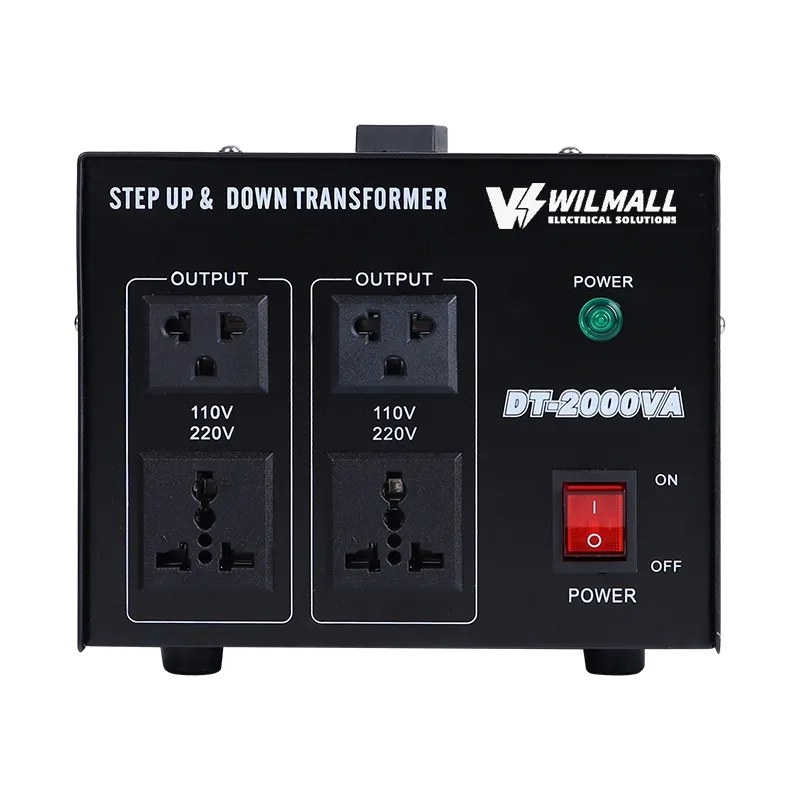
This is the design detail that matters most in the country of Georgia and the one I spend the most time explaining. A cheap transformer is wound for one input voltage and treated as if the wall always delivers exactly that. A transformer built for this market can be wound with a wider input tolerance, or with selectable input taps, so that a site running at 200V and a site running at 240V both end up with a usable 110V output.
Taps are not a magic trick. They trade a little output accuracy for a lot of survivability, and if you go too wide the output sags under load. What they do give you is a way to commission a unit on a site whose voltage is not what the drawing promised, without sending it back to China. For a buyer in a town outside Tbilisi, that is worth asking about at quotation stage.
If the site voltage is genuinely unstable rather than just offset, a transformer is not the right tool on its own. The honest answer there is a stabiliser upstream and the transformer behind it, or a transformer wound to accept the swing and no more. Ask me and I will tell you which one your site needs. Telling a buyer he needs something we do not sell is cheaper than selling him the wrong thing.
Type C and Type F Sockets, and Labels in Russian and Georgian
On the input side there is nothing exotic to solve. Type C and Type F are both ordinary 220V patterns and either one feeds the unit without a fuss. The 110V side is where your own equipment decides the answer, because a machine that arrived from the United States usually has a NEMA plug and deserves a real outlet on the transformer rather than an adapter taped to a terminal block.
Documentation is a bigger point in this market than most buyers anticipate. Georgian buyers often need the rating label and the manual in Russian, and increasingly in Georgian as well, and equipment sourced through Turkey or the Gulf may come with its own paperwork that has to match. We print the labels and the manual in the languages you specify and keep the artwork on file, so the second order arrives with identical labelling without an email chain about it.
It sounds like a small thing until a shipment is held because the rating label is not in a language the receiving inspector reads. Getting it right the first time costs nothing. Fixing it after the container has left Ningbo costs a week and a reprint.
Poti and Batumi: A Caucasus Gateway That Moves Stock Onward
The country of Georgia is one of the more useful entry points in the region, and a good part of the trade that runs through it does not stop there. Poti and Batumi on the Black Sea take the container, and from there the road network carries goods onward to Armenia and to Azerbaijan. If you are supplying a distributor who serves all three markets, telling us that at quotation stage changes how we pack and label the cargo.
We ship FOB Ningbo or Shanghai, so your forwarder books the main leg and nominates the discharge port. What we need from you is the port, the consignee and the document set you want. For transit cargo that will be trucked onward, a certificate of origin and a clean packing list that matches the invoice line by line save a long argument at the border, and goods that are repacked in Georgia for onward sale need labelling that survives the second journey.
For a direct sale into Georgia, the paperwork is the standard three: commercial invoice, packing list and bill of lading, plus a certificate of origin where your customs entry calls for it. Give us the exact consignee name and address as it will appear on the entry and we will mirror it. Mismatched names are the single most common reason a container sits for days.
The Step Down Transformer for Uzbekistan: 220V to 110V guide covers a neighbouring 220V market with a similar feeder pattern, so much of the sizing reasoning carries across if you trade in both countries.
What We Supply Into Georgia
Because I am on the factory floor rather than at a trading desk, I can tell you exactly what leaves the workshop. The ST-1500 is the light single-load unit, and for a Tbilisi apartment with one or two imported appliances it is usually the whole answer.
The ST-2000 is our 2000VA step down transformer, 220V in and 110V out, with the RCD built into the case. Guesthouses and small hotels land on that unit most often, because it covers a mixed breakfast-hour load and the local trip means a fault on the 110V side does not go hunting for a breaker in another room. If a guest unplugs something badly, the unit reacts at the unit.
Heavier work goes to the STU series. The STU-3000 and STU-5000 are bidirectional, so they will step up as well as down, and that matters when a hotel or workshop buys equipment from several continents and cannot say today which way the box will need to run next season. For lighter mixed feeds the DT-1000VA does the same job automatically with nobody at the switch, the TC series covers panel and control duty inside equipment, and the Variac range at 500VA, 1KVA, 2KVA and 3KVA gives a service engineer a variable output for commissioning an unfamiliar imported machine. Once a technician has used one to bring a machine up gently on a bench, he tends to want one permanently on the shelf.
Send These Details and We Can Quote Properly
You do not need a drawing. Send the equipment list with each nameplate wattage, the output voltage each machine wants, the input voltage at the socket, the number of units, and the port you will use. If you can add which items carry motors, that is the difference between an accurate quotation and a guess.
Two pages are worth a look while you assemble that. If you are still deciding between stepping down, stepping up, or a unit that does both, the step up & down transformers page sets out the three arrangements without any arithmetic to untangle. And if you want to compare the supply conditions elsewhere in the region, we keep a set of voltage guides by country that covers it port by port.
If something on the list is ambiguous, photograph it and send it over. Choosing a step down transformer for Georgia is routine work here, and I would rather spend ten minutes on WhatsApp than have you find out in a January cold snap that the unit you bought cannot carry the laundry.
Georgian Buyers Ask Me These Most Often
These are the questions that come up again and again from Tbilisi importers and from contractors in Batumi, with my answers written the way I would give them over the phone.
Does the country of Georgia use 110V or 220V?
The country of Georgia runs a nominal 220V supply at 50Hz, with Type C and Type F sockets, so equipment built for 110V needs a step down transformer for Georgia. This is the South Caucasus country, not the US state of Georgia, which uses 120V at 60Hz and needs no conversion.
Why does voltage deviate so much outside Tbilisi?
Feeder length and local load do the damage. Central Tbilisi is generally steady, but towns and mountain settlements can swing well away from 220V, especially in the winter heating peak. We can wind the input with a wider band or fit selectable taps so the ST-2000 still delivers the output your machine expects.
Can a transformer change the frequency for my 60Hz equipment?
No, and no transformer can. It changes voltage only, so a North American appliance designed for 60Hz will see Georgia’s 50Hz on the output side. Electronics with switch-mode supplies rarely care, but a motor runs slightly slower and warmer, which is why we ask about motor loads before quoting.
Can you print the rating label and manual in Russian or Georgian?
Yes, and we usually do for this market. Tell us which languages you need and we print the rating label and the manual accordingly, keeping the artwork on file so repeat orders carry identical labelling. It avoids a shipment being held because the label is not in the language the inspector reads.
How do I bring transformers into Georgia and move them onward?
Minimum order is 10 pieces, built and tested in Yueqing, shipping FOB Ningbo or Shanghai in 15 to 25 days. Poti and Batumi are the usual ports, and cargo can be trucked onward to Armenia and Azerbaijan. Give us the consignee exactly as it appears on your entry and we mirror it on the documents.
Send us the nameplates and tell us what the site voltage does in winter. List the 110V machines you run, mark the ones with motors, and tell us whether the goods stop in the country of Georgia or travel on to Armenia or Azerbaijan. That gives us enough to pick a rating and put a firm price and date on it.
Or talk to us directly: WhatsApp +86 197 3022 6757 · Email sales@wilmall.com
MOQ 10 pcs · Lead time 15-25 days · FOB Ningbo or Shanghai · 12-month warranty