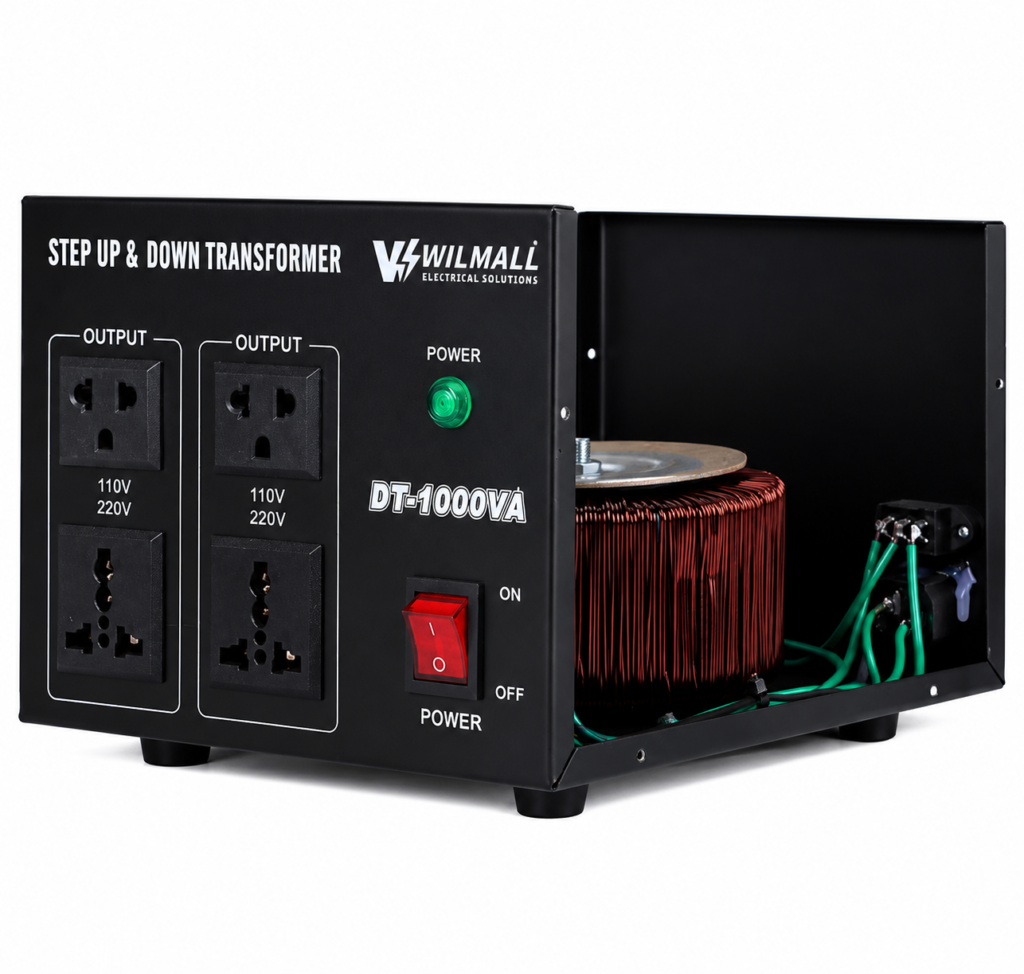
How to Test a Transformer with a Multimeter
A transformer that stops working can shut down a whole machine, and before you call the supplier, it helps to know whether the transformer is actually the problem. With a basic multimeter you can test a transformer in a few minutes – no special equipment, no guesswork. This guide walks through the checks, what readings you should see, and how to tell a dead transformer from a wiring problem.
Safety first
A transformer is a mains device. If you are testing it live, you are one slip away from touching 220V, so here is the rule: test the windings with the transformer disconnected from power, using the resistance (ohms) function. Only use the live voltage checks if you know exactly what you are doing and the transformer is properly isolated. Disconnected testing answers most questions anyway – you rarely need to power it up to find the fault.
The other thing to understand is that a transformer has at least two separate circuits: the primary winding (the side that connects to mains) and the secondary winding (the side that feeds your load). Your multimeter tests each winding independently, and that is where the diagnosis comes from.
The tests, step by step
| Test | How | What you should see |
|---|---|---|
| Visual check | Look for burns, smell, swelling | No charring, no smell |
| Primary resistance | Ohms across primary terminals | Low but not zero (tens of ohms) |
| Secondary resistance | Ohms across secondary terminals | Lower than primary (a few ohms) |
| Primary to secondary | Ohms between the two windings | Open circuit (no reading) |
| Winding to core | Ohms from winding to metal frame | Open circuit (no reading) |
| Live voltage test | Input voltage in, output out | Rated ratio at the output |
The first three checks confirm each winding is intact. The fourth and fifth check the insulation – the isolation between windings and to the core. If you get a reading there when there should be none, the transformer has a short to ground or between windings, and it needs replacing, not repairing.
Reading the resistance numbers
A healthy primary winding shows a low resistance – typically tens of ohms for a small transformer, less for a big one. Zero ohms means a shorted winding; infinite resistance means an open winding. The secondary is usually lower still, a few ohms, because it is wound with thicker wire for higher current. If either winding reads open or dead short, the transformer is the problem.
Here is the practical detail: small resistance values are easy to misread on a cheap multimeter. Touch the probes together first and note the reading – that is your probe resistance, and you subtract it from what you measure. A 5-ohm reading on a meter that shows 0.8 ohms with probes touched is really 4.2 ohms. It changes how you judge a marginal winding.
When it is not the transformer
About half the time we hear from a customer with a “dead transformer”, the transformer is fine and the problem is upstream or downstream: a blown fuse, a tripped RCD, a loose terminal, or a load that is shorted. Test the transformer first – if the windings check out, follow the circuit. Check the supply voltage at the primary, check the load on the secondary, and check every connection in between. A transformer is one link in a chain, and the chain is what you are really testing.

What the readings mean
- Open primary – internal fuse or winding break. Replace.
- Short primary – burnt winding. Replace, and check what overloaded it.
- Short primary-to-secondary – insulation failure. Dangerous, replace now.
- Short to core – the frame is live. Dangerous, replace now.
- All windings fine – look upstream at fuses and supply, downstream at the load.
Why buy from a factory directly
If your test shows the transformer is dead, replace it with one that was load-tested at the factory. Wilmall manufactures step up, step down and control transformers with copper winding, batch test records and CE / RoHS documents. MOQ 10 pcs, 15-25 day lead time, FOB Ningbo or Shanghai. Send us your old unit details and we match it within 24 hours.
Testing different transformer types
The same multimeter tests apply to every transformer, but the numbers look different by type. A step down transformer has a low-voltage secondary with thick wire, so the secondary resistance is very low – often under an ohm. A control transformer with a 24V secondary reads a little higher. An isolation transformer, whether 1:1 or not, shows two independent windings that must read open between them and open to the core.
The test procedure does not change – resistance checks on each winding, isolation checks between windings and to the core – but knowing what a healthy reading looks like for your transformer type stops you from condemning a good unit. If the numbers seem off, compare with the datasheet or ask the supplier for the expected winding resistance.
When to call the supplier
If your tests show a shorted or open winding, or a short to the core, the transformer is done and needs replacing – that is not a repair job. Before you order, note the full nameplate data: the primary voltage, the secondary voltage, the VA rating, and the mounting style. A supplier can match a replacement from that alone. If you bought from us, the batch test record is on file and we can confirm what the unit should have read when it left the factory.
One more scenario worth mentioning: if the transformer tests fine but your machine still does not work, stop replacing parts and trace the circuit. A transformer that tests healthy is rarely the culprit, and the fault is usually a fuse, a relay, a loose connection or the load itself. Method beats parts-swapping every time.
Preventive checks
Transformers fail from heat, moisture and overload, and a quick annual check catches most problems early. Look for discoloured varnish, a smell of burnt enamel, or swelling in the case. Measure the winding resistance once a year and note the numbers – a creeping drop over time is a warning long before the transformer dies. In humid environments, check the insulation resistance to the core, because moisture is the quiet killer.
Keep the terminals tight and clean, make sure the ventilation is not blocked, and verify that nothing has been added to the load since installation. Most transformer failures we see trace back to a load that grew over the years while the transformer stayed the same size. The annual check catches that too.
The short version for buyers
Test each winding with the unit disconnected, check isolation to the core, and compare with the expected numbers. If the transformer reads healthy, trace the rest of the circuit. If it is dead, send us the nameplate and we match a replacement within 24 hours.
Reading the nameplate for testing
The nameplate is your map when testing: it tells you the expected primary and secondary voltages, the VA rating, and often the winding configuration. If the unit is multi-tap – a primary that accepts several voltages – test each tap pair the same way and note which one reads healthy. When you contact us for a replacement or a check, the nameplate data is the first thing we ask for, because it tells us what the transformer should do before it does anything.
And the last safety note: never test a transformer that is wet, never bypass the fuse on your meter, and if a reading looks wrong, double – check the meter range before condemning the unit. A transformer that tests healthy is worth keeping; a meter set to the wrong range is a common false alarm.
Frequently asked questions
Can I test a transformer with a multimeter?
Yes. With the transformer disconnected, measure the resistance of each winding, the isolation between windings, and the isolation to the core. Low but not zero is healthy; open or dead short means a faulty winding.
How do I test a transformer under power?
Measure the input voltage at the primary and the output at the secondary. The ratio should match the transformer rating. Only do this with proper isolation and care – it is live mains.
Why does my transformer read open circuit on the primary?
An open primary usually means a broken winding or an internal thermal fuse that has blown. The transformer needs replacing.
What resistance should a transformer show?
A healthy primary is typically tens of ohms, the secondary a few ohms. Subtract your probe resistance from small readings. Zero means shorted, infinite means open.
Where can I get a replacement transformer?
Wilmall manufactures replacement step up, step down and control transformers with matching voltage combinations. Send us your old unit details for a quote within 24 hours.
Related reading
- Step Down Transformer Keeps Tripping: Causes and Fixes
- Control Transformer Sizing: How to Calculate VA
- Control Transformer Range
Get a factory-direct quote
Email sales@wilmall.com or WhatsApp +86 197 3022 6757 with your transformer details. We match a replacement within 24 hours. MOQ 10 pcs.