Step Down Transformer for Vacuum Cleaner: Sizing Guide
A US 110V vacuum cleaner draws 1000-1500W to drive a universal motor and the suction fan. Choosing the right step-down transformer for a vacuum cleaner is about handling the motor inrush and the continuous load. This guide covers sizing for upright, canister, robot, shop and central vacuum systems in any 220V country.
Why vacuum cleaners need careful sizing
A vacuum cleaner uses a universal motor that draws several times its running wattage for a fraction of a second at start. A 1200W upright vacuum may pull 2500-3500W at start-up, which is the sizing factor for the transformer. The motor also draws continuous current for as long as the vacuum is on, often 10-30 minutes per cleaning session.
The combination of high start-up surge and continuous running load is the main challenge. A transformer that can deliver the running wattage but not the surge will trip thermal protection immediately on switch-on.
What size transformer do you need?
| Vacuum type | Running wattage | Start-up surge | Recommended transformer |
|---|---|---|---|
| Stick / handheld vacuum | 100-300W | 300-900W | 1000VA |
| Robot vacuum | 30-80W | 60-200W | 500VA |
| Canister vacuum (home) | 800-1200W | 1500-2500W | 2000-3000VA |
| Upright vacuum (home) | 1000-1500W | 2000-3500W | 2000-3000VA |
| Shop / wet-dry vacuum | 1200-2000W | 2500-4000W | 3000-5000VA |
| Central vacuum system | 1500-2500W | 3000-5000W | 5000-7500VA |
The right way to size
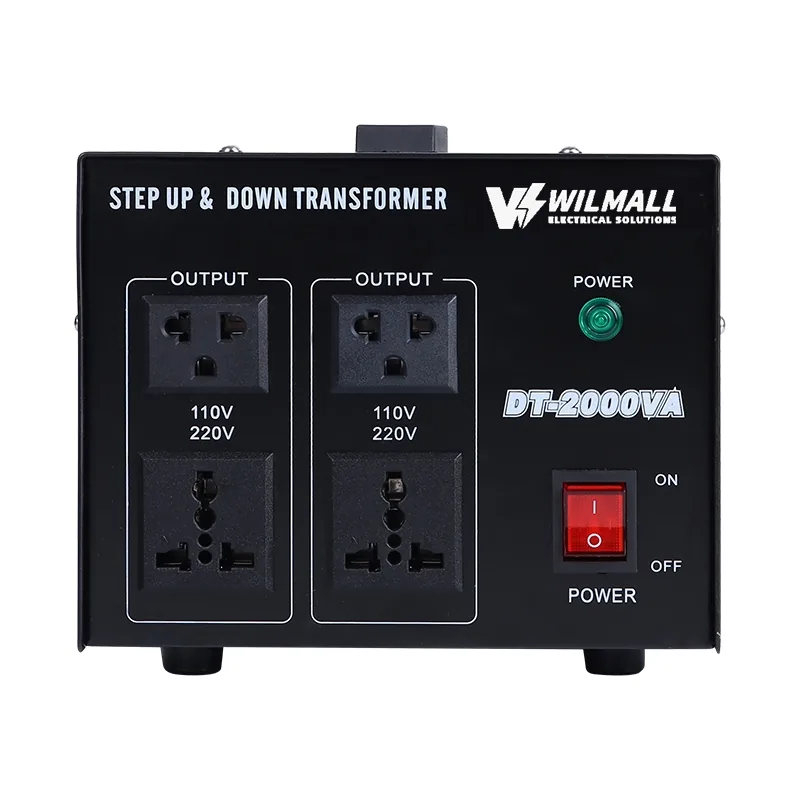
Two numbers matter: the running wattage and the start-up surge. Add 30% margin on top of the surge for safety, and choose the next standard transformer size up. For a 1200W upright vacuum with a 2500W surge, a 3000VA transformer (STU-3000) is the right size.
Robot vacuums and stick vacuums draw much less and are well within the rating of a small transformer. A 1000VA unit covers most robot vacuums with plenty of margin.
Why transformer type matters
Choose an isolation transformer (ST or STU series), not an electronic converter. Electronic converters are usually rated for resistive loads and cannot start the universal motor in a vacuum cleaner. Even the better electronic converters trip when the motor surges. Copper-and-steel transformers handle the surge and the continuous load without complaint.
RCD protection
Vacuum cleaners are used on damp floors, near water (bathroom spills, kitchen accidents) and outdoors (patio cleaning). RCD protection on the transformer is essential — the RCD trips on leakage current if any part of the vacuum develops a fault. The Wilmall ST series includes RCD protection as standard.
Central vacuum systems
Central vacuum systems use a powerful motor in a fixed location, often 1.5-2.5kW, with hose outlets throughout the house. The motor runs on 110V or 220V depending on the system. For a US-spec 110V central vacuum, the transformer must carry the motor surge (3-4x running wattage) with margin. A 5KVA or 7.5KVA transformer is the typical size.
Mount the transformer close to the central vacuum unit and use appropriately sized cable from the transformer to the vacuum inlet. A central vacuum may run 30 minutes continuously during a thorough cleaning, so ventilation around the transformer matters.

Commercial and industrial vacuums
Shop vacs, construction vacuums and industrial wet-dry vacuums draw 1500-3000W continuously with even higher surge. A 5KVA transformer is the typical starting point; for 3000W industrial vacuums, choose a 7.5-10KVA unit. Industrial vacuums also benefit from a hardwire connection rather than a plug-and-socket unit.
For continuous-duty industrial use, consider a three-phase transformer if the rest of your equipment runs on three-phase. Wilmall builds project-sized three-phase transformers on request.
Voltage considerations for 240V markets
For 240V markets (Qatar, Malaysia, Kenya, parts of UK), the transformer primary must be wound for 240V or with input taps. A 220V primary on a 240V supply delivers higher output voltage, which can shorten the motor life. Wilmall builds ST series with 240V primary windings on request — specify when ordering.
Travel use: 110V vacuum abroad
For business travellers carrying a 110V handheld vacuum abroad, a 1500VA travel transformer is the right size. Combined weight of vacuum plus transformer is around 6-8 kg, which fits standard checked baggage. Plug adapters for the destination country complete the travel kit.
Wet-dry and shop vacuum specifics
Wet-dry shop vacuums handle liquids, which raises the risk of water ingress into the motor and the transformer outlets. Mount the transformer at least one metre away from the vacuum working area, on a wall bracket or shelf above the floor. RCD protection is essential for wet applications.
Canister vs upright vs stick vs robot
Different vacuum form factors have different power profiles. Canister vacuums run 800-1200W continuously with moderate surge. Upright vacuums run similar wattage with higher surge at brush-roll start. Stick and handheld vacuums run 100-300W and surge minimally. Robot vacuums run 30-80W continuously with virtually no surge — a 500VA transformer covers several robots at once.
Pet hair and brush-roll clogging
When a vacuum brush roll is clogged with pet hair, the motor draws more current to maintain RPM. This is not a start-up surge but a continuous high-load condition. A transformer sized for the unclogged motor may overheat under clogged conditions. Choosing a transformer with at least 30% margin helps, but the right fix is to clean the brush roll regularly.
Cordless vs corded considerations
Cordless vacuums run on internal batteries, so the transformer is irrelevant unless the charger is 110V. For 110V chargers, a small 500VA transformer covers the charger and any other small appliance.
Common mistakes
- Sizing to running wattage. The motor surge is 2-3x the running wattage.
- Using an electronic converter. Most cannot start universal motors.
- Skipping RCD protection. Vacuum cleaners run near water and outdoors.
- Confusing watts with VA. Motors need VA headroom for the surge.
- Loading to 100%. Continuous duty requires 25% margin.
Recommended Wilmall transformers
For most household vacuum cleaners, the ST-2000 (2000VA) or STU-3000 (3000VA) is the right size. For shop and industrial vacuums, the STU-5000 (5000VA). Wilmall supplies these factory direct from Yueqing, China, with MOQ 10 pcs per model and 15-25 day lead time.
Email sales@wilmall.com or WhatsApp +86 197 3022 6757 with your vacuum model and target market for pricing within 24 hours.
How to measure your vacuum power draw
If you want an accurate reading instead of a rule-of-thumb estimate, use a plug-in wattmeter. Plug the vacuum into the meter, run it for 30 seconds on the highest setting, and note the peak reading. That peak — not the average — is the number you size the transformer for. A simple wattmeter costs little and removes the guesswork from sizing.
Vacuum transformers for multi-story homes
In a multi-story home, you may want the transformer fixed on one floor and use extension cords for the others. For runs longer than 10 metres, choose the next size up transformer to compensate for voltage drop in the cable. Alternatively, install two smaller transformers, one per floor, each sized for the vacuums used on that level.
Buying advice for importers and distributors
For an importer stocking US vacuums alongside transformers, the ST-2000 is the core SKU for most household models, with the STU-3000 covering shop vacs and the STU-5000 for industrial units. Bundling a transformer with each vacuum in one carton simplifies logistics and increases the average order value. MOQ 10 pcs per model keeps the trial small and the growth path clear.
Noise, heat and placement on the transformer
A step-down transformer produces a gentle hum and some heat when running. If the vacuum cleaner transformer is placed in a hallway or living area, the hum may be noticeable — this is normal for an EI-core transformer. Ensure at least 10 cm of clearance around the case so heat dissipates. If the hum is loud or the case is hot to the touch, switch off and check the load and ventilation.
What to do if your vacuum trips the transformer
If the transformer trips repeatedly when you switch on the vacuum, the most likely cause is an undersized unit or a stiff brush roll. Check the brush roll for tangled hair or debris first, then check the transformer sizing against the vacuum nameplate. If both are fine, the transformer may be defective — return it under the 12-month warranty.
Summary: choosing the right size
The correct transformer size for a US vacuum cleaner in a 220V country depends on the vacuum power and the motor surge. For most household vacuums, a 2000VA ST-2000 is the safe choice. For shop and industrial units, step up to 3000VA or 5000VA. Order from Wilmall factory direct with MOQ 10 pcs and 15-25 day lead time.
Frequently asked questions
Vacuum Cleaner Sizing: The Motor Surge and Duty Cycle
A vacuum cleaner is a motor load, so its start-up surge matters more than its running watts. A typical US-spec vacuum draws 600W to 1200W running, but the motor can spike well above that when it starts, especially when the bag or filter is full and the motor works harder. The practical sizing is 1500VA to 2000VA for a standard vacuum, which covers the running load with enough margin for the surge. Vacuums also run for extended periods, so the transformer should be rated for continuous duty, which our ST series is. If the vacuum runs at the same time as other appliances, add their wattages. The surge is the reason an undersized transformer trips right as the vacuum starts, and sizing with margin prevents that. Send us the vacuum’s nameplate rating and we will confirm the right transformer.
What size transformer do I need for a vacuum cleaner?
For a home upright or canister vacuum (1000-1500W), a 2000-3000VA transformer. For shop and industrial vacuums, 5KVA. For robot vacuums, 1000VA.
Can I use an electronic converter for a vacuum cleaner?
No. Most electronic converters cannot start the universal motor in a vacuum cleaner. Use a copper-and-steel step-down transformer.
What is the surge wattage of a vacuum cleaner?
A 1200W upright vacuum may pull 2500-3500W at start-up. The surge is the sizing factor, not the running wattage.
Why does a vacuum cleaner transformer need RCD protection?
Vacuum cleaners are used on damp floors, near water and outdoors. RCD protection trips on leakage current and protects the user from shock.
What size transformer do I need for a central vacuum system?
A 5KVA or 7.5KVA transformer is the typical size for a US-spec 110V central vacuum system, depending on the motor wattage.
Related reading
- Transformer Sizing Calculator
- How to Choose a Step Down Transformer
- Step Up and Down Transformer Products
Get a factory-direct quote
Email sales@wilmall.com or WhatsApp +86 197 3022 6757 with your appliance list.