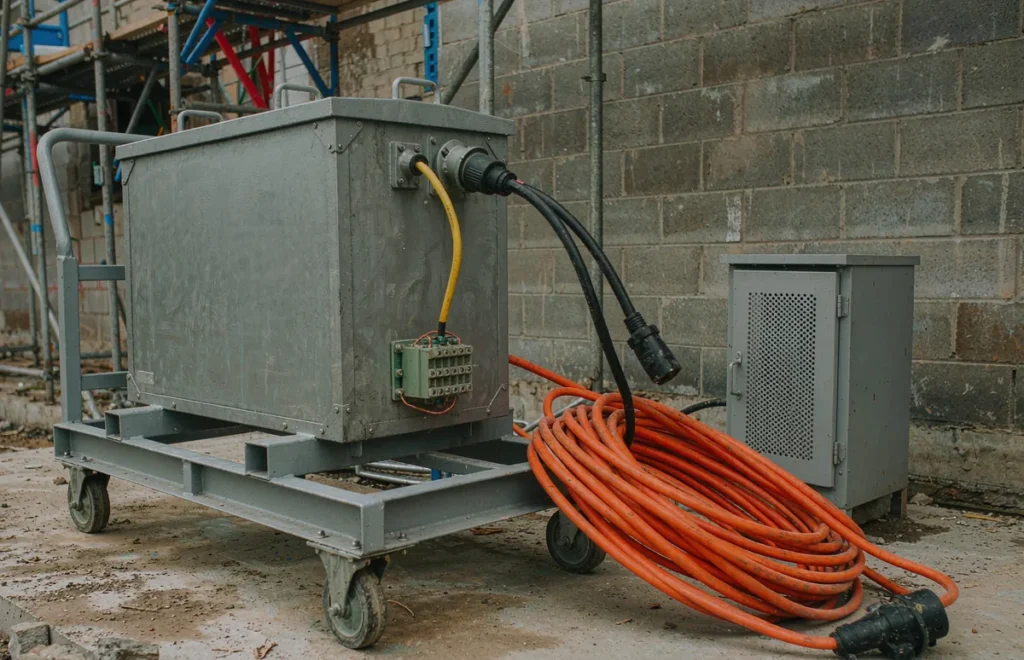
Step Down Transformer for Construction Sites: 220V to 110V
A construction site is where a transformer earns its keep or falls apart. The tools are American, the sockets are 110V, and the supply on site is 220V or 230V off the temporary board or the generator. The box then gets dragged across mud, dropped off a pallet, rained on, and run through a cut-off saw start that would make a tidy office unit blink. Somebody then buys the cheapest adapter they can find, and the site electrician is the one who pays for it later.
I build these units in Yueqing and site enquiries are a steady part of the week, usually from a contractor, a tool hire firm, or a safety officer specifying the temporary supply. The questions repeat, so let me answer them the way I would on a call, no brochure voice.

Why a Site Transformer Takes More Abuse Than an Office One
The short answer is that a site never sits still. An office unit is mounted once and left. A site unit is moved every few days as the work fronts shift, so the enclosure has to take knocks, the cable glands have to stay sealed, and the whole thing has to survive being carried by a man in gloves who is in a hurry. Mechanical strength is part of the spec, not a footnote.
Then there is the supply. Sites often run off a generator, and a generator is not the same as clean mains. The voltage wanders, the frequency holds but the waveform is rougher, and a hard tool start can sag the generator for a moment. The transformer has to ride that without tripping on every saw cut, and it has to do it day after day in dust.
One point I want straight, because it saves a call later. A transformer changes voltage and nothing else. It does not make a 220V generator safe to touch, and it does not replace the site RCD. The RCD is what keeps a man alive if a tool faults, and on our site units it is built in so the 110V side trips locally instead of waiting for a board somewhere across the compound.
Which Site Equipment Usually Runs on 110V
When a contractor sends me the tool list I split it the way I always do. Here is what normally needs a transformer on a site, with the ranges I see on real quotes.
- Rotary hammers and demolition breakers, 800W to 1500W, with a hard motor start on every bite.
- Cut-off saws and disc cutters, 1200W to 2400W, the heaviest draw on most sites.
- Concrete vibrators and pokers, 500W to 1200W, run for long stretches pouring slabs.
- Site lighting and flood towers, 200W to 1000W, often on through the evening shift.
- Drills, grinders and sanders, 400W to 1000W, the everyday background load.
- Site chargers for cordless packs, 100W to 400W, small but always drawing.
- Temporary distribution and small pumps, 200W to 800W, depending on the job.
What does not need us: most three-phase plant, which takes the site supply directly, and any tool already rated 100-240V. Go through the nameplates before you build the load sheet, because counting a three-phase mixer as a 110V load pushes you into a unit far bigger than the gang needs.
How to Size a Transformer for a Site
Here is the method I use. Group the tools by the gang that uses them, because a steel fixer and a joiner do not pull at the same moment. Add the items that could plausibly run together, add 25 to 30 percent headroom, and size for the start surge on the biggest tool, because a cut-off saw or a breaker decides the frame, not the idle drill.
For a single heavy tool, a 2000W cut-off saw with a 3 times start, the unit has to survive a brief pull near 6000W without tripping. That does not mean a 6kVA box, because the start is momentary, but it does mean the frame must be rated for that repetitive surge. We build our ST series with that headroom, and I would rather see a gang on a 3000VA unit than a 2000VA box living at the edge.
A Worked Example: A Two-Gang Fit-Out
Say one gang runs a rotary hammer at 1200W, a grinder at 900W and site lights at 400W. The worst case is both tools plus lights: 1200 + 900 + 400 = 2500W, with a brief surge on the hammer start. Add 30 percent and you are near 3250VA, so a 3000VA unit is tight and a 5000VA is the safer call for a second tool joining. A second gang with a vibrator at 900W and a drill at 500W is about 1400W, a 2000VA unit covers it.
For a small one-man job, a drill at 600W and a charger at 200W, the load is about 800W. With headroom that is a 1500VA unit, and the man never thinks about it. Same site, same supply, different sizing for different gangs.
| Site gang | Typical simultaneous load | Suggested unit rating | Why this size |
|---|---|---|---|
| One heavy tool plus lights | 2000 – 3000 W | ST-2000 2000VA with RCD | Cut-off saw start surge needs the headroom |
| Two-gang with breaker and grinder | 2500 – 3500 W | STU-3000 bidirectional | Both can start while lights run, size for that |
| Vibrator and small power tools | 1200 – 2000 W | ST-2000 2000VA with RCD | Long runs, steady output keeps the poker going |
| Full site, several gangs | 4000 – 7000 W | Two STU-5000 units | Split gangs so one fault does not stop the board |
| Lights and chargers only | 300 – 1000 W | DT-1000VA bidirectional | Light load, some items already dual voltage |
When the Tool Count Pushes You up a Size
There are cases where I tell a site to go past the 30 percent rule. A gang that adds a second saw or a second breaker later should buy the bigger frame now rather than a second unit down the line. A site running mainly off a small generator should size up, because the generator sags more on a hard start and the transformer has to absorb it. And any compound planning to split into more fronts should standardise on one rating so spares are interchangeable.
If you are not sure where your gang sits, send us the tool list. We have sized enough site loads to tell you in one message whether a 2000VA unit is enough or whether the saw start puts you on the 3000VA.
Portable Build, Dust Proofing and Generator Compatibility
The enclosure has to be built for the site, not the shelf. Our site units use a tough housing with sealed glands so dust and a rain shower stay out, and a frame you can carry or bolt to the board. Do not leave the unit where a passing dumper can clip it, and do not run the cable through a puddle without a proper raised route, because the transformer is only as safe as the wiring around it.
Generator compatibility is the part contractors ask about most. Our units take the wandering voltage a site generator gives without tripping on every tool start, and the wide input tolerance means a sag to 200V or a rise to 250V does not push the 110V output out of range. That matters when the only supply for miles is a dented diesel set someone borrowed.
RCD, Earthing and Site Electrical Safety
On site RCD is the rule, not the option, so spec it up front. On the ST-2000 the RCD is in the build, so a 110V fault trips at the unit instead of waiting for a breaker across the compound. On a wet trench with men in boots, that local trip is the thing that keeps a fault from becoming a reportable incident.
The next item on my list is the earth bond. The enclosure has to bond to the site earth, and the 110V output should feed proper sites sockets, not a loose lead out of the box. If you are also fitting out a fixed workshop alongside the site, our guide to a Step Down Transformer for Workshops: Buyer’s Guide covers the more permanent end of this work, though a moving site is a tougher duty as you can see above.
The Units We Build for Site Work
We are the ones winding the coils, so the numbers are ours to stand behind. The ST-2000 is a 2000VA step down transformer, 220V in and 110V out, RCD in the case, and it runs one heavy tool plus the site lights off a single gang.
On the bigger site I reach for the STU range. The STU-3000 and STU-5000 work both ways, up and down, and they take the heavier, surge-loaded site duty. Both ways earns its keep on a compound that runs 110V and 220V plant together, because it will need to flip direction down the line, and changing the box later is a job nobody puts in the estimate.
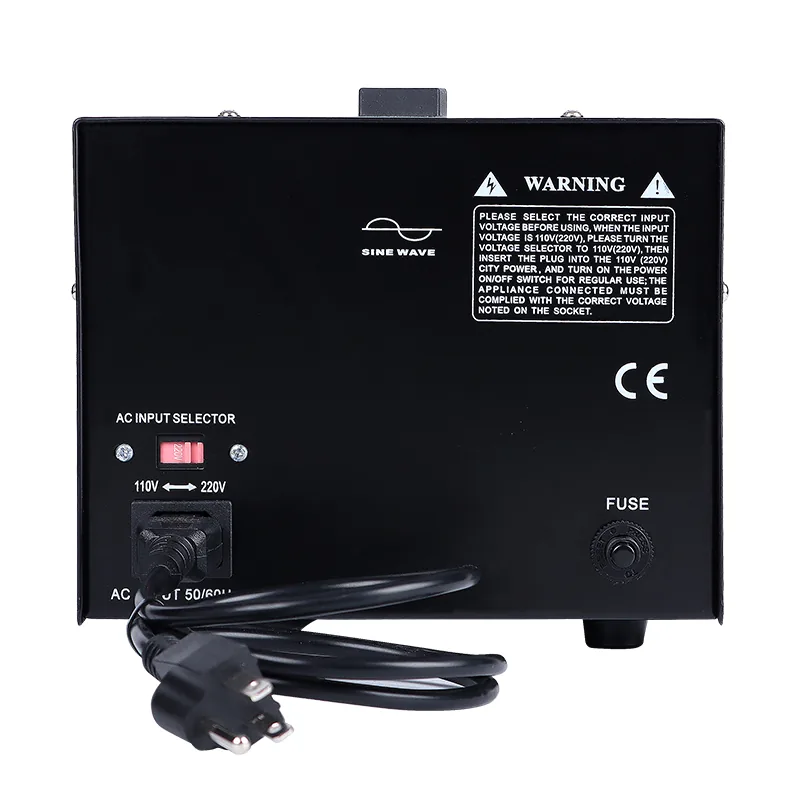
The DT-1000VA is our automatic bidirectional unit, and it pulls its weight on the light end where chargers and lamps run either way unseen. The Variac range bridges test and commissioning from 500VA through 3KVA, and a dial you can wind is easy to dismiss until you are setting up an imported tool and want to check it at 105V or 115V before the gang touches it.
Order Size, Delivery Window and Test Paperwork
The cost side goes first, because site buyers want the figures before the rest. Our minimum order is 10 pieces, whether you are kitting out one compound or sampling before a fleet roll-out. Lead time is 15 to 25 days, and where you sit in that span comes down to quantity and to custom labelling or a set socket type. We move FOB Ningbo or Shanghai, and every unit carries a 12-month cover. Open the box and you get the test slip for the batch your unit came from, with input voltage, loaded output and no-load draw, because we test everything we build at our Yueqing factory.
Site work is where the custom side pays off. We match the sockets to the tools on site, dial the secondary to 110V or 120V from the nameplate, brand the faceplate for you, and crate each unit so it lands ready at its gang box. Fitting out more than one front, send us the dates and we stagger the drops rather than stacking one pallet by the board.
Copper is what we wind with on the site, not aluminium. Aluminium coils get hotter for the same power, and that heat is what finishes off the insulation ahead of time. Under site duty, where a unit is dragged around and run through hard starts all day, that difference shows up inside a season, not a couple of years.
What to Send Us Before We Size a Site
A finished specification is not needed before we talk. Send whatever you already have. The tool list with the wattage from each nameplate, whether you run off mains or a generator, your supply voltage and frequency, the socket type on site, how many separate 110V feeds the gangs need, and your target date. Once I have that, I size it, quote the count and pin down a delivery date.
Two write-ups to skim while you set the list out. Should you still be deciding between step down, step up or a do-both model, our page on step up & down transformers sets out the difference with nothing to calculate. There is a full set of more application guides on the site as well, covering everything from cold rooms to food plants.
When a line on the list is vague, fire it over with a photo of the plugs. Sizing a step down transformer for construction sites is routine work for us, and we would much rather spend ten minutes on WhatsApp than have you order the wrong unit for a gang that cannot stop.
Construction Site Transformer Questions I Get Most Weeks
The questions below are the ones that land on my desk most weeks from contractors and their safety officers, answered the way I would on a call.
Can one transformer run a cut-off saw and a grinder together?
Yes if you size for both starting together, which is the hard part. A 2000W saw and a 900W grinder with lights land near 3300W plus start surge, so a 3000VA or 5000VA step down transformer is the call. Our ST-2000 covers one heavy tool, the STU-3000 covers two gangs starting close. Send the list and we confirm the rating.
Will the transformer work off a site generator?
Yes, ours are built for it. A generator voltage wanders and sags on a hard tool start, and our ST-2000 step down transformer rides that without tripping on every cut. The wide input tolerance means a sag to 200V or a rise to 250V keeps the 110V output in range, which matters when the only supply is a borrowed diesel set.
Do I need RCD protection on a site transformer?
Yes, on a site it is the rule, not the option. On our ST-2000 the RCD is part of the build, so a fault on the 110V side trips the unit locally instead of waiting for a breaker across the compound. On a wet trench with men in boots, that local trip is what keeps a fault from becoming a reportable incident.
Is a site transformer tough enough to be moved daily?
It has to be, and ours are built for it. The enclosure takes knocks, the cable glands stay sealed against dust and rain, and the frame carries or bolts to the board. A site unit that cannot survive being dragged across mud is the wrong unit, so we build the ST series for the abuse rather than the shelf.
How many 110V feeds should one site unit give?
Split by gang, not by tool count. Put one gang on an ST-2000 step down transformer and another on a second unit, so a fault on one front does not stop the whole board. For a compound with several fronts, two STU-5000 units beat one oversized box, because spares stay interchangeable and one trip stays local.
Send us your tool list and we will size it at no charge. Tell us the wattage from each nameplate, whether you run off mains or a generator, and how many 110V feeds the gangs need. By and large you have a unit, a count and a delivered price within a working day, matched to your site timetable.
Or talk to us directly: WhatsApp +86 197 3022 6757 · Email sales@wilmall.com
MOQ 10 pcs · Lead time 15-25 days · FOB Ningbo or Shanghai · 12-month warranty