Voltage in Brazil: Why 127V and 220V Both Exist
Brazil is the only major country where you cannot answer “what voltage is it there?” with one number. Rio de Janeiro and São Paulo run 127V, Brasília and most of the interior run 220V, and the whole country is 60Hz. If you are importing appliances, buying transformers, or spec’ing equipment for a Brazilian client, this split system decides half your purchasing decisions. Here is how it happened and what it means in practice.
Why Brazil Has Two Standard Voltages Instead of One
The short answer is that electrification in Brazil happened state by state, financed by different players, with no federal standard until it was too late to unify. The states that electrified earliest, led by the energy companies of Rio de Janeiro and São Paulo, adopted the 127V standard. Later development, and the decision to build Brasília from zero in the late 1950s, used 220V because it lets a utility deliver more power through thinner, cheaper wire for the same current.
By the time the federal government tried to standardize, the cost of rewiring every coastal city was absurd, so the split stayed. That is why today you will find 127V in the southeast coastal belt and 220V across the central-west, north and northeast, with many cities carrying both depending on the neighbourhood.
The Rough Voltage Map of Brazil
Every buyer asks for a simple map, so here is the working version we use at the factory when a client in Brazil tells us their city. It is a guide, not a guarantee, because pockets of the opposite voltage exist in most states.
- Predominantly 127V: Rio de Janeiro, São Paulo state (city and most municipalities), Espírito Santo, and most of the coastal zone from Paraná up to Bahia’s southern edge.
- Predominantly 220V: Federal District (Brasília), Goiás, Mato Grosso and Mato Grosso do Sul, most of Minas Gerais, the entire Northeast (Bahia interior, Pernambuco, Ceará, Maranhão, Paraíba, Rio Grande do Norte, Alagoas, Sergipe, Piauí), and the whole North region (Amazonas, Pará, Rondônia, Acre, Amapá, Roraima, Tocantins).
- Genuinely mixed: Parts of Paraná and Rio Grande do Sul, and some municipalities in São Paulo state where the street grid is 127V but newer buildings are wired 220V.
If your client or your own property is in the mixed zone, the only reliable check is reading the label on an existing appliance or measuring the outlet with a multimeter. Labels in Brazil usually print “127V” or “220V” clearly, because the manufacturers learned that customers plug 220V appliances into 127V sockets all the time and vice versa.
The Frequency Is 60Hz, and That Matters More Than People Think
Brazil runs 60Hz, same as the United States, Canada and Japan’s eastern grid, and different from Europe’s 50Hz. For anyone importing US appliances, this is the good scenario: a US 120V 60Hz appliance only needs the voltage corrected, never the frequency. A transformer that steps 220V down to 120V solves the whole problem.
For European appliances (230V 50Hz) the situation is harder. Some, like modern switch-mode chargers and many LED drivers, accept 50/60Hz and a wide voltage range. Others, especially anything with a synchronous motor or a timer that depends on mains frequency, will run fast or slow on 60Hz. We tell buyers: if the appliance label says only 50Hz, do not run it on 60Hz Brazilian mains with a transformer, no matter how well the voltage matches.
Sockets: the NBR 14136 Standard Replaced the Old Chaos
Before 2011, Brazil had a jumble of socket patterns, flat-pin sockets in some states and round-pin in others, and appliances arrived from every market in the world with the wrong plug. The NBR 14136 standard fixed that with a single three-round-hole pattern, rated 10A or 20A, polarized by geometry so you cannot insert a 20A plug into a 10A socket.
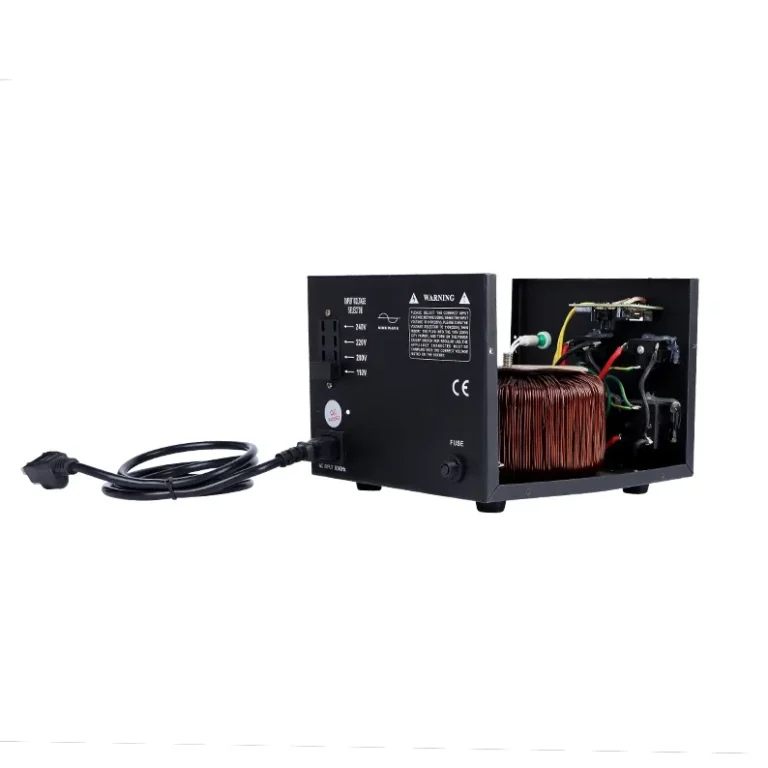
For importers this means one thing: the input plug of any transformer or appliance you bring in should be the Brazilian NBR 14136 type, or you carry adapters forever. When we build a transformer for Brazil, we fit a genuine NBR 14136 input plug matched to the VA rating and keep a US NEMA output socket on the other side for US appliances. One plug, no adapter, ground continuity intact.
What This Split System Means for Your Buying Decision
Here is the practical checklist we give to buyers who message us about Brazil:
- Find out the actual outlet voltage at the point of use, not the “national voltage”. A transformer specified for the wrong one is a wasted purchase.
- If the point of use is 220V and the appliance is a US 120V unit, you need a 220V to 120V step down transformer sized with the 1.25x rule for heating loads and 2x-plus for motors and compressors.
- If the point of use is already 127V and the appliance is US 120V, plug it straight in; 127V is within the 120V tolerance and no transformer is needed.
- Keep 60Hz in mind for any European 50Hz equipment, and check the label before you buy it.
- Budget for the NBR 14136 plug so the unit is plug-and-play on arrival.
If you are running a US appliance from a 220V Brazilian circuit, our step up and down transformer range includes 220V to 120V and 220V to 127V builds in 500VA to 5000VA. You can read the sizing walkthrough in our voltage converter for Brazil guide, which covers the appliance-by-appliance numbers.
Why We Still See 127V and 220V Mistakes Every Month
Honestly, the most common mistake is not technical, it is informational. Buyers search “transformer for Brazil”, land on a product page written for the US market, and order a 220V to 110V unit. Then the hair dryer runs weak, or the fridge compressor runs hot, because the output does not match a 120V appliance.
The fix is small. Output winding can be 110V, 120V, 127V or anything else you need, at no extra cost, because we wind to order. If you already have appliances in hand, send us photos of their nameplates, tell us the city, and we will confirm the exact input and output before you pay. That 15-minute conversation saves everyone a return shipment.
Stepping Up for the Other Direction: Brazilian Appliances in 127V Areas
Most of this guide covers bringing US 120V equipment into 220V regions, but the split system creates the mirror problem too. A Brazilian who moves from Sao Paulo (127V) to Brasilia (220V) carries appliances built for 127V, and they need a step up transformer from 127V to 220V, or they buy new appliances. Brazilian appliance makers handle this with dual-voltage products where they can, which is why you see 127V/220V selectors on Brazilian refrigerators and air conditioners, but single-voltage 127V appliances are still common, especially imported ones and older stock.
If you are in the 220V zone and own a 127V-only Brazilian appliance, the transformer you need is the mirror image of everything above: input 220V, output 127V, same sizing rules, same copper-and-core honesty checks. Our step up and down range is wound both ways, so tell us your real input and output and the unit arrives correct. And if you move between zones, a two-winding transformer with selectable taps beats carrying two units, something we build on request for exactly this market.
The Three Most Expensive Mistakes We See on Brazil Orders
After years of Brazilian orders, three mistakes come back to us over and over, and all three are avoidable in the first message. First, buying on the national voltage without checking the actual outlet, which produces the wrong primary and a unit that either under-delivers or needs rewiring. Second, trusting a marketplace wattage figure instead of the VA rating and the physical weight; a genuine 3000VA copper unit weighs around 22kg, and a 5000W box that weighs 9kg is not a 5000W anything. Third, forgetting that 127V regions do not need a transformer for US 120V gear at all, so buyers spend money and add a failure point where none was needed.
When you write to us, include the city, the appliance nameplates and the actual outlet voltage if you can measure it. That one message lets us quote the exact unit, the exact plug and the exact lead time, and it is why our Brazilian customers rarely need a second shipment.
Frequently Asked Questions About Brazil Voltage
When your unit arrives, run the simple acceptance check we print on every packing list. Measure the outlet voltage with a multimeter first, then plug in the transformer unloaded and check the output reads close to its label, then load it with your biggest appliance and confirm the output holds within about 10%. That ten-minute check catches wiring errors before they cost an appliance, and it is the same test we run at the factory before shipment, so the numbers on your meter should match the numbers on the test sheet we sent you.
Is Brazil 110V or 220V?
Both, depending on the region. Rio de Janeiro and São Paulo run 127V, while Brasília, Minas Gerais interior, and most of the Northeast and North run 220V. The entire country operates at 60Hz. Always verify the outlet voltage at your specific address.
Why does Brazil use 127V in some cities and 220V in others?
Electrification happened state by state before a federal standard existed. Early coastal utilities adopted 127V, while later regions and the new capital Brasília were built on 220V because it delivers more power with thinner copper. Unifying the grid later would have meant rewiring entire cities, so the split stayed.
Can I use a 220V to 110V transformer for US appliances in Brazil?
Only as a last resort. US appliances are built for 120V. A 110V output starves motors and heaters, making compressors run hot and heating elements weak. Order a 220V to 120V unit instead, which costs the same because we wind the output to your spec.
What plug type does Brazil use?
Brazil adopted the NBR 14136 standard in 2011: a three-round-hole socket in 10A and 20A versions. Transformers we ship to Brazil come with a genuine NBR 14136 input plug, so no adapter is needed on arrival.
Is Brazilian frequency 50Hz or 60Hz?
Brazil uses 60Hz, matching the US. US 120V 60Hz appliances therefore only need voltage conversion. European 230V 50Hz appliances with motors or mains-timed functions should not be used on 60Hz Brazilian mains.
Need the exact picture for your city or your appliance list? Send us a message at sales@wilmall.com or on WhatsApp +86 197 3022 6757, and we will confirm the correct transformer spec for Brazil before you order.