50Hz vs 60Hz: Does Frequency Matter for Transformers?
Half the world runs on 50Hz and the other half on 60Hz, and a transformer changes voltage but never frequency. That single fact causes more confusion than any other topic in voltage conversion. This guide explains what frequency actually does to appliances, when it matters, and when you can safely ignore it.
What frequency does
Frequency is how many times per second the alternating current changes direction. The two world standards are 50Hz and 60Hz. A transformer converts voltage but passes frequency through unchanged — a 110V transformer fed from a 50Hz grid delivers 110V at 50Hz, not 60Hz. That is a law of the technology, not a defect.
What this means in practice: an appliance designed for 60Hz runs on a 50Hz supply, but anything with a motor that relies on the grid frequency runs about 17% slower — the ratio of 50 to 60. Fans blow less air, pumps move less water, and clock radios that count the mains cycles run slow.
Which appliances care about frequency
| Appliance type | Effect of 50Hz on a 60Hz appliance | Practical impact |
|---|---|---|
| Heaters, ovens, kettles | None | None — resistive loads ignore frequency |
| LED and fluorescent lighting | Minimal | Slight flicker risk on old magnetic ballasts |
| Fans and blowers | ~17% slower | Noticeable but usually acceptable |
| Pumps and compressors | ~17% slower | Less flow; check duty before buying |
| Refrigerators and freezers | Slight | Most tolerate it; compressor runs slightly slower |
| Timers, clocks, record players | Runs slow | Will not keep time — avoid |
| Switched-mode electronics | None | Internally converted to DC; unaffected |
The 17% rule in detail
Here is the thing: the 17% slowdown is the headline, but the real question is whether it matters for the specific appliance. A blender that spins 17% slower still blends. A water pump that delivers 17% less flow may still be fine — or may not, if it was already borderline. A fan moves less air, which matters in a hot climate. The honest advice: for most household appliances, 50Hz operation of a 60Hz device is acceptable; for motor-critical industrial equipment, check first.
The reverse: 60Hz on a 50Hz appliance
Running a 50Hz appliance on a 60Hz supply is usually the safer direction. Motors designed for 50Hz typically run at a higher speed on 60Hz, and the internal losses do not increase dangerously because the magnetic design has more headroom. In practice, most 50Hz appliances run fine on 60Hz. The dangerous direction is the other way — 60Hz equipment on 50Hz runs slower and can overheat if it was already loaded.
Dual-frequency appliances
Most modern appliances are dual-frequency, marked 50/60Hz on the nameplate, because manufacturers sell the same product worldwide. Electronics with switched-mode power supplies convert to DC internally and are frequency-independent. If the nameplate says 50/60Hz or 110-240V, the frequency question disappears entirely. Check the label before worrying about any of this.
How Wilmall transformers handle frequency
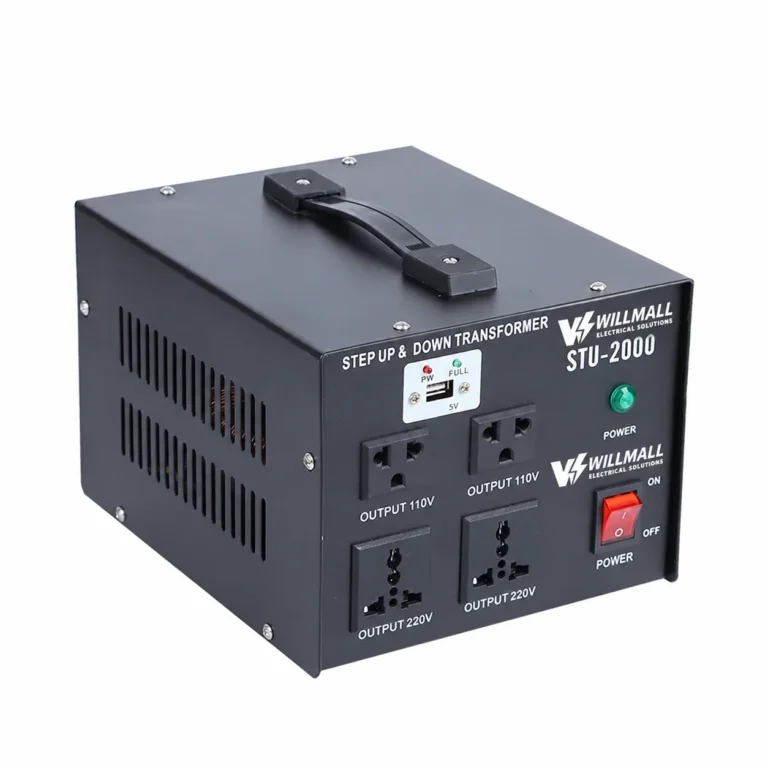
Wilmall ST and STU series transformers are designed to operate on 50Hz or 60Hz. The core and winding design covers both, so the same transformer works in a 60Hz country (Saudi Arabia, the Philippines) or a 50Hz country (most of the rest). Tell us your country and we confirm the unit is rated for your grid frequency. The transformer never changes frequency — it just converts the voltage cleanly.
Common mistakes with frequency
- Expecting the transformer to change frequency. It cannot and never does.
- Buying a 60Hz-only transformer for a 50Hz grid. Check the rated frequency on the nameplate.
- Ignoring motor-critical loads. Pumps and compressors deserve a check before buying.
- Assuming clocks and timers are fine. Mains-synchronous clocks run slow on the wrong frequency.
- Worrying about electronics. Switched-mode supplies are frequency-independent.
Why buy from a factory directly
Wilmall builds 50/60Hz-rated transformers with the test records to prove it. Every unit is load-tested before packing, and the batch report shows the measured voltage and temperature. MOQ 10 pcs per model, 15-25 day lead time, FOB Ningbo or Shanghai with CE / RoHS documents.
Frequency by country: a quick map
The 50Hz world covers Europe, most of Africa, the Middle East, Asia and Australia. The 60Hz world covers the Americas, parts of the Caribbean, Saudi Arabia, the Philippines and parts of Japan. When you import an appliance from a 60Hz country into a 50Hz country, the frequency question applies to the appliance, not the transformer. Knowing your own grid frequency is the first step before buying anything.
The voltage-by-country guide on this site lists both numbers for every market we serve, so you can check before ordering.
Does the transformer care about frequency
Wilmall ST and STU series transformers are designed for 50Hz and 60Hz operation, so the frequency of your grid does not change the transformer choice. What matters is the voltage conversion and the appliance tolerance. If you move between 50Hz and 60Hz countries, the same transformer works in both — only the appliance behaviour changes.
That is why we ask for your country on every order, not just the voltage. It tells us the frequency and the socket standard in one line.
Real-world examples
A US blender (60Hz) running in the UAE (50Hz) blends slightly slower — fine. A US sewing machine in Vietnam runs at about 83% speed — fine for most stitching. A US record player in the Philippines (60Hz, same as the US) runs perfectly. A Japanese appliance from the 50Hz region of Japan runs fine in Korea or Taiwan. The pattern is simple: check the frequency of the device against your grid, and decide whether 17% matters for that device.
When in doubt, ask. One message with the appliance label photo is enough for us to tell you whether frequency matters for that specific device.
The short version
Transformers change voltage, never frequency. 60Hz equipment on 50Hz runs 17% slower on motor loads; 50Hz equipment on 60Hz is usually fine. Check the nameplate for 50/60Hz dual rating, check motor-critical loads before buying, and ask us when in doubt. That covers 95% of the frequency questions we get.
Generators and frequency stability
Generators do not always hold 50Hz or 60Hz precisely. Under load, a generator can droop a few percent, and some run slightly fast or slow. Motors fed from a generator already run at the generator frequency, so the transformer is not the cause of any speed change — the generator is. A transformer with margin handles the voltage swings; the frequency follows the generator.
If you run a 60Hz appliance from a generator that puts out 50Hz, the appliance runs slower regardless of any transformer in between. Matching the generator to the appliance frequency is the fix, not a different transformer.
The short version
Frequency is set by the grid or the generator, never changed by the transformer. 60Hz equipment on 50Hz runs 17% slower on motors; the reverse is usually fine. Check the nameplate for dual rating, check motor-critical loads, and ask when in doubt. That is the complete frequency story.
Frequency and the grid in your country
Before buying any transformer, know your grid frequency — it is printed on every electricity bill and listed in the voltage-by-country guide. The transformer works on either frequency, but the appliance decision depends on it. One message with your country and the appliance label is enough for us to confirm both the transformer and the frequency question.
Frequency and the grid in your country
Before buying any transformer, know your grid frequency — it is printed on every electricity bill and listed in the voltage-by-country guide on this site. The transformer works on either frequency, but the appliance decision depends on it. One message with your country and the appliance label is enough for us to confirm both the transformer and the frequency question.
Talk to the factory
If you are not sure whether frequency matters for your appliance, send us a photo of the nameplate. We see these labels every day and can tell you in minutes whether the device is dual-frequency, whether the motor tolerates the 17%, and which transformer size to order. That is the kind of advice a factory can give, and it is free.
Frequently asked questions
The Frequency Question for Motor Appliances
The 50Hz vs 60Hz question has a practical answer for most appliances and a caution for a few. Most modern electronics with switched-mode power supplies accept both frequencies, and most motor appliances run fine on either because the difference is only 20 percent and the motors tolerate it. The caution applies to frequency-dependent devices: turntables, electric clocks, and some motors that use the mains frequency for timing or speed. A US turntable designed for 60Hz will run slightly slower on 50Hz, and a clock will lose time. For those devices, a frequency converter, not just a voltage transformer, is needed, or a model that accepts both. Our transformers are rated for 50/60Hz, so the voltage conversion is always correct, and we can advise which of your appliances is frequency-sensitive. When in doubt, check the label for the frequency rating before assuming the appliance is safe to run.
What happens if I run a 60Hz appliance on 50Hz?
Motor-driven appliances run about 17% slower. Fans blow less air, pumps move less water. Most household devices tolerate it; motor-critical equipment should be checked first.
Does a transformer change frequency?
No. A transformer changes voltage only. The frequency on the output is the same as the input grid. That is a fundamental law of transformers.
Is 60Hz on a 50Hz appliance safe?
Usually yes. 50Hz appliances typically run fine on 60Hz because the magnetic design has headroom. The risky direction is 60Hz equipment on 50Hz.
How do I know if my appliance is dual-frequency?
Check the nameplate. If it says 50/60Hz or 110-240V, it accepts either frequency and needs no special consideration.
Are Wilmall transformers rated for 50Hz and 60Hz?
Yes. The ST and STU series are designed for both 50Hz and 60Hz grids. Tell us your country and we confirm the rating.
Related reading
- Voltage by Country: 110V, 220V and 240V Guide
- Step Down Transformer 220V to 110V: Sizing and Safety
- Step Up and Down Transformer Products
Get a factory-direct quote
Email sales@wilmall.com or WhatsApp +86 197 3022 6757 with your country and appliance list and we will confirm the right transformer. MOQ 10 pcs.