Custom Transformer Winding: How to Order Custom Voltages
Standard catalogue voltages cover more orders than most people realise. If you need 220V, 230V or 240V on one side and 110V or 120V on the other, you can pick a model off the shelf, pay a normal price and have it on a vessel within a month. But somewhere around one order in five, a buyer writes to us with something the catalogue does not have. 208V to 100V. 400V to 230V. 480V to 120V. 575V to 240V. 380V to 24V for a control panel. That is the point where a custom transformer winding stops being a complication and starts being the only sensible route.
I work with a transformer factory in Yueqing, China, and custom winding is a normal part of our week rather than a special favour. So let me show you exactly what custom winding involves, what we need from you before we can quote, and how the whole thing runs from first email to container loading. If you are ordering a non-standard voltage for the first time, this is the piece I wish more buyers read before they wrote to us.
What Custom Transformer Winding Actually Means
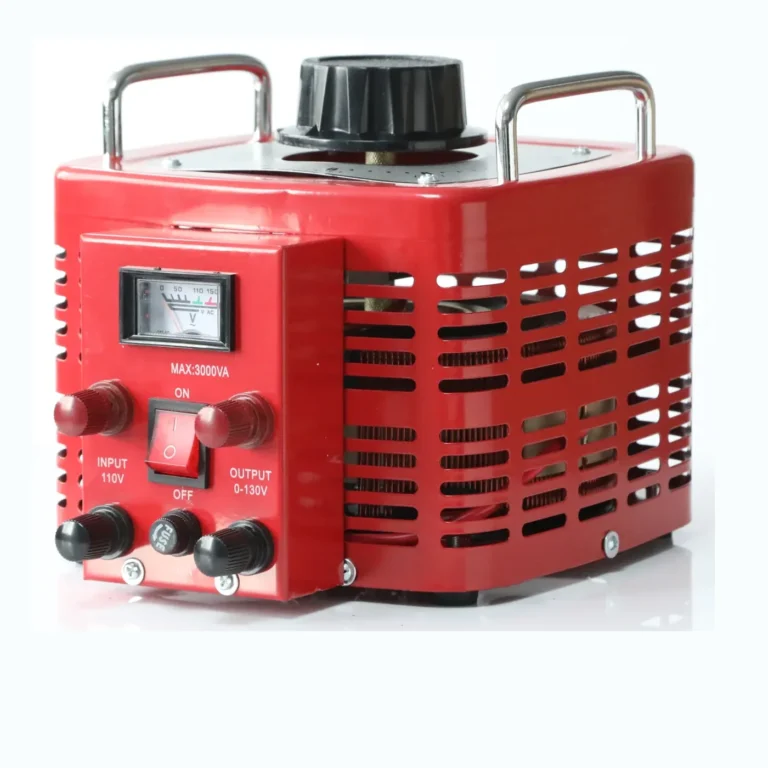
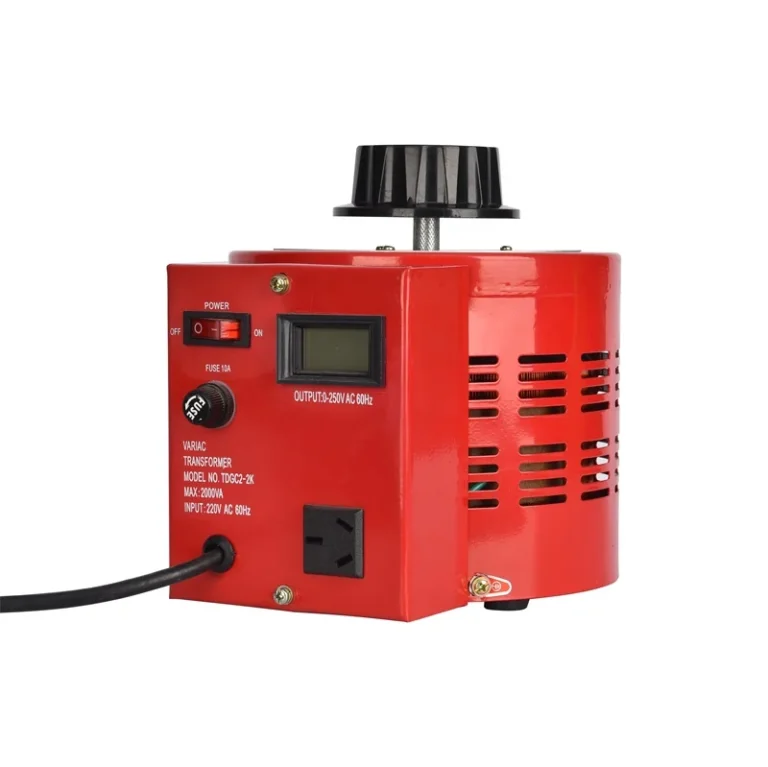
A custom transformer is not a standard unit with a different sticker on the front. Once the ratio leaves the standard set, almost everything downstream changes with it. The number of turns on the primary and the secondary changes, which changes the wire gauge needed to carry the current at the new voltage. If the core would saturate at the new flux density, the lamination stack grows. If the stack grows, the bobbin, the mounting bracket and the case all change to suit it. Lead-out positions move, terminal blocks change, and the nameplate gets printed again with your figures on it.
That is the honest reason a custom voltage carries a minimum order quantity of 10 pieces while a standard model does not. Our standard lines run through fixed fixtures and standard bobbins, so setting up a run is quick. A custom unit needs a fresh setup, a fresh winding program, extra inspection points and usually a sample before anyone commits to a production batch. The setup cost does not disappear because you order one piece. It just has to be spread across ten.
Which brings me to the advice I give most often. Check whether a standard model already solves your problem. If your supply is 230V and you need 110V, or your supply is 110V and you need 230V, there is nothing to design. Buying standard saves you weeks and a good deal of money. Custom winding earns its place when the voltages genuinely do not match anything in the catalogue, when the physical size is constrained by a panel you already built, or when the original transformer in a machine is obsolete and you need a drop-in replacement with the same footprint and lead positions.
Before You Ask for a Price: The Parameters We Need
The short answer is that I can price a custom winding once I know a handful of figures, and most first emails arrive missing three of them. Here is the full list, and if you send all of it in one message, you will usually have a firm quotation within a working day instead of a week of back and forth.
| Parameter | Example | Why it matters |
|---|---|---|
| Primary voltage | 380V, 50Hz, single phase | Sets the turns count and the wire gauge on the input side. Tell us the real supply, not the nominal figure, if yours swings. |
| Secondary voltage | 230V, plus or minus 3 percent | This is the number the whole design hangs on. Say whether you mean it at no load or at full load. |
| Voltage tolerance | Plus or minus 3 percent at full load | Regulation is a real thing. A small unit typically drops 4 to 8 percent between no load and full load, and tighter is possible with more copper. |
| Power rating | 1500VA continuous | Sets the core size. Understating the load is the single most common mistake we see. |
| Frequency | 50Hz or 60Hz | Changing frequency changes the core design. A 50Hz core run at 60Hz is safe, but not the other way round. |
| Load type | Motor, rectifier, resistive heater | Rectifier and motor loads draw more than their nameplate suggests, and the winding has to cope. |
| Duty cycle | Continuous, or 30 minutes in an hour | An intermittent duty transformer can be smaller and cheaper than a continuous one at the same rating. |
| Number of phases | Single phase or three phase | Three phase means a different core construction and a different connection arrangement. |
| Isolation | Isolated, or autotransformer | Isolation gives you galvanic separation and lets you choose the earthing. An autotransformer cannot. |
| Winding material | Copper, class F insulation | Copper runs cooler than aluminium at the same rating. We wind copper as standard. |
| Terminations | Screw terminal block, or 300mm leads | Decides how the unit installs. Send a photo of the old one if you are replacing something. |
| Enclosure | Open frame, or ventilated steel case | Affects cooling, noise and how the unit mounts. Panel mount and DIN rail are also possible. |
| Ambient conditions | 45 degrees C, dusty room, coastal | Hot or dusty sites need derating and a larger core, and coastal air asks for better protection. |
| Certification and labelling | CE mark, English or bilingual nameplate | Tell us what your market requires so the paperwork matches the unit that arrives. |
| Quantity and target price | 10 pcs sample, then 200 pcs | Lets us quote the sample and the production run against each other instead of guessing. |
Two of those rows cause more trouble than the rest, so let me say a little more about each. The first is voltage tolerance. If you specify 110V and we deliver a unit whose open-circuit output is exactly 110V, the loaded output will be lower, because every transformer drops voltage under load. If you need 110V at full load, tell us that, and we design the secondary to sit slightly high at no load so it lands where you want it when the load is on. The second is ambient temperature. A transformer rated 1000VA at 25 degrees is not a 1000VA transformer at 50 degrees, and buyers who forget to mention a hot or enclosed installation are the ones who come back reporting warm cases.
Single Phase or Three Phase
Most custom orders we handle are single phase, because most equipment is single phase. Three phase custom winding is a different exercise. The core is usually a three-limb stack, the windings come in pairs rather than singles, and the connection arrangement, star or delta, has to be agreed because it changes the secondary voltage by a factor of 1.73. If you are replacing a three phase transformer, photograph the nameplate and the terminal block and send both. The terminal layout you already have is usually the fastest way to explain what you need.
Three phase also raises the question of phase shift and imbalance. If your load is not balanced across the three phases, ask us to size on the worst phase rather than the average. It costs a little more core and a little more copper, and it prevents the situation where one phase runs hot while the other two coast.
Isolation, or an Autotransformer to Save Space
An isolation transformer has separate primary and secondary windings, so there is no electrical connection between input and output. That gives you galvanic separation, and it lets you decide how the secondary is earthed, which matters when you are feeding a machine whose reference is not the same as the building’s. An autotransformer uses one winding with a tapped section, so it is smaller, lighter and cheaper for the same power. What it does not give you is isolation. If the reason you are buying is safety separation or noise reduction, say so in the first email, because the two designs are not interchangeable and the price difference surprises people in both directions.
If you are fighting electrical noise rather than voltage, ask about an electrostatic shield between the windings. It is a thin foil layer with its own lead, it goes between primary and secondary, and it takes a lot of high frequency rubbish out of the secondary. For control and instrumentation work it is often the difference between a machine that behaves and a machine that misbehaves for reasons nobody can explain.
How a Custom Winding Is Built and Tested
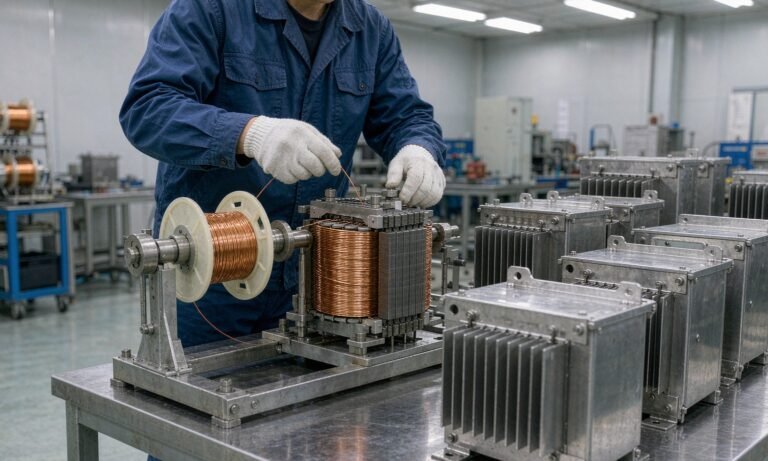
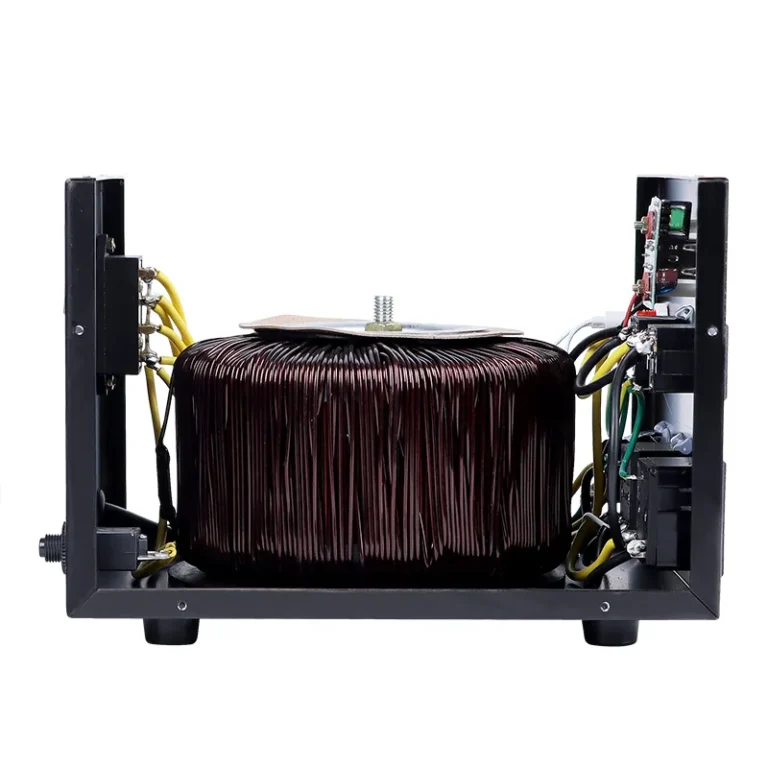
Winding a transformer is careful manual work with a machine doing the counting. Copper enamel wire goes onto a bobbin in layers, with insulating film between layers and extra insulation between primary and secondary. Where we need tighter regulation and lower leakage, we interleave the windings rather than putting all of the primary down first. After winding, the coil is impregnated with varnish, and for tougher environments we can vacuum impregnate, which fills the gaps in the winding and makes the whole assembly more resistant to moisture and vibration.
Assembly then puts the coil onto a laminated core, clamps it, and brings the connections out to a terminal block or to lead wires with ferrules crimped on the ends. Where the application asks for it, we can pot or resin-cast the unit instead. Each finished transformer gets its nameplate with the voltages, rating, frequency and your model reference, and the units are packed in a way that survives a sea container rather than a short van ride.
Testing is the part buyers ask about most, so here is what we do on custom work. Every unit gets a turns ratio check to confirm the voltage relationship, a no-load current measurement, and a load test at the rated current, where we record input voltage and output voltage so you can see the regulation for yourself. Insulation resistance is measured, and each unit takes a dielectric withstand test between windings and between winding and core, at a level agreed with you for the insulation class involved. We also check polarity and continuity on every lead. On a new design we will usually run a temperature rise check on the sample so you know what to expect in service, and the batch test record for your order ships with the goods. If a unit ever gives trouble later, that record is the first thing we look at, and it usually tells us within minutes whether the problem is inside the transformer or outside it.
The Sample Loop: 7 to 10 Days, Then 15 to 25 Days
For a new custom voltage, the process runs like this.
- You send the parameters from the table above, or as many of them as you have.
- Our engineer reviews the design and confirms the core, the wire and the terminations, normally within one to two working days. If anything in your specification looks risky, we say so before quoting.
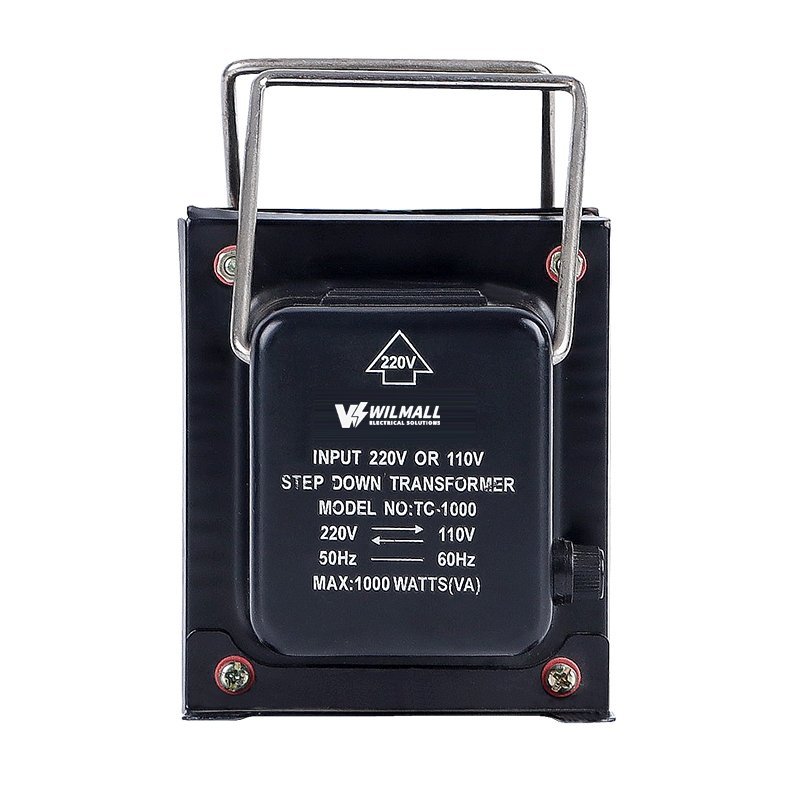
- We build a sample and test it. Allow 7 to 10 days for this on a straightforward design.
- The sample ships to you with its test report, so you can try it on your own bench before committing.
- You approve, or you tell us what to change. Changes at sample stage are cheap. Changes after production starts are not.
- Production runs 15 to 25 days depending on quantity and how much of the design is new.
- Final inspection, photographs of the finished units, and a batch test record for the whole order.
- Shipment, FOB Ningbo or Shanghai, with a 12-month warranty on everything we make.
The minimum order for a custom voltage is 10 pieces. That applies to the production run, not to the sample, and we are happy to build one sample first so you are not committing to a batch on a drawing alone. Samples for custom work are charged at sample price rather than production price, and I would rather explain that clearly up front than have you discover it in the invoice.
The two mistakes that cost custom buyers the most time are both avoidable. The first is understating the load, usually by quoting the motor nameplate and ignoring the starting current or ignoring a rectifier’s power factor. The second is leaving out the environment. If the unit is going into a sealed panel in a hot room, or into a workshop full of metal dust, that belongs in the first email, because it changes the core size and the case design. Tell us the awkward details early and the sample will be right the first time.
Where Custom Winding Pays for Itself
Some of the clearest cases we see are machine builders who export. A machine built for a 400V European supply that has to run in Canada on 575V, or in the United States on 480V, needs a transformer designed for the destination rather than a stack of adapters. The same applies to imported second-hand equipment, where the transformer that came with the machine is missing, damaged, or simply rated for a supply that does not exist in your country.
Retrofit and replacement work is the other big category. Original transformers go obsolete, lead times from the machine maker stretch to months, and the machine sits idle. If you send us the old nameplate and the mounting dimensions, we can usually wind a drop-in replacement that fits the same holes with the same terminals, which is worth far more than the small saving from buying something that almost fits.
Control panels are the third area. Panel builders often need several different secondaries from one unit, say 24V for the controls, 110V for the contactors and 230V for a small supply, with taps in between. That is a routine custom winding for us, and it removes three separate transformers from a panel that is already tight on space.
What Arrives With Your Order
Every custom order ships with its batch test record, a wiring and connection sheet showing which lead is which, and nameplates printed to the figures you approved on the sample. If your market needs a declaration of conformity or a technical file for customs, tell us at the quotation stage rather than after production, because some of those documents are easier to prepare while the order is open. If you are new to specifying transformers of any kind, our Transformer Buying Guide: How to Choose and Buy walks through the load and sizing side in plain terms before you get to the winding details.
Much of what we build in this category ends up as a control transformer or an isolation transformer inside a panel, and you can see that side of the range on our page covering control transformers. For everything else, from sizing arithmetic to packaging decisions, there are more transformer buying guides on the site.
What to Put in Your First Email
Give me the primary voltage, the secondary voltage and whether that figure is at no load or under load. Add the power rating in VA, the frequency, the load type and how long the unit runs at a time. Then the physical side: open frame or cased, terminal block or leads, mounting holes if it is a replacement, and anything unusual about the room it lives in. Finish with the quantity you have in mind and the country it is going to, and we will take it from there.
If you are missing some of that, send what you have and mark the rest as unknown. Working out what a machine actually needs from a nameplate photo and a wiring diagram is a normal part of our day, and it is much quicker than a week of guessing. Send it to us and we will come back with a design proposal and a price.
Custom Winding Questions Buyers Ask
These are the ones that show up in our inbox most often, answered the way I would answer them on a call.
What is the minimum order for a custom transformer winding?
MOQ is 10 pieces for a custom voltage, because every non-standard ratio needs its own setup, winding program and inspection points. The sample is separate and we will happily build one first so you can test it before committing to a batch. Standard catalogue models do not carry that minimum.
How long does a custom transformer sample and production take?
Allow 7 to 10 days for a sample on a straightforward design, including its test report. Once you approve the sample, production runs 15 to 25 days depending on quantity and how much of the design is new. Shipping is FOB Ningbo or Shanghai and everything carries a 12-month warranty.
What information do you need to quote a custom voltage?
Primary and secondary voltage, whether your secondary figure is at no load or full load, the VA rating, frequency, load type, duty cycle, winding material, terminations, enclosure and ambient conditions. Quantity and destination country finish it off. Send all of that and you will usually have a firm price the same working day.
Do I need an isolation transformer or is an autotransformer enough?
An isolation transformer has separate primary and secondary windings, so it gives you galvanic separation and control over how the secondary is earthed. An autotransformer uses one tapped winding and is smaller and cheaper, but it offers no isolation. If safety separation is your reason for buying, tell us at the start.
Do you provide test records with custom wound transformers?
Yes. Every unit gets a turns ratio check, no-load current measurement, a load test recording input and output voltage, insulation resistance and a dielectric withstand test. New designs also get a temperature rise check on the sample. The batch test record for your order ships with the goods.
Send us your voltages and we will tell you whether you need a custom winding or a standard model. Include the primary and secondary figures, the VA rating, the frequency and the environment the unit will live in. Our engineer will come back with a design proposal and a price, usually within one working day.
Or talk to us directly: WhatsApp +86 197 3022 6757 · Email sales@wilmall.com
Custom voltage MOQ 10 pcs · Sample 7-10 days · Production 15-25 days · FOB Ningbo or Shanghai · 12-month warranty