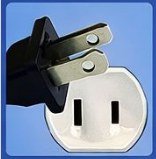
 A
US CA MX JP
Type A
Pins: 2
Grounding: No
Current: 15 A
Voltage: 100-127V
Fits: Type A
110V appliances on 220V mains need a step down transformer. 220V to 110V step down transformer →

Which plug does each country use, and do you need a voltage converter? 15 plug types that cover the world, with the transformer you need for each.
Pin count, grounding and the voltage you will meet behind each one. Jump to a letter, or read on for pin sizes, which plugs fit which sockets, and how to specify the right socket on an order.
A
110V appliances on 220V mains need a step down transformer. 220V to 110V step down transformer →
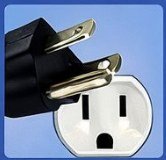 B
Grounded US 110V appliances need a step down transformer outside North America. 110V step down transformer with RCD →
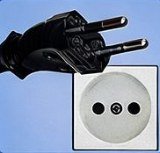 C
Type C is the standard EU plug - most 220V transformers accept it directly. 220V transformers →
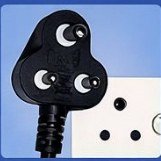 D
India uses 230V mains - imported US 110V appliances need a step down transformer. 230V to 110V transformers →
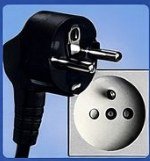 E
French 220V sockets - use a step up transformer for 110V appliances. 220V to 110V solutions →
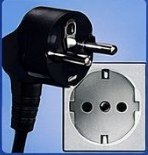 F
European 220V standard - 110V US appliances need step down conversion. step down transformer for 220V →
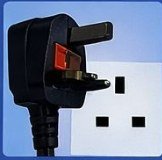 G
UK and Middle East 230V - US 110V appliances need a step down transformer. Middle East step down guide →
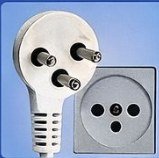 H
Israel uses 230V mains - US 110V appliances need a step down transformer. 230V to 110V converters →
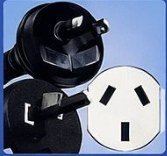 I
Australia and China 220V - imported 110V gear needs conversion. 220V to 110V transformers →
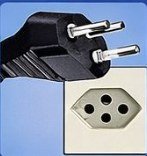 J
Switzerland runs 230V - US 110V equipment needs a step down transformer. 230V to 110V solutions →
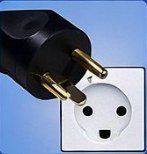 K
Denmark uses 230V - imported 110V appliances need step down conversion. step down transformer →
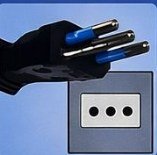 L
Italy runs 230V mains - US 110V appliances need a step down transformer. 230V to 110V transformers →
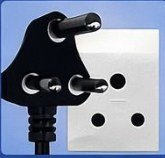 M
South Africa and India run 230V - US 110V equipment needs step down conversion. 230V to 110V converters →
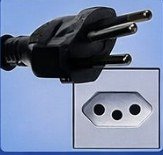 M2
South African 230V mains - imported 110V appliances need a step down transformer. South Africa step down guide →
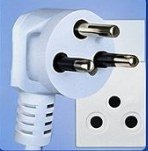 N
Brazil and South Africa - check local voltage (127V or 220V) before converting. Brazil voltage guide →
A plug adapter only changes the shape - it does not convert voltage. Plugging a 110V appliance into a 220V socket will damage it. Check the appliance nameplate, then use a step up / step down transformer rated for the load. Our transformers ship with US, EU or UK sockets - tell us your market and we will match the plug type.
A plug tells you very little about whether an appliance will survive the trip. Voltage and frequency decide that. What the plug tells you is whether you can physically get power into the thing, and that turns out to matter more often than people expect — not because reshaping a plug is difficult, but because reshaping it is exactly where the earth connection and the current rating quietly go missing.
The fifteen types catalogued above are the ones we build sockets and cords for. What follows is the part that actually costs buyers money: which plugs physically enter which sockets, what happens to your earth pin when you use a travel adapter, and what the current rating of a plug does to the largest transformer you can feed from it.
If your question is about voltage rather than shape — whether a 110V appliance runs on a 230V supply, what frequency does to a motor — the voltage by country lookup answers that side of it. This page stays on the metal.
The letters A to N come from a United States government publication written for travellers in the 1980s. It numbered plug shapes, one letter each, so a tourist could point at a chart. The letters are a catalogue, not a specification. Behind every one of them sits a real national or regional standard, and the standard is what a factory has to build to.
This matters because a customer writes “EU plug” and means three different things. Type C, Type E and Type F all appear in Europe, all have two round pins at 19 mm spacing, and none of them is interchangeable with the others in every respect. The table below is the one we keep on the wall in the sample room.
| Type | Standard | Pins | Pin size | Spacing | Earth | Rating |
|---|---|---|---|---|---|---|
| A | NEMA 1-15 | 2 flat, parallel | 1.5 × 6.3 mm | 12.7 mm | None | 15 A, 125 V |
| B | NEMA 5-15 | 2 flat + round earth | 1.5 × 6.3 mm, earth 4.8 mm | 12.7 mm | Round pin | 15 A, 125 V |
| C | CEE 7/16, Europlug | 2 round | 4.0 mm | 19 mm | None | 2.5 A, 250 V |
| D | BS 546, 5 A | 3 round, triangle | 5.08 mm | Triangle | Round pin | 5 A |
| E | CEE 7/5, French | 2 round, earth in socket | 4.8 mm | 19 mm | Socket-side pin | 16 A |
| F | CEE 7/4, Schuko | 2 round, side clips | 4.8 mm | 19 mm | Side contacts | 16 A |
| G | BS 1363 | 3 rectangular | 1.4 × 6.35 mm | Triangle, earth 8 mm | Round pin, fused | 13 A |
| H | SI 32 | 3 round, Y shape | 4.0 mm | Y shape | Round pin | 16 A |
| I | AS/NZS 3112 | 2 or 3 flat, V shape | 1.6 × 6.4 mm | V shape | Flat pin | 10 A |
| J | SEV 1011 | 3 round, triangle | 4.0 mm | Triangle | Round pin | 10 A |
| K | DS 60884-2-D1 | 3 round, triangle | 4.0 mm | Triangle | Round pin | 16 A |
| L | CEI 23-16/7 | 3 round, in line | 4.0 mm | In line | Round pin, centre | 10 A or 16 A |
| M | BS 546, 15 A | 3 round, large | 7.06 mm | Triangle | Round pin | 15 A |
| N | IEC 60906-1, Brazil | 3 round, triangle | 4.0 mm | Triangle | Round pin | 10 A or 20 A |
Two of these rows explain most of the confusion we see. Type C is the Europlug, a deliberately thin 2.5 A plug designed for radios, shavers and lamps, so it fits into everything in Europe without a ground connection. Type F is Schuko, rated 16 A, which also fits into everything in Europe but does carry an earth, through two spring clips on the side rather than a pin. They look similar on a phone screen. They are not the same component and they do not cost the same.
“Fits” and “works” are separate questions, and this is the table where travellers get caught. A plug that enters a socket is not automatically earthed, and it is not automatically within the current rating of the socket behind it.
| Plug you hold | Sockets it physically enters | What you give up |
|---|---|---|
| A (2 flat) | A, B | No earth, 15 A only |
| B (2 flat + earth) | B only | Nothing, but no socket outside North America accepts it |
| C (Europlug) | C, E, F, J, K, L, N | Earth, and the plug itself is limited to 2.5 A |
| D (5 A old British) | D, M | 5 A only; a D plug in an M socket is fine, the reverse is not |
| E (French) | E, F | Nothing across the pair; CEE 7/7 plugs handle both |
| F (Schuko) | E, F | Nothing across the pair; earth is by side clips in F sockets |
| G (British) | G only | Not interchangeable with anything, and the fuse is in the plug |
| H (Israeli) | H, and C in most modern H sockets | Earth when a C plug is used |
| I (Australasian) | I only | Nothing, but 10 A is the ceiling on the common version |
| J (Swiss) | J, and C in most J sockets | Earth when a C plug is used |
| K (Danish) | K, and C in most K sockets | Earth when a C plug is used |
| L (Italian) | L, and C in the 10 A hybrid socket | Earth when a C plug is used |
| M (15 A old British) | M only | Too large for a D socket |
| N (Brazilian) | N, and C in the 10 A version | Earth when a C plug is used |
Four groups come out of that table, and they are worth memorising because they cover almost every export order.
The 19 mm round-pin family. C, E and F share 19 mm spacing and 4.0 or 4.8 mm pins, so a C plug goes into an E or F socket and an E plug goes into an F socket. This is why a European appliance seems to work anywhere in Europe and why nobody notices the missing earth until something goes wrong.
The British family. G is an island. The pins are rectangular, the earth is longer than the live and neutral so it makes contact first, and the fuse lives inside the plug rather than in the panel. Nothing else in the world plugs into it and it plugs into nothing else. D and M are the older round-pin British standard still found in India, Sri Lanka, Nepal and parts of Africa and the Middle East; M is the 15 A version with 7.06 mm pins, and a D plug will enter an M socket while an M plug will not enter a D socket.
The flat-pin family. A enters both A and B sockets, B enters only B. Australian and Chinese Type I uses a V layout and is not compatible with the North American flat pins despite looking similar in a photograph.
The national single-standard types. H, J, K, L and N each belong to one market, and most of them accept a C plug in the unearthed 10 A socket. That acceptance is a convenience for a table lamp and a hazard for a washing machine.
Plug a Type C appliance into a French Type E socket and it works. The pins line up, the appliance runs, and nothing feels wrong. What has happened is that the protective earth has been disconnected, because Type C has no earth contact at all and Type E delivers earth through a male pin standing in the socket that the C plug never touches. The same thing happens in a Schuko socket, where earth arrives through two side clips that a Europlug is too narrow to reach.
On a metal-bodied appliance that is a real risk. If a live conductor comes loose inside and touches the case, there is no low-resistance path to carry the fault current, so the case sits at mains potential until someone touches it. The fuse does not blow, because nothing is drawing current. That is the failure mode, and it is why we care about which socket goes on the output side of a transformer.
When we build a step down unit for a market, the output socket is earthed and tied to the enclosure earth point, whether that socket is North American Type B, European Schuko or British Type G. The input side follows the same logic. A transformer that arrives with a two-pin unearthed input cord is a transformer whose earth is decorative.
There is one deliberate exception worth naming. The isolation transformers we build for medical and laboratory use have a floating secondary on purpose, so that a single fault to earth cannot complete a circuit through the patient or the operator. That is not a missing earth, it is an isolated one, and it comes with a monitoring terminal so the insulation state can be checked. Do not confuse the two: a floating secondary is engineered, a Europlug in a Schuko socket is an accident.
This is the number that catches out buyers who order a large transformer and then ask for a normal plug on the end of it. A plug can only pass so much current, and the transformer cannot be fed through a plug that is smaller than the load.
Multiply the plug rating by the supply voltage and you get the largest transformer the plug can feed, before any efficiency loss.
| Plug type | Rating | At 120 V | At 230 V | At 240 V |
|---|---|---|---|---|
| C, Europlug | 2.5 A | 300 VA | 575 VA | 600 VA |
| I, AS/NZS | 10 A | 1200 VA | 2300 VA | 2400 VA |
| G, British | 13 A | 1560 VA | 2990 VA | 3120 VA |
| A, NEMA 1-15 | 15 A | 1800 VA | — | — |
| B, NEMA 5-15 | 15 A | 1800 VA | — | — |
| F, Schuko | 16 A | — | 3680 VA | 3840 VA |
| M, BS 546 | 15 A | — | 3450 VA | 3600 VA |
| N, Brazil 20 A | 20 A | 2400 VA at 127 V | 4600 VA | 4800 VA |
Read the third row and the practical limit becomes obvious. A 5 kVA transformer cannot be fed through a British 13 A plug, because 13 A at 230 V is 2990 VA. It needs a 32 A industrial connector to IEC 60309, or a terminal block with a gland, or a hard-wired supply. The same applies to a 10 kVA unit on a Schuko plug, which would sit at 2.7 times the plug rating.
We see this on roughly one order in twenty. The customer specifies a 10 kVA transformer for a workshop and adds “with UK plug” because that is what the wall has. The right answer is to feed the transformer from a dedicated 32 A circuit, or to buy three smaller units. Fibbing the plug on the drawing does not create current capacity.
The reverse mistake is just as common and less dangerous: a 500 VA transformer with a 16 A Schuko plug is perfectly fine and is what most of our export units carry. The plug is a connector, not a fuse.
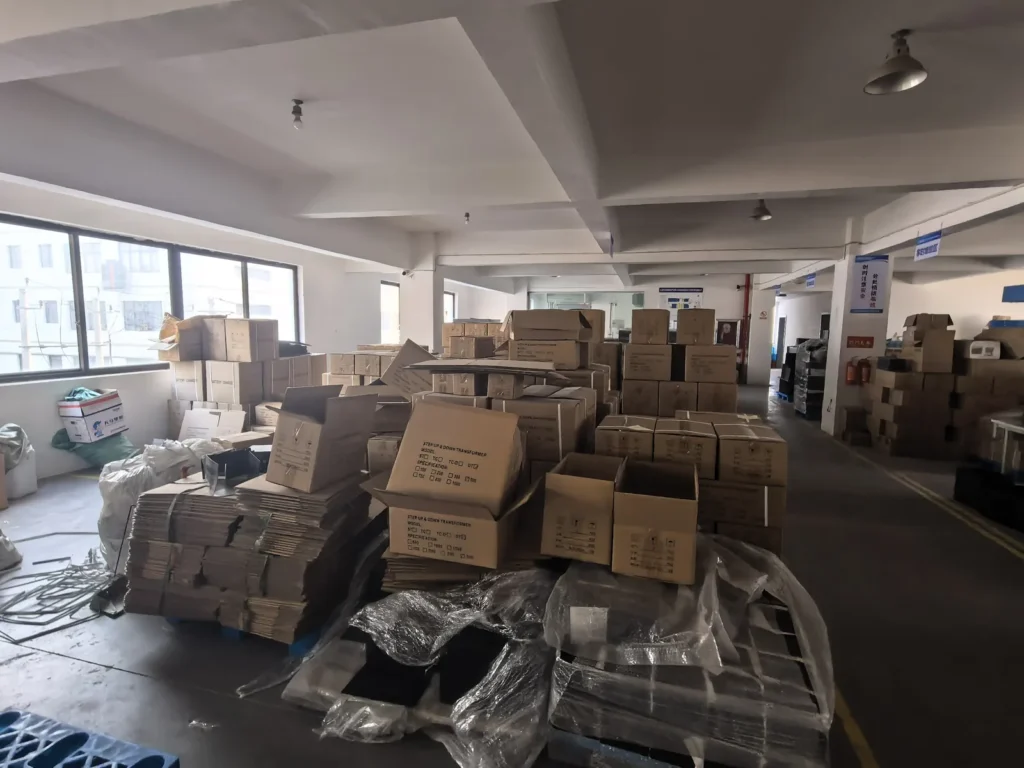
An export order has two connectors, not one, and both have to be written down. The input side is the plug that goes into the wall. The output side is the socket that the appliance plugs into. They are almost never the same, and a specification that only says “EU plug” leaves the factory guessing about half the job.
Here is how we ask for it, and how you can ask your supplier for it:
Standard configurations ship from stock at a 10 piece minimum. A non-standard socket or a different cord length is a 50 piece minimum, because the panel cut-out is punched before painting and the change runs through the whole batch. Lead time is 15 to 25 days either way, FOB Ningbo or Shanghai.
One real example from this month. A distributor in Riyadh wanted 200 units of a 2000 VA step down transformer, input from the Saudi wall and output to US appliances. The order read input Type G at 13 A, output Type B at 15 A, 1.8 m cord, earth tied to the enclosure. That is a standard build for us and it shipped inside three weeks. The order before it said “EU plug” on the drawing, we quoted CEE 7/7, and the customer came back asking for Schuko because his warehouse had F sockets only. A five-word correction on the drawing would have saved a week.
When the plug does not match the wall, there are only three real options. They are not interchangeable, and the cheapest one is usually the safest.
| Approach | Changes voltage | Keeps earth | Current ceiling | Use it when |
|---|---|---|---|---|
| Fit the local plug | No | Yes, if wired correctly | As the cord allows | The voltage already matches and the appliance stays put |
| Travel adapter | No | Often no | 6 to 10 A typical | Small unearthed loads, short term, low power |
| Step up / step down transformer | Yes | Yes, if the socket is earthed | As the socket allows | Voltage does not match and the appliance must run |
Fitting the local plug is the cheapest and the most reliable. Cut the original off, fit a plug to the local standard, tighten the terminals, check the earth. A few dollars in parts and ten minutes with someone competent. The downside is that it is a modification: the appliance’s warranty may not survive it, and if it is later sold into another market the plug has to change again. For a fixed installation in one country, this is what we recommend.
A travel adapter only changes the shape. That is its entire function. It does not change voltage, it usually does not carry the earth through, and the cheap ones are rated 6 A or less because the brass inside is thin. On a 1500 W heater at 230 V you are asking a small adapter to pass 6.5 A continuously, and the contacts will warm up. Use one for a phone charger. Do not use one for anything that heats.
A transformer is the only option when the voltage is wrong, and that part is not negotiable. Sizing is the sizing calculator‘s job: enter the load, pick the load type, and it returns the VA rating with the margin already applied. If the load is a motor or a compressor, read the inrush current note first, because the starting current sets the size, not the running current.
These are not hypothetical. They are the six lines we correct most often, in roughly the order they appear.
“EU plug” on the drawing. Europe runs C, E, F, J, K and L. A CEE 7/7 hybrid covers E and F, which is most of the volume, but it does not cover Swiss J, Danish K or Italian L. Name the standard.
A 13 A plug on a 5 kVA transformer. 2990 VA is the ceiling at 230 V. Above that the plug has to become industrial. We quote a 32 A IEC 60309 connector instead and explain why.
Assuming Type C is the universal European plug. It is the universal European unearthed plug, at 2.5 A. It fits, it works, and it disconnects your earth. Anyone who has run a European washing machine through a Europlug has been running it unearthed.
Forgetting the output socket. A step down transformer with a Schuko input and no output socket forces the customer to buy an adapter for the appliance side, which is exactly the part we were trying to solve.
A 10 A Australian socket on a 12 A load. Type I is commonly 10 A. Above that you need the 15 A version with a wider earth pin, and it will not fit a normal wall plate.
Two flat pins on a 2000 W heater. NEMA 1-15 is unearthed and 15 A, and heaters are exactly the load where a poor contact becomes a hot contact. Type B exists for this reason.
None of these are expensive to fix at order stage. All of them are expensive to fix in a container that has already landed.
If you want the numbers behind the appliance rather than the plug, the VA to watts converter handles the power factor side, and the guide to choosing a 220V to 110V unit walks through sizing from a nameplate. The step up and step down range shows the frames and the sockets each one can take. For a market-specific answer, the Saudi Arabia and Brazil pages cover the two markets where plug confusion is worst.
No. Both are two round pins at 19 mm spacing, which is why they are confused. Type C is the Europlug, rated 2.5 A, with no earth contact at all. Type F is Schuko, rated 16 A, with earth delivered by two spring clips on the side of the plug. A Type C plug will enter a Type F socket and run the appliance without any earth connection. Type E, the French socket, uses a male earth pin standing in the socket, which a Type C plug also cannot reach.
Not without an adapter, and the adapter you need is a mechanical converter rather than a cable. British Type G uses three rectangular pins in a triangle with the earth longer than the other two, so nothing else in the world enters it. Adapters from C to G exist and are common in travel kits, but they carry no fuse of their own and are typically rated well below the 13 A the socket can deliver. For anything with a heating element, fit a proper Type G plug instead.
Read the label on the appliance. If it says 100 to 240 V, 50/60 Hz, the appliance has a switched-mode supply inside and an adapter is all you need. If it says 120 V only, an adapter will destroy it and you need a step down transformer sized for its wattage. Heating appliances, motors, compressors and anything with a mechanical timer are almost always single voltage. Laptop supplies and phone chargers are almost always dual voltage.
About 3.7 kVA from a 16 A Schuko or French socket at 230 V, about 3 kVA from a British 13 A plug, and about 1.8 kVA from a North American 15 A socket at 120 V. Above those figures the supply has to move to an industrial connector to IEC 60309 or to a hard-wired terminal block. The limit is the connector, not the transformer, so ordering a bigger unit with the same plug does not create capacity.
North American Type B, European CEE 7/7 and British Type G are the three we build from stock, matched to the destination market when you tell us where it is going. A non-standard socket or a different cord length is a 50 piece minimum because the panel is punched before painting. Stock configurations start at 1 piece, and lead time is 15 to 25 days FOB Ningbo or Shanghai.
Send us your appliance, destination country and quantity - we reply within 24 hours.