Step Down Transformer for Schools: 220V to 110V Guide
A school is the one place where the 110V equipment list keeps growing and nobody ever goes back to check the power supply. It starts with a computer room. Then somebody donates a set of projectors, the science department buys an imported microscope and a centrifuge, the canteen gets a second chest freezer, and the staff room adds a water dispenser that only takes 110V. By the time the purchase order reaches us, the school has forty machines and one wall socket, and the facilities manager is asking what size transformer to buy.
I work at a transformer factory in Yueqing, China. School and training centre projects reach my desk most months, and they have a character of their own. Private schools move fast and want the units before term starts. Public schools go through a tender and want paperwork, CE marks and a test report in a folder. Both end up asking the same technical questions, so let me walk through them the way I would on a call.

Why a School Load Behaves Differently From a Home Load
The pattern in a school is bursty. Nothing happens for six weeks, and then thirty computers, two projectors, a printer and an air conditioner all run at once between nine and eleven in the morning, five days a week, for a whole academic year. It is not a heavy load by industrial standards, but it is a load that repeats, and the unit running it never gets a rest during the school day.
Demand factor is the concept that saves schools money here, and most buyers have never heard of it. If a school owns sixty computers, it does not need to size for sixty computers. A computer room with thirty seats rarely draws more than a fraction of the nameplate total, because the machines are idle most of the time and only a handful are doing anything demanding at once. Size off the nameplate total and you buy a unit two sizes too big. Size off the simultaneous figure and the price drops sharply.
One point worth stating plainly, because it comes up in every tender meeting. A transformer changes voltage. It does not change frequency. Most of the world outside North America runs 50Hz, so a device built for 60Hz gets a clean 110V at 50 cycles. Computers, projectors and anything with a switch-mode power supply will not notice. Motor-driven items such as a canteen freezer compressor or a centrifuge run about seventeen percent slower and slightly warmer, which matters more for equipment you plan to keep for a decade.
What in a School Usually Needs a 110V Supply
When a school sends me an equipment list, I sort it into things that need a transformer and things that already work on 220V. The yes side normally looks like this.
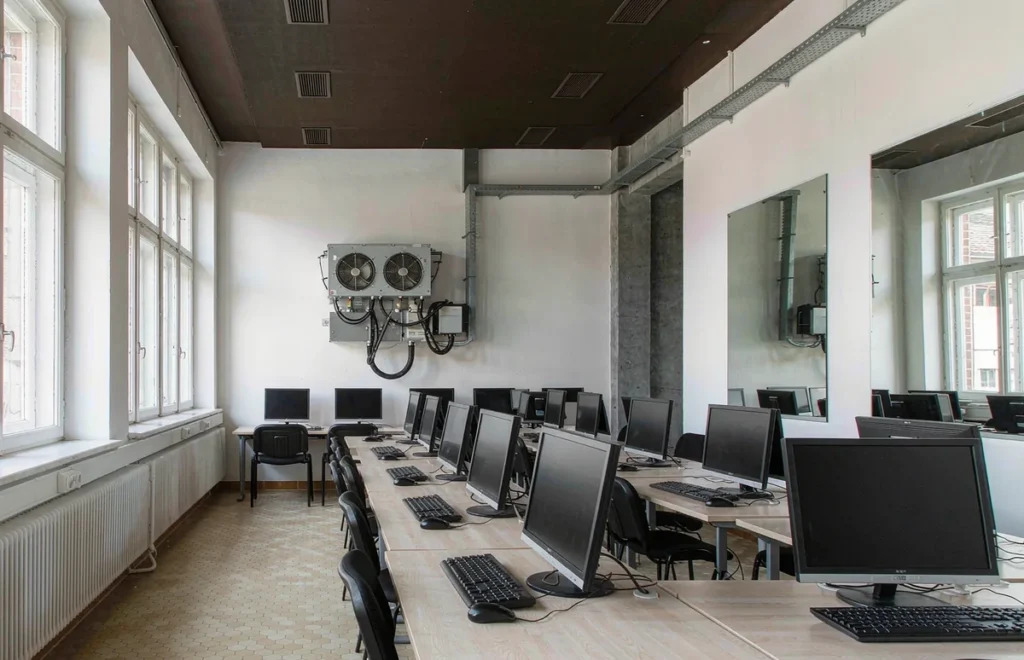
- Desktop computers and monitors in a language or IT lab, 150W to 400W per seat depending on age and screen size, and the whole room switches on at the same minute.
- Laser and colour printers, 300W to 1200W, with a short heating surge on every print job that is bigger than the running figure.
- Projectors and interactive whiteboards, 200W to 700W each, and staff rooms can have several running together.
- Science laboratory equipment, microscopes, hotplates, stirrers, small centrifuges and a drying oven, 100W to 1500W with a mix of steady and surge loads.
- Canteen chest freezers and refrigerated display units, 200W to 800W, all compressor driven and running around the clock.
- Drinking water dispensers with a cooling compressor, 100W to 500W, and schools usually have several.
- AV trolleys, music room amplifiers and stage lighting controllers, 200W to 1000W on an intermittent duty.
- Workshop bench tools in a design and technology room, 300W to 1200W, each with a real motor inrush.
- Server cabinets and network switches where the rack hardware is 110V, 100W to 400W, and these must never lose supply during an exam week.
What does not need us, and I say this on nearly every school call: laptops, tablets, phone chargers, most LED lighting and an increasing share of classroom electronics that carry a 100-240V, 50/60Hz rating on the back panel. Those devices are already happy on a 220V socket. Count them into your load sheet and the school buys capacity it will never use.
How to Size a Step Down Transformer for a School
Here is the method I use, and a bursar can run it in a spare half hour. Work room by room rather than building by building. Inside each room, list the equipment that could realistically run at the same moment, then apply a demand factor of 0.6 to 0.8 for computer and AV rooms, and 1.0 for anything with a compressor or a heating element. Add 25 to 30 percent headroom on the result. That is your VA figure.
Rooms run with no heating element and few motors can take the lower demand factor with confidence. Rooms with a compressor, an oven or a bank of printers should take the higher one, because a transformer that trips in the middle of an exam does not care that the average load was well within rating. For motors, remember the start current sits at roughly 2.5 to 3 times the running figure for a moment, so a room with two or three of them needs the higher number.
A Worked Example: A Thirty Seat Computer Room
Thirty desktop seats at 250W each is 7500W on paper, which sounds alarming. In practice, thirty seats doing browser work and a bit of word processing sit near 45 to 55 percent of that, so call it 4000W. Add a teacher station at 300W, a laser printer at 900W while it heats, and a projector at 400W, and the realistic simultaneous figure is about 5600W. Add 25 percent headroom and you land at 7000VA. A single 7000VA unit, or better, two 3500VA units each feeding fifteen seats, does the job without overspending on a monster box.
Now compare a canteen. Two chest freezers at 400W each plus a display fridge at 250W plus a water dispenser at 200W is only 1250W running, but three compressors can start close together. A 2000VA unit covers the running load and the starts comfortably, and it costs a fraction of the computer room figure. Same school, same voltage, two completely different conversations.
| School area | Typical simultaneous load | Suggested unit rating | Why this size |
|---|---|---|---|
| 30 seat computer lab | 4500 – 6000 W | Two 3500VA units, one per bench row | Keeps one fault from stopping the whole room |
| Science laboratory bench | 1200 – 2000 W | STU-3000 bidirectional | Oven and centrifuge loads plus future equipment |
| Canteen freezer and chiller bank | 1000 – 1600 W | ST-2000 2000VA with RCD | Compressor starts repeat all day, low running watts |
| Staff room AV and printers | 600 – 1200 W | ST-1500 1500VA | Printer heating surge decides the size |
| Network rack and admin office | 300 – 800 W | DT-1000VA bidirectional | Small mixed load, needs to stay on during exams |
| Design and technology workshop | 800 – 2000 W | STU-3000 bidirectional | Bench motors pull 2.5 to 3 times running current |
| Maintenance bench for equipment checks | 200 – 1000 W variable | Variac 1KVA to 3KVA | Adjustable output for verifying imported instruments |
When to Go Bigger Than the Numbers Say
A few situations push me past the standard headroom, and schools hit all of them. A room scheduled for more seats next year should be sized for next year now, because adding a second transformer later costs more than the difference in unit price today. Any room that will also carry an air conditioner on the 110V side needs the air conditioner’s compressor counted properly rather than guessed at. And any school running online exams needs to decide early which loads are protected, because a transformer trip during a two hour online paper is a problem nobody forgives.
Circuits, RCD Protection and a Layout That Survives a Fault
The layout question comes up on every school project. One large unit in the electrical room feeding 110V wiring through the building, or one smaller unit in each room? Both work. The choice usually comes down to the state of your existing wiring and how quickly your caretaker can react, not to price. A central unit is tidy and cheaper on hardware, but it concentrates risk. If it trips at ten in the morning, every computer room, the canteen and the network rack stop at once.
For retrofit work, which is what most schools are doing, we normally suggest one unit per room or per pair of rooms. A 2000VA unit mounted on the wall of the science lab, feeding three or four dedicated 110V sockets. If a unit ever fails, the caretaker swaps in a spare and the lesson continues. On a new build you can group several rooms onto a bigger unit in a service cupboard, which cuts the unit count without losing the ability to isolate one wing for maintenance.
RCD, Earthing and Pupil Safety
RCD protection should be the first question in any school tender, not an afterthought. On our ST-2000 it is part of the build, so a fault on the 110V side trips the unit locally rather than waiting for a breaker in a distant panel. In a room full of children with wet hands, a science bench with a tap, or a workshop with metal benches, that is not a place to save money per unit.
Earthing is the second thing I check on a school drawing. The enclosure must be bonded to the building earth, and the 110V output should feed proper fixed sockets rather than a chain of extension leads across a classroom floor. If your electrical contractor has not done this before, send us the single line diagram and we will mark up where the unit sits and what it needs. There is more on the general comparison between arrangement types in our piece on step up & down transformers, if you want the background before the tender document gets written.
CE Marks, Test Reports and Tender Paperwork
Public school procurement almost always asks for documents before it asks about price. We supply a CE declaration, a test report for the batch your units come from, and a datasheet with the input and output figures and the temperature rise. Every unit is wound and 100 percent tested in our own factory in Yueqing, and the test record that ships in the carton shows input voltage, output voltage under load and no-load current for that specific unit. If your tender needs the paperwork in a particular format, tell us early and we will prepare it with the quotation rather than after the order.
The Units We Build for School and Campus Work
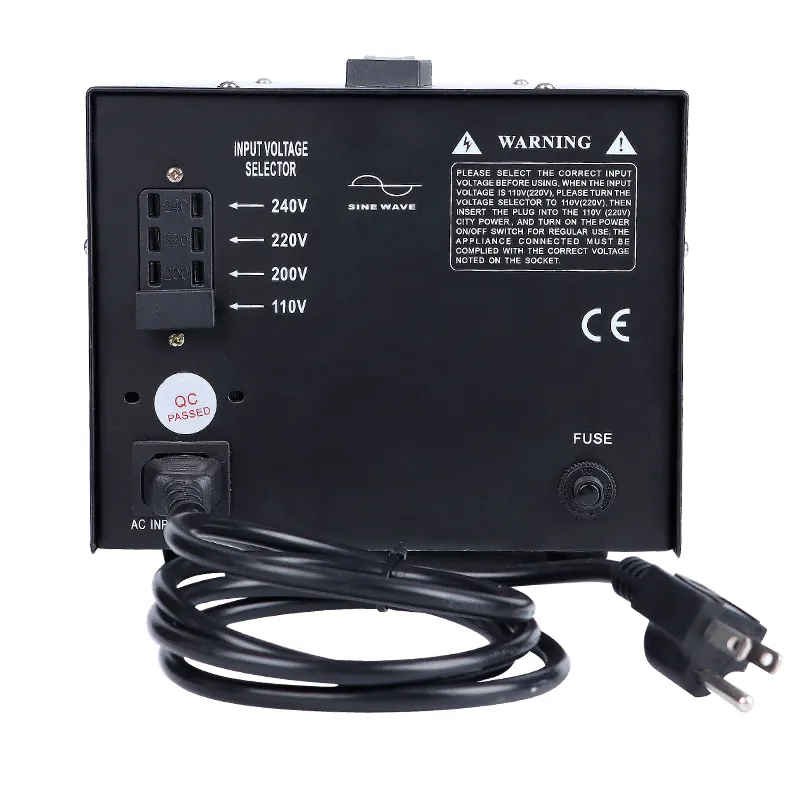
We are a factory, not a trading company, so I can tell you exactly what comes off the line. The ST-2000 is a 2000VA step down transformer that takes 220V in and gives 110V out, with RCD protection inside the enclosure. For a canteen bank of freezers, a staff room or a small lab bench, that is the unit I quote most often.
Above that rating the STU series is what we quote. STU-3000 and STU-5000 are bidirectional, so they step up as well as step down, and they carry the heavier side of school work: science laboratories, design and technology rooms, and large AV installations. The bidirectional part matters more than people expect, because schools import 110V and 220V equipment in the same year, and swapping the box on the wall later is a nuisance nobody budgets for.
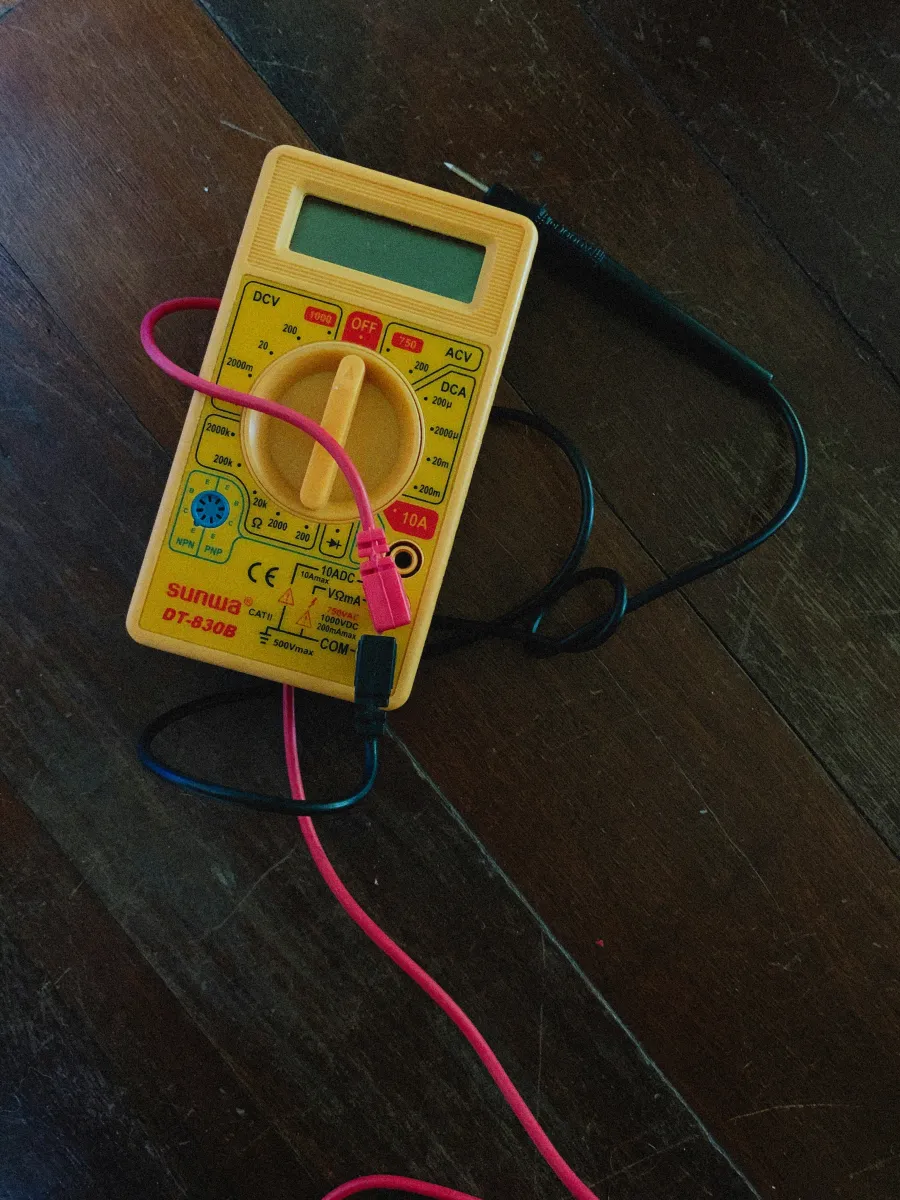
The DT-1000VA is our bidirectional automatic unit and it suits network racks, admin offices and AV carts where a modest load has to work in either direction without anyone thinking about it. For bench testing we keep a Variac line in 500VA, 1KVA, 2KVA and 3KVA. Adjustable voltage sounds dull until your technician needs to check how an imported instrument behaves at 105V or 115V, and after that the Variac never goes back in the store cupboard.
Order Size, Lead Time and Test Documents
The commercial side is short, and school buyers tend to want it first. Minimum order is 10 pieces, whether you are fitting out one computer room or sampling before a full campus roll-out. Production takes 15 to 25 days, counted from deposit, with the quantity and any custom labelling deciding the exact point in that range. We ship FOB Ningbo or Shanghai and every unit carries a 12-month warranty, with a batch test record in the carton. Because we wind with copper rather than aluminium, the winding runs cooler at the same rating, and in a room that stays on all day for a decade that is the difference between a unit that lasts and one that does not.
Customisation is where school orders get interesting. We can fit the socket type your rooms use, set the output to 110V or 120V depending on your nameplates, print the school name or your distributor brand on the faceplate, and pack units individually so they can go straight to each building. If you are fitting out several campuses, give us the schedule and we will stage the deliveries instead of shipping a pallet of thirty units for the site team to store.
Getting the Size Right: What to Send
There is no need for a finished specification at this stage. Anything you have on paper will do to start. The room by room equipment list with the wattage from each nameplate, a photo of one nameplate if that is faster than typing, your mains voltage and frequency, the socket type your rooms use, how many separate 110V feeds you need, and the date the rooms have to be working. From that we can size the unit, quote the quantity and give you a delivery window, usually the same working day.
One more thing worth reading if your facilities team also looks after offices, admin blocks and staff welfare rooms, since those loads behave much like a school’s. Our Step Down Transformer for Offices: 220V to 110V Guide covers printers, workstations and kitchen equipment in the same plain language. There is a full set of more application guides on the site as well, covering everything from dental chairs to farm pumps.
If a nameplate is hard to read, send the list anyway and add a photo of your sockets. Sizing a step down transformer for a school is routine work for us, and we would much rather spend ten minutes on WhatsApp than have you order the wrong unit for every classroom in the building.
School Transformer Questions I Get Asked Most Weeks
Below are the questions schools put to us again and again, with the answers I would give you if you rang the factory.
How do I size a step down transformer for a school computer lab?
Go room by room, not building by building. Add the seats that realistically run at the same moment, use a demand factor of 0.6 to 0.8 for computer rooms, then add 25 to 30 percent. A thirty seat lab with a printer and a projector lands near 7000VA, so two 3500VA units split by bench row work well.
Do I need to size for every computer in the school?
No, and sizing off the nameplate total is the most common and most expensive mistake we see. A computer room rarely draws more than half its combined nameplate figure, because most machines are idle at any given moment. Size off the realistic simultaneous load and the price drops sharply without any loss of performance.
Should each classroom have its own transformer or one big unit?
Most schools we quote are retrofits, and we suggest one unit per room or per pair of rooms. A single central unit is cheaper on hardware, but a trip at ten in the morning stops every computer room, the canteen and the network rack together, and in an exam week nobody wants that conversation.
What paperwork does a school tender usually require?
Usually a CE declaration, a datasheet with input, output and temperature rise figures, and a test report for the batch. Our ST-2000 step down transformer ships with a test record inside the carton showing input voltage, output voltage under load and no-load current, because every unit is tested in our own factory in Yueqing.
Can a school run canteen freezers on the same transformer as computers?
It works, but we normally advise against sharing one unit. Compressors start two to three times their running current, and that dip is felt by everything else on the same unit. A separate ST-2000 on the canteen side keeps the kitchens self contained and leaves the computer rooms undisturbed.
A room by room list costs you nothing to send and it usually rules out a sizing mistake. Tell us which 110V machines you run in each room, how many separate 110V feeds you need, and which country you are in. A recommended unit, a quantity and a price come back to you, and on most days that is the same working day.
Or talk to us directly: WhatsApp +86 197 3022 6757 · Email sales@wilmall.com
MOQ 10 pcs · Lead time 15-25 days · FOB Ningbo or Shanghai · 12-month warranty