Control Transformer Sizing: How to Calculate VA
Quick answer: control transformer VA = (sum of all control-circuit loads in VA) x 1.2 safety margin, rounded up to the nearest standard size. If your PLC panel, relays and indicator lamps draw 80VA total, you need a 100VA control transformer — not a 50VA.
Key Takeaways
- VA = Volts x Amps, added up for every load on the control circuit — then add 20-25% margin.
- Relays and contactors draw 5-10x their holding current at inrush — that is what the margin is for.
- Size by VA, not watts — coils are inductive loads.
- Reading the old nameplate (input / output / VA) is the fastest path when replacing.
Quick Size Guide
| Panel type | Typical control transformer |
| Small PLC + I/O | 80-100VA |
| PLC + relays + contactors | 150VA |
| Multi-station machine panel | 250-500VA |
| Heavy machine tools | 500-1500VA |
The Formula, Plain and Simple
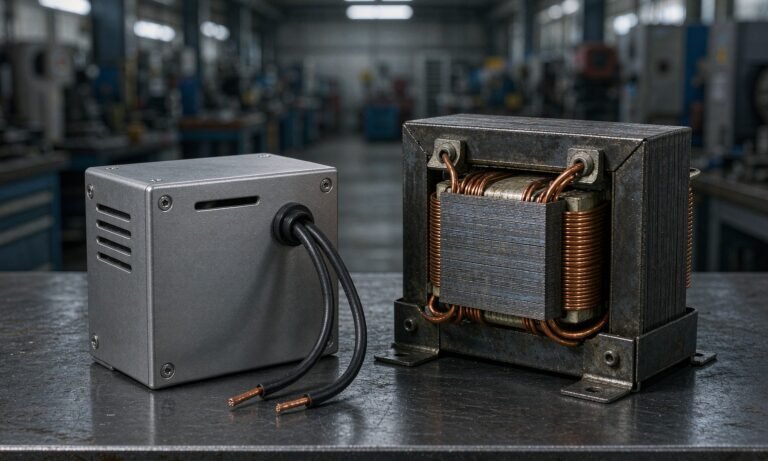
Control transformers feed low-voltage control circuits — typically 110V, 24V or 12V — inside panels, machine tools and automation equipment. Sizing them is one calculation:
Total VA = Volts x Amps, added up for every load on the control circuit.
Then add a safety margin. We use 20–25% as standard. Why? Because relays and contactors draw a much higher inrush current when they energize — sometimes 5-10x their holding current. A transformer sized to holding loads alone will sag under the inrush and your contactor will chatter or fail to pick up.
Worked Example: Sizing a Control Transformer
Say you’re building a small machine control panel:
| Component | Load |
| PLC (24V DC supply via transformer) | 40VA |
| 3 x relays (each 4VA holding, 20VA inrush) | 12VA holding |
| 2 x indicator lamps (24V, 2W each) | 4VA |
| Contactor coil (24V) | 8VA |
If you skipped the margin and bought a 63VA transformer, the panel would work on the bench — and randomly fail on the factory floor when three relays fired at once.
Holding total: 40 + 12 + 4 + 8 = 64VA. Add 20%: 64 x 1.2 = 76.8VA. Round up to the nearest standard size: 100VA.
If you skipped the margin and bought a 63VA transformer, the panel would work on the bench — and randomly fail on the factory floor when three relays fired at once. We see this constantly in support tickets.
How to Read the Label on Your Machine
If you’re replacing a control transformer, the fastest path is reading the old one’s nameplate: input voltage, output voltage, and VA rating. Match those three and you’re done. If the label is gone, measure the coil voltages in the panel (usually printed on each relay and contactor) and run the same formula.
Common Sizing Mistakes
- Only counting holding current. Inrush is 5-10x holding for relays and contactors — that’s what the margin is for.
- Forgetting the input voltage. 380V vs 220V vs 110V panels need different primary taps. Tell us your mains voltage.
- Mixing VA and watts. For a mostly-resistive control load they’re close, but coils are inductive — use VA.
- Oversizing wildly. A 500VA unit on a 30VA panel wastes money and, in a small enclosure, heat.
For ready-made ratings from 25VA to 10KVA, see our industrial control transformer range.
What Our Control Transformers Cover
Our control transformer range (JBK3 series) runs from 40VA to 1500VA, with 110V / 24V / 12V secondary options and insulation class B/F/H. Standard input voltages cover 220V and 380V, with custom combinations built to order — MOQ from 10 pcs, production 15–25 days.
Reading the Nameplate on Your Machine
Before you calculate anything, find the nameplate on the machine and read it properly. It will list the control voltage the panel needs, usually 24V, 36V, 110V, or 220V, and the total VA of the control circuit. The number to use in sizing is the VA figure, not the amperage alone, because VA accounts for both current and voltage. If the nameplate only shows watts, treat watts as roughly equal to VA for control circuits unless the load is heavily inductive, in which case add margin. Write down the input voltage of the panel too, because a control transformer must match both sides: the line voltage feeding it and the control voltage the machine expects. A machine built for 380V input running on a 220V supply needs a transformer with the right primary taps, and getting that wrong is a common cause of panels that hum loudly or trip as soon as power is applied.
Adding Up the Load: PLCs, Relays, and Contactors
The load on a control transformer is the sum of everything it powers: PLC power supplies, relay coils, contactor coils, solenoid valves, indicator lamps, and small motors. Each of these draws current, and they add up faster than people expect. A typical cabinet with a small PLC, six relays, and four contactor coils can easily need 100VA or more just for the coils, before you count the PLC itself. The important detail is that contactor and relay coils draw several times their holding VA for the first few cycles when they energize. That inrush is why a transformer that looks perfectly sized on paper can still drop voltage and cause a contactor to chatter or fail to latch. The fix is to size with 20 to 30 percent margin and to use the inrush figure for coil-heavy panels, not just the steady-state VA. If in doubt, go up one size, a 150VA transformer costs little more than a 100VA unit.
Temperature, Ventilation, and Panel Placement
Where the transformer sits inside the panel matters as much as its rating. A control transformer rated for a 40°C ambient will run hot and age fast if it is mounted next to a VFD or a bank of power resistors that push the local temperature higher. Give the transformer space for airflow, mount it away from heat sources, and leave at least a few centimeters around it. In sealed or poorly ventilated cabinets, add a ventilation grille or a small fan if the transformer runs continuously. Our control transformers use class B or class F insulation depending on the rating, and the class is printed on the label so you can match the unit to your environment. For panels in hot workshops or near ovens, choose the higher insulation class. The extra cost is small compared with the downtime of a failed transformer shutting down a whole production line.
OEM and Custom Control Transformers
If you build panels or machines, you probably need more than an off-the-shelf transformer. We make control transformers to order with your choice of input and output voltages, secondary taps, terminal layout, mounting pattern, and even your brand label. Custom builds run from 25VA up to 10KVA, and we can match a specific enclosure layout so the transformer fits your cabinet without rework. For OEM customers, the batch test report and the consistent quality from lot to lot matter more than the unit price, because a failed transformer in a machine you shipped reflects on your brand. Tell us your panel load list and enclosure constraints, and we will confirm a model with the right VA, insulation class, and physical size within 24 hours. The MOQ for custom builds is flexible, and standard sizes ship faster because we keep them in stock.
Buying in Volume: How the MOQ and Pricing Work
For workshops and panel builders, buying control transformers is often a repeat purchase, not a one-off. Our MOQ for standard control transformers is 10 pieces, which keeps the door open for small orders while letting us offer better unit pricing as quantities climb. At 10 to 50 pieces you get the standard factory-direct price, at 50 to 200 pieces there is a volume discount, and above 200 pieces we quote a production price with a firm lead time. Every order includes the batch test report, and units are packed to survive container shipping, with the terminals protected and the label facing out for quick identification at your end. If you are a distributor stocking control transformers for resale, we can also supply a mixed container of different VA sizes so your stock covers the common machine panel needs without tying up capital in one size. Send us your annual volume and we will quote a ladder price.
How to Avoid the Three Most Common Panel Failures
Three failures cause most control transformer problems in the field, and all three are avoidable. The first is undersizing: a panel where the contactor coils and PLC draw more than the transformer delivers, causing the voltage to sag and contactors to drop out under load. The fix is the 20 to 30 percent margin we keep repeating. The second is poor ventilation: a transformer mounted in a sealed, crowded cabinet runs hot and its insulation ages in months instead of years. The fix is airflow, spacing, and choosing the right insulation class. The third is the wrong input voltage: a transformer wired for 380V fed from 220V, or a 220V unit on a 415V line, produces the wrong output and can burn out. The fix is checking the nameplate and the wiring diagram before energizing. If you have a panel that misbehaves, start with these three checks before suspecting the transformer itself.
FAQ
How many VA do I need for a PLC?
A typical small PLC plus its I/O draws 30–60VA. Add relays and contactors on the same circuit and you’re usually in the 80–150VA range.
Can I use a bigger control transformer than needed?
Yes — it won’t hurt the circuit, it just costs more and takes more space. Oversizing by one step for future expansion is fine.
24V or 110V control?
24V is safer for touch and common in modern panels; 110V is still standard in many retrofit and industrial environments. Match your existing components — don’t mix.
Do control transformers need fusing?
Yes — a secondary-side fuse (or MCB) sized to the transformer protects the control wiring. We can supply fused options.
Need help sizing one for your panel? Send us your load list and we’ll confirm the right VA within 24 hours.
Still not sure which model fits?
Tell us your appliance, wattage and country — we reply within 24 hours with a straight recommendation.
Related: Step Down Transformer Guide
Need 220V to 110V for home appliances instead? Read our step down transformer buying guide with a sizing table.