Voltage Converter for Cameroon: 220V to 110V Guide
Cameroon runs on 220V at 50Hz, with French-style round-pin sockets in most of the country and British-style sockets in the two English-speaking regions. If you are arriving with US appliances, or shipping equipment to a client in Douala or Yaoundé, every 120V device needs a step down transformer from 220V to 110V or 120V. The good news is that the conversion is straightforward once you size it honestly, and that is exactly where most buyers make their one mistake.
Cameroonian Mains: What Arrives at the Wall Socket
The national grid in Cameroon is nominally 220V at 50Hz, run by ENEO under a public-private concession, and in practice the supply can run high or low depending on the season and the neighbourhood. The dry season, when hydro output drops, is when brownouts become common, and many homes and businesses run on generators for part of the week.
For a US appliance user this means the same layered advice we give across the region: the step down transformer handles the voltage conversion, but if the input sags, the output sags with it, because a transformer only changes the ratio, it does not regulate. In Douala, where supply dips are part of life, we recommend a stabilizer before the transformer. In Yaoundé and areas on reliable feeder lines, buyers often skip the stabilizer and accept the margin of the 120V tolerance.
Frequency is 50Hz. US heating appliances and electronics run fine on it. US motor appliances, like a refrigerator compressor or a heavy blender, will run slightly slower, and if the label says “60Hz only” it is not a good candidate for Cameroonian mains, transformer or not.
Which of Your US Appliances Actually Needs a Transformer
Check labels first, because it saves money. Universal-input devices are marked “100-240V ~ 50/60Hz” and run on Cameroonian mains with only a plug adapter:
- No transformer: phone and laptop chargers, most modern TVs, most game consoles (recent generations are universal), LED lamps, shavers marked universal.
- Transformer needed: US hair dryers, curling irons, blenders, coffee machines, rice cookers, microwaves, older TVs and consoles, printers, CPAP machines, electric tools, robot vacuums, sound bars.
- Size carefully: US refrigerators, freezers, washing machines, window air conditioners. Compressor surge decides the size, not the running watts.
If you run a clinic, laboratory or workshop, plan for isolation transformers on sensitive equipment. An isolation transformer separates the output from the mains earth and filters common-mode noise, which a step down autotransformer does not do. For a CPAP machine at home, a small isolation transformer is a genuinely better choice and we build those to order.
Sizing the Transformer: The Factory Method
Here is the sizing method we use on every Cameroonian order, and it takes two minutes:
1. Read the appliance nameplate. Watts, or amps. If amps only: watts = volts × amps (for a 120V appliance, simply amps × 120).
2. Multiply: heating and electronics × 1.25; motors and compressors × 2 to 3.
3. Add the VA of everything running at once. Buy the next standard size up.
4. Standard sizes we build: 500VA, 1000VA, 1500VA, 2000VA, 3000VA, 5000VA.
| Equipment Set | Combined Load | Recommended Unit (220V to 120V) |
|---|---|---|
| TV + decoder + console + sound bar | ~700W | 1000VA |
| Hair dryer + straightener | ~2000W | 2000VA |
| Blender + coffee machine + kettle | ~2200W worst case | 3000VA |
| US refrigerator | ~700W run, ~2100W surge | 3000VA |
| Fridge + freezer together | ~1500W run | 5000VA |
One warning from our order history: the worst oversights are not small appliances, they are refrigerators and air conditioners bought on a 1500W guess. A compressor can demand three times its running watts for the first second, and an undersized transformer sags, heats up, and trips its protection while the compressor struggles. If your appliance list includes anything with a compressor, send it to us before you order and we will size it properly.
Plugs and Sockets: The Cameroon Split
Cameroon is bilingual and the electrical legacy splits the same way the language does. The French-speaking regions, including Douala and Yaoundé, use Type C (two round pins) and Type E (round pins with a grounding pin in the socket). The English-speaking Northwest and Southwest regions use the British Type G three-rectangular-pin socket in newer buildings, with Type C common in older wiring.
When you order a transformer from us, tell us which region it is going to and we fit the matching input plug. The output side is a US NEMA socket for your US appliance. If the unit will move between regions, order a detachable input cable set (Type C/E and Type G) and switch cables instead of carrying adapters.
What a Factory-Built Unit Includes (and What to Ask For)
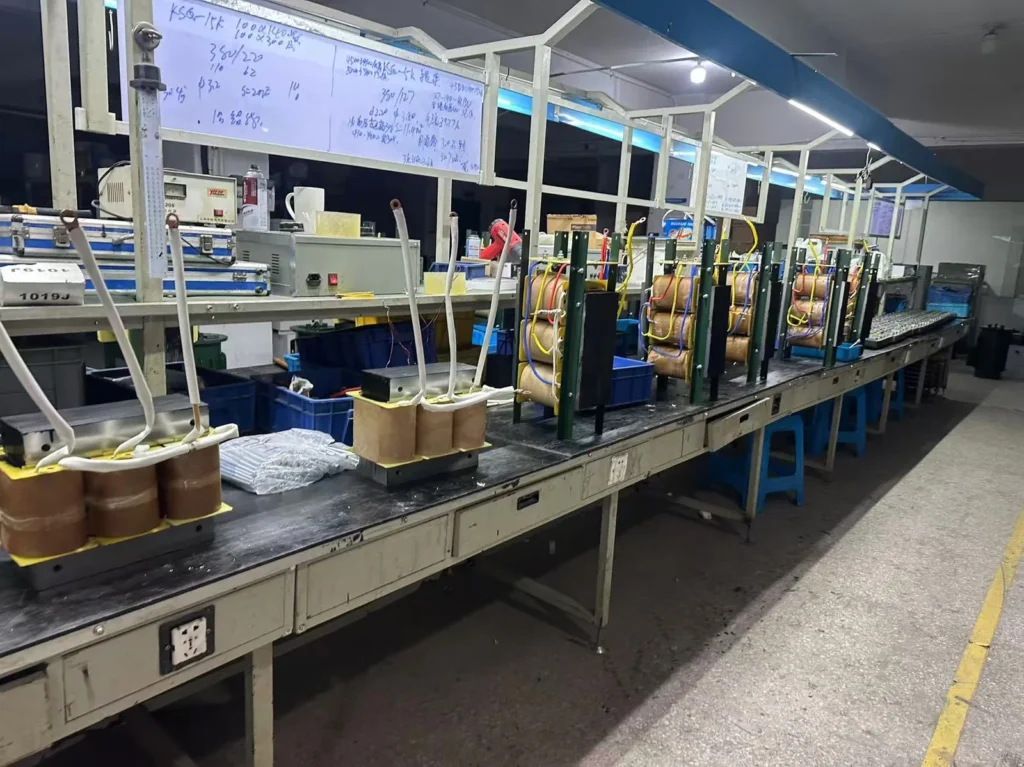
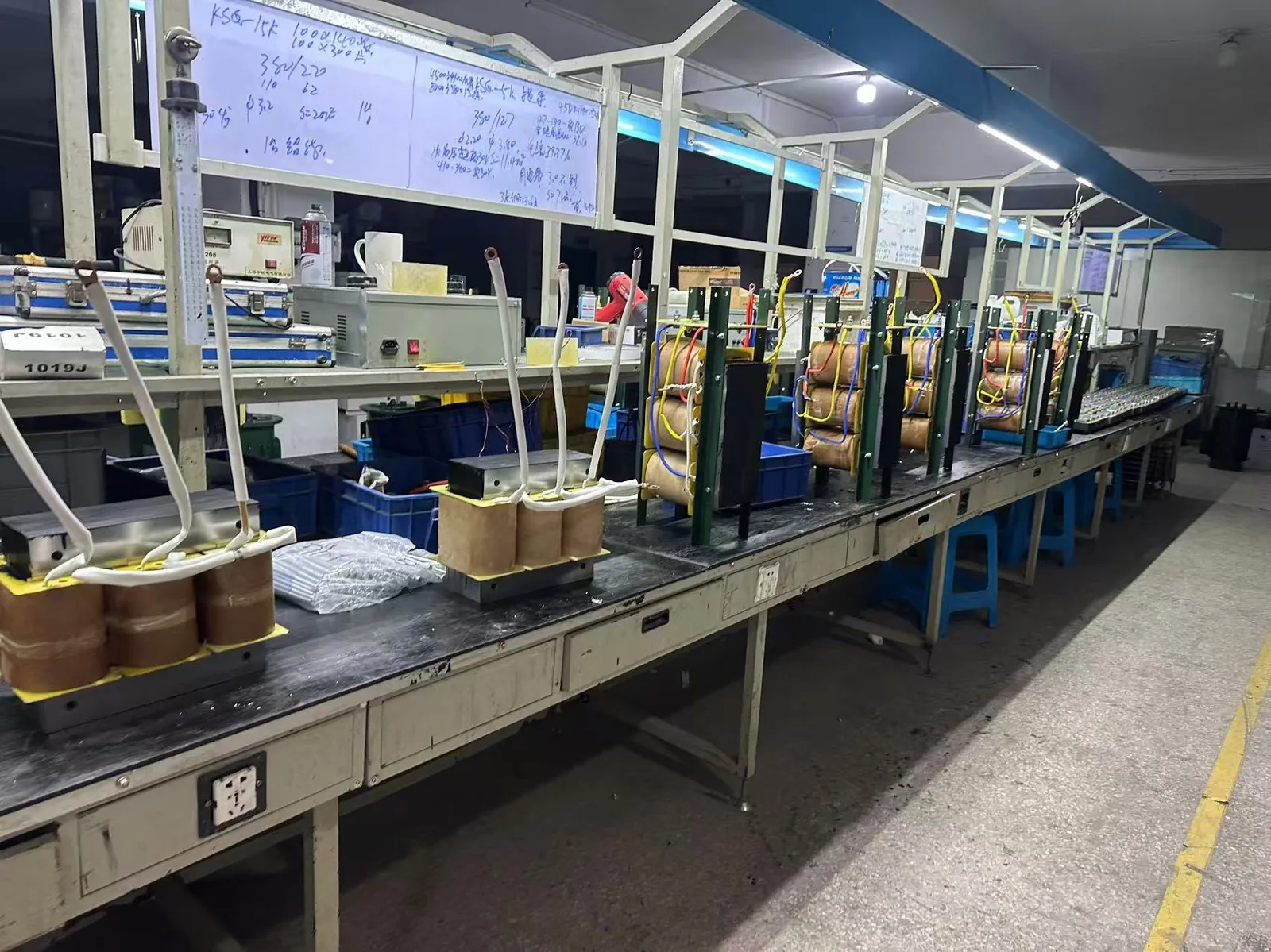
A step down transformer is a simple device, but the build quality decides whether it survives Cameroonian conditions. Every export unit from our floor includes:
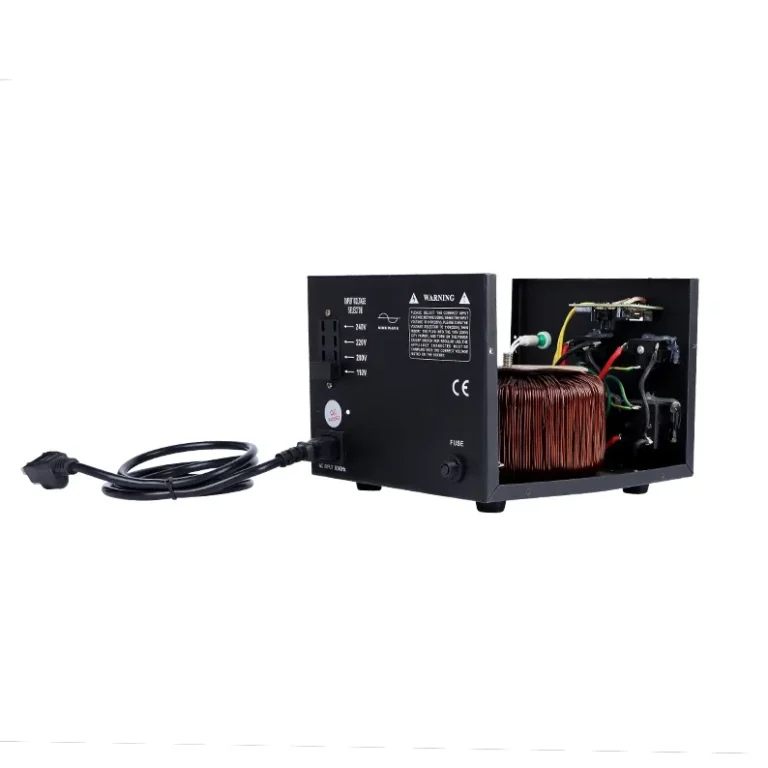
- Copper winding on a core sized for the true VA rating. Weight is a quick honesty test: a genuine 2000VA copper unit weighs roughly 14-18kg; a box that is much lighter is almost certainly aluminium or overrated.
- Thermal protection that disconnects the output on overload, plus an input fuse on every unit.
- A label printed with the wiring diagram and the actual voltage spec, in English and French, because installers on site appreciate it.
- A test record: we measure output voltage under full load and no-load current, photograph the meters, and the test sheet ships with the unit.
- CE certificate and test report with the paperwork for customs.
If you are buying for a business, ask about the three-phase options. Hotels, bakeries and workshops in Cameroon running US-sourced three-phase machines need proper transformer banks, and our commercial range goes up to large kVA sizes. MOQ for reseller orders is 10 pcs; single units for personal use are always available.
Shipping and Customs for Transformers to Cameroon
Personal shipments of one or two transformers clear Cameroonian customs without special permits, and we ship them by air courier, usually arriving within a week of production. Commercial shipments go by sea FOB Ningbo or Shanghai with the standard 15 to 25 day production lead time, and we supply the commercial invoice, packing list, CE certificate and test report that your customs broker uses for the declaration.
Transformers are heavy, and sea freight is charged by volume or weight, so for a full container we pack the units on pallets and strap them properly; nobody wants a 20kg transformer bouncing around a container for three weeks.
Small Businesses in Cameroon: The Loads People Forget
Household guides cover refrigerators and TVs, but a large share of our Cameroonian orders go to small businesses, and those buyers consistently forget two loads when sizing. The first is the cash register, POS terminal and printer setup: individually small, collectively 300-500W of continuous electronics that run all day, and they deserve their own small transformer or a clean share of the main one so a compressor start elsewhere does not dip them. The second is the water pump: many small compounds and workshops run a 120V US pump or booster, and pump start current is brutal, often six times the running load, so a pump needs its own 5000VA unit or a soft starter rather than sharing the kitchen transformer.
For barbershops, salons and clinics, the pattern is consistent: a mix of US hair tools (dryers, clippers, flat irons) that run one at a time but each pulls near 1500W, plus refrigeration for stock. The practical setup we ship most often is a 3000VA unit for the tools and a separate 3000VA for the fridge and freezer, rather than one giant unit, because a hair dryer surge and a compressor start should never share a winding. If your business runs on generator power, read the generator section of our West Africa guide, because the same rules apply across the region.
Frequently Asked Questions: Voltage in Cameroon
Finally, protect the unit itself at the distribution board. A correctly rated breaker or fuse on the transformer input, sized at about 1.25 times the transformer input current, means a fault downstream trips the breaker instead of cooking the transformer. Many of the failure photos we receive turn out to be installations with no input protection at all, where a shorted appliance cable took the transformer with it. If your local electrician is unsure of the breaker size, send us the VA rating and we will give you the exact input current and recommended breaker for your supply voltage.
Whether you are a family arriving in Douala or a company outfitting a guesthouse in Buea, the same three questions decide everything: what voltage is at the wall, what do the appliance nameplates say, and do any of them have compressors or motors. Answer those three and the transformer size answers itself.
What voltage is used in Cameroon?
Cameroon uses 220V at 50Hz. Sockets are French Type C/E in the francophone regions, including Douala and Yaoundé, and British Type G in the anglophone Northwest and Southwest. US 120V appliances need a step down transformer from 220V to 110V or 120V.
Do I need a stabilizer before my step down transformer in Cameroon?
In areas with frequent brownouts, particularly Douala in the dry season, yes. The transformer converts 220V to 120V but does not regulate; when the grid sags below 220V, the output sags below 120V. A stabilizer on the input holds the output steady.
What size transformer do I need for a US refrigerator in Cameroon?
Use a 3000VA step down transformer for a single US refrigerator, rated 220V to 120V. The compressor start surge can reach three times the running load, and an undersized unit will sag and overheat. Add a second unit or step up to 5000VA for a freezer.
Which plug should a transformer have for Cameroon?
It depends on the region: Type C/E for the francophone regions, Type G for the anglophone regions. We fit the input plug to the destination and keep a US NEMA output socket, or supply both input cables for a unit that will move between regions.
Can I use US 60Hz appliances on Cameroon’s 50Hz grid?
Resistive loads like heaters and switch-mode electronics run correctly. Appliances with induction motors run slower on 50Hz, and those labelled 60Hz only should not be connected. Check each appliance label; most modern electronics are rated 50/60Hz.
Shipping US appliances to Cameroon, or outfitting a home or business there? Send us your appliance list and the region, and we will confirm the exact 220V to 110V step down transformer, stabilizer and plugs. Email sales@wilmall.com or WhatsApp +86 197 3022 6757.
Start from our step up and down transformer range, or read the wider African context in 110V vs 220V in Africa.