Step Down Transformer for Tunisia: 230V to 110V Guide
If you are searching for a step down transformer for Tunisia, the number that matters most is not printed on any product page. It is the voltage sitting on the wall of your building. Tunisia runs 230V at 50Hz, and while the supply around Tunis is usually well behaved, the reading at the socket moves with the season, the feeder and how far you sit from the nearest substation. A coastal apartment in La Marsa may hold 228V all week. An inland town on a July afternoon, with air conditioning running in every other window, can sag well below 210V and climb back up after dark.
We build transformers in Yueqing, China, and Tunisia is one of those markets where the questions are refreshingly practical. A family returning from the United States brings back a kitchen full of 110V appliances. A clinic imports a US-spec dental chair or an ultrasound unit. A hotel installs American laundry equipment. An office runs US-spec servers and a wide format printer. Every one of them wants 110V, and nobody wants a box that gives up in its second summer.
Tunisia Runs on 230V at 50Hz With French Pattern Sockets
Start with the official picture, because it saves arguments later. Tunisia’s nominal supply is 230V at 50Hz, with 220V still quoted in older documents and older buildings. The socket pattern across the country is the French style you find through much of the Maghreb, which means Type C and Type E. Type E is the one with the earth pin sticking out of the socket itself rather than sitting in the plug, and it is what you will see in the great majority of Tunisian homes, apartments and small businesses.
Your imported appliance almost certainly arrives with a North American NEMA 5-15 plug on it, and that fits nothing on a Tunisian wall. So frame the wiring question properly and the rest gets easy. The transformer takes 230V from the wall on its input side and gives you 110V on the output side through a socket your appliance can actually use. Tell us at the quotation stage which socket you want on the output and which plug you want on the input, and we build it that way. For us that is a normal order, not a special project, and it saves you a drawer full of adapters that end up warm to the touch.
Where Tunisian Voltage Is Softest
The Tunisian grid is better than its reputation in some places and weaker than you would expect in others. Greater Tunis, Sousse and Sfax generally hold within a few percent of nominal, and most of what people describe as power problems there is scheduled maintenance rather than daily life. Push inland and south, towards Kasserine, Gafsa, Kébili and Tataouine, and the low voltage feeders get longer, the load gets more seasonal, and summer afternoons take a visible bite out of the voltage.
Buildings add a problem of their own. In older housing stock with undersized internal wiring, the drop happens inside the building rather than out on the street, so your socket reads low even when the neighbourhood supply is fine. If you measure 200V at a socket while the utility insists it is delivering 230V, that is usually a wiring issue, and no transformer on the market will repair it. What you can do is make sure the transformer is not the second weak link stacked on top of the first one.
Here is the part I want you to sit with, because it catches out a lot of first time buyers. A transformer changes voltage by a fixed turns ratio. For a 230V to 110V design that ratio is about 0.478. Feed it 200V and you get roughly 96V at the outlet. Feed it 245V and you get around 117V. The unit is working exactly as designed in both cases, because it is not a regulator. If your site has a real stability problem, the correct answer is a stabiliser or an automatic voltage regulator in front of the transformer. I would rather tell you that today than hear about a dead compressor in six months.
What Tunisian Buyers Actually Plug Into 110V
The lists that land in my inbox look similar whoever sends them. Here is the split I would make, and it is worth holding your own list up against it.
- American kitchen appliances — stand mixers, blenders, air fryers, coffee makers, mostly 800W to 1800W and resistive, so easy work for a transformer.
- 110V refrigerators and freezers — 150W to 600W running, but the compressor start is the real test, not the running figure.
- Washing machines and dryers built for the US market — 500W to 2000W, and the dryer is nearly always the heavier of the two.
- Air conditioners and window units on 110V — 1000W to 2500W, compressor driven, the hardest load a household owns.
- Water pumps and booster sets — 300W to 1500W, induction motors, common in buildings where rooftop tanks feed the upper floors.
- Televisions, audio and gaming setups rated 110V only — 50W to 300W each, light individually but they add up quickly.
- Clinic and dental equipment — US-spec chairs, sterilisers and small imaging units, where you cannot gamble on the supply.
- Workshop tools and imported power equipment — 500W to 2000W, used in bursts and hard on start-up.
Now the honest other half. Laptops, phone chargers, most monitors, many modern televisions, camera chargers and a long tail of small electronics carry a 100-240V, 50/60Hz label. Those run on Tunisian mains with nothing more than a plug adapter, and putting them on the transformer quietly eats capacity you were saving for the compressor. Read the nameplate before you send the list. It takes half a minute and it often changes the size you should be buying.
The 50Hz Question for Motor Appliances
Tunisia runs at 50Hz. Almost every 110V appliance from the United States was designed for 60Hz. A transformer does not change frequency, and no transformer sold for household money will. So whatever comes out of the outlet is still 50Hz, and your appliance has to live with that.
For resistive loads it makes no difference at all. Kettles, irons, toasters and space heaters do not care. Motors do care. A 60Hz induction motor running on 50Hz turns about 17 percent slower, and because the fan on the motor shaft turns slower too, it sheds less heat while drawing slightly more magnetising current. That combination is why a US-spec fridge compressor or a swimming pool pump can feel warm and sluggish on Tunisian power. Transformer best practice here is simple: give motor loads more headroom than you would give a heater, and never run a compressor at the transformer’s rated limit.
Clocks are the other giveaway. Anything that keeps time from the mains frequency will drift on 50Hz versus 60Hz, so if a device has a mechanical timer or a mains-synced clock, expect it to be wrong. There is nothing to fix there, it is just physics, and it is worth knowing before you promise a customer anything.
Why We Tell Tunisian Buyers to Leave 25 to 30 Percent Headroom
In a market with steady power I would suggest 25 percent spare capacity. For Tunisia I nudge it up to 30 percent, for two reasons.
When input voltage sags, a transformer running near its rating behaves worse. The same load current at a lower input voltage means higher primary current and more heat in the winding. Headroom keeps the unit out of that stressed zone on the afternoons when the feeder is struggling. The second reason is simpler and just as real: households and businesses here add appliances over time. A transformer sized exactly for today’s load is one you will be replacing next year.
Let me put numbers on it. Imagine a home with a 110V fridge drawing 400W, a 1200W microwave, a 900W kettle and a 150W entertainment setup. Nobody runs all of that together, but the microwave and the kettle overlap easily in the evening, so call it 2100W of resistive load plus the fridge compressor. Add 30 percent headroom and you are asking for something around 3000VA. That lands on the STU-3000, and because it is bidirectional it also covers the day you buy a 230V appliance and want to run it from a 110V source.
| Typical load in Tunisia | Running watts | Load type | Suggested unit |
|---|---|---|---|
| 110V fridge or freezer | 150 – 600 W | Compressor motor | ST-2000 |
| Microwave, kettle, small kitchen set | 900 – 1800 W | Resistive with high inrush | ST-2000 or STU-3000 |
| Washing machine or dryer | 500 – 2000 W | Motor plus heater | STU-3000 |
| Air conditioner, window or split | 1000 – 2500 W | Compressor, heavy start | STU-3000 or STU-5000 |
| Water pump or booster set | 300 – 1500 W | Induction motor | STU-3000 |
| TV, audio and small electronics | 50 – 300 W | Electronic | DT-1000VA or ST-2000 |
| Dental or clinic equipment | 200 – 1200 W | Mixed, sensitive | ST-2000 |
| Workshop tools | 500 – 2000 W | Motor, intermittent | STU-3000 |
If you are not sure what your appliances add up to, send us the list anyway. Sizing is the part of this job we do all day, and it costs you nothing to ask.
Heat, Dust and the Second Summer
A Tunisian summer is not a normal operating environment for electrical equipment. When the ambient temperature in the room is already over 40 degrees Celsius, a transformer that was comfortable at 25 degrees runs much hotter, and its usable capacity drops. That is not a marketing line, it is how insulation classes work, and it is the single biggest reason units fail early in hot countries.
Two habits genuinely help. Put the unit where air can move around it rather than inside a closed cupboard, and keep it off the floor and out of direct sun. If it has to live in an unconditioned room, buy the next size up so it is loafing at half its rating instead of grinding along at three quarters. Coastal humidity is the other half of the story, so keep the vents clear, dust them out once a month in summer, and do not stack anything on top of the case.
We wind with copper rather than aluminium, and that choice matters more in a hot climate than in a mild one, because aluminium windings run hotter at the same rating and hot insulation is what ends a transformer’s life. Every unit we build is 100 percent tested in our own factory here in Yueqing and ships with a batch test record showing input voltage, output voltage under load and no-load current. If something ever goes wrong, that record is the first thing we will ask for, because it tells us whether the problem is the transformer or the supply feeding it. That is also why our warranty runs 12 months.
Which Models We Send to Tunisia
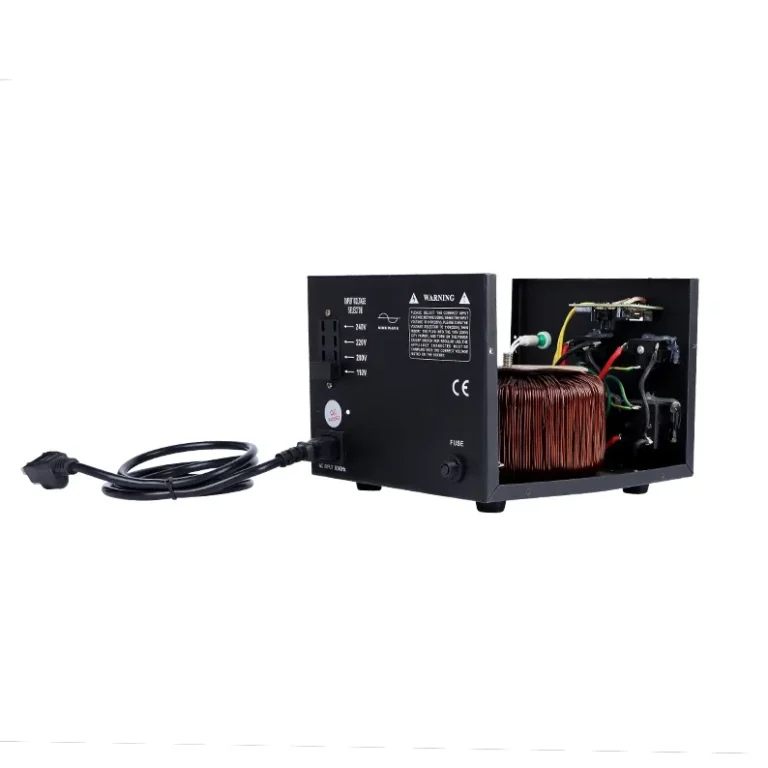
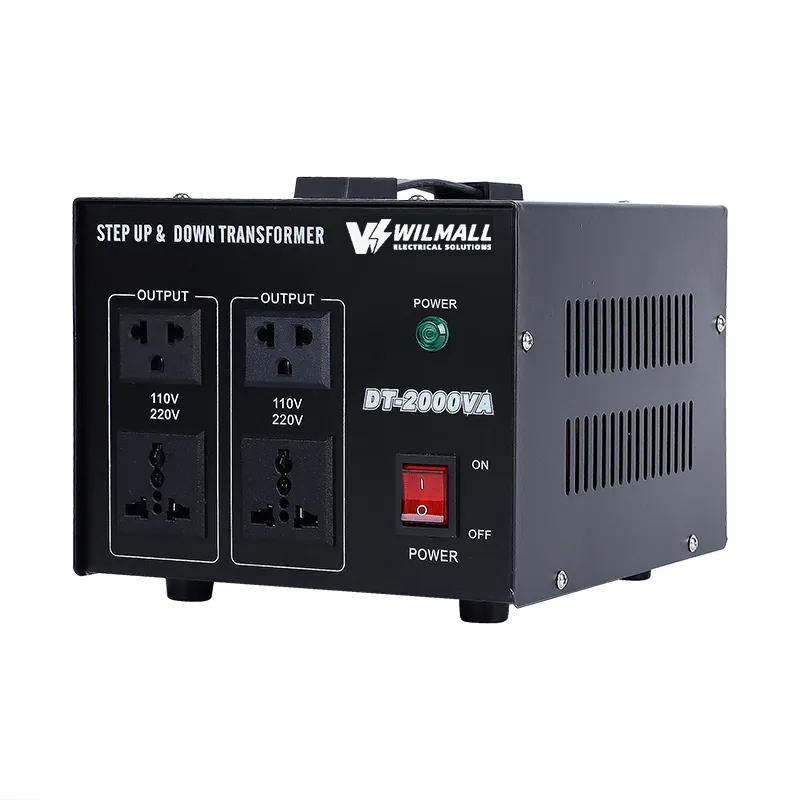
The ST-2000 is our 2000VA step down transformer, 220V to 110V, with RCD protection built in. It suits a single fridge, a television and audio setup, a small kitchen appliance group, a home gym, or an office printer. The RCD is worth having in a building where the earthing may not be perfect, which is a fair description of a good deal of older housing in the region.
The STU-3000 and STU-5000 are the bidirectional high power units, and they carry the loads that matter most in Tunisia: air conditioners, washing machines, water pumps, workshop tools and whole-room distribution. Bidirectional means the same box steps up as well as down, which suits a household that ends up with a mix of 110V and 230V equipment. In practice that describes most of the homes we quote for.
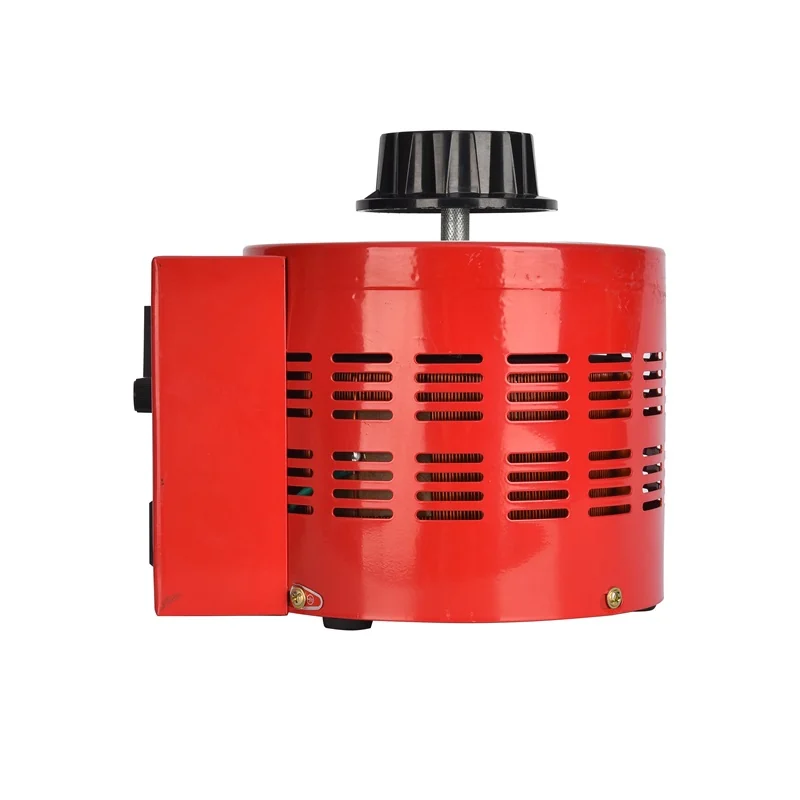
Our DT-1000VA is the bidirectional automatic unit for lighter duties, useful for a shop counter, a small office with a router and CCTV, or a single fixed-input device. The Variac range at 500VA, 1KVA, 2KVA and 3KVA gives you adjustable output voltage. It is not the first thing a household buys, but technicians who service appliances in Tunisia tend to want one, because it lets them bring an unknown machine up slowly instead of feeding it full mains on a day when the mains is misbehaving anyway.
Ordering, Lead Time and Shipping Through Rades
The commercial side is simple. Our MOQ is 10 pieces, so a single household order often means joining with neighbours or holding a small stock, while shops, hotels and contractors order comfortably above the minimum. Production runs 15 to 25 days depending on quantity and customisation, we ship FOB Ningbo or Shanghai, and every unit carries a 12-month warranty.
Most Tunisian shipments we handle come in through Radès, the commercial gateway for Tunis, with Sfax, Sousse and Bizerte used when the buyer is based closer to them. From the Chinese port the routing is yours to control, and most of our Tunisian customers work through a freight forwarder of their own. If you do not have one, say so and we will share the names our other buyers in the region use, but the booking stays in your name so you keep the cost visibility.
On paperwork, expect the usual set: commercial invoice, packing list, bill of lading and a certificate of origin. Tunisia also applies a certificate of conformity regime to a range of regulated electrical imports, so ask your customs broker which regime covers your HS code before the goods leave China rather than after they land. Budget for Tunisian import duty and VAT, currently 19 percent on standard goods, when you work out your landed cost. We can supply the technical documents, test records and declarations you need to support that file.
Customisation for Tunisia usually means plug and socket configuration, output set to 110V or 120V to match your appliance labels, and bilingual Arabic and French labelling on the faceplate where the buyer wants it. If you are a contractor kitting out several buildings, give us the rollout plan and we will stage deliveries around your installation schedule. For more on how other markets in the region are wired, our guide to a Step Down Transformer for Kenya: 240V to 110V Guide covers a 240V picture with its own quirks. To see the full spread of what we build, look through our step up & down transformers range, and there are voltage guides by country on the site covering market after market.
What to Send Us for a Tunisia Quote
Send your appliance list with the watts from each nameplate, a photo of one or two labels if you can take them, whether your supply is mains, rooftop solar or generator, the socket pattern in the building, and how the unit will be used. Mention it if your supply is known to swing, because that changes my recommendation and I would rather know before I quote than after you tell me the output reads 96V.
If the list is half finished, send it anyway. Working out whether a 600W fridge needs more headroom than a 1200W microwave, and by how much, is exactly the sort of question we answer all day. Asking is much cheaper than replacing a compressor.
Tunisia Voltage Questions Buyers Ask Most
These are the messages we get most often from Tunisia, answered the way I would answer them on a call.
What voltage does Tunisia use, and do I need a step down transformer?
Tunisia runs 230V at 50Hz, with 220V still quoted for older buildings and older documents. You need a step down transformer if your appliance has a fixed 110V or 120V input. If the label reads 100-240V, 50/60Hz, it already runs on Tunisian mains with a plug adapter and does not need one.
Which plug and socket types are used in Tunisia?
Tunisia uses the French pattern, which means Type C and Type E sockets. Type E has the earth pin built into the socket rather than the plug. An American NEMA 5-15 plug will not fit any of them, so we build the transformer with the output socket your appliance needs and the input plug your building needs.
Will a step down transformer fix unstable Tunisian voltage?
No, and this one matters. A transformer changes voltage by a fixed ratio, roughly 0.478 for a 230V to 110V build, so 200V in gives about 96V out. If your site really does swing a lot, put a stabiliser or automatic voltage regulator in front of the transformer instead of buying a bigger box and hoping.
What size transformer do I need for a 110V air conditioner in Tunisia?
A compressor is the hardest load in any home, so start at 150 percent of the running watts and round up to the next model. For a 1500W window unit that points to the STU-3000 rather than anything smaller. Frequency matters too, since a 60Hz compressor running on 50Hz turns slower and gets warmer.
How long is production and how do you ship to Tunisia?
MOQ is 10 pieces, production runs 15 to 25 days depending on quantity and customisation, and we ship FOB Ningbo or Shanghai with a 12-month warranty. Most shipments clear through Rades for Tunis, with Sfax, Sousse and Bizerte used depending on where you are based. We supply test records and technical documents for your customs file.
Tell us your appliances and your supply situation, and we will size the unit for Tunisian conditions. Send the watts from your nameplates, whether you are on mains, solar or generator, and which city you are in. We will come back with a recommended model, a quantity and a price, normally the same working day.
Or talk to us directly: WhatsApp +86 197 3022 6757 · Email sales@wilmall.com
MOQ 10 pcs · Lead time 15-25 days · FOB Ningbo or Shanghai · 12-month warranty