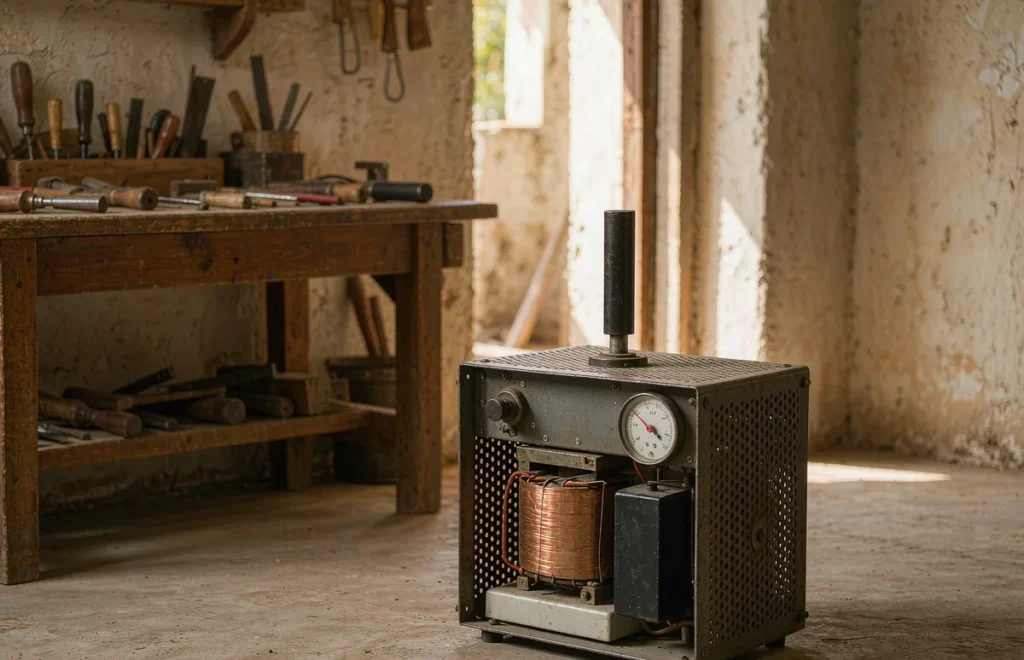
Step Down Transformer for Libya: 230V to 110V Guide
Libya runs on 230V at 50Hz, with Type C and Type L sockets in most buildings. If that were the whole story, choosing a step down transformer for Libya would be a short conversation. It is not the whole story, and any buyer here knows it. Outages are part of daily life, the voltage at the socket can swing a long way from nominal, and a large share of the load in the country right now is either running off a generator or waiting for a supply that comes back at an unpredictable moment.
We make transformers in Yueqing, China, and we ship to Libya through Tripoli, Misrata and Benghazi. Our units are copper wound and 100 percent tested in our own workshop before packing, with the batch test record going into the carton. Most Libyan enquiries we get come with the same opening line: the equipment is imported, it is 110V, and the power here is not friendly. That is exactly the problem we build for.
What the Libyan Supply Actually Does
Nominal voltage is 230V, 50Hz, and you will see 220V printed on plenty of older equipment and building documentation. Both figures sit inside the 220-240V band that most appliances tolerate, so the nominal number is rarely the problem. Behaviour is the problem.
Three patterns show up again and again. First, deep sags. When the grid is loaded heavily or a feeder is long and undersized, the voltage at the socket drops well below nominal, and it can stay low for hours rather than minutes. Second, hard switching. Power returning after an outage does not come back gently. There is a surge as everything on the circuit energises at once, and a transformer with no margin takes that hit on the primary every single time. Third, the generator. When the mains drops out and the generator picks up, you inherit a completely different supply with its own voltage regulation, its own frequency stability and its own earthing arrangement.
That third point deserves attention, because it changes what you should buy. A generator’s output voltage depends on its excitation and its governor, and a small standby set will dip noticeably when a compressor or a pump starts. If your 110V equipment runs off a step down transformer fed by a generator, the transformer is now handling two layers of instability instead of one.
Designing for a Grid That Will Not Sit Still
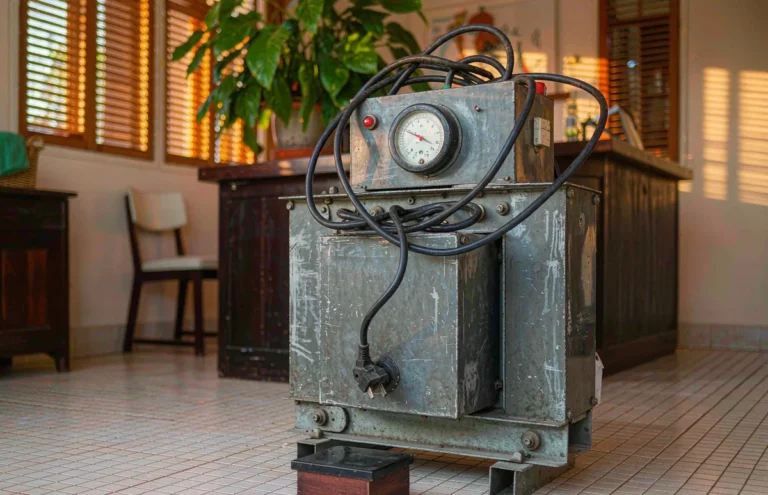
Here is the honest engineering version, without the sales language. A transformer converts by ratio. It multiplies whatever it is given by a fixed factor. Nothing inside it can invent volts that are not on the primary. So the two things we can genuinely do for a Libyan site are give you margin in the design and protect the unit and your equipment from the transients.
Margin means sizing so the unit runs at roughly 70 percent of its rating at your normal load. That gives you three benefits at once. The internal voltage drop across the winding is a smaller proportion of the output, so your 110V holds up better when the input sags. The core and windings run cooler, which matters enormously in a Libyan summer where an unventilated room can sit above 40C. And there is room left for startup surge when a motor kicks in.
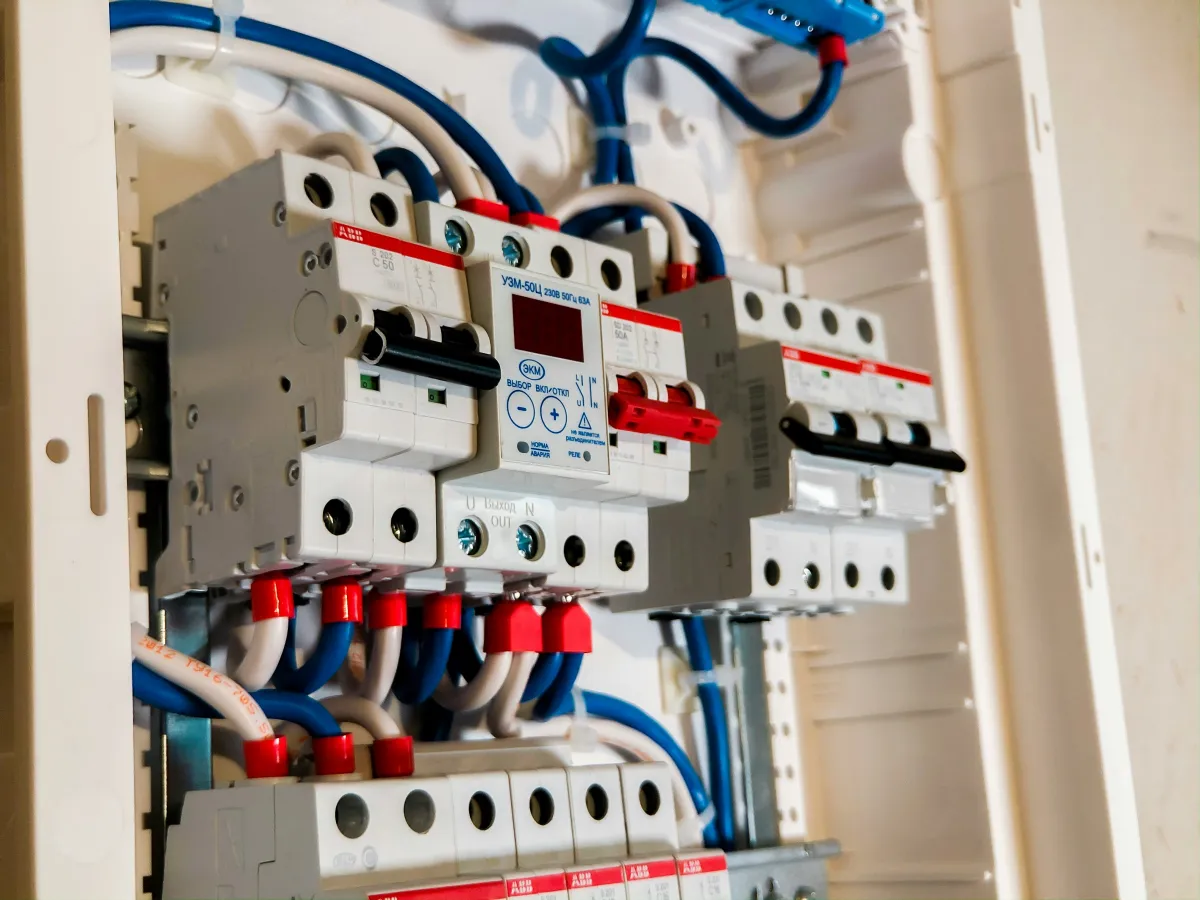
Protection is the second half. Surges arriving on a supply that switches on and off all day will eventually find a weak point, and the cheapest place to deal with them is at the input of the transformer or at the distribution board ahead of it. Metal oxide surge protection, correct earthing and a proper main breaker are the practical measures. If you want surge protection incorporated in the unit itself, tell us your site conditions when you enquire and we will confirm what we can build for the model you need rather than guessing on your behalf.
For the roughest sites, the arrangement I would actually recommend to a friend is three pieces rather than one. A voltage stabiliser or AVR first, so the transformer sees something close to 220-230V. The step down transformer second, doing the 230V to 110V conversion. And your generator or inverter set up to feed the stabiliser, not the equipment directly. It costs more upfront than a single box. It also means your imported equipment is not the thing that absorbs every bad event on the network.
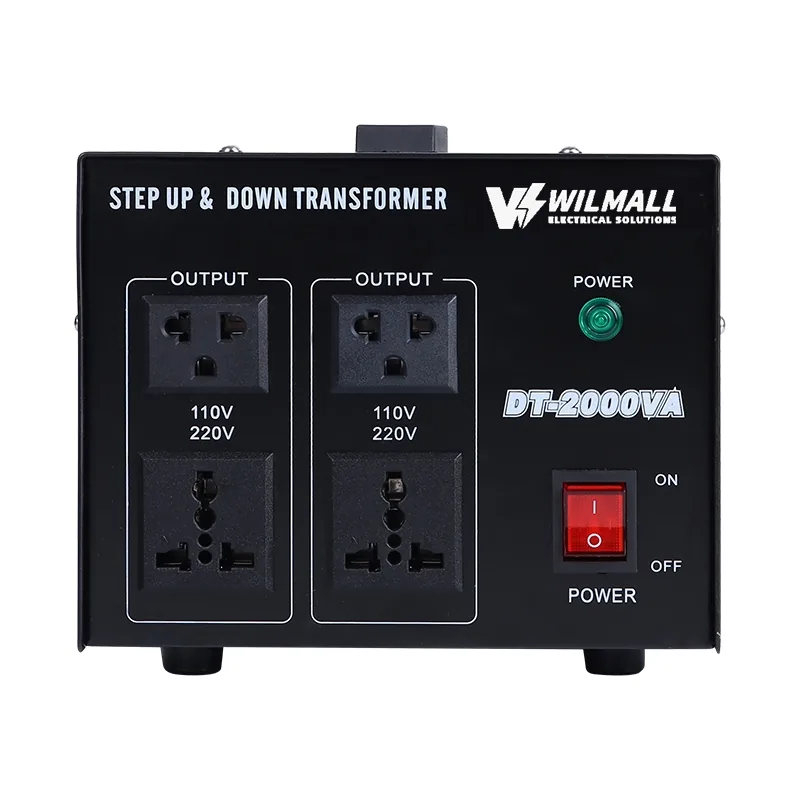
Inverters, Generators and the 50Hz Question
Buyers here ask about inverters a lot, and the answer depends on what kind of inverter you have. A small modified sine wave unit feeding a transformer is a poor match, because the waveform has sharp edges that make the core buzz and run warm, and the effective output sags under load. A pure sine wave inverter is a different story and works much like a mains supply. If you are running 110V equipment off an inverter through a transformer, tell us the inverter type and rating, because that combination is where most of the avoidable failures we hear about come from.
Frequency deserves a plain answer too. A transformer changes voltage. It does not change frequency, and it does not stabilise it either. Libya is 50Hz. North American equipment is usually built for 60Hz. The difference shows up in induction motors, which run about 17 percent slower on 50Hz and warmer because the cooling fan slows down with them. Electronics, including laptops, chargers, most medical devices, monitors and anything with a switched mode supply, could not care less.
There is one more wrinkle when a generator is involved, since small sets sometimes run at a slightly high or low frequency depending on load. A motor that is already turning slowly on 50Hz notices that. If the equipment matters to your work, send us the nameplate and we will tell you what we expect.
Where the Demand Comes From in Libya Right Now
Rebuilding is the shape of the market at the moment, and the equipment orders we see reflect it clearly.
- Construction sites and contractors. Imported 110V power tools, mixers, compactors, bench saws, welding sets, and site lighting fed from temporary distribution boards.
- Workshops and garages. Compressors, tyre machines, lifts, diagnostic equipment and bench tools, mostly American or dual-rated units.
- Commercial kitchens and bakeries. Mixers, dough sheeters, slicers, grinders, freezers and imported coffee equipment, often a whole kitchen fitted out from one container.
- Hotels and guesthouses. Room air conditioners, mini-fridges, laundry machines and hair dryers, installed floor by floor as rooms are refurbished.
- Clinics, labs and pharmacies. Sterilisers, centrifuges, suction units, examination lighting and monitoring gear that must not drop out mid-procedure.
- Shops and offices. Display freezers, POS hardware, servers and network cabinets, plus the imported appliance stock that retailers resell.
- Households and farms. Kitchen appliances, grooming kit, CPAP machines, and water pumps on boreholes where the supply is at its worst.
Do the label check before you place an order, because it is where Libyan buyers save the most money. A very large share of modern electronics carry a 100-240V, 50/60Hz rating and will run straight off your 230V socket with a plug adapter. Divide your list into dual voltage and 110V only before you talk to a supplier, and your order gets smaller, your shipping volume drops and your customs charge follows it down.
Sizing Table by Site Type
Add up everything that can run at the same moment, apply 25 to 30 percent headroom, then go one size up if the site is on a generator or includes a compressor. That last step is not padding. In Libya it is the difference between a unit that lasts and a unit that comes back.
| Typical Libyan site | 110V load that can overlap | Realistic peak | Headroom applied | Unit we usually suggest |
|---|---|---|---|---|
| Home or small shop | Fridge, TV, small appliances | Around 1500 W | 25 percent | ST-2000 with RCD |
| Household on a generator | Fridge, pump, kitchen kit | 2000 – 3000 W | 30 percent plus surge | STU-5000 |
| Commercial kitchen or bakery | Mixer, sheeter, freezer, grinder | 3500 – 6000 W | 30 percent plus motor surge | STU-5000, one per equipment group |
| Workshop or garage | Compressor, lift, bench tools | 4000 – 6000 W | 30 percent plus surge | STU-5000 |
| Clinic or lab | Steriliser, centrifuge, lighting | 2500 – 4000 W | 30 percent, split circuits | STU-3000 or STU-5000 per room group |
| Hotel floor under refurbishment | AC units, fridges, dryers | 3000 – 5000 W | 30 percent | One unit per floor, not one per building |
| Instrument bench | Adjustable test supply | Up to 3000 VA | Continuous duty | Variac 3KVA |
The Units We Build, and Why We Quote Them
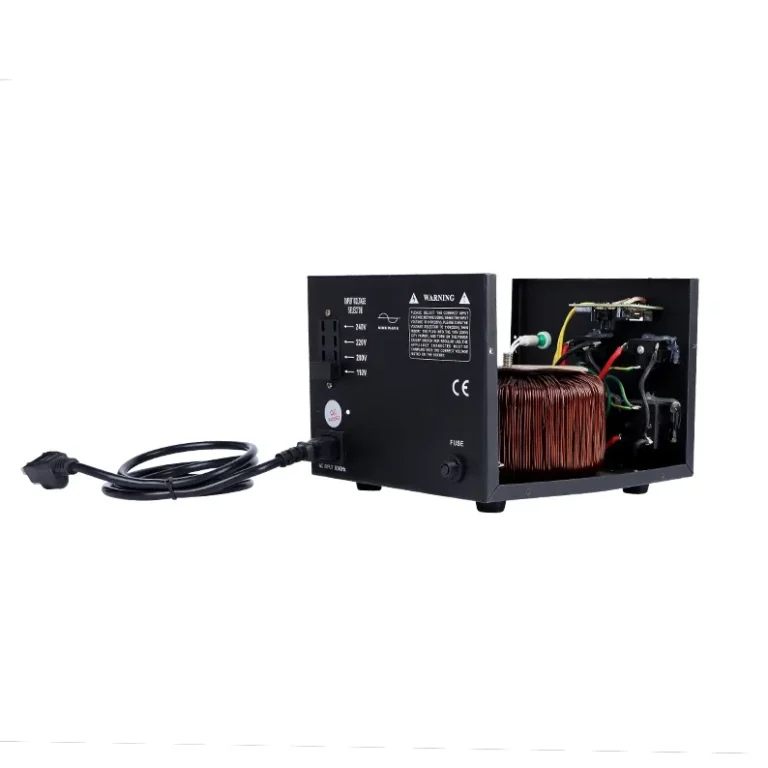
We are a factory, not a trading house, so I can tell you what actually comes off our line. The ST-2000 is a 2000VA step down transformer, 230V in and 110V out, with RCD protection built in. For a household, a small shop or a single clinic room it is the unit I quote most often, and the RCD is the part I care about. Imported 110V appliances on tiled floors, plugged into circuits of uncertain quality, next to water, in a country where the earth connection is sometimes a theory rather than a fact. A local trip beats a shock.
Above that the STU series takes over. STU-3000 and STU-5000 are bidirectional, stepping up as well as down, and they carry the heavier side of the work: kitchen loads, workshop machines, compressors, welders and clinic groups. Bidirectional is more useful here than people expect, because Libyan sites often run both 110V imports and 230V local equipment, and one box that handles either direction saves buying twice.
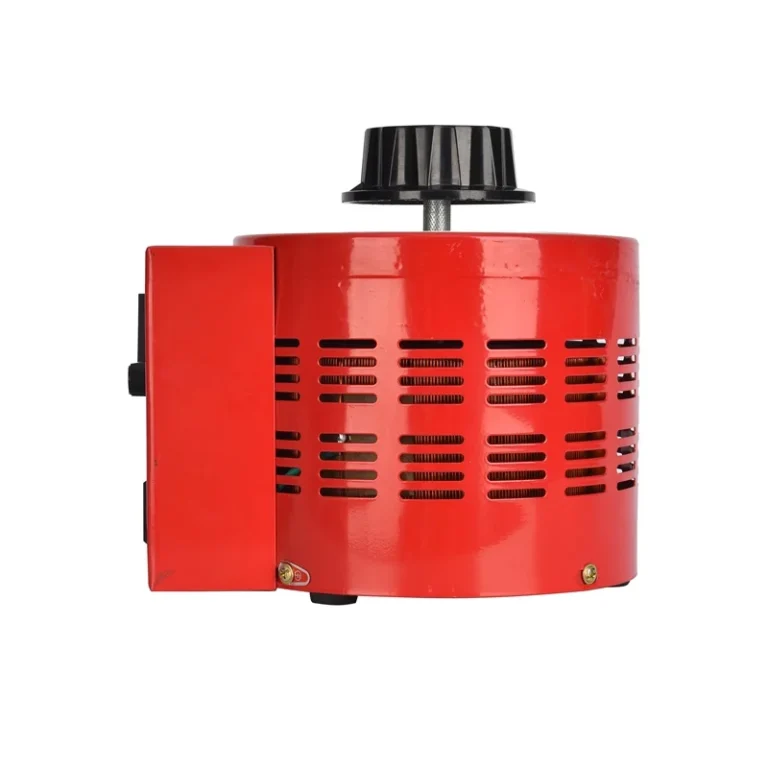
The DT-1000VA is our smaller bidirectional automatic unit, suited to a home office, a single workbench or a remote station where a modest load has to work in either direction without anyone thinking about it. The Variac range, at 500VA, 1KVA, 2KVA and 3KVA, gives you adjustable output on a dial. Technicians here use them to check how an imported machine behaves at 105V or 115V, and to commission equipment on a supply that refuses to hold its voltage.
Plugs, Sockets and Not Relying on Adapters
Type C, the thin round two-pin, and Type L, the Italian-style three-pin in a line, are what you will meet in Libya. A transformer changes voltage, not plug shape, so your unit needs an input side matching your wall and an output side matching your appliance. Tell us at the time of order and we build it that way, which costs nothing then and saves a drawer of adapters afterwards.
Those adapters are a genuine hazard rather than an inconvenience. A lightweight travel adapter rated for 6A behind a 2000W appliance will get warm, and warmth is how they fail. Where the current is serious, use a proper plug and socket, or a short fixed lead. If you are installing several units, have an electrician wire them as real circuits with proper earthing, not daisy-chained off one socket.
MOQ, Lead Time and Payment for Libyan Orders
The commercial side, since Libyan buyers ask it early. Minimum order is 10 pieces, which works for a distributor loading a container and equally for a contractor or a hotel group buying a batch. Production takes 15 to 25 days depending on quantity and whether you need custom labelling. We ship FOB Ningbo or Shanghai, and every unit carries a 12-month warranty.
On payment, I will be practical rather than clever. Most Libyan importers we work with route payment through banks outside the country, and the usual structure is a 30 percent deposit to start production with the balance settled before shipment or against a copy of the bill of lading. A documentary credit can work, and it is the safer instrument when the order is large or the two sides are new to each other, but it needs a bank on both ends willing to handle Libya and it adds time. For a first order of ten or twenty units, most buyers here find the deposit arrangement simpler. Tell us your preferred route when you enquire and we will work with it, and please start the banking process before the container is due to leave rather than the week it sails.
Shipping to Tripoli, Misrata or Benghazi
Libyan imports usually land at Tripoli, Misrata or Benghazi, and depending on the sailing the cargo may be transhipped through a Mediterranean hub before it reaches you. Nominate the port in your order and we will prepare documents to match. Two things worth planning around. First, berth and clearance times can move, so build a little slack into your schedule and keep demurrage in mind, because storage at the port is where budgets quietly disappear. Second, arrange marine insurance, particularly for a route with a transhipment leg.
Every shipment leaves with a commercial invoice, a packing list and a bill of lading, and we can supply a certificate of origin. Your broker may also want documents attested or legalised, and he will know the current requirement better than we can from China. Send us his list before we issue the invoice and we will match the description and the declared values exactly. A mismatch between invoice and packing list is the most common reason a container sits.
One more thing that costs nothing. Ask for the batch test record with your shipment. It lists input voltage, output voltage under load and no-load current for the batch your units came from, and it is real paperwork from a real test bench rather than a template. Every unit we build is tested here in Yueqing, and we wind with copper rather than aluminium because at the same rating aluminium runs hotter, and hot is the last thing you want on a grid like this one.
What to Send Us for a Quote
You do not need a finished specification. Send the equipment list with watts or amps off each nameplate, a photo of one nameplate if that is easier, your city so we can judge how rough the supply tends to be, the socket type at your wall, whether the site runs on a generator or inverter and what type, whether the load includes a motor or a compressor, your quantity, and your port. From that we can size the unit and give you a window, usually the same working day.
Two pages on our site are worth a look while you compile that. Conditions in Libya are not unique in the region, and our Voltage Converter for Egypt: 220V to 110V Guide deals with a very similar set of supply problems next door. If you are still working out whether you need to step down, step up, or both, our page on step up & down transformers sets it out in plain language. There is also a set of voltage guides by country covering sockets, grid habits and port options market by market.
If you are unsure, send the list anyway. Sizing a step down transformer for Libya is routine work for us, and ten minutes of messages beats importing the wrong capacity into a country where returning it is not realistic.
Libya Transformer Questions Buyers Ask Most
These are the questions that land in our inbox every week, answered the way I would answer them on a call.
What size step down transformer do I need in Libya for 110V equipment?
Add up the appliances that can run at the same time, add 25 to 30 percent headroom, then go one size up if the site runs on a generator or the load includes a compressor. A household on standby power with a fridge, a pump and kitchen kit lands near 3000W, and an STU-5000 covers it with margin to spare.
Can I run a step down transformer from a generator or an inverter?
Yes, with two conditions. Use a pure sine wave inverter or a generator with stable excitation, and size the transformer with extra margin, because generator output dips when a motor starts. Modified sine wave inverters make the transformer core buzz and run warm, so tell us your inverter type before you order.
Which plug types are used in Libya and how should I specify them?
Libya uses Type C, the thin round two-pin, and Type L, the Italian-style three-pin in a row. A transformer changes voltage, not plug shape, so tell us your wall socket type and your appliance plug when you order. We build the input and output sides to match, which is far safer than stacking travel adapters.
How do payments usually work for transformer orders shipped to Libya?
Most Libyan importers we work with route payment through banks outside the country. The common structure is 30 percent deposit to start production, with the balance before shipment or against a copy of the bill of lading. A documentary credit suits larger first orders, but it needs banks at both ends set up for the trade and it adds time.
Which ports do you ship to in Libya and what happens with customs?
Cargo usually lands at Tripoli, Misrata or Benghazi, sometimes with transhipment through a Mediterranean hub. Every shipment includes a commercial invoice, packing list and bill of lading, and we can add a certificate of origin. Your broker may need attestation, so send us his document list before we issue the invoice.
Send us your equipment list and we will size it for you. Tell us what 110V equipment you run, which city you are in, whether you run on mains, generator or inverter, and your quantity. We will come back with a recommended unit, a quantity and a price, normally the same working day.
Or talk to us directly: WhatsApp +86 197 3022 6757 · Email sales@wilmall.com
MOQ 10 pcs · Lead time 15-25 days · FOB Ningbo or Shanghai · 12-month warranty