Step Down Transformer for Iraq: 230V to 110V Guide
If you are looking for a step down transformer for Iraq, there is one thing to understand before you look at any model number. Iraq runs on 230V at 50Hz, and the supply you actually receive at the socket is often nothing like 230V. On a good day it is close. In summer, on a bad feeder, or on private generator power, it can be anywhere from the high 180s to the high 250s, and it can move while your appliance is running.
I work at a transformer factory in Yueqing, China, and we ship into Iraq and the wider region regularly. The orders come from households who brought 110V appliances with them, from shop owners running imported display equipment, and from offices with US-spec IT hardware. The engineering question is always the same, and it is not just “which size do I buy”. It is “which size do I buy so that it still works on the worst night of the year”.
Iraq’s Power Reality: 230V Mains, Generators and Wide Voltage Swings
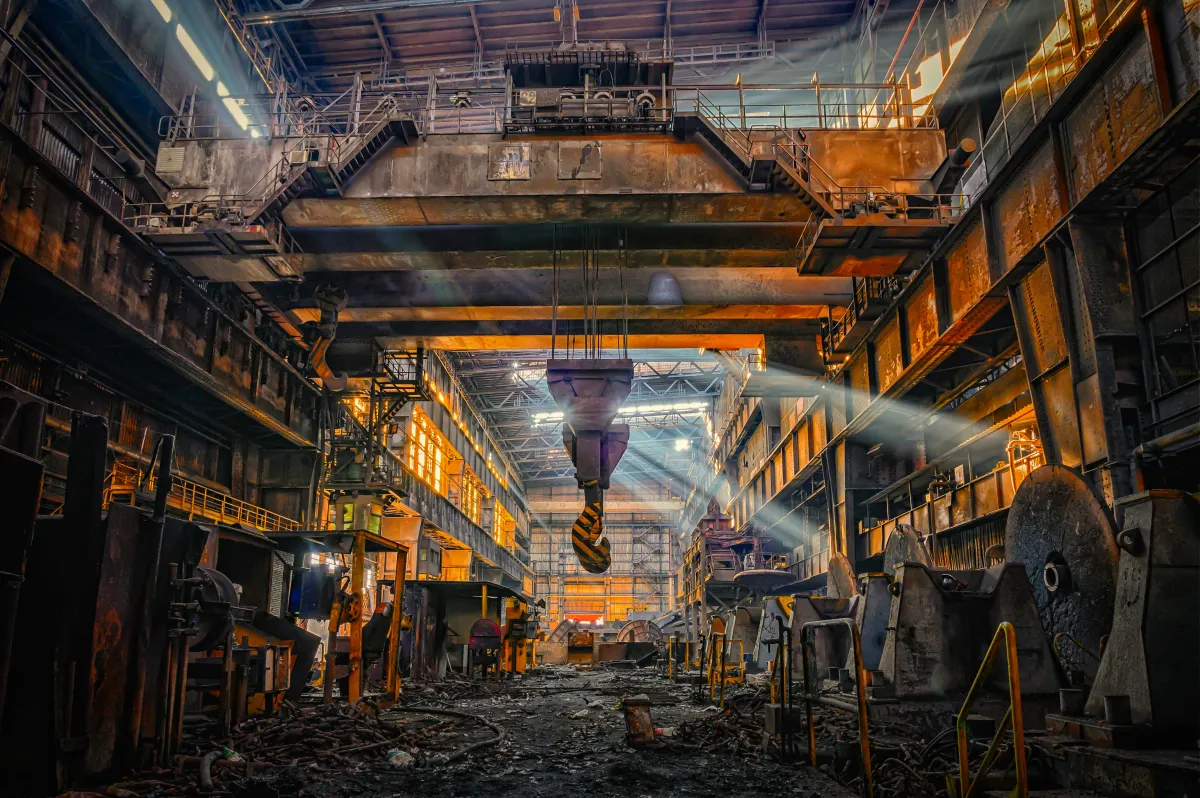
Start with the standard. Iraq uses 230V at 50Hz as its nominal supply, with 220V still showing up in older descriptions and older buildings. Plugs are mostly the British Type G pattern in many installations, with Type C and Type F sockets also common depending on when and where the building was wired. Nothing about that is unusual. What is unusual is the stability of the supply.
Most Iraqi homes and businesses have two sources. There is the public feeder, which in many districts runs with scheduled interruptions, and there is a private neighbourhood generator that fills the gaps. Both sources are real, both are used daily, and they do not behave the same way. A generator that is loaded heavily will sag. When a large load next door starts up, your voltage dips. Over a summer afternoon with air conditioning running everywhere, the swings get wider and more frequent.
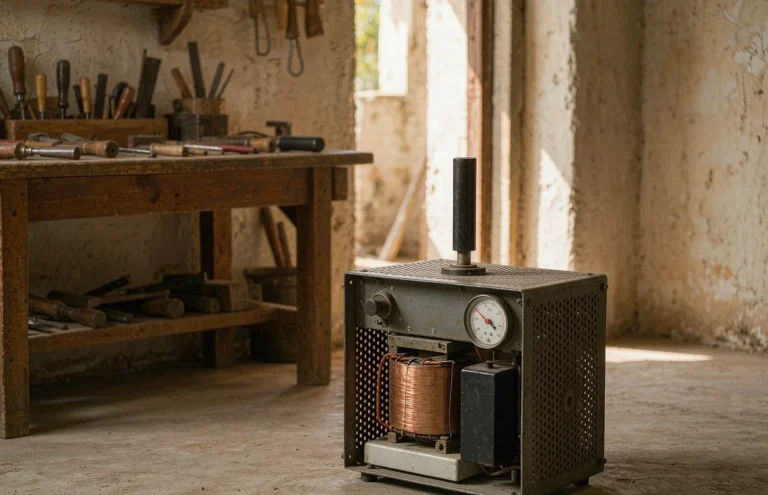
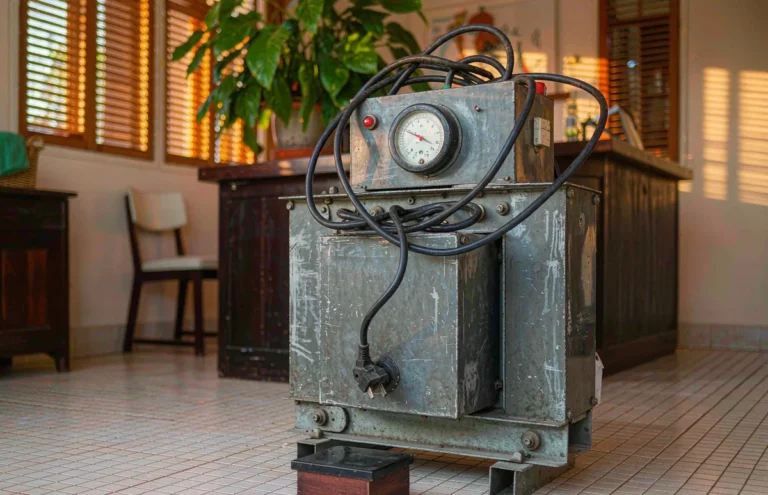
This is the part I want you to sit with. A transformer changes voltage. It does not hold voltage steady. If your wall is sitting at 205V instead of 230V, a step down transformer rated 230V to 110V will hand you roughly 98V rather than 110V. If your wall spikes to 255V, the output goes to about 122V. The transformer is doing its job perfectly in both cases. The number at the output is just the input multiplied by the turns ratio, which is around 0.478 for a 230V to 110V design.
That matters because the appliances at the other end notice. Motors run warmer on low voltage and draw more current. Electronics with a narrow input window can drop out. If your site has a genuine voltage stability problem, the correct answer is a transformer plus a stabiliser or automatic voltage regulator in front of it, and I would rather tell you that than sell you a box that disappoints you.
What Actually Needs a Step Down Transformer in Iraq
When buyers message us, the list usually contains a mix of things, and some of them do not belong on it. Here is the split I would make.
- Kitchen appliances from the US market, stand mixers, blenders, toasters, coffee machines, air fryers, typically 800W to 1800W and mostly resistive.
- Refrigerators and freezers on a 110V specification, 150W to 600W running, with a compressor that starts hard.
- Washing machines and dryers built for the North American market, 500W to 2000W, and the drier is usually the heavier of the two.
- Air conditioners or window units on 110V, 1000W to 2500W, compressor driven and the hardest load in a household.
- Televisions, sound systems and set top boxes rated 110V only, 50W to 300W. Many modern sets are dual voltage, so check the label first.
- Water pumps and booster sets, 300W to 1500W, motor loads, common in buildings where rooftop tanks feed upper floors.
- Power tools and workshop equipment, 500W to 2000W, used intermittently and often on generator power.
- Office and shop equipment, US-spec printers, POS terminals, display chillers and medical or dental machines.
And here is the honest other half. Laptops, phone chargers, most monitors, many modern TVs, camera chargers and a lot of small electronics carry a 100-240V, 50/60Hz rating on the label. Those run on Iraqi mains with nothing more than a plug adapter, and adding them to a transformer only eats capacity you need for the compressor. Read the nameplate. It takes thirty seconds and it can change the size you buy.
Sizing a Step Down Transformer for Unstable Iraqi Supply
My advice for Iraq specifically is to size one step bigger than you would in a market with stable power. There are two reasons, and both of them are practical.
First, when input voltage sags, a transformer running at or near its rating behaves worse. The same load current at a lower input voltage means higher current on the primary side, and more heat in the winding. Giving yourself headroom keeps the unit out of that stressed zone on the days when the feeder is struggling. Second, most households in Iraq run more equipment than they originally planned. A transformer sized exactly for today’s load is a transformer you will replace next year.
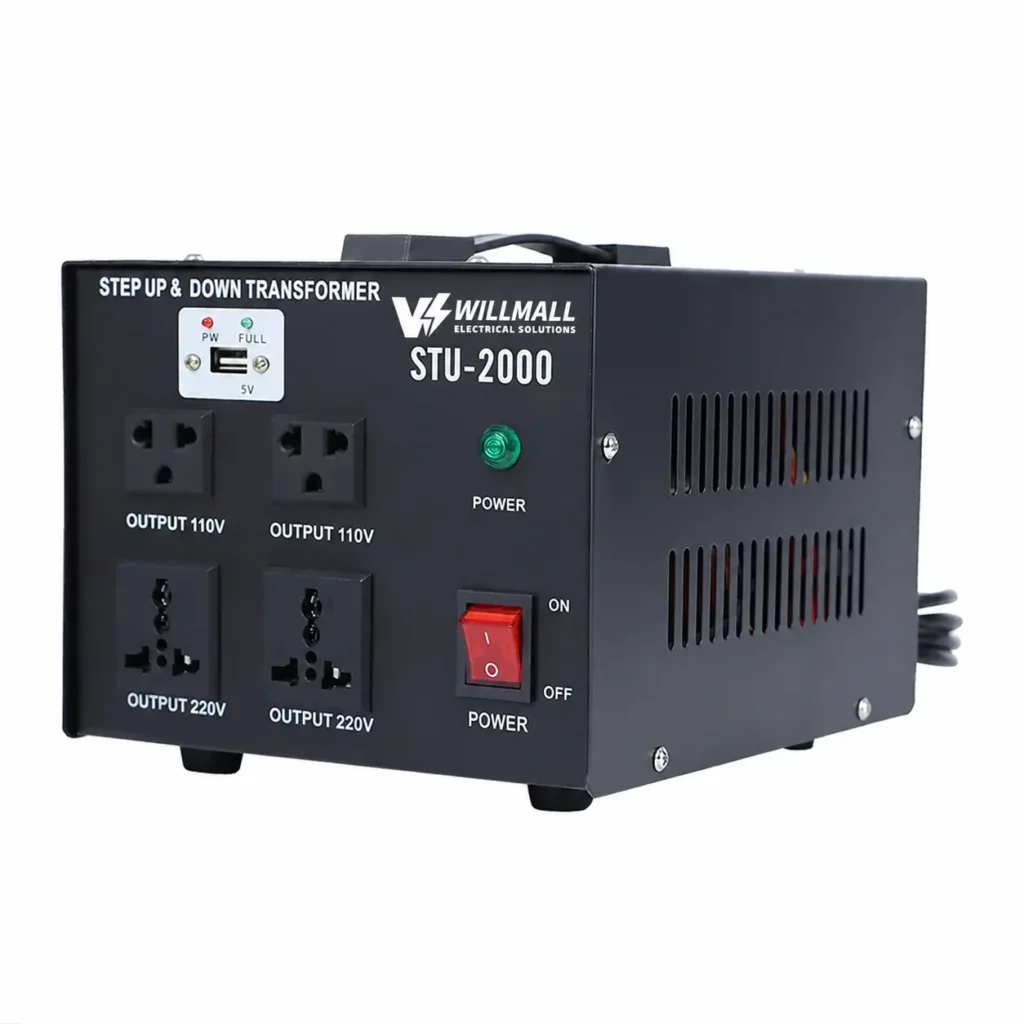
Worked example. A household with a 110V refrigerator at 400W running, a 1200W microwave, a 900W kettle and a 150W entertainment setup. Nobody runs all of it at once, but the microwave and the kettle can overlap in the evening, so call it 2100W of resistive load plus the fridge compressor. Apply 40 percent headroom rather than the 25 percent I would suggest in a stable market, and you are asking for something around 3000VA. That is where the STU-3000 comes in, and because it is bidirectional it also covers the day you buy a 230V appliance and want to run it from a 110V supply, which happens more often than you would think in mixed households.
| Typical Iraqi load | Running watts | Load type | Suggested unit |
|---|---|---|---|
| Fridge or freezer, 110V spec | 150 – 600 W | Compressor motor | ST-2000 |
| Microwave and small kitchen appliances | 900 – 1800 W | Resistive, high inrush | ST-2000 or STU-3000 |
| Washing machine or dryer | 500 – 2000 W | Motor plus heater | STU-3000 |
| Window or split air conditioner | 1000 – 2500 W | Compressor, heavy start | STU-3000 or STU-5000 |
| Water pump or booster set | 300 – 1500 W | Induction motor | STU-3000 |
| TV, audio and small electronics | 50 – 300 W | Electronic | DT-1000VA or ST-2000 |
| Office printer or POS station | 200 – 1500 W | Mixed | ST-2000 |
If you are not sure what your appliances add up to, send me the list. That is genuinely the fastest way through this, and it costs nothing.
Generator Supply: Frequency Drift and What It Does
Neighbourhood generator power is a fact of daily life in much of Iraq, and it introduces a problem that mains power does not. A generator’s output frequency depends on its engine speed. When the engine is loaded down, frequency drops below 50Hz. When it is lightly loaded, it can rise above it.
Your transformer passes that frequency straight through, same as it passes voltage. So on generator power, an appliance may be seeing a supply that wanders between something like 47Hz and 53Hz. Resistive appliances, heaters, kettles, irons, do not care in the slightest. Items with motors will run slightly faster or slower and will draw different current. Sensitive electronics can behave oddly, and a cheap motorised clock will not keep time.
There is nothing a transformer can do about any of that, and anyone who tells you otherwise is selling you something. What you can do is make sure the transformer is generously sized so it is not the weak link on top of an already imperfect supply, and keep sensitive equipment off generator power where you can. If you run a shop or an office, put the equipment that must not glitch, tills, servers, medical devices, on the mains side or behind a proper UPS.
Plugs, Sockets and the Cable You Will Need
Iraq uses a mix of socket patterns, with British Type G widespread alongside Type C and Type F. Your imported appliance will very likely have a North American NEMA 5-15 plug on it, which fits nothing on the wall. So the practical wiring looks like this. The transformer takes your 230V supply on its input side with an Iraqi plug fitted, and provides 110V output at a socket your appliance can use.
Tell us at the quotation stage which socket you want on the output and which plug you want on the input, and we will build it that way. That is a normal request for us, not a special project, and it saves you buying a bag of adapters that end up half-inserted in a wall socket and warm to the touch. Which brings me to the one safety point I will repeat: do not run several extension leads off one transformer so that three rooms can share it. In a market where the supply is already wobbling, adding an overload on top is how equipment gets destroyed.
Summer Heat: Derating Matters More Than You Think
An Iraqi summer is not a normal operating environment for electrical equipment. When the ambient temperature in a room is already over 45 degrees Celsius, a transformer that was comfortable at 25 degrees is running much hotter, and its usable capacity drops. This is not a marketing point, it is how insulation classes work.
Two habits help. Mount the unit where air moves, not in a closed cupboard, and keep it off the floor and out of direct sun. If it must live in an unconditioned room, buy the next size up so it is running at maybe half its rating rather than three quarters. We wind with copper, not aluminium, and that choice matters more in a hot climate than in a mild one, because aluminium windings run hotter at the same rating and hot insulation is what ends a transformer’s life.
Every unit we build is 100 percent tested in our own factory here in Yueqing and ships with a batch test record showing input voltage, output voltage under load and no-load current. If a unit ever gives you trouble, that record is the first thing we will ask for, because it tells us whether the problem is the transformer or the supply feeding it.
The Models We Ship to Iraq
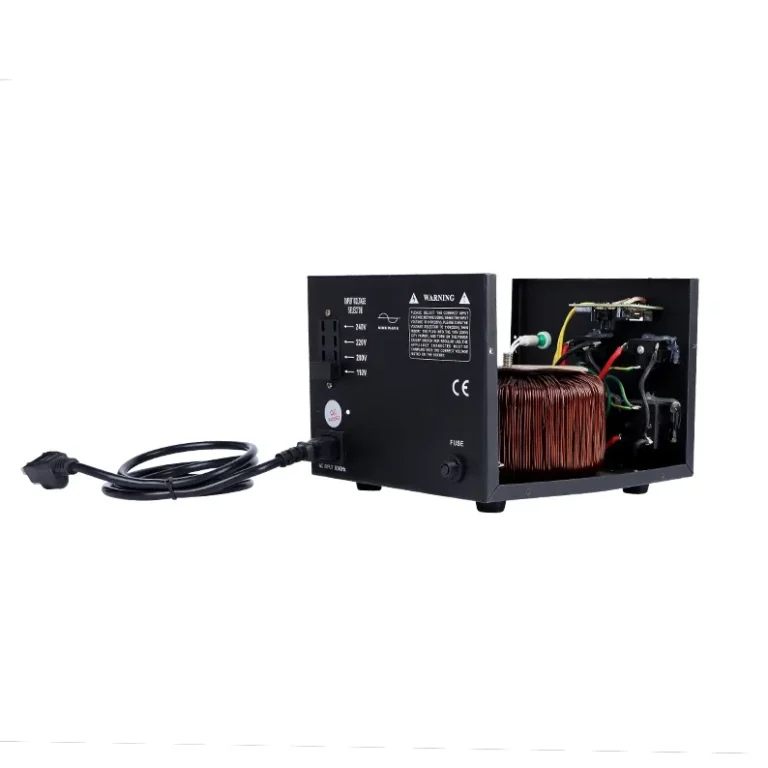
The ST-2000 is our 2000VA step down transformer, 220V to 110V, with RCD protection built in. It suits a single fridge, a television setup, a small kitchen appliance group or an office printer. The RCD is worth having in a building where the earthing may not be perfect, which is a fair description of a lot of older housing stock.
The STU-3000 and STU-5000 are the bidirectional high power units, and they carry the loads that matter most in Iraq: air conditioners, washing machines, water pumps, workshop tools and whole-room distribution. Bidirectional capability means the same box steps up as well as down, which suits a household that ends up with a mixture of 110V and 230V equipment, and that description covers most households we quote for.
Our DT-1000VA is the bidirectional automatic unit for smaller duties, useful for a service counter, a small shop, a router and CCTV setup or a single fixed-input device. And the Variac range at 500VA, 1KVA, 2KVA and 3KVA gives you adjustable output voltage. That last one is not the first thing people buy, but technicians who service appliances in the region tend to want one, because it lets them bring an unknown machine up slowly rather than feeding it full mains on a day when the mains is misbehaving anyway.
Ordering, Lead Time and Shipping to Iraq
The commercial side is straightforward. Our MOQ is 10 pieces, so a household order usually means joining with neighbours or ordering a small stock, while shops and contractors order comfortably above the minimum. Production runs 15 to 25 days depending on quantity and customisation. We ship FOB Ningbo or Shanghai, and every unit carries a 12-month warranty.
From the Chinese port, the shipment is yours to route, and most of our Iraqi customers use a freight forwarder through Umm Qasr or via a regional hub and then inland to Baghdad, Basra, Erbil or Mosul. If you do not have a forwarder, tell us and we will share the details of the ones our other buyers in the region use, though the booking stays in your name so you keep control of the costs.
Customisation for Iraq usually means plug and socket configuration, output set to 110V or 120V to match your appliance labels, and Arabic or bilingual labelling on the faceplate where the buyer wants it. Give us the rollout plan if you are a contractor kitting out multiple buildings and we will stage the deliveries around your installation schedule.
There is one more thing worth reading if you are working out how the wider region is wired. Our guide to a Voltage Converter for Egypt: 220V to 110V Guide covers a neighbouring market with a similar 220V to 230V picture and its own supply quirks. To see the full spread of what we build, look at our step down transformer range, and there are more buying guides on the site covering country by country requirements across the region.

What to Send Us for an Iraq Quote
Send your appliance list with the watts from each nameplate, a photo of one or two labels if you can take them, your supply voltage and whether it is mains, generator or both, the socket pattern in the building, and how the unit will be used. Mention it if your supply is known to swing, because that changes my recommendation and I would rather know before I quote than after you tell me the output reads 98V.
If the list is half finished, send it anyway. Working out whether a 600W fridge needs a bigger transformer than a 1200W microwave, and by how much, is exactly the kind of question we answer all day, and it is much cheaper to ask than to replace a burnt-out compressor.
Iraq Voltage Questions Buyers Ask Most
These are the messages we get most often from Iraq, answered the way I would answer them on a call.
What voltage does Iraq use, and do I need a step down transformer?
Iraq runs 230V at 50Hz, with 220V still referenced in older buildings. You need a step down transformer if your appliance has a fixed 110V or 120V input. If the label reads 100-240V, 50/60Hz, it already works on Iraqi mains with a plug adapter and does not need a transformer at all.
Will a step down transformer stabilise unstable Iraqi mains voltage?
No, and this is important. A transformer changes voltage by a fixed ratio, it does not regulate it. If your wall sits at 205V instead of 230V, your output drops to roughly 98V. If your site has a real stability problem, you need a stabiliser or automatic voltage regulator as well as the transformer.
What size step down transformer should I buy in Iraq?
Size one step larger than you would in a market with stable power. Sagging input voltage makes a fully loaded transformer run hotter, and most households add appliances later. As a rough example, a fridge plus microwave plus kettle plus entertainment setup lands around 2100W, and with 40 percent headroom that points to a 3000VA unit.
Can I run a 110V air conditioner on Iraqi generator power?
You can, but a compressor is the hardest load in a household, so size generously, at least 150 percent of running watts. Generator frequency also drifts with engine load, and a transformer passes that straight through. Keep sensitive electronics off generator power and put anything that must not glitch behind a proper UPS.
Do you supply transformers with Iraqi plug and socket configurations?
Yes. Tell us which socket you want on the 110V output and which plug you want on the 230V input, and we will build it that way. We can also set the output to 110V or 120V and add bilingual labelling. MOQ is 10 pieces, lead time 15 to 25 days, shipped FOB Ningbo or Shanghai.
Tell us your appliances and your supply situation, and we will size the unit for Iraq conditions. Send the watts from your nameplates, whether you are on mains, generator or both, and which city you are in. We will come back with a recommended unit, a quantity and a price, normally the same working day.
Or talk to us directly: WhatsApp +86 197 3022 6757 · Email sales@wilmall.com
MOQ 10 pcs · Lead time 15-25 days · FOB Ningbo or Shanghai · 12-month warranty