Step Down Transformer for Angola: 220V to 110V Guide
Angola runs on 220V at 50Hz, sockets are the European two-round-pin pattern, and the country’s oil economy means there is a steady flow of American, Brazilian and Asian professionals arriving with US appliances that expect 120V. If that is you, or you are sending equipment to a client in Luanda, the step down transformer you need is a 220V to 110V or 220V to 120V unit, and this guide covers the details that decide whether it works first time.
Angolan Mains: Voltage, Frequency and Supply Quality
Angola follows the Portuguese electrical legacy: nominal 220V, 50Hz, with Type C (two round pins) and increasingly Type F (Schuko) sockets in newer buildings. The state utility END E.P. runs the grid, and in central Luanda the supply is reasonably stable, while outside the capital, and in some Luanda neighbourhoods during the rainy season, brownouts and outages are part of normal life.
That supply quality matters for your transformer choice in a specific way. A step down transformer is a ratio device: feed it 180V and it outputs proportionally less than its rated 120V. So for a US appliance in Angola, we recommend the same layered setup we sell to other African markets: a voltage stabilizer on the input if your area dips, then the step down transformer, then a surge-protected strip on the output for electronics.
Frequency is 50Hz. US appliances with heating elements and switch-mode power supplies run fine on it. Appliances with induction motors, like a US refrigerator or a blender with a heavy motor, run roughly 17% slower on 50Hz than on 60Hz, and some labels say “60Hz only”. Read the label before you buy a transformer for a motor appliance; if it accepts 50/60Hz you are fine.
What Needs a Transformer in an Angolan Expat Household
Sort your shipment into three piles before ordering anything, because about half of what people bring actually runs without a transformer.
- Runs directly: Phone, laptop and tool chargers marked “100-240V”. These only need a plug adapter for the round-pin socket.
- Needs a 220V to 110/120V transformer: US hair dryers, curling irons, electric razors (check), blenders, coffee machines, microwaves, TVs, sound bars, gaming consoles that are not universal input, robot vacuums, CPAP machines and other medical devices that are 120V-only.
- Buyer beware: US refrigerators, freezers, washing machines and window air conditioners. They work, but they need honest sizing for the compressor surge, and they are the items most likely to arrive under-transformed.
For medical equipment like CPAP machines we strongly recommend an isolation transformer rather than an autotransformer, because it separates the output from the mains ground and gives a cleaner supply. If the equipment is for a clinic, the whole installation should be sized by a professional; we supply the transformers, but a local electrician should do the wiring.
Sizing a Step Down Transformer for Luanda
Use the standard factory rule, then round up generously because of the supply quality:
- Heating and electronics: running watts × 1.25.
- Motors and compressors: running watts × 2 minimum, and check starting current on the nameplate if it is shown.
- Add the VA of everything you will run at the same time, then buy one size up.
| Equipment | Typical Load | Recommended Unit (220V to 120V) |
|---|---|---|
| TV + decoder + console | ~600W | 1000VA |
| US hair dryer | ~1875W | 2000VA |
| Microwave + kettle | ~1800W | 2000VA |
| US refrigerator | ~700W run, ~2100W surge | 3000VA |
| Freezer + refrigerator combined | ~1500W run | 5000VA |
| CPAP or medical device | ~100W | 500VA isolation transformer |
If in doubt, send the factory your appliance list and we will give you the exact VA, no obligation. Most mistakes come from buying on a guess, and a return shipment to China costs more than the transformer.
What We Build Into an Angola Export Unit
Angola runs hot, and transformers hate heat more than anything else. Every unit we ship there is built with the export treatment:
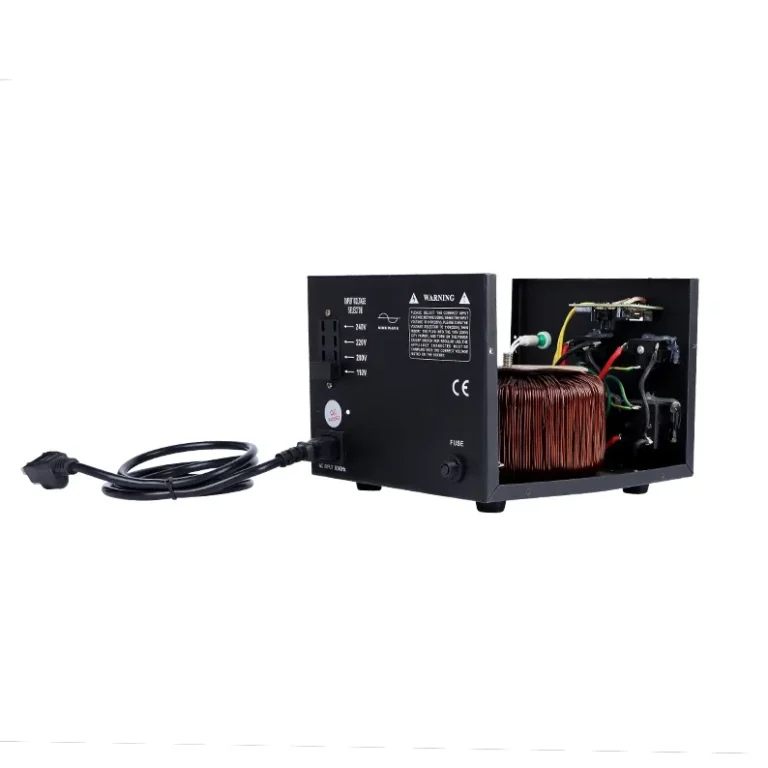
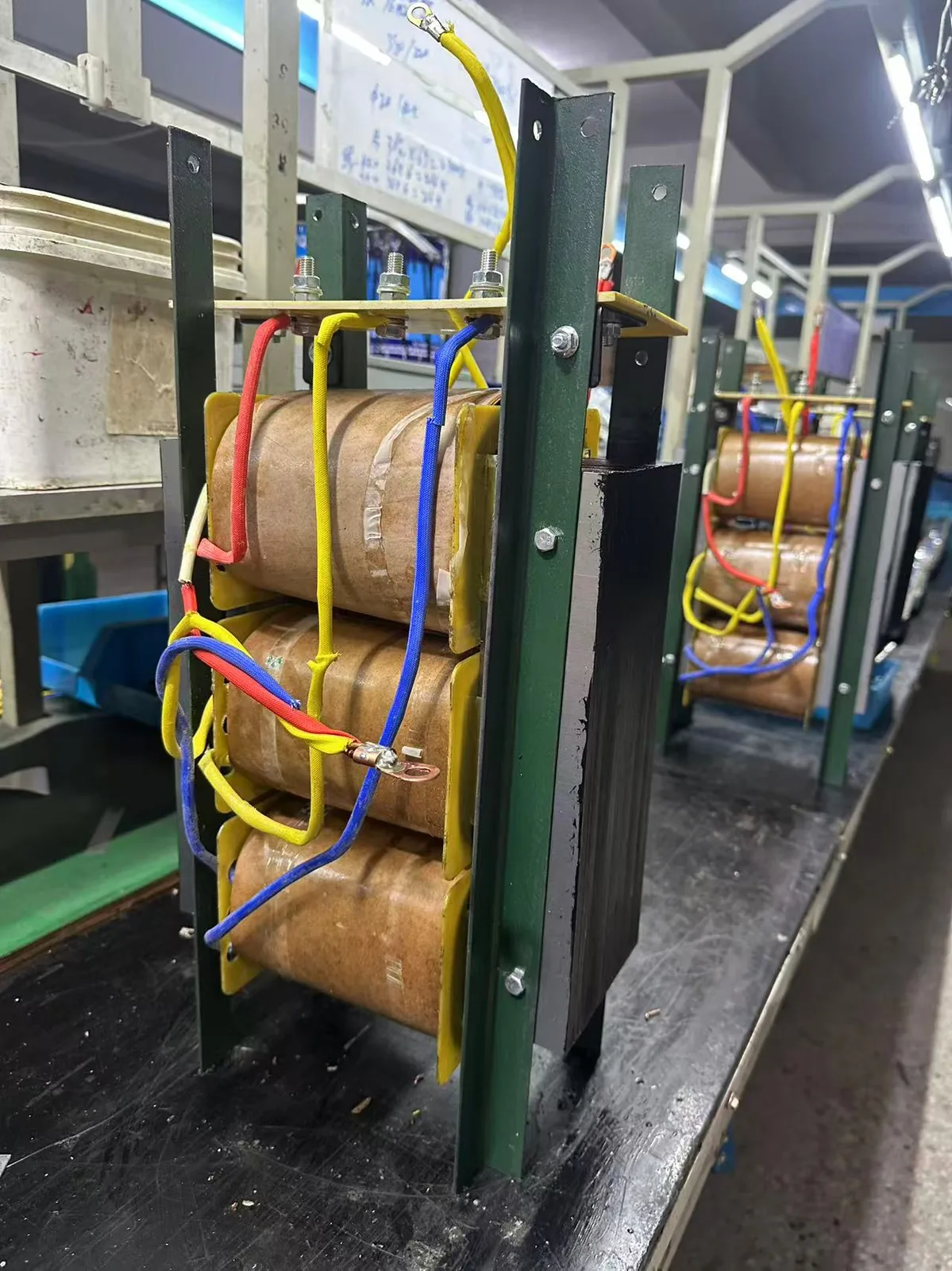
- Copper winding on a properly sized core, so the unit runs cool at its rated VA rather than at the edge of its limit.
- Thermal protection that disconnects the output before the winding can overheat in a Luanda summer or an overloaded circuit.
- Clear input/output terminals and a wiring diagram printed on the unit label, because installers on site do not always speak English.
- An input plug option: Type C or Type F for Angola, or a flying input cable if the local electrician prefers to hard-wire it.
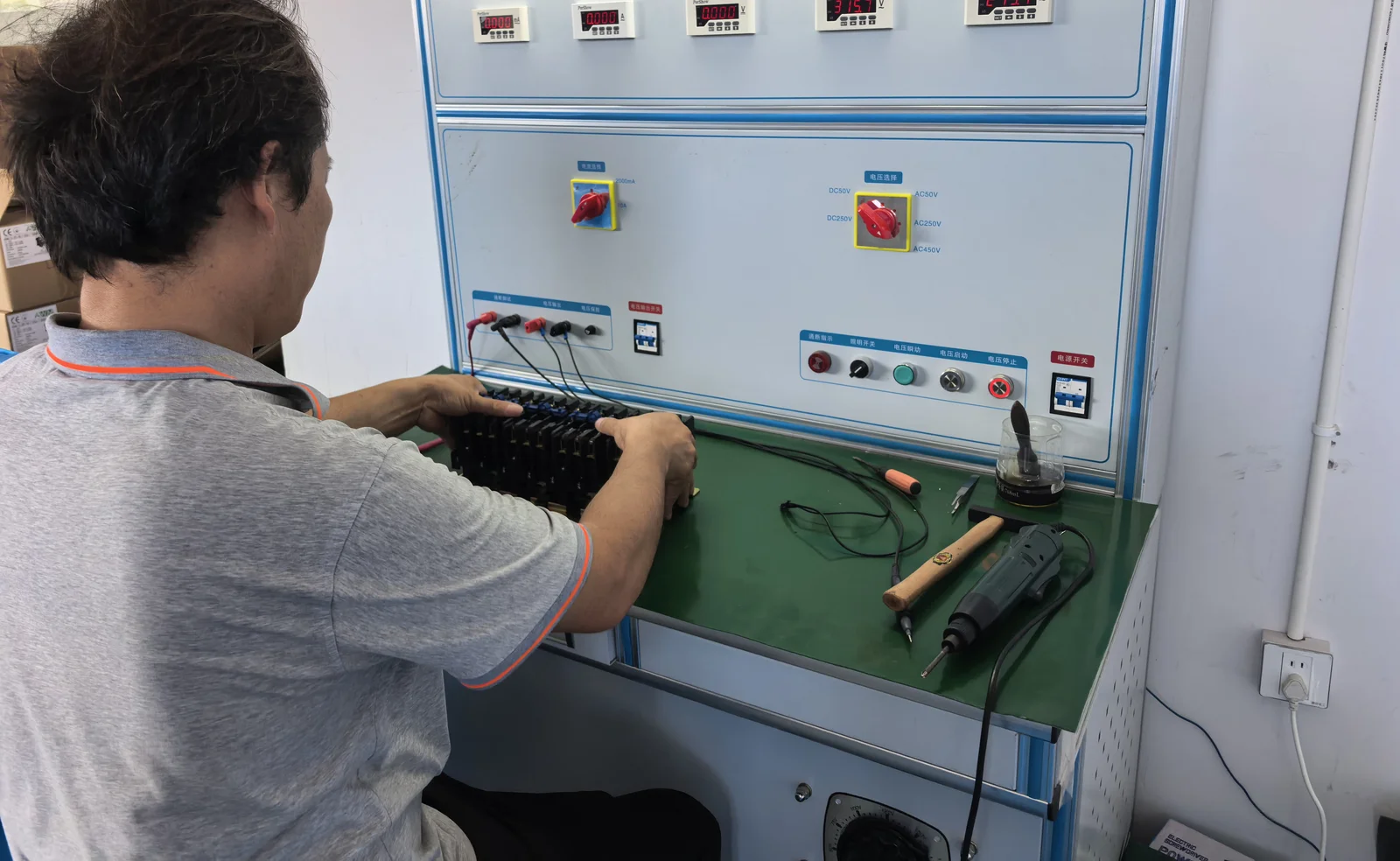
- A 100% test record with measured output voltage under full load, photographed at the factory and included with the unit.
For buyers shipping a full container, we also mark every carton with the country, voltage spec and a barcode of your choice, and we can consolidate the stabilizers and surge protection in the same shipment so everything arrives together.
Importing Transformers into Angola
Angola applies import duties by HS code; transformers fall under the electrical machinery chapters and a single unit for personal use is a routine customs clearance. For commercial import you or your agent in Angola handles the DU (Declaração Única) process, and we provide the commercial invoice, packing list, CE certificate and test report that the clearance needs. If your freight forwarder asks for a specific document format, send us the template and we will fill it.
Personal single units ship by air courier and typically arrive in about a week after production. Reseller orders, MOQ 10 pcs, go by sea from Ningbo or Shanghai, with the standard 15 to 25 day production lead time.
If you are reading this before placing an order, the single best piece of advice is to take a photo of every appliance nameplate before you pack. Those photos answer every sizing question instantly, and they save you from measuring anything twice.
What Life in Luanda Actually Throws at a Transformer
Angola conditions are specific enough that our advice differs from a generic European answer. The heat in Luanda means the transformer works in ambient temperatures above 30 degrees for months, which derates any unit, so we build Angolan export units with a larger thermal margin and advise buyers not to mount them in enclosed spaces. The rainy season brings outages and restorations, which is when surge damage happens, so the output surge strip matters more here than almost anywhere else. And because many residents run on generators or share compound wiring, the input voltage at the wall can be lower than the nominal 220V in the evening; a stabilizer is not a luxury in these conditions, it is the difference between a transformer that holds 120V and one that delivers 105V when the fridge starts.
If you are outfitting a compound or a small business rather than a single apartment, send us the full appliance list and the number of units. For compounds we often supply two medium transformers instead of one large one, so a fault on one circuit does not kill the whole compound, and the electrician can balance the load across the two units. It is a small design choice that saves a lot of frustration later.
Frequently Asked Questions: US Appliances in Angola
Because Angola is a Portuguese-speaking market, we print the wiring diagram and safety labels on the unit in both English and Portuguese, and our test sheets use the same dual language. If your electrician works in Portuguese only, that detail saves a phone call, and it is a standard part of our Angola export spec rather than a special request.
Warranty and after-sales are the questions serious buyers ask before the price. Every unit carries a 12-month warranty against manufacturing defects, and because transformers are heavy, our after-sales process is designed around diagnosis first: we walk you through the checks by message or video call, and only if a fault is confirmed do we arrange the return or replacement. In practice most reported problems are wiring or sizing issues that we solve remotely in a few minutes, which is faster for you than shipping a 20kg transformer anywhere.
One last Angola note on paperwork: if your freight forwarder asks for a certificate of origin or a EUR.1-type form for preferential duty, tell us when you place the order, because origin certificates are issued with the shipment and cannot be produced cleanly afterwards. We handle this for all African destinations and the paperwork is ready when the cargo is.
For anyone moving with a container of US appliances, the planning rule is to size the transformer bank before the container leaves, not after it lands, because a transformer bought locally in Luanda at short notice costs more and often waits weeks for stock. Include the transformers and stabilizers in the container and you land with power on day one rather than day thirty.
What voltage does Angola use?
Angola uses 220V at 50Hz, following the Portuguese standard, with Type C and Type F round-pin sockets. US 120V appliances require a step down transformer from 220V to 110V or 120V.
Do I need a voltage stabilizer in Angola?
Outside central Luanda, where supply can dip during brownouts, a stabilizer on the transformer input is recommended. The transformer converts voltage but does not regulate it, so a stabilizer keeps the output near 120V when the grid sags.
What transformer size do I need for a US refrigerator in Angola?
For a US refrigerator with a compressor, use a 3000VA step down transformer rated 220V to 120V. The running load is around 700W but the compressor start surge can exceed 2000W, so undersizing causes voltage sag and hot running.
What plug type should the transformer have for Angola?
Angola uses Type C (two round pins) and Type F (Schuko) sockets. We fit the input plug to your building’s socket type and keep a US NEMA output socket for your US appliances, or supply a flying input cable for hard-wired installation.
Is an isolation transformer better than a step down transformer for medical devices in Angola?
For CPAP machines and medical electronics, yes. An isolation transformer separates the output from the mains earth and reduces noise, which is safer for sensitive equipment. We supply 220V to 110V and 220V to 120V isolation transformers for this purpose.
Moving to Angola or supplying equipment there? Send your appliance list and we will size the 220V to 110V step down transformer, stabilizer and plugs from the factory. Email sales@wilmall.com or WhatsApp +86 197 3022 6757.
Related: for the African regional picture, see our 110V vs 220V guide for Africa and the single-country walkthrough in voltage converter for Egypt.