Voltage Converter for Oman: 240V to 110V Guide
Oman runs on 240V at 50Hz. If you shipped a 110V appliance over from the United States or Canada, or your project uses imported equipment built for the North American market, the wall socket in Muscat is not going to be gentle with it. Push 240V into a 110V compressor and the best outcome is a fuse you can replace. The other outcome involves smoke, a scorched winding, and a very unhappy hotel guest or site manager.
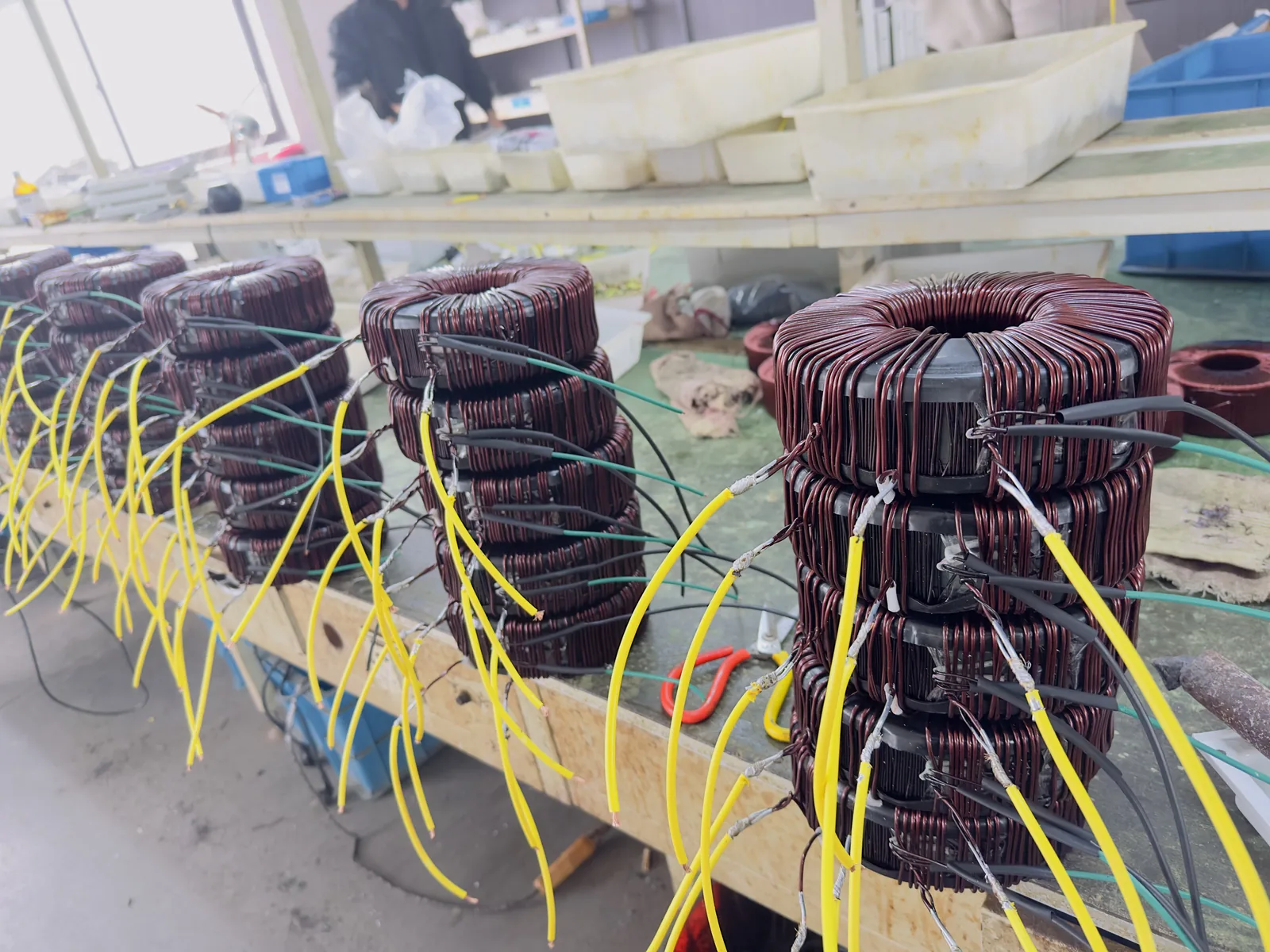
I work at a transformer factory in Yueqing, China, and we build step down units for Gulf buyers most weeks of the year. The messages we get from Oman tend to repeat themselves. What size do I need? Will 240V really damage my machine? Do I need a stabiliser on top of the transformer? And what is the cheapest sensible way to get the box to Muscat? Here are the answers I type out, in the same plain language I use when a buyer is standing next to our test bench.

What the Omani Grid Actually Delivers to Your Wall
The official numbers are 240V and 50Hz, and the standard outlet is the UK-style three-pin square pattern most people call Type G. That is the same family you meet in the UK, the UAE and Qatar, which is handy if your equipment moves between Gulf countries. Coming from North America, though, the plug shape is different and the voltage is more than double. You are dealing with two separate problems: changing the pin shape, and changing the voltage. They are not solved by the same product.
Adapters Change the Plug, Not the Power
This one catches people out constantly, so let me be blunt about it. A travel adapter is a piece of plastic with brass pins. It lets your American plug sit inside an Omani socket. It does nothing at all to the 240V sitting behind that socket, and nothing to the 50Hz frequency. If your appliance is a laptop brick or a phone charger stamped 100-240V, an adapter on its own is fine. If the nameplate says 120V and nothing else, an adapter alone will kill it.
So read the label before you pack anything. If it says 110V, 115V or 120V only, you need a step down transformer in the chain. If it says 100-240V, plug adapter and done. That single check saves more appliances than any other piece of advice on this page.
The Real Voltage Drifts Around
Official figures are tidy. Real sockets are not. Buyers in the older parts of Muscat and in some residential blocks tell us they measure 215V in the evening and close to 248V at midday. Summer makes it worse, because every air conditioner in the building starts at once, the local voltage sags, then it springs back up when the load drops off. The newer industrial estates around Sohar, Duqm and Rusayl hold steadier, but steadier in this region still means a few percent either way.
Why should a transformer buyer care? Because a unit running with no margin left will follow that drift straight into trouble. When the mains drops, current climbs to hold the same output power, and the winding gets hotter than it was designed to run. Margin is not a sales trick we invented. It is the difference between a unit that quietly works for fifteen years and one that dies in eighteen months with a burnt smell.
The 110V Equipment Buyers in Oman Actually Run
Almost every enquiry we get from Oman falls into a handful of buckets. Hotel and serviced apartment operators bring in US-spec hair dryers, irons, kettles and coffee makers for guest rooms. Dental and medical clinics import equipment specified for the American market. Contractors run 120V power tools because that is what their head office already owns. Families relocating from Texas or Ontario want the kitchen appliances they paid good money for, the blender, the stand mixer, the rice cooker, to keep working. And there is a steady trickle of people running imported audio gear, gaming consoles and home theatre kit.
Each of those has a different appetite for current, and that is exactly where sizing goes wrong. Most buyers read the wattage on the label and stop there. The label is a starting point, not the answer.
| Equipment | Typical running watts | Start-up surge | Sensible transformer size |
|---|---|---|---|
| Guest room hair dryer | 1200W to 1800W | Minimal | 2000VA or larger |
| Coffee maker or kettle | 900W to 1500W | Minimal | 1500VA to 2000VA |
| Blender or mixer | 500W to 900W | 2x to 3x for a moment | 1500VA to 2000VA |
| 120V power tool | 600W to 1500W | 3x on motor start | 2000VA to 3000VA |
| Dental or lab unit | Varies by model | Depends on the drive | Size from the nameplate |
| Audio and gaming gear | 150W to 600W | Low, but sensitive | 1000VA is usually plenty |
That last column is where people get generous. A blender labelled 800W can pull two to three times that for a split second when you hit go, and a power tool motor is worse. If your transformer is sitting exactly at the label figure, that surge is a problem. The unit will buzz louder, the output will dip, and the winding will age much faster than it should. Leave room.
How to Size a Step Down Transformer for 240V Mains
Here is the method we walk buyers through on WhatsApp, and it takes about two minutes with a pencil.
- Write down every appliance you plan to run, with the wattage from its nameplate.
- Mark the ones that start with a motor or a compressor. Motors surge hard. Heaters and lamps do not.
- Add up the continuous watts of everything you need running at the same time.
- Divide by the power factor if the label gives you one. If it does not, assume 0.8 for anything with a motor.
- Add 25 to 40 percent on top of that result. That number is your VA figure.
Let me put real numbers in. Say a guest room kit is a 1400W hair dryer, a 1000W kettle and a 600W television. The dryer and the kettle will not be running at the same moment, but the television probably will be. Take the largest single load, 1400W, add 600W, and you are at 2000W. Divide by 0.8 and you land near 2500VA. A 2000VA unit is close, but on a hot afternoon with a low mains supply, close is not a comfortable place to be. Go up a size, or send us the list and we will do the arithmetic with you.
One more thing about 240V specifically. Our fixed step down units are built for 220V to 110V conversion, and they hold their output under normal load. On a 240V supply the primary sees a little more voltage than it would on 220V, which the design accounts for, but it is one more reason not to buy a unit that is already working flat out. If your site regularly sits above 245V and your equipment is expensive, it is worth telling us so we can talk about the options.
Converter, Step Down Transformer, or Something Bidirectional?
Buyers use a lot of names for the same idea. Voltage converter, power converter, travel converter, step down transformer. They all describe a box that changes AC voltage, and the names that matter are the ones describing direction, capacity and protection.
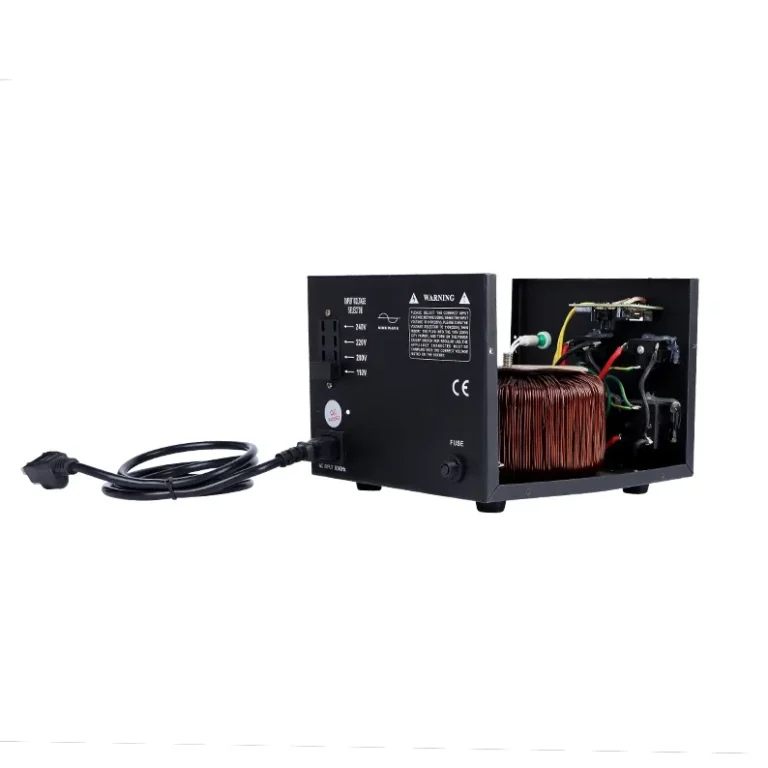
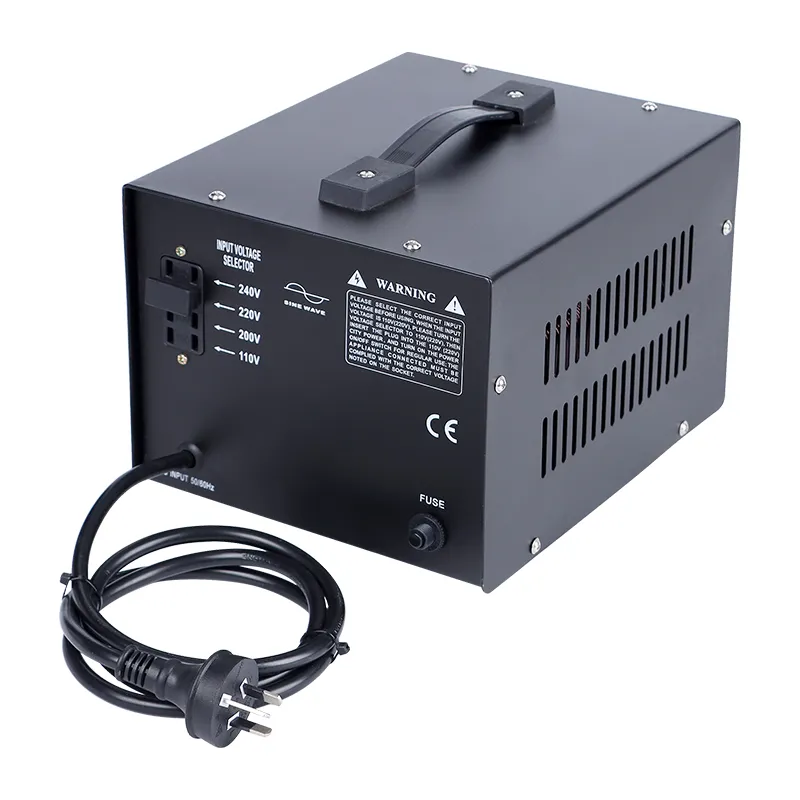
A fixed step down unit is the workhorse of the family. Our ST-2000 is a 2000VA step down transformer that takes 220V in and gives 110V out, with RCD protection built in so a fault on the appliance side trips the unit instead of cooking the winding. That is the one most hotel rooms, clinics and small workshops end up with, and it is the one we ship to Oman most often.
If you also need to go the other way, say running a 240V appliance from a 110V supply, you want a bidirectional unit. The STU-3000 and STU-5000 handle both directions at higher power, which suits bigger loads than a fixed step down box will carry. The DT-1000VA is a bidirectional automatic unit that sorts the direction out for you. And if your job needs an adjustable output rather than a fixed 110V, the Variac range covers 500VA, 1KVA, 2KVA and 3KVA, so you can dial the voltage to whatever a test bench or a piece of imported equipment actually wants.
If you would rather compare the whole family before deciding, have a look at our step down transformer range and send us the application. We would rather point you at the right unit than the biggest one, because the biggest one is not automatically the one that fits your wall.

RCD Protection, Earth and Where the Unit Should Live
A transformer is a simple box of copper and steel, but how you install it decides whether it is safe. Three things matter more than the rest.
Earthing comes first. Your unit needs a proper earth connection, and in Oman that means the socket you feed it from must be earthed. Do not run a step down transformer off a two-pin extension lead with the earth pin taped over. It happens, and it is the kind of shortcut that turns a small fault into a serious one.
RCD protection is second. An RCD watches the current going out and the current coming back, and it trips the moment those two numbers stop matching, which is what a fault to earth looks like. Our ST-2000 ships with RCD protection built in for exactly that reason. If you are looking after guest rooms or a clinic, this is not a feature to treat as optional.
Third, give the unit air. A transformer gets warm in normal use, because converting voltage means losses, and losses come out as heat. Leave ten centimetres of clearance around the vents, do not bury it under folded towels in a housekeeping cupboard, and do not stack boxes on top of it. In a workshop, mount it somewhere a forklift cannot reach and where a puddle cannot form. If you are installing several units in a rack, space them out and let the cabinet breathe.
One honest note that we tell every buyer: a transformer hums a little under load and it will feel warm to the touch. That is physics, not a fault. What you should worry about is a unit too hot to hold your hand on, or one that buzzes loudly and dips every time an appliance starts. That points to a unit running past its rating, and it needs a bigger one behind it.
Getting Your Order to Oman, and the Details We Need From You
We ship FOB Ningbo or Shanghai, and our normal lead time is 15-25 days from deposit to container loading. For Oman, most full orders move by sea into Sohar or Jebel Ali and then travel overland, while small trial orders of a few units usually fly by express air because the time saved is worth more than the freight difference. Our minimum order is 10 pcs, which sounds like a lot if you only want one, so most individual buyers order a spare alongside it. Honestly, a spare is not a bad call when the alternative is waiting three weeks for a replacement unit to clear customs.
If you are an importer, a hotel group or an electrical wholesaler, tell us the port you use and the quantity you want and we will quote you FOB with packing details. Tell us your project date as well. If your opening date does not fit our schedule, we will say so upfront rather than promise something we cannot hold.
What to Send Us Before You Buy
You do not need a technical document. A photo of the appliance nameplate and a sentence about what you are trying to do is usually enough for us to size the unit correctly. Add the country, the quantity you have in mind and the port you ship into, and we can come back with a full quote the same working day.
Buyers working through the same problem in other countries find our Step Down Transformer for Kenya: 240V to 110V Guide useful, because Kenya also runs 240V and the sizing logic carries straight across. If your market runs a different voltage, our more buying guides are organised by country so you can find yours quickly.
Voltage Converter for Oman: Questions We Get Every Week
These five come up again and again in our inbox, so here they are with straight answers.
Do I need a voltage converter for Oman, or just a plug adapter?
It depends on the nameplate. Oman runs 240V at 50Hz and uses Type G sockets. If your appliance says 100-240V, a plug adapter is enough. If it says 110V or 120V only, you need a step down transformer, because an adapter changes the pin shape and nothing else.
Will 240V damage my 110V appliance in Oman?
Yes, if you connect it directly. Feeding 240V into equipment built for 110V usually blows the internal fuse first, and if the fuse holds you get a burnt motor or power supply instead. With a correctly sized step down transformer in front of it, the appliance only ever sees around 110V and runs normally.
What size step down transformer do I need for a hotel room in Muscat?
Work out the continuous watts of everything that runs at the same time, add 25 to 40 percent, and that is your VA figure. A guest room with a hair dryer, a kettle and a television usually lands around 2000VA to 2500VA, which is why our ST-2000 is a common choice for this kind of job.
Can I run a 110V air conditioner in Oman with a transformer?
Only with a unit sized for the compressor start current, and that is usually much larger than the running watts suggest. Air conditioners also run for hours, so the transformer has to carry a continuous load without overheating. Send us the compressor nameplate and we will size it properly rather than guess.
How long does shipping a transformer to Oman take?
Our production lead time is 15-25 days from deposit, and sea freight into Sohar or Jebel Ali then adds transit time on top. Small orders of a few units can go by express air if you need them faster. Tell us your timeline and we will tell you honestly what is realistic.
Need a voltage converter for Oman but not sure which size fits? Send us your appliance nameplate photos, your quantity and your port, and we will come back with the right unit from our factory range.
Or talk to us directly: WhatsApp +86 197 3022 6757 · Email sales@wilmall.com
MOQ 10 pcs · Lead time 15-25 days · FOB Ningbo or Shanghai · 12-month warranty